

What demand gen content actually is (and what it isn't)
Quick definition, because the term gets muddled with lead gen. Demand generation content creates awareness and interest in a problem and your category. Lead gen content captures contact details from people who already know they want a solution. A gated ebook behind a form is lead gen. The blog post that taught someone the problem existed in the first place is demand gen.
In practice, demand gen content maps to the funnel like this:
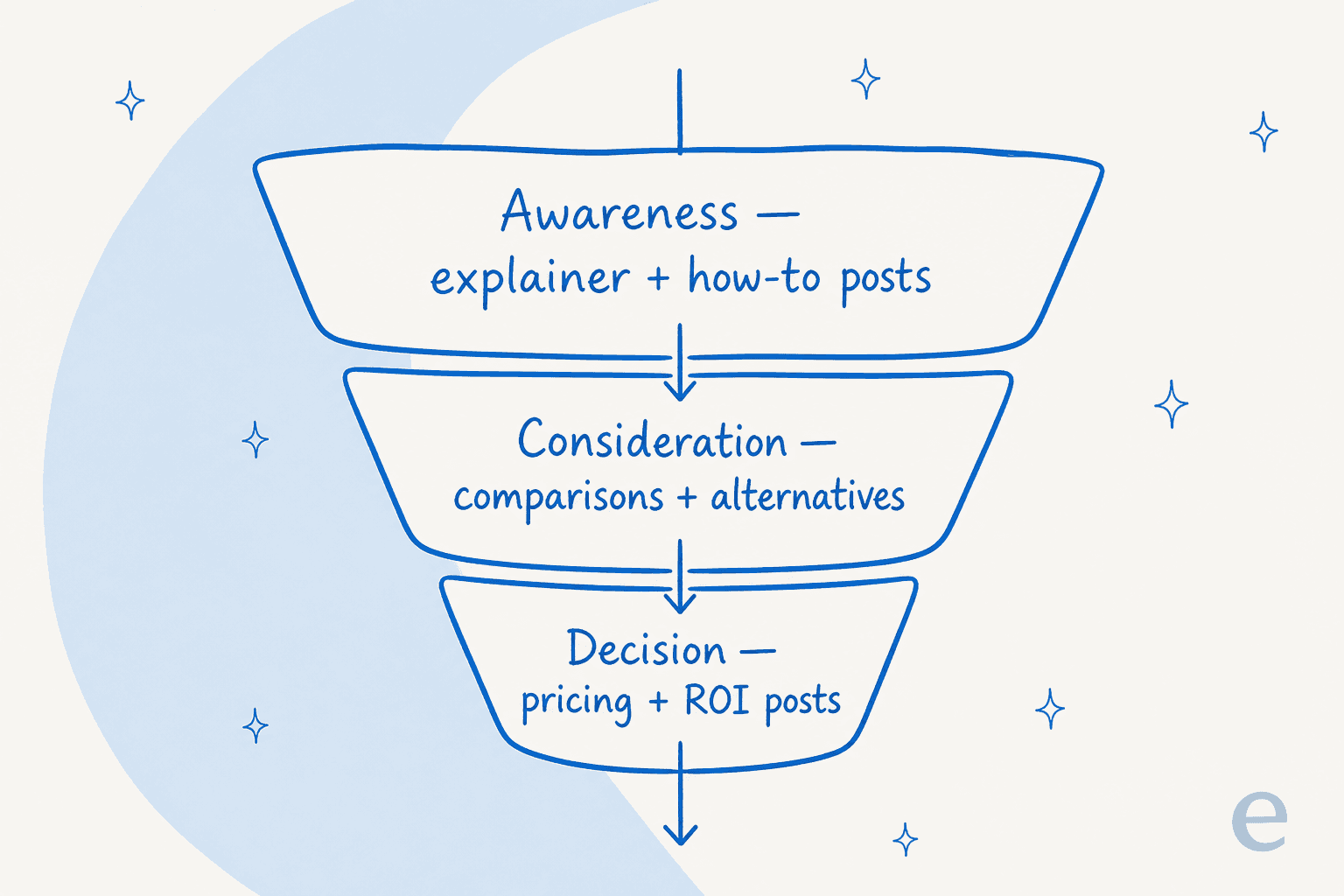
At the top, you've got explainers and how-to posts that catch people searching a problem ("how do I reduce ticket volume"). In the middle, comparisons and alternatives posts for people weighing options. At the bottom, pricing and ROI posts for buyers doing final diligence. The whole point is to be useful at every one of these stages before anyone is ready to buy. It's a discipline closer to SEO content creation than to one-off campaign copy.
This is why demand gen is a volume game. You're not writing one perfect landing page; you're covering a whole map of buying questions, in your category and adjacent ones. That map is usually hundreds of posts wide, which is exactly why marketers reach for AI marketing tools in the first place, and exactly where it goes wrong.
Where AI is genuinely good at demand gen content
Let me be on AI's side first, because the honest answer is that it's very good at a real chunk of this work. I run eesel's blog with our own AI writer, so this isn't theory. A few things it does well:
It collapses the research-to-draft time. A solid demand gen post needs the real pricing tables, the real feature behaviour, the real community sentiment. Pulling all of that by hand is most of the work. A good AI content generation tool does the scraping and the first synthesis, so a writer starts from a researched draft instead of a blank page.
It makes volume survivable. One content team we work with, an AI phone-support startup, publishes 360 SEO posts a month (12 a day) off a keyword-to-publish pipeline, and ranks #1 for competitive category keywords. That's not achievable with a human-only team without a huge headcount. Another set of customers, marketing agencies and travel content teams, run the same AI blog writing setup to produce client SEO blogs at a pace they couldn't bill for otherwise.
It's fast in a way that changes what you attempt. A typical 2,000 to 2,900-word post with a hero image, three to five infographics, FAQs, and internal links lands in about 12 to 20 minutes in our own pipeline. One user produced a 5,000-word reference article with 25 citations in a single chat. That kind of content production speed changes the maths: when a post costs minutes instead of days, you'll actually go after the long tail of buying questions you'd otherwise skip, the same logic behind a good bulk content generator.
Here's the workflow that holds it all together:
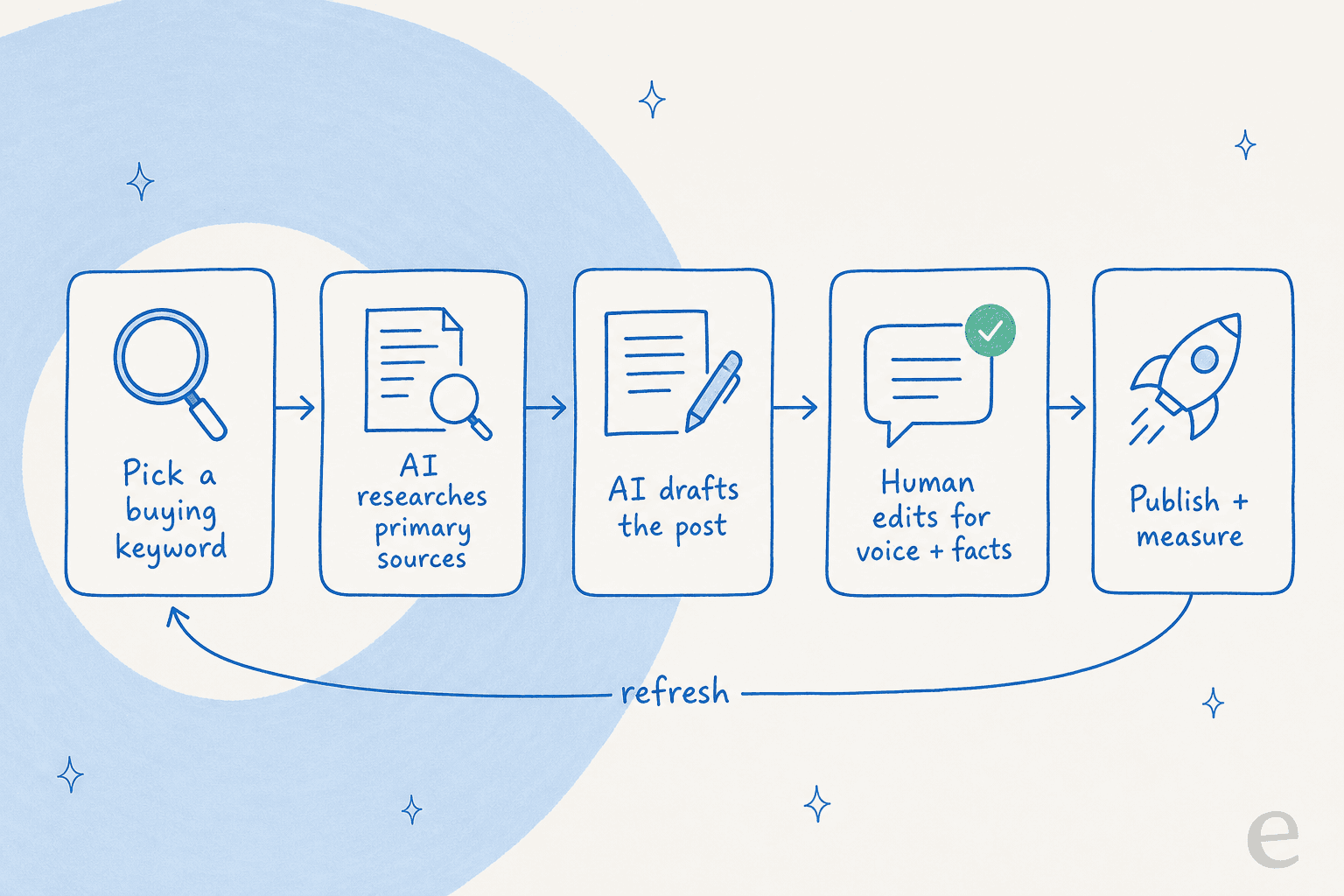
Notice the human edit step in the middle and the refresh loop at the end. Skip either and you get the failure mode in the next section. Keep them, and AI becomes the best thing to happen to demand gen content since the CMS. If you want the longer version, we wrote up a full AI blog writing workflow and a separate guide for agency content workflows.
Where AI demand gen content falls on its face
Now the honest part. Most AI demand gen content is bad, and it's bad in a predictable way: it rewrites the marketing page, cites nothing, and reads exactly like every other post in the search results.
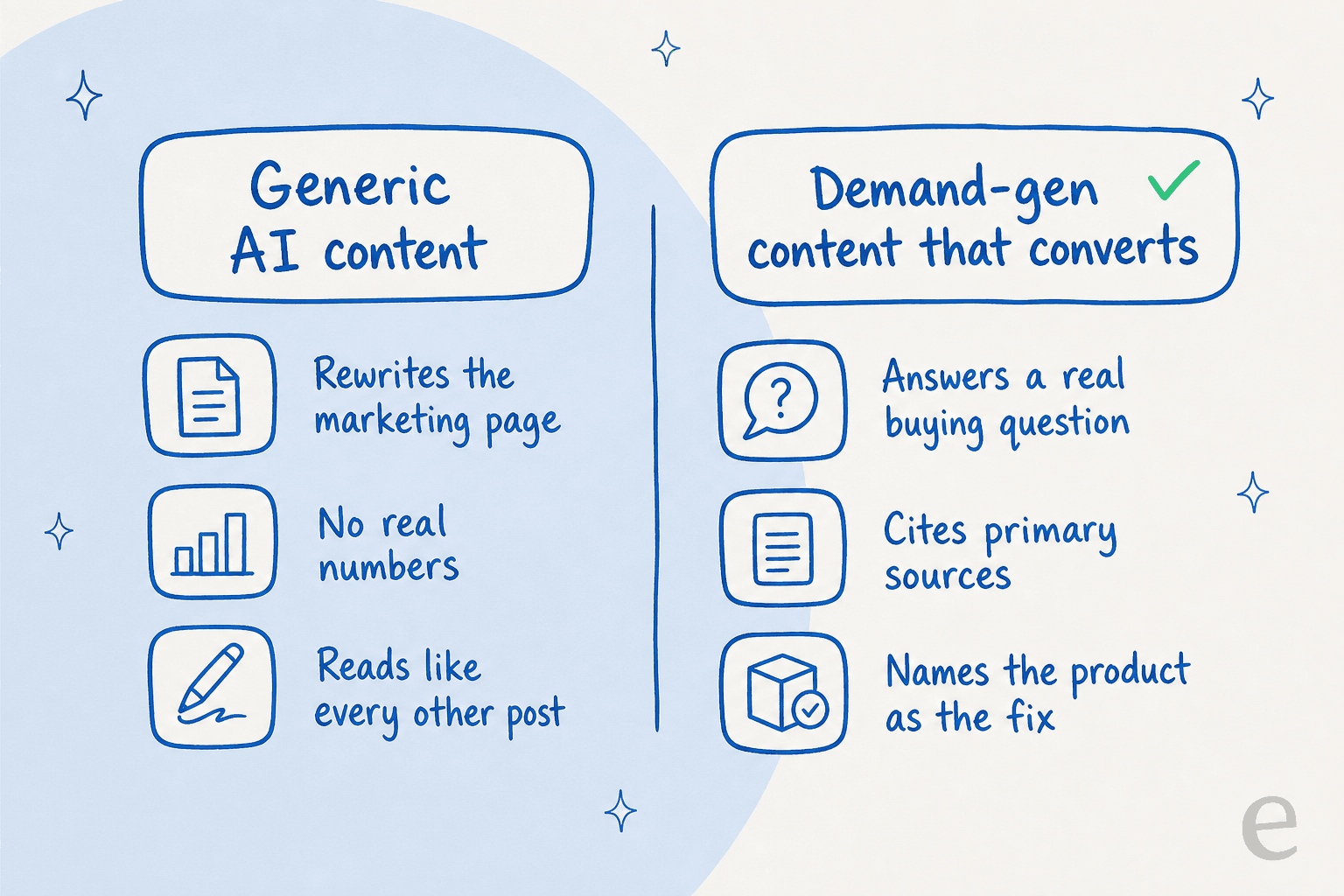
The people who buy your product can feel the difference immediately, and so can Google's quality systems. Practitioners are blunt about it. Ahrefs' Tim Soulo put it plainly:
"Scaling content with AI is the biggest lie in content marketing."
He's not wrong about the version of "scaling" most teams mean, which is mass-producing thin posts and hoping volume wins. It doesn't anymore. And the readers notice the texture, too. Marketer Alexandra Greifeld was candid about working with AI scripts:
"I'll be honest here: I work with a lot of creative agencies, and it's obvious when the scripts are written by AI (almost 100% of the time). And then I'm the one who has to edit it. Not fun."
That "obvious almost 100% of the time" is the whole problem with naive AI demand gen content. If a reader can tell a robot wrote it, the trust you were trying to build is gone before the second paragraph. (If you want to know what graders actually look for, our piece on how AI content detectors work breaks it down.)
I'll own eesel's version of this too, because it'd be dishonest not to. We've watched our own rankings move when posts drift toward generic rewrites, and we've had customers love the output in-app but struggle to get it cleanly into a locked-down CMS that won't take Markdown or FAQ schema. AI doesn't remove the hard parts of content; it just moves them. The hard part is no longer typing, it's having something true and specific to say, and getting it published intact.
How to actually use AI for demand gen content
So here's the workflow I'd actually run, the one that keeps the speed without the slop.
1. Start from a real buying question, not a keyword list
The slug isn't the point; the question behind it is. "ai demand gen content" only matters because a marketer is sitting there wondering whether AI can carry their top-of-funnel without tanking quality. Write to that person. This is where a human still has to lead: a keyword tool gives you the phrase, but search intent tells you what answer earns the click. Map your category's buying questions across the funnel first, then hand the list to the AI.
2. Make the AI research primary sources, not other blogs
This is the single biggest quality lever. Generic AI content comes from AI summarising other AI summaries; good content comes from primary sources. Point your tool at the actual pricing pages, docs, changelogs, and real community discussion (Reddit, G2, LinkedIn). A post that quotes a real review with a link, or cites a real number from a vendor's own page, reads as researched. One that says "studies show" reads as filler. Our guide on fact-checking AI generated content is worth a read here.
3. Give it your brand voice and your own data
Default model output sounds like default model output. Feed the AI your style, your positioning, and crucially your proprietary data, the numbers and customer stories no competitor can copy. A tool with brand voice training keeps a hundred posts consistent instead of each one reading like a fresh ChatGPT session. This is also how you build topical authority instead of a pile of disconnected posts.
4. Edit. Every time.
The draft is a draft. A human pass is what catches the hallucinated stat, strips the AI tells, adds the one opinion the model would never risk, and makes sure the post actually argues something. This is the step the failing teams skip. It's also fast: editing a researched draft is an hour, not a day. If you're seeing repetitive, samey output, that's usually a brief-and-edit problem, and our piece on fixing repetitive AI content covers it.
5. Publish intact, then refresh on a loop
Getting the post out of the tool and into your CMS without losing the formatting, the FAQ schema, and the metadata is where a lot of value leaks out. Plan for it: pick tools that handle CMS publishing or at least clean Markdown export (here's our WordPress guide). Then treat content as living, not shipped, and refresh it automatically as pricing and facts change. That refresh loop is most of what separates content that keeps ranking from content that decays.
One more honest note on cost, since demand gen content is a volume play: pricing model matters more than sticker price. Per-credit and per-post pricing punishes you for the exact thing you're trying to do (publish a lot), so check the real cost math before you scale. And if you're still picking a tool, our hands-on roundups of AI content generators, B2B SaaS writing tools, and AI copywriting tools are the places to start.
Try eesel for demand gen content
If your demand gen content plan is "rank for hundreds of buying questions without hiring ten writers," that's the exact job eesel's AI blog writer was built for. You give it a domain and a keyword; it researches primary sources, drafts a brand-voiced, 2,000+ word post with a hero image, infographics, FAQ schema, and internal links, and hands it back in about 15 minutes, ready to publish.
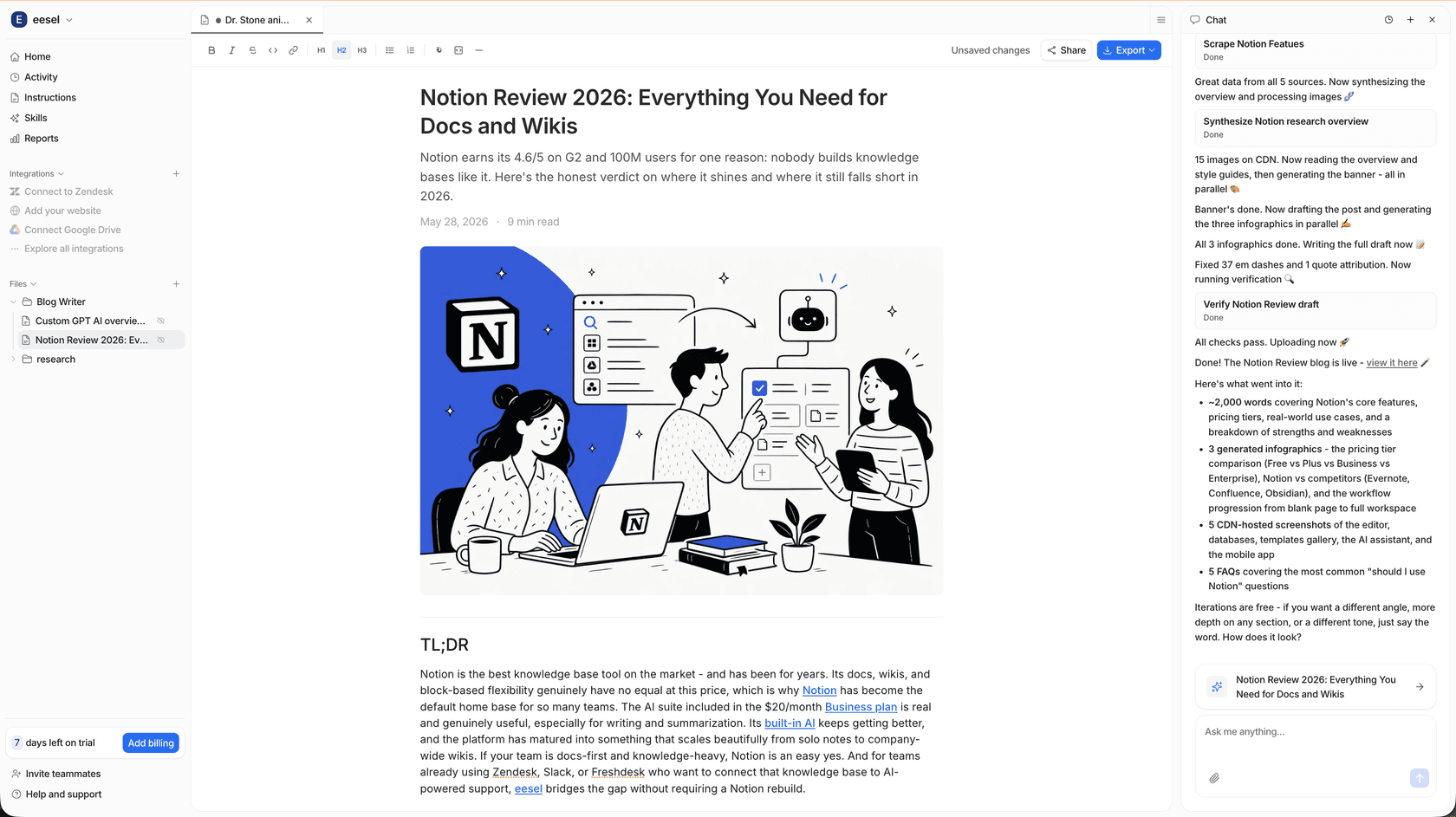
What makes it fit demand gen specifically is the research-and-refresh side, not just the drafting. It pulls from your real sources, keeps voice consistent across a whole content library, and you can put it on a schedule to run autonomously, so the long tail of buying questions actually gets covered instead of sitting on a backlog. Pay-as-you-go pricing means a volume strategy doesn't turn into a surprise bill.
It won't replace your editor, and I wouldn't want it to. But as the fast junior writer in the workflow above, it's the closest thing I've used to demand gen content at scale that doesn't read like demand gen content at scale. You can try eesel free.
Frequently Asked Questions
What is AI demand gen content?
Can AI demand gen content actually rank and convert?
How much does AI demand gen content cost?
How do I stop AI demand gen content from sounding generic?
What's the best AI tool for demand gen content?


Article by
Kurnia Kharisma Agung Samiadjie
Kurnia is a software engineer and writer at eesel AI with two years of SEO experience, writing about AI tools, helpdesk software, and customer support. He pairs a developer's understanding of how these products are built with search-driven research into what actually ranks and resonates with the people searching for them.