Zendesk self-service for ecommerce: A practical guide for 2026

Stevia Putri
Last edited March 6, 2026
Ecommerce never sleeps. While your team clocks out at 5 PM, customers in other time zones are browsing your store, placing orders, and running into questions. That's where self-service comes in. Instead of waiting hours for a response, customers find answers themselves. Zendesk built a comprehensive self-service platform for exactly this scenario. But is it the right fit for your store? Let's break it down.
What is Zendesk self-service for ecommerce?
Self-service in ecommerce means giving customers the tools to solve their own problems without contacting support. Think order tracking, return requests, and answers to "will this fit?" questions. Zendesk approaches this through three main channels: a branded knowledge base, AI agents that handle conversations on their own, and community forums where customers help each other.
For ecommerce specifically, self-service matters because shopping happens around the clock. A customer in London shouldn't have to wait until your San Francisco team wakes up to check their order status. Research shows 69% of customers want to resolve issues on their own, and 91% would use a knowledge base if it met their needs.
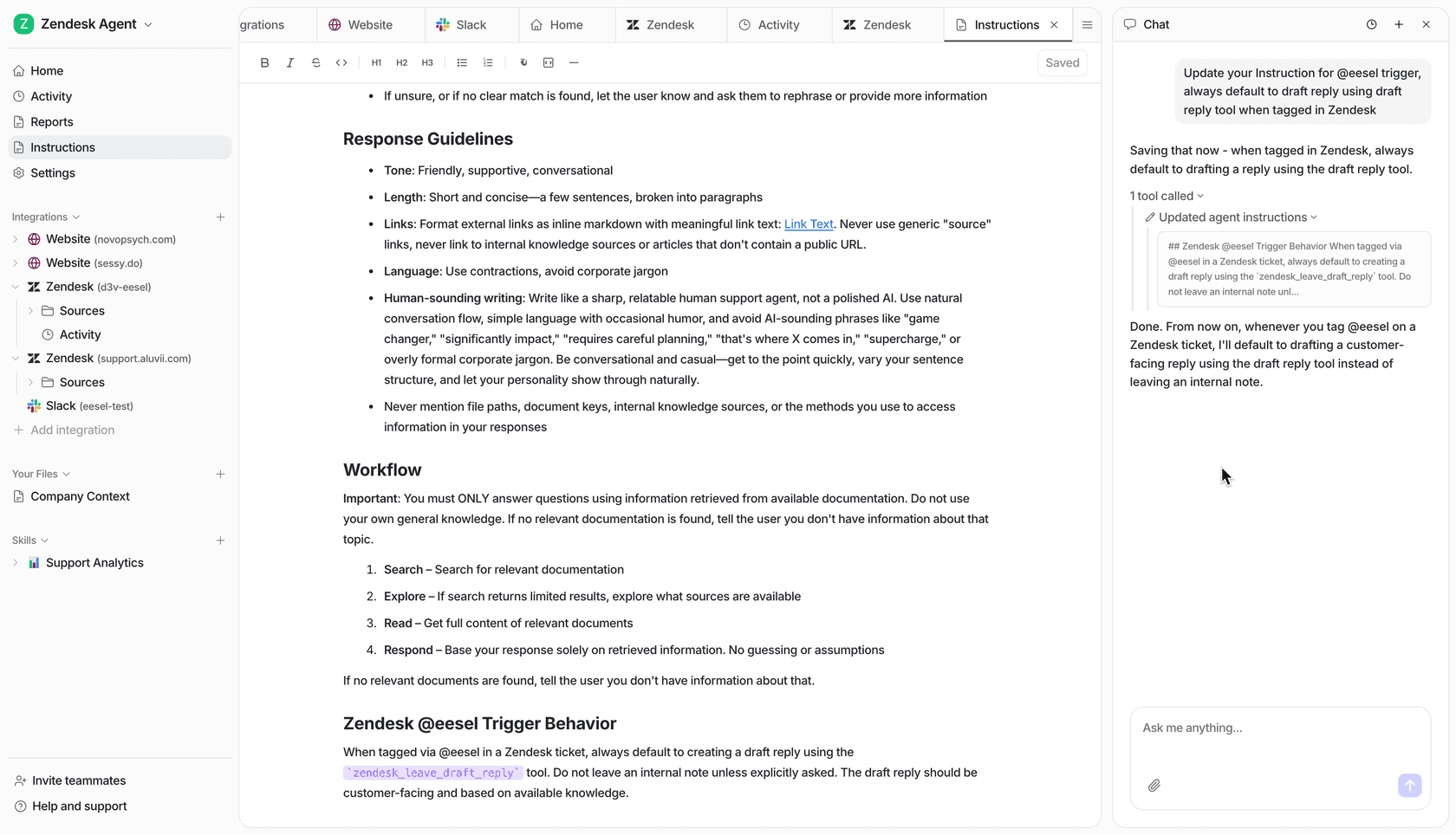
Here's the thing about Zendesk: it's a tool you configure. You build the knowledge base, set up the AI agents, create the workflows. That works well for teams with dedicated IT resources and time to invest. But there's another approach gaining traction: treating AI support as a teammate you hire rather than software you configure. That's where modern alternatives like eesel AI come in. They learn from your existing data in minutes instead of requiring weeks of setup.
Key self-service features Zendesk offers
Knowledge base and help center
At the core of Zendesk's self-service offering is the help center. This is your branded knowledge base where customers find articles, FAQs, and troubleshooting guides. You can customize the theme to match your store's look and feel, organize content into categories and sections, and even create multiple help centers for different brands or regions.
The AI-powered features here are worth noting. Zendesk's system can suggest articles based on what customers are typing, identify knowledge gaps where you need new content, and even generate article drafts from your existing support tickets. For global ecommerce, the multilingual support covers 40+ languages on Professional and Enterprise plans. If you're looking to enhance your existing Zendesk setup with AI, check out our guide on the best AI chatbots for Zendesk.
AI agents for autonomous resolution
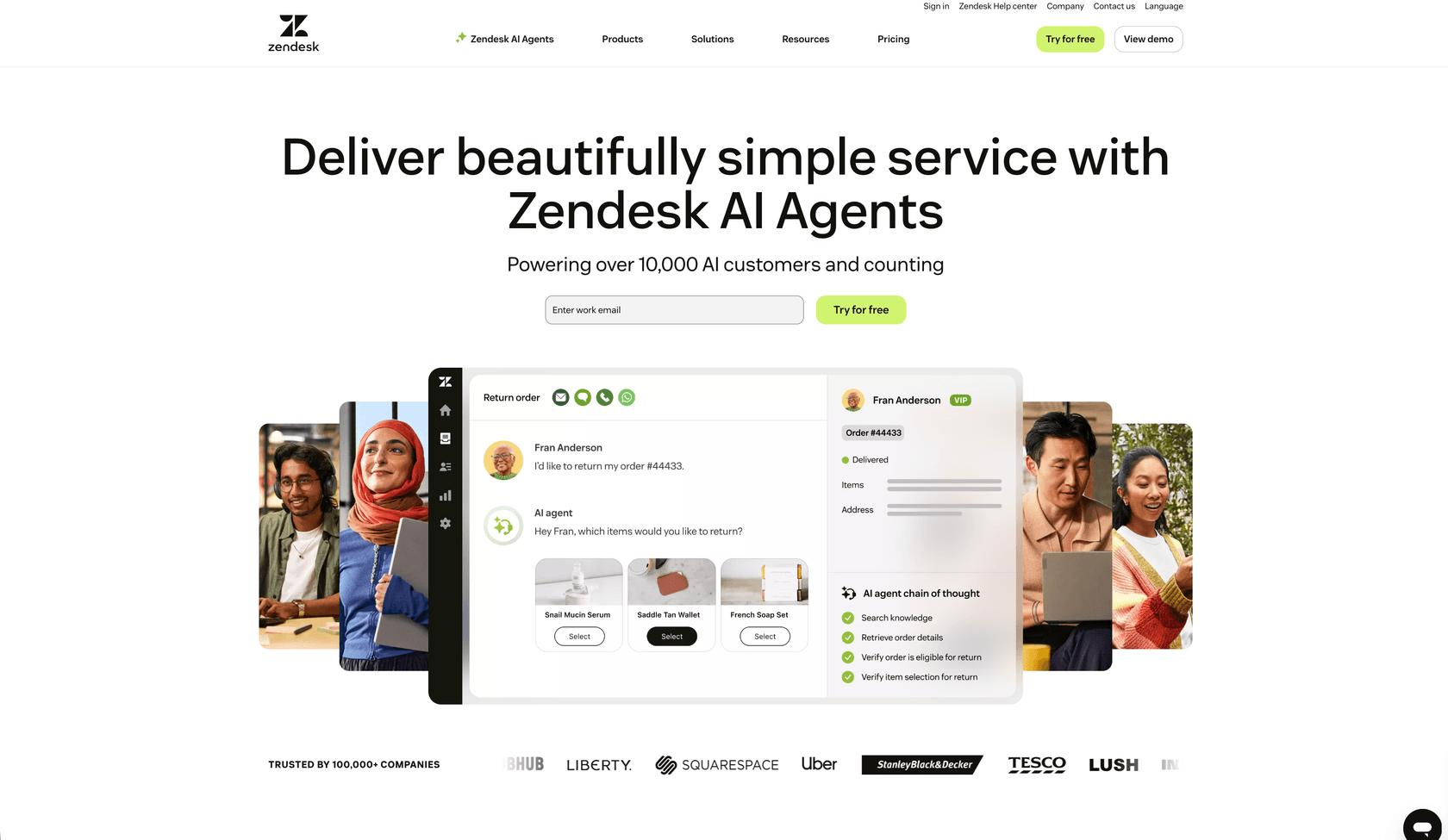
This is where Zendesk has invested heavily. Their AI agents are designed to resolve customer requests without human intervention. The company claims these agents can handle 80%+ of interactions, working across email, chat, social media, and voice channels.
The setup is marketed as simple: connect your AI agent to knowledge sources like your help center or Confluence, and it starts automating 30% of requests from day one. As it learns, you can expand its capabilities to handle complex requests, integrate with backend systems like Shopify, and eventually reach that 80% automation target.
The AI agents support 80+ languages and can switch automatically based on customer input. When they can't resolve something, they escalate to human agents with full context.
Customer portal and analytics
Beyond the knowledge base and AI, Zendesk offers a customer portal where shoppers track their tickets, view order history, and access account details. The analytics side tracks self-service deflection rates (how many tickets you avoided), article performance metrics, and customer satisfaction scores. For more on improving deflection rates, see our guide on deflection rate best practices.
Zendesk pricing for ecommerce self-service
Let's talk numbers. Zendesk's pricing is per-agent, which means costs scale with your team size rather than your support volume.
| Plan | Price (per agent/month, annual) | Key Self-Service Features |
|---|---|---|
| Support Team | $19 | Basic ticketing only, no help center or AI agents |
| Suite Team | $55 | AI agents (Essential), 1 help center, 5 automated resolutions/agent/month |
| Suite Professional | $115 | Up to 5 help centers, Copilot writing tools, 10 automated resolutions/agent/month |
| Suite Enterprise | $169 | Up to 300 help centers, 15 automated resolutions/agent/month |
Important add-ons to factor in:
- Advanced AI agents: Contact sales (required for full AI agent builder and integrations)
- Copilot: $50/agent/month
- Additional automated resolutions: $1.50 committed, $2.00 pay-as-you-go
The per-agent model can add up quickly. A team of 10 agents on Suite Professional runs $1,150/month before add-ons. Compare that to usage-based alternatives like eesel AI, where you pay per interaction rather than per seat. For seasonal businesses, that difference matters. You shouldn't pay for 10 agent seats in January when you only need them during holiday rushes.
Benefits of Zendesk self-service for ecommerce
The business case for self-service is strong. Unity saved $1.3 million in one year by deflecting approximately 8,000 tickets through self-service. Lush achieved $434,000 in annual cost savings with a 93% customer satisfaction score. Squarespace saw a 27% increase in help center usage with a 95% self-service success rate.
Beyond cost savings, self-service delivers:
- 24/7 availability: Customers get answers whether it's 3 PM or 3 AM
- Seasonal scaling: Handle Black Friday volume without proportional hiring
- Agent productivity: Reduce time spent on repetitive questions
- SEO benefits: Public help center content ranks in search results
- Customer preference: Most shoppers would rather find answers themselves than wait for a response
Implementation considerations
Here's where you need to be realistic. Setting up Zendesk's self-service capabilities takes time and expertise. You're looking at:
- Content creation: Writing dozens or hundreds of help articles
- AI training: Configuring agents, setting up escalation rules, testing responses
- Integration work: Connecting Shopify, WooCommerce, or BigCommerce
- Agent training: Teaching your team the new system
- Ongoing maintenance: Keeping content updated as products and policies change
The AI agents promise "3 clicks to launch," but the reality is more nuanced. You need clean knowledge base content first. You need to define escalation paths. You need to test extensively before going live with customer-facing automation.
When self-service fails, and it will for complex issues, you need clear escalation paths to human support. Zendesk handles this well, but it's something to plan for from day one.
Alternatives to consider for ecommerce self-service
eesel AI: The teammate approach
Instead of configuring software, what if you hired an AI teammate? That's the premise behind eesel AI. Connect it to your help desk, and it learns from your past tickets, help center articles, and macros in minutes. No manual training. No documentation uploads.
The progressive rollout model is particularly interesting for ecommerce. Start with eesel drafting replies that agents review before sending. Once you're confident it understands your business, let it send replies directly. Eventually, it can handle full frontline support 24/7. You control the pace.
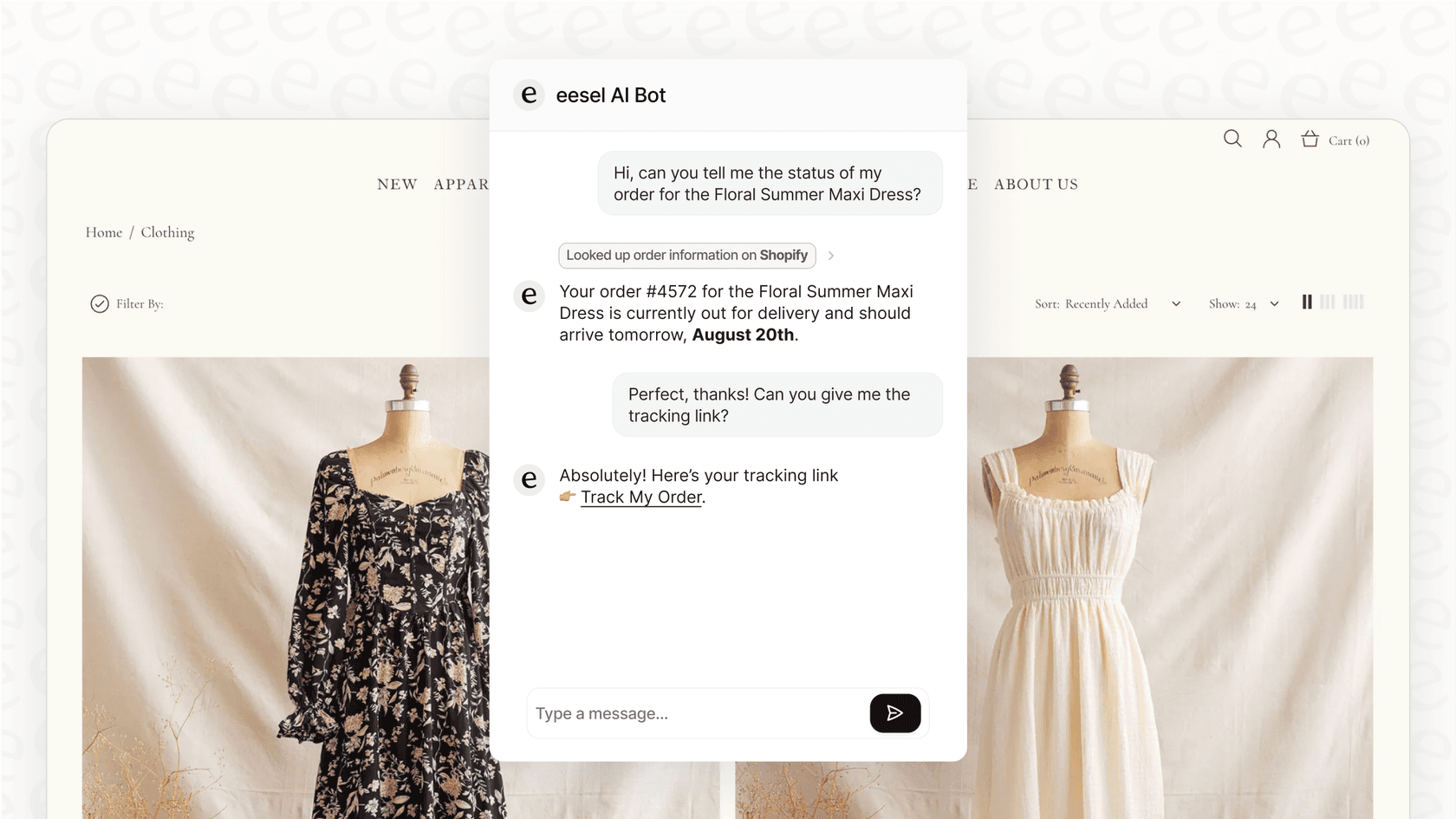
Pricing is per-interaction, not per-agent, which can mean significant savings for growing teams. And the Shopify integration handles order lookups, refunds, and returns just like Zendesk.
Gorgias: Ecommerce-native option
If you want something built specifically for online stores, Gorgias is worth considering. Their AI agent resolves 60% of inquiries and integrates deeply with Shopify. Pricing starts at $10/month for 50 tickets, making it more accessible for smaller stores. You can also explore how eesel AI integrates with Gorgias to enhance your support capabilities.
The usage-based model (pay for tickets, not seats) works well for seasonal businesses. And the ecommerce-specific features like product recommendations and order editing are polished.
Freshdesk: Budget-friendly alternative
Freshdesk offers similar knowledge base and AI features at a lower price point. Growth plans start at $19/agent/month, and there's even a free tier for up to 2 agents. If budget is tight and you don't need Zendesk's advanced features, it's worth evaluating. Learn more about how eesel AI works with Freshdesk to add AI capabilities to your existing setup.
Getting started with Zendesk self-service for your store
If you're set on Zendesk, here's a practical roadmap:
- Audit your current support: What questions come up most often? What could be self-served?
- Start with the knowledge base: Get your help center solid before adding AI agents
- Set clear escalation rules: Define exactly when issues go to humans
- Measure everything: Track deflection rates, customer satisfaction, and resolution times
- Iterate continuously: Update content based on what customers actually ask
But before you commit to months of setup and configuration, consider whether a modern alternative might get you to the same place faster. Tools like eesel AI can be deployed in days, not months, learning from your existing data rather than requiring you to build everything from scratch. You can also explore our Zendesk AI integration if you want to enhance your existing Zendesk setup with AI capabilities.
The goal is the same: give your customers instant answers while freeing your team to handle the complex issues that actually need human attention. How you get there is up to you.


Frequently Asked Questions
Share this article

Article by
Stevia Putri
Stevia Putri is a marketing generalist at eesel AI, where she helps turn powerful AI tools into stories that resonate. She’s driven by curiosity, clarity, and the human side of technology.