Good writing is about more than just what you say; it's about how you say it. The same idea can be inspiring, boring, or persuasive, all depending on the writing style you pick. It's the difference between a blog post that gets a quick skim and one that gets shared with the entire team.
If you've ever felt like your content isn't quite hitting the mark, getting a handle on these foundational styles can make all the difference. This guide will break down the five essential writing styles every creator should know, with clear examples to show you exactly how to use them.
Of course, knowing these styles is one thing, but actually producing perfectly styled content takes time and a lot of coffee. This is where modern tools like the eesel AI blog writer can help, generating publish-ready content from a single keyword and adapting to any of these approaches on demand.
What are writing styles? A quick refresher
So, what exactly is a "writing style"? Think of it as the specific technique a writer uses to get their ideas across and connect with a reader. It’s not just about grammar and punctuation; it's the whole framework for how you present information and the foundation of effective communication.
Writing experts generally agree that the main styles exist to achieve different goals. Some are built to inform, some to paint vivid pictures, and others are designed to convince you of something.
It's easy to get style mixed up with a few other common writing terms, so let's clear that up:
- Tone: This is the author's attitude toward the subject. Are they being formal, funny, serious, or sarcastic? Tone is the feeling you get from the words.
- Voice: This is the author's unique personality shining through. If you can read something without a name attached and know exactly who wrote it, that’s a strong voice.
- Genre: This is simply the category of the work. Is it a sci-fi novel, a romance, a business blog post, or a technical manual?
While all these elements work together, style is the blueprint. It dictates the structure and approach you use to deliver your message.
A tool for mastering different writing styles
Consistently producing content in the right style for each article can be a challenge. The eesel AI blog writer is our go-to for creating content that aligns perfectly with any specific writing style. It creates publish-ready content with the right structure, voice, and even assets for whatever you’re trying to achieve.
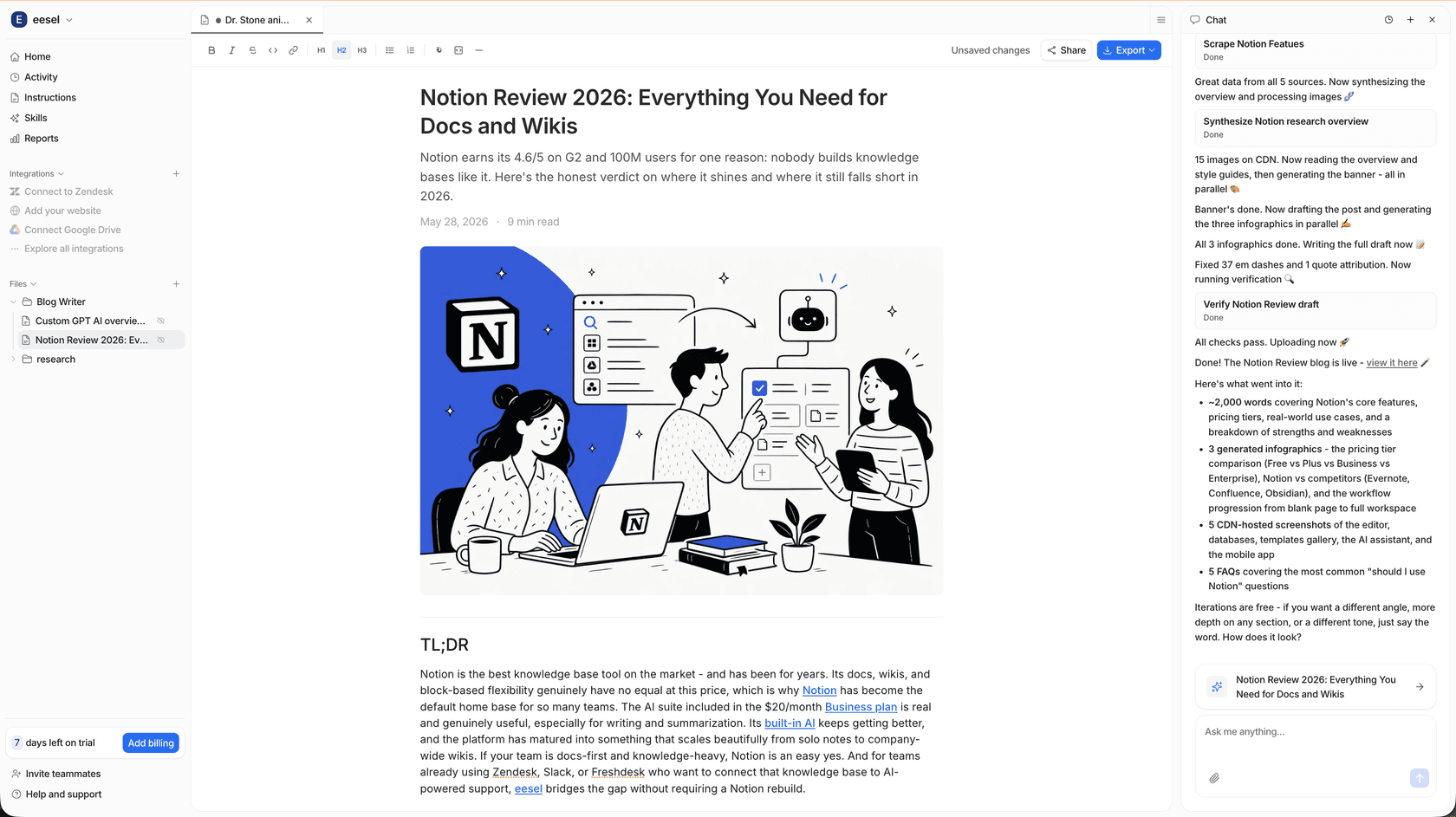
Here’s how it can help:
- Deep brand context: Instead of working from a static style guide, eesel learns your brand voice by scanning your website. It figures out your products, your usual tone, and your key messages to write like a genuine member of your team.
- Context-aware research: The AI is smart enough to know that a persuasive comparison article needs a pricing table and that an expository "how-to" guide needs clear, numbered steps. It automatically tailors its output to match the search intent behind your topic.
- Automatic asset generation: eesel AI blog writer automatically creates and embeds relevant media like images and infographics. For narrative or persuasive content, it can also integrate Reddit quotes and YouTube videos to provide social proof.
I work at eesel AI, and our whole approach with our AI blog writer is to avoid that exact problem. Instead of just scraping the SERPs, it can pull context from a specific URL you give it. This means it can learn a company's actual brand voice, product details, and unique perspective, rather than just regurgitating what's already out there.

We use this tool internally, which helped us grow from 700 to 750,000 daily impressions in three months.
The 5 core types of writing styles
Okay, let's get into the main event. These five styles are the building blocks of almost all effective communication you see today. The best writers know how to use each one, but more importantly, they know how to blend them for maximum impact.
1. Narrative writing
What it is: Narrative writing is all about telling a story. Its main purpose is to engage the reader on an emotional level by taking them on a journey. It has characters, a plot, and a sequence of events that unfolds over time.
Key Characteristics: It’s usually written in the first person ("I") or third person ("he/she/they"). It follows a chronological plot with some kind of conflict and an eventual resolution. Good narrative writing often includes dialogue to make the characters and story feel more alive and relatable.
When to Use It: You’ll find narrative writing everywhere, from novels and memoirs to brand case studies. In blog posts, using a personal anecdote to kick things off is a classic narrative technique to build an instant connection with the reader.
Example: A single line from Tara Westover’s memoir Educated shows how powerful narrative can be: “I am not the child my father raised, but he is the father who raised her.” This sentence doesn't just state a fact; it creates immediate intrigue and hints at a deep, complex personal story of transformation and conflict. You immediately want to know more.
2. Descriptive writing
What it is: This style is all about painting a picture with words. It uses sensory details (sight, sound, smell, taste, and touch) to create a vivid and immersive experience for the reader. The goal is to make the reader feel like they are right there in the scene.
Key Characteristics: Descriptive writing leans heavily on figurative language like metaphors ("her voice was music") and similes ("the clouds were like cotton balls"). It focuses on creating a specific mood and often slows down the pacing to give the reader time to absorb all the details.
When to Use It: You’ll see this style in poetry, literary fiction, and travel writing. It's also incredibly useful in marketing. A great product description doesn't just list features; it describes the feeling of using the product.
Writing style is different YA tends to have shorter sentences with less archaic language. Austen is more flow on sentences with poetic descriptions.
Example: William Gibson’s famous opening line from the sci-fi novel Neuromancer is a masterclass in descriptive writing: “The sky above the port was the color of television, tuned to a dead channel.” He could have just said "the sky was gray," but his description instantly sets a specific, cold, and futuristic mood without needing any lengthy explanation.
3. Expository writing
What it is: Expository writing is all about informing, explaining, or clarifying a topic. It's the opposite of flowery or emotional; it's fact-based, logical, and objective. It presents information without personal opinions or storytelling flair.
Key Characteristics: This style presents information in a highly structured and organized way, like a step-by-step guide or a compare-and-contrast analysis. The language is clear and concise, and the content remains free of bias. The goal is pure clarity.
When to Use It: This is the most common academic style and it’s the backbone of most content marketing. Think textbooks, how-to articles, recipes, scientific papers, and news reports. If you're explaining how something works, you're using expository writing.
Example: A simple, direct sentence from James Clear's Atomic Habits illustrates its purpose perfectly: “You do not rise to the level of your goals. You fall to the level of your systems.” This statement is direct, informative, and presents a core concept without any ambiguity. It’s a pure explanation of an idea.
4. Persuasive writing
What it is: Just like it sounds, persuasive writing aims to convince the reader to adopt a certain viewpoint, believe an idea, or take a specific action. It’s all about building a compelling argument.
Key Characteristics: It masterfully blends logic (logos), emotion (pathos), and credibility (ethos) to make its case. It presents a clear argument, backs it up with evidence (stats, testimonials, examples), and almost always ends with a clear call to action telling the reader what to do next.
When to Use It: Persuasive writing is the language of marketing. You'll find it in opinion editorials (Op-Eds), advertisements, cover letters, product reviews, and all sorts of marketing copy on websites and landing pages.
Example: Think about a classic marketing hook you’ve probably seen a dozen times: “Stop wasting hours on tedious tasks. Our software automates your workflow so you can focus on what truly matters.” This is pure persuasion. It identifies a pain point (wasted time), presents a clear solution (our software), and implies a call to action (try it and get your time back).
5. Creative writing
What it is: Creative writing throws the rulebook out the window. It goes beyond the traditional boundaries of other styles to focus on imagination, artistry, and self-expression. It often blends narrative and descriptive elements in new and unconventional ways to entertain and stir emotion.
Key Characteristics: It prioritizes originality, emotional impact, and artistic language. The author has complete freedom to experiment with form, structure, and voice. The goal isn't just to communicate an idea, but to create a piece of art.
When to Use It: This is the domain of fiction, poetry, scriptwriting, and personal essays where artistic expression is the main goal. However, elements of creative writing can be used in marketing to tell a powerful brand story.
Yeah, almost every art movement translates into a literary movement. You can have modernism, post-modernism, surrealism, to name a few.
Example: An excerpt from the poet Mary Oliver shows how creative writing can be both simple and profound: “Instructions for living a life: Pay attention. Be astonished. Tell about it.” This example isn't telling a story in the traditional sense or explaining a concept. It’s using carefully chosen words to evoke a feeling and offer a unique perspective on life.
A quick comparison of writing styles
Feeling a little overwhelmed? No worries. Here’s a quick reference table to help you keep these five styles straight.
| Writing Style | Primary Purpose | Key Characteristics | Common Examples |
|---|---|---|---|
| Narrative | To tell a story | Plot, characters, setting, conflict | Novels, memoirs, case studies |
| Descriptive | To paint a picture | Sensory details, figurative language | Poetry, travel blogs, product descriptions |
| Expository | To inform or explain | Facts, logic, structure, objectivity | How-to articles, textbooks, news |
| Persuasive | To convince or argue | Arguments, evidence, call to action | Ads, op-eds, marketing copy |
| Creative | To express and entertain | Imagination, originality, artistic language | Fiction, poetry, screenplays |
For a deeper dive into these concepts with visual examples, this video offers a great overview of the different writing styles and how to identify them in practice.
Blending multiple writing styles
Here’s the most important takeaway: these styles are not rigid, separate boxes. The most effective content almost always combines them to achieve a specific goal. Sticking to just one style can make your writing feel flat or one-dimensional.
Let's look at a great blog post as a concrete example.
It might start with a short narrative (a personal story about a problem you faced) to hook the reader. Then, it might use descriptive language to make the consequences of that problem feel real and relatable. The core of the article will be expository, clearly explaining the steps to solve the problem. Finally, it will end with a persuasive call to action, encouraging the reader to try a tool or service that makes the solution even easier.
See how that works? Knowing the rules of each style is what allows you to bend and blend them effectively. This is how you create truly compelling content that connects with readers on multiple levels.
Finding your style
Mastering the five core writing styles—Narrative, Descriptive, Expository, Persuasive, and Creative—gives you a powerful and versatile toolkit as a creator. You can inform, entertain, inspire, and convince, all by choosing the right approach for the right moment.
The key is to think about your goal first. What do you want your reader to think, feel, or do after reading your piece? Once you know that, you can choose the right style for the job and blend in other elements to create content that really resonates.
If you're looking to speed up your content creation, tools like the eesel AI blog writer can generate a complete blog post in minutes. You can try it for free to create an article in any style.