It feels like the internet is drowning in content, doesn't it? Millions of blog posts go live every day, and so many of them sound exactly the same. They’re packed with keywords, follow a rigid formula, and have zero personality. It’s a real challenge to get anyone to pause their endless scrolling and actually read what you’ve written.
As one Reddit user pointed out, even with all the AI tools available, you still need a human to add real substance because a lot of AI just rehashes what’s already out there. This is where creative blog writing makes all the difference. It’s about blending solid information with a genuine voice and good storytelling to create something people genuinely want to read.
This guide will show you how to do just that. We’ll cover the core principles of connecting with readers, how to find an endless supply of ideas, and which tools can streamline your process without making your content sound like it came from a robot.
Speaking of tools, our team has experience in this area. We used the eesel AI blog writer to scale our own blog. This approach helped us grow our impressions from 700 to over 750,000 in just three months by creating content that was both optimized and interesting. This guide will show you how.
What is creative blog writing?
So, what do we actually mean by "creative blog writing"? It’s a style that prioritizes voice, emotional connection, and storytelling, rather than just listing facts on a page.
Think of the difference between a dry textbook and a great magazine article. The textbook gives you the information, no doubt. But the article pulls you in, makes you feel something, and stays with you long after you've finished. That’s creative blogging.

While a standard blog post might just aim to inform, a creative one aims to engage. It’s about building a relationship with your readers, earning their trust, and creating a community around your brand. When you get it right, your marketing doesn't feel like marketing. It feels like a helpful conversation.
In today's crowded digital space, this isn't just a nice-to-have, it's a necessity. Cutting through the noise requires more than just good SEO. It requires a human connection, and that’s what creative writing provides. It’s how you turn casual visitors into loyal fans who look forward to your next post.
The core pillars of effective creative blog writing
Alright, let's get into the good stuff. Building a blog that people love isn't about some secret trick, but it does depend on a few key pillars. If you can nail these, you'll be able to create content that connects on a human level, every single time.
Finding your authentic voice
Your voice is your most valuable asset as a blogger. It’s the personality that comes through in your words and makes your content instantly recognizable. It’s what sets you apart from the thousands of other blogs in your niche.
But how do you "find" it? Here are a few practical ideas:
- Write like you talk. Seriously. Imagine you're explaining your topic to a friend. How would you phrase it? Use contractions (like "you're" and "it's"), ask questions, and don't be afraid to be a bit informal.
- Have an opinion. Don't just repeat what everyone else is saying. Share your unique perspective, your personal insights, and what you’ve learned from your own experiences. People connect with a point of view, not just data.
- Read your work out loud. This is a huge help. If it sounds clunky or awkward when you say it, it will feel that way to your reader. Adjust it until it flows naturally.
The key is consistency. Once you find a voice that feels like you, stick with it. This builds familiarity and trust with your audience, making them feel like they actually know you.
Weaving stories into your writing
Humans are wired for stories. They help us make sense of the world and make abstract ideas feel real and relatable. As publishing expert Jane Friedman says, authors need to think strategically about their content, and stories are one of the most powerful tools you have.
When you're developing a story for visual content, a storyboard can help turn the narrative into a clear sequence of scenes before production begins.
You don't need to be a novelist to be a storyteller. Here are a few simple ways to work narratives into your posts:
- Share a personal anecdote. Talk about a time you struggled with a problem related to your topic and how you solved it. This makes your advice feel more credible and human.
- Use a customer success story. Frame a client's journey as a mini-case study. Show the problem they faced, the solution you offered, and the great results they achieved.
- Reference a real-world example. Connect your topic to a current event, a well-known brand, or a historical moment to make it more memorable.
Facts and figures can inform, but stories are what stick. They activate the reader's imagination and create an emotional connection that a simple list of bullet points just can't match.
Crafting effective hooks
You could write the most brilliant blog post in the world, but if your headline is dull, no one will read it. The headline's only job is to get the click, and the intro's only job is to keep the reader hooked for the next few sentences.
So, what makes a great headline?
- Be specific: "How to Get More Traffic" is vague. "5 Simple SEO Tweaks That Doubled My Organic Traffic in 30 Days" is specific and much more compelling.
- Create intrigue: Ask a question or make a bold statement that makes people curious.
- Offer a clear benefit: Tell the reader exactly what they'll get out of it. What problem will you solve for them?
Once they're in, your opening line needs to deliver on that promise right away. Don't waste time with a long, rambling intro. Get straight to the point and pull the reader into the story.
Structuring your post for impact
Creativity doesn't have to mean chaos. Creative content actually needs a solid structure to work well, especially for online readers who tend to scan. You need to make your post easy on the eyes and simple to follow.
Here are a few formatting techniques to keep in mind:
- Use short paragraphs. Nobody wants to face a giant wall of text. Break your thoughts into small, easy-to-read chunks. A single-sentence paragraph can be a powerful way to add emphasis.
- Leverage subheadings. Use clear H2 and H3 subheadings to guide your reader through the post and help them find the sections that interest them most.
- Incorporate lists. Bulleted or numbered lists are perfect for breaking down steps, tips, or features in a way that's easy to scan.
- Use visual cues. Make important points stand out with bold or italics. This helps scanners quickly pick up the main ideas of your article.
How to never run out of blog ideas
One of the biggest struggles for any blogger is the constant need to come up with fresh ideas. Writer's block is a real thing, but it doesn't have to stop you. With the right approach, you can build a system for generating a nearly endless stream of creative topics.
Tapping into communities for inspiration
Want to know what people are really thinking? Go where they're already talking. Online communities like Reddit and Quora are goldmines for content ideas because they show you the exact questions people are asking and the problems they're facing, in their own words.
The strategy is simple: find subreddits or forums in your niche and just listen. What topics keep coming up? What frustrations do people share? What advice are they looking for? Every one of those conversations is a potential blog post that you already know has an interested audience.
Try to find less competitive keywords in your niche and write the best content on the internet about it. You can get some additional traffic and the visitors can become your regular readers. Slowly move to more competitive keywords as your blog starts growing and becoming an authority. (doesn't mean that you must write only SEO posts, just time to time)

Modern tools can even help automate this. For example, the eesel AI blog writer is designed to find and embed real quotes from Reddit directly into its drafts. This not only helps with brainstorming but also adds a layer of genuine social proof to your content.
Analyzing competitor content for ideas
It’s always smart to keep an eye on what the leaders in your field are doing. Identify the top blogs in your niche and study them. For instance, writers often look to Jane Friedman's blog, which she calls the "number one lead generator" for her entire business for a reason.
The goal isn't to copy them. It's to spot patterns. What topics get the most comments and shares? What formats do they use (listicles, how-to guides, interviews)? More importantly, what are they not covering? Look for gaps you can fill with your unique perspective or by going deeper on a topic they only skimmed. This is how you can create cornerstone content that becomes the go-to resource on a subject.
Repurposing your existing content
You don't always have to start from scratch. Repurposing content is an efficient way to get more value out of your best work while reaching new audiences on different platforms.
Here are a few ideas to breathe new life into your existing content:
- Turn a popular blog post into an infographic. Visualize the key points and share them on Pinterest or LinkedIn.
- Expand a single section into a new post. If you wrote a big guide, take one of its sub-sections and turn it into its own detailed article.
- Bundle related posts into a downloadable guide. Combine several articles on a similar topic into an ebook or checklist that you can offer as a lead magnet to grow your email list.
Tools that enhance and scale your creative blog writing
Let's be clear: technology isn't here to replace your creativity. It's here to support it. The right tools can handle the repetitive tasks, freeing you up to focus on what you do best: coming up with great ideas and telling compelling stories.
Generate publish-ready posts with the eesel AI blog writer
For scaling high-quality, creative content, the eesel AI blog writer offers a full-cycle solution. It takes a single keyword and turns it into a complete, SEO-optimized blog post that’s ready to publish.
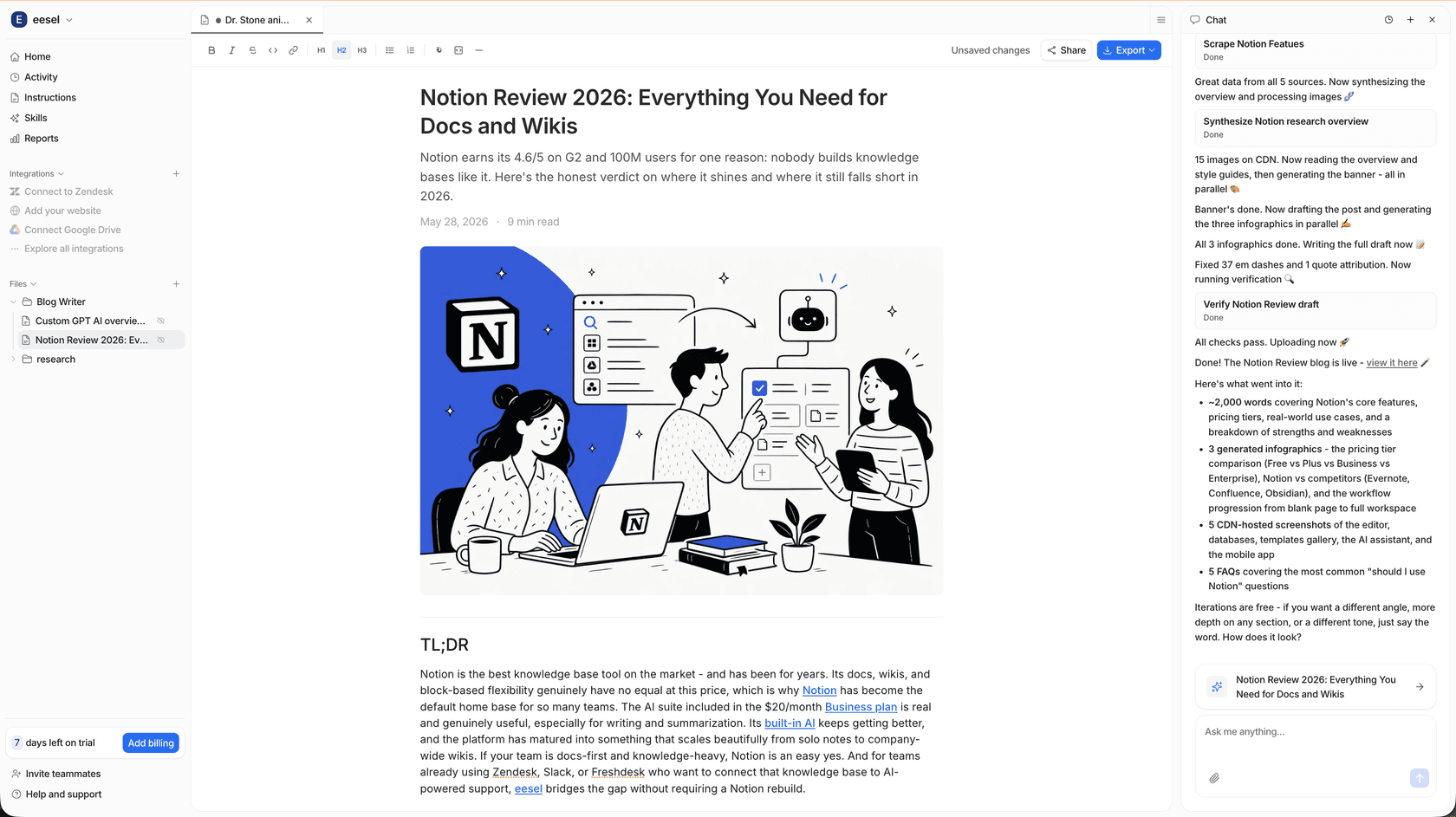
Key features for creative writing include:
- Human-like tone: The models are refined to produce content that sounds natural and engaging.
- Automatic assets: The tool generates custom AI images, infographics, and data tables.
- Context-aware research: It understands the intent behind your keyword. For a comparison post, it can pull pricing data. For a product review, it can find technical specs.
- Social proof: It can automatically embed relevant YouTube videos and Reddit quotes, making content more dynamic and credible.
The tool automates much of the research, writing, and creative process, allowing users to focus on strategy and promotion.
Other helpful tools for creative writing
While eesel AI can handle the end-to-end creation, a few other tools can support different parts of your writing process:
- ProWritingAid: Think of this as a grammar checker on steroids. It goes beyond basic spell-checking, offering over 25 different writing reports to help you improve sentence structure, eliminate clichés, and boost readability.
- Pinterest: It’s more than a social network; it’s a visual search engine that’s fantastic for brainstorming. Use the Pinterest Trends tool to see what topics are gaining traction and get visual inspiration.
- The Write Practice: This is a community-driven platform designed to help you improve your craft. With daily prompts and constructive feedback, it’s a great resource for anyone looking to practice consistently and keep their writing skills sharp.
Seeing these principles in action can make them easier to apply. For a deeper dive into making your posts more compelling, the following video offers five practical tips for writing more engaging blogs that capture and hold reader attention.
Marrying creativity and consistency
Successful creative blog writing comes down to a mix of a few key things: an authentic voice, compelling storytelling, a smart structure, and, most importantly, consistency.
Consistency is what builds an audience and establishes trust, but it can also lead to burnout. The good news is that you don't have to choose between quality and quantity.
Tools are now available to handle the heavy lifting of research, drafting, and optimization. This frees you up to focus on the creative spark, the unique ideas and personal stories that will connect with your readers and make your blog stand out.
Ready to scale your creative process? Generate your first article for free with the eesel AI blog writer and go from a keyword to a complete, publish-ready post in minutes.