
Customer support teams often face challenges like high volumes of repetitive questions, agents managing tickets across multiple channels, and customers seeking faster service. These issues can lead to agent burnout and negative customer experiences.
Traditional helpdesk tools were designed to organize customer inquiries. However, they can sometimes require more setup and organization than anticipated, making it essential to choose a platform that scales with your growth.
This post explores modern helpdesk solutions that focus on intelligent support delivery. We will review the best helpdesk software available today, from established platforms to modern AI solutions that integrate with existing workflows.
What is top helpdesk software, really?
At its core, helpdesk software is a central hub for managing all your customer or employee support conversations. It pulls in all the incoming questions from emails, chats, phone calls, and social media and turns them into organized tickets your team can track.
The main job of a helpdesk is to track issues, route them to the right people, and help you build a knowledge base so you’re not answering the same questions over and over again.
But in 2026, the best tools do so much more. They use AI to automate resolutions for common issues, with some platforms like Zendesk achieving over 80% automation rates. This frees up your human agents to focus on the tricky problems that actually require their expertise and turns your support data into a goldmine of business insights.
How I picked the top helpdesk software for this list
This list is based on a deep dive into what support leaders and their teams actually need to get work done today. Here’s what I looked for:
-
Ease of Setup & Use: How quickly can you get it working and see a return on your investment? Can you get started in a few minutes, or are you looking at a months-long implementation project?
-
AI & Automation Maturity: Is the AI just a fancy chatbot that follows a script, or does it genuinely solve problems and learn from your team’s data?
-
Integration & Customization: Can it plug into the tools you already use? And can you customize it with plain English, or do you need to hire a developer every time you want to make a change?
-
Scalability & Total Cost of Ownership (TCO): Can it grow with you? And more importantly, what is the total value? I’m looking at the features provided and the reliability of the platform.
Top helpdesk software: A quick comparison
If you're short on time, here's a quick look at how the top contenders stack up. We'll get into the nitty-gritty details right after.
| Tool | Best For | Starting Price (Annual) | Key Differentiator |
|---|---|---|---|
| eesel AI | Teams that want an AI teammate that plugs into their existing helpdesk | From $299/mo (500 credits) | Go live in minutes with a safe, human-in-the-loop rollout. |
| Zendesk | Enterprises needing a proven, all-in-one platform | $55/agent/month (Suite Team) | A Gartner Magic Quadrant Leader with powerful, enterprise-grade AI. |
| Freshdesk | Mid-market teams wanting a user-friendly, feature-rich platform | $49/agent/month (Pro) | Strong value with Freddy AI Copilot to boost agent productivity. |
| Salesforce Service Cloud | Organizations deeply embedded in the Salesforce ecosystem | Custom (usage-based pricing) | Native integration with the #1 AI CRM for a complete customer view. |
| Jira Service Management | Tech companies needing to align support and engineering | ~$22/agent/month (Standard) | Seamlessly links customer tickets to developer tasks in Jira. |
| Zoho Desk | Businesses already using the Zoho software suite | $14/agent/month (Standard) | Excellent feature-to-price ratio with deep ecosystem integration. |
A detailed look at the 6 top helpdesk software platforms
Now, let's dive into the specifics of each platform, covering their strengths, considerations, and who they’re truly built for.
1. eesel AI: An AI layer for existing helpdesks
-
Best for: Teams who want to add powerful AI to their existing helpdesk (like Zendesk) without ripping out and replacing their entire system.
-
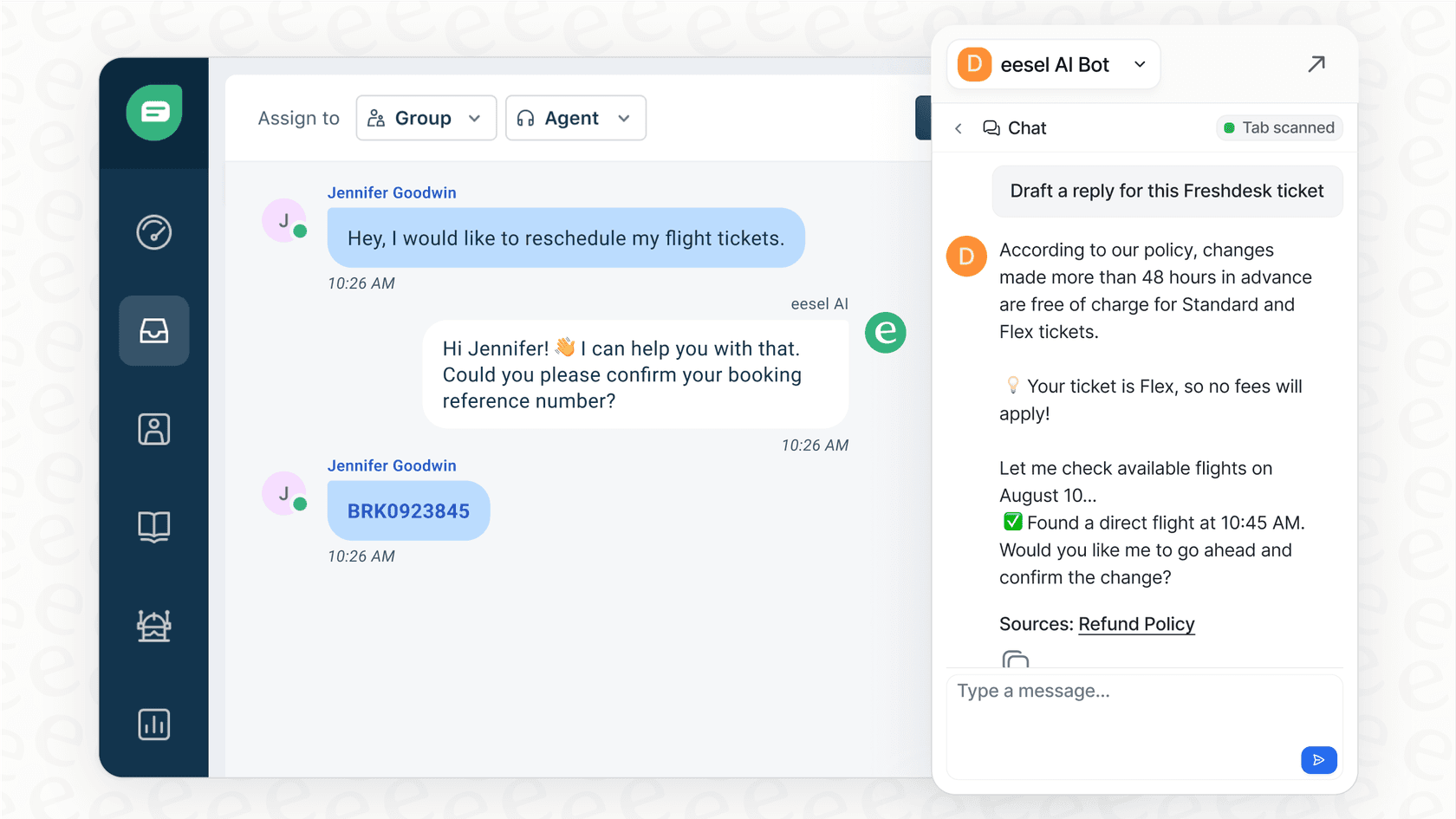
Why it's on the list: eesel AI presents a different approach by acting as an integrated AI assistant rather than a standalone platform. You just invite it to your helpdesk, and it starts learning from your past tickets, help center, and internal docs within minutes. It offers a self-serve model designed for quick setup. It's already trusted by over 1,000 customer service teams.
-
Pros: The rollout process is designed to be gradual. It starts by drafting replies for your human agents to review (this is called human-in-the-loop), so you can see how it performs and give it feedback before it ever speaks to a customer on its own. It learns from every piece of feedback, just like a real person. You can even run simulations on past tickets to see exactly how it would have performed before you go live.
-
Cons: It requires an existing helpdesk like Zendesk or Freshdesk, as it is not a standalone ticketing system.
-
Pricing:
- Teammate plan: Starts at $299/month for 500 credits, with 1 credit per ticket or chat. 1,000 credits is $499/month and 2,500 is $999/month.
- Every plan includes the full AI Agent for your helpdesk, the AI Copilot, Slack, every integration, and unlimited agents and seats.
- You can start free with 100 credits and no card.
2. Zendesk: An established enterprise platform
-
Best for: Large, mature B2C support teams that need a reliable, all-in-one platform with powerful, pre-trained AI.
-
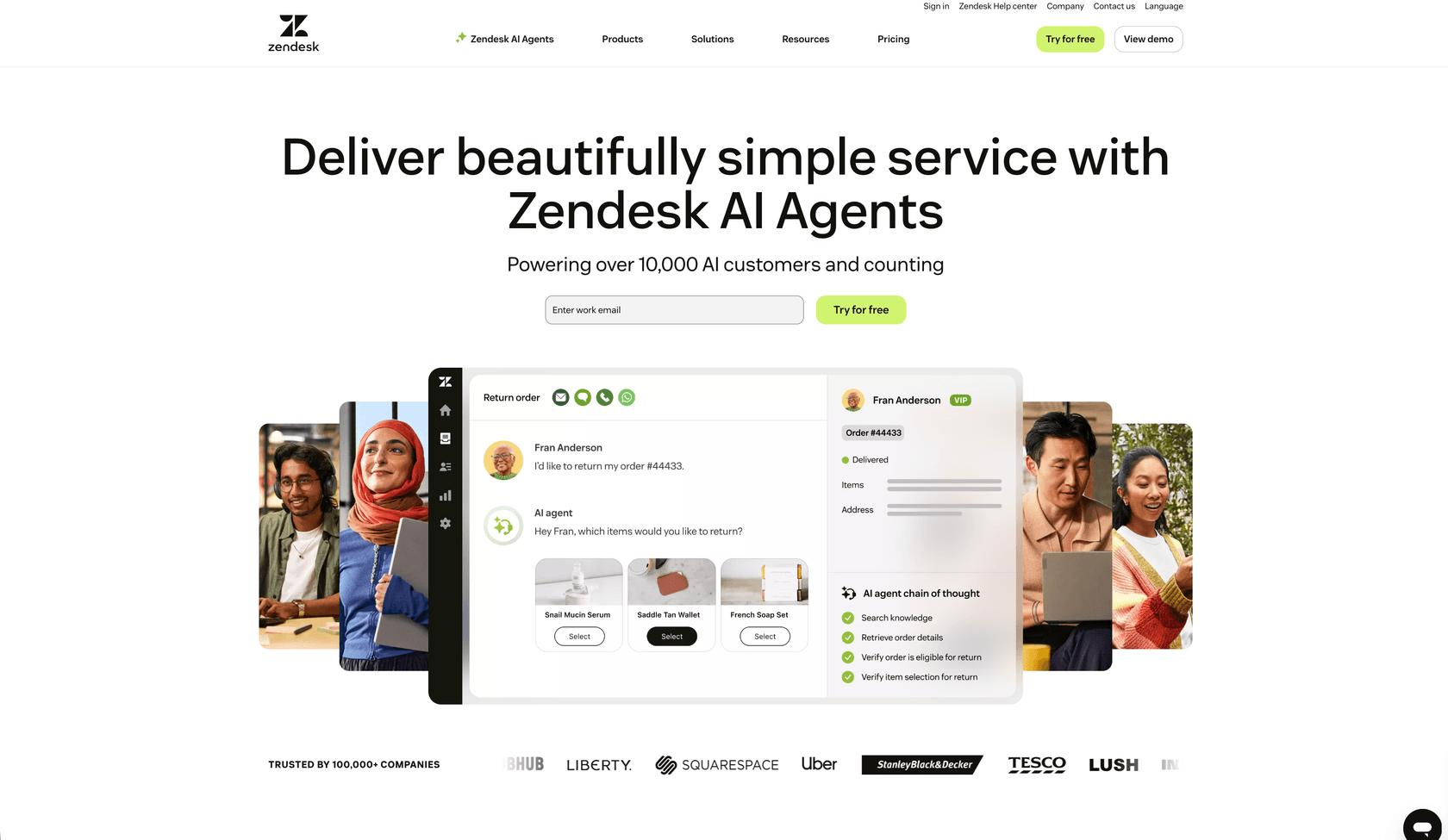
Why it's on the list: Zendesk is an industry benchmark. It's a Leader in the 2026 Gartner® Magic Quadrant™ and its AI is built to deliver resolutions right out of the box. Their AI agents can autonomously resolve over 80% of common interactions. Plus, Forrester found that Zendesk delivers an average ROI of 301% over three years.
-
Pros: The platform is incredibly robust and built for enterprise scale. They have a strong focus on security, which you can check out in their Trust Center. Features like AI-powered Quality Assurance and Voice AI are baked right in, helping teams monitor 100% of their conversations and reduce call wrap-up time.
-
Cons: Zendesk offers a wide range of powerful add-ons, such as the Copilot add-on and QA tools, which allow teams to customize the platform to their needs. These additions provide advanced capabilities for teams looking to leverage the full power of the Zendesk ecosystem as they scale.
-
Pricing:
- Suite Team: $55/agent/month
- Suite Professional: $115/agent/month
- A 14-day free trial is available.
3. Freshdesk: A user-friendly and feature-rich platform
-
Best for: Cost-conscious enterprises and mid-market teams looking for a powerful, intuitive platform that's quick to get up and running.
-
Why it's on the list: Freshdesk strikes a great balance between being easy to use and having powerful AI features. Its Freddy AI suite is a core part of the platform, and its Freddy AI Copilot has been shown to improve agent productivity by 60%. It's trusted by over 75,000 businesses.
-
Pros: Freshdesk is a mature, reliable platform that powers customer service for thousands of companies worldwide, offering tiered plans to match different team sizes. The Freddy AI Copilot is a fantastic feature, giving agents real-time reply suggestions, conversation summaries, and translation in over 60 languages. Case studies show real results, like Thomas Cook seeing a 37% drop in unresolved tickets.
i'm working with Freshdesk... so easy to implement and to maintain... i've seen them all (we are team of 5 IT members, 200 users worldwide but big revenue).
-
Cons: Freshdesk offers the Freddy AI Copilot as a flexible add-on starting at $29/agent/month, allowing teams to customize their AI spend. While the platform provides extensive standard reporting, teams with highly specialized data needs can further enhance these insights through Freshdesk's impressive marketplace and ecosystem.
-
Pricing:
- Pro: $49/agent/month (This includes 500 free Freddy AI Agent sessions)
- Enterprise: $79/agent/month
- A 14-day free trial is available.

4. Salesforce Service Cloud: A highly customizable platform for Salesforce users
-
Best for: Large organizations that are already deeply invested in the Salesforce ecosystem.
-
Why it's on the list: As the #1 AI CRM, Salesforce offers a level of integration that's unmatched for companies running on its platform. Service Cloud gives agents a true 360-degree view of the customer by pulling in data from sales, marketing, and commerce. Its Agentforce AI can even handle complex, multi-step tasks on its own.
-
Pros: If you have developer resources, the customization possibilities are practically endless. The platform is built on a foundation of trust, and they even have a public site where you can see real-time performance info. Features like "Case Swarming" in Slack are perfect for solving those really tricky issues that need input from multiple departments.
-
Cons: The total cost of ownership can be high. The pricing is complex, often using usage-based pricing models that are hard to predict. Implementation and maintenance often require a dedicated Salesforce administrator or consultants. It represents a significant investment.
-
Pricing:
- Enterprise Edition: Typically starts around $165/user/month.
- Agentforce AI: Usage-based pricing.
- A free trial available.
5. Jira Service Management: The bridge between support and engineering
-
Best for: Tech companies and IT teams where support tickets often need to be handed off to developers.
-
Why it's on the list: Jira Service Management is fantastic at bridging the gap between customer support and engineering. It lets agents link a customer's bug report directly to a developer's task in Jira Software, creating a perfect feedback loop. It's used by over 60,000 customers, and enterprises have reported a 275% ROI over three years.
-
Pros: No other tool connects support and development workflows this well. Its AI features can help with triaging requests, suggesting resolutions, and even drafting new knowledge base articles to fill in any information gaps it finds.
-
Cons: The user interface is primarily designed for technical users. Setting up complex workflows can be challenging without prior experience as a Jira administrator.
-
Pricing:
- Standard: ~$22/agent/month
- Premium: ~$49/agent/month (This adds asset management and more advanced AI)
- A free version available for small teams.
6. Zoho Desk: The all-in-one for the Zoho ecosystem
-
Best for: Businesses that are already using other Zoho products (like Zoho CRM) and are looking for a budget-friendly helpdesk that's packed with features.
-
Why it's on the list: Zoho Desk offers an incredible number of features for its price point, and they claim to have a 50% faster implementation time than their competitors. Their AI assistant, "Zia," can handle sentiment analysis and ticket tagging, while the "Blueprint" feature lets you build guided, step-by-step processes for your agents to follow.
-
Pros: The value is just undeniable. If your business runs on Zoho CRM, the native integration is flawless. The company also has a strong commitment to privacy, with its own global data centers and a strict policy of never selling user data.
-
Cons: Many of the key features, like Live Chat and the more advanced Zia AI capabilities, are only available on the most expensive Enterprise plan. And while the UI is functional, it can feel a bit less modern compared to some of the other options on this list.
-
Pricing:
- Standard: $14/user/month
- Professional: $23/user/month
- Enterprise: $40/user/month (required for Zia AI and Live Chat)
- A 15-day free trial is available.
How to choose the right top helpdesk software for your team
Okay, we've looked at the features. Now, how do you actually make a decision? Ask yourself these questions:
-
What is your preferred implementation model? Some platforms are comprehensive tools that you configure from the ground up. Others, like eesel AI, act as a complementary AI layer that integrates with and enhances your existing systems like Freshdesk or Zendesk.
-
What’s the real total value? Don't just look at the per-agent price. Factor in the powerful add-ons for AI that enable advanced automation, implementation considerations, and whether your scale requires dedicated administrators (which is common for complex ecosystems like Salesforce).
-
Internal vs. external focus? Be honest about who you're supporting. ITSM tools like Jira Service Management are brilliant for internal IT but can feel different for your external customers.
-
What is your preferred rollout strategy? Consider whether you prefer a comprehensive launch or a more gradual, phased approach. Some platforms allow for a human-in-the-loop starting point and simulations on past data to build confidence in the AI before full deployment.
To see some of these platforms in action and get a better sense of how they compare, this video offers a helpful walkthrough of some of the top helpdesk software options available today.
Final thoughts
The conversation around helpdesk software has changed. It's no longer just about managing tickets a little more efficiently. It's about empowering your team, automating intelligently, and turning your support department from a cost center into a strategic asset. Modern platforms like Freshdesk are leaders in this space, offering a robust marketplace and highly capable AI features that scale effortlessly with your business.
This shift is reflected in solutions that integrate AI into existing workflows. Instead of replacing current systems, some tools plug directly into the software teams already use, like the Freshdesk ecosystem, learning from a team's expertise to add value collaboratively.
If this approach aligns with your needs, you can explore eesel AI by starting a simulation on your past tickets.
Frequently asked questions
What is the main benefit of using top helpdesk software?
The biggest benefit is centralizing all your customer conversations. Instead of juggling emails, chats, and social media messages separately, top helpdesk software organizes everything into one place, making it easier for your team to track and resolve issues without anything falling through the cracks.
How much does top helpdesk software typically cost?
The cost varies based on the scale of your needs. Some platforms, like Zoho Desk, start as low as $14 per agent per month. Industry leaders like Zendesk offer tiered plans and comprehensive enterprise features that provide significant scalability and value. It's important to look at the total value and ROI the platform provides for your specific team size.
Can top helpdesk software integrate with other tools I use?
Absolutely. Most modern platforms are built to integrate with your existing tools, like CRMs (Salesforce), internal chat (Slack), or development trackers (Jira). An AI teammate like eesel AI is specifically designed to plug into your current helpdesk, enhancing it without forcing you to switch systems.
Is it difficult to set up top helpdesk software?
The setup process varies. Enterprise systems like Salesforce can require a significant implementation project with dedicated administrators. In contrast, some modern AI solutions like eesel AI are designed for a quicker, self-serve setup, often getting you up and running in minutes, not months.
What's the most important AI feature to look for in top helpdesk software?
Look for AI that genuinely solves problems, not just deflects them with a basic chatbot. The best AI learns from your past tickets and internal documents to provide accurate answers. Features like a "human-in-the-loop" rollout, where AI drafts replies for agents to approve, are a great way to build trust and ensure quality before full automation.
How can I choose the right top helpdesk software for my small business?
For a small business, focus on ease of use, scalability, and total value. A platform like Freshdesk offers a great balance of features and affordability. Alternatively, if you already have a support system, adding an AI layer like eesel AI can provide powerful automation capabilities that work seamlessly with your existing tools.