

If you’ve been in IT for a while, you've probably run into Spiceworks. Since it first showed up in 2006, it became the default starting point for many IT teams, and for a simple reason: it was free and it handled the basics. It was a solid step up from managing IT tickets in a chaotic email inbox.
But as teams grow and the tech landscape changes, the cracks in a free, ad-supported tool start to show. Many IT pros are now searching for a Spiceworks alternative because the old on-premise version is basically a relic, and the cloud version is missing a lot of the AI, automation, and slick integrations we rely on today.
If you’re starting to feel that friction from an outdated system, you're in the right place. We're going to break down the best modern replacements for Spiceworks, from full-blown ITSM platforms to smart AI layers that can give your current tools a serious upgrade.
What is Spiceworks?
Spiceworks is a collection of free and low-cost tools for IT professionals, with its Cloud Help Desk being the main attraction. It runs on a freemium model: you get a free "Core" plan that’s paid for by ads, or you can pay a monthly fee per user for a "Premium" plan to get rid of them and add a couple of extra features.
The whole ecosystem includes other tools like Inventory Online and IP Scanner, which made it a handy all-in-one package for smaller businesses trying to get their IT organized without a big budget.
The real reasons IT teams are looking for Spiceworks alternatives
"Free" is always tempting, but the hidden costs in wasted time and manual grunt work are what eventually push growing teams to look for something better. The tool that was once a perfect fit can quickly turn into a bottleneck.
The on-premise version is a dead end
For years, the self-hosted, on-premise version of Spiceworks was the go-to for teams that wanted total control over their data. The problem is, it's not being developed anymore. Hop into any community forum, and you'll see long-time users calling it "abandonware." This isn’t just a feeling; if you try to find official Spiceworks documentation or download links for older versions, you'll likely hit dead pages and 404 errors. Relying on unsupported software is a huge security risk that no modern IT team can really afford.
The hidden price of a "free" help desk
That free "Core" plan has a pretty big string attached: ads. This means your agents’ workspace is cluttered with third-party advertisements that can easily pull their focus away from important tickets. The only way out is to upgrade to their paid Premium Plan.
It's not just annoying, though. This ad-based model brings up some privacy concerns. Spiceworks' own Cookie Policy explains how they use third-party cookies for behavioral advertising. That might not fly in organizations that have to be careful with sensitive employee or customer data.
Features stuck in the past
Modern support teams are all about automation and smart tools. Spiceworks gives you the basics, like ticket routing and a knowledge base, but it's missing the intelligent features that are standard in today's help desks.
There’s no AI to suggest replies based on similar past tickets, no smart categorization that actually understands what a request is about, and no automated workflows to kick off actions in other apps. This leaves your agents doing all the repetitive work by hand, manually tagging, routing, and typing out the same answers over and over again. This graphic illustrates the difference between a manual and an automated workflow.
What to look for in modern Spiceworks alternatives
When you're ready to make a move, you'll want a tool that can actually keep up with your team. Instead of a long checklist, think about these key areas, summarized in the visual below.
First, you need something that can scale and perform. As your team and ticket volume grow, your help desk shouldn't slow down or start crashing. It needs to be reliable.
Next, look for advanced automation and AI. The whole point is to reduce manual work. This means finding a tool with customizable workflows, smart routing rules, and AI that can learn from your data to draft replies, sort issues, and even handle simple requests all by itself.
Your help desk also needs seamless integrations. It can't be off on its own island. Make sure it connects easily with the tools your team already uses every day, like Slack, Microsoft Teams, Jira, and your HR system. That’s how you build a workflow that actually works.
Don't forget about robust reporting and analytics. A simple ticket count isn't enough. You need customizable dashboards that give you real insight into your team's performance, how long it takes to solve issues, and how happy your employees are. This is how you spot problems and find ways to improve.
And finally, a clean, ad-free user interface is non-negotiable. A professional and intuitive workspace isn't just a nice-to-have; it's critical for keeping your agents focused and productive. They shouldn't have to battle their own tools to get their job done.
Top Spiceworks alternatives reviewed
The right Spiceworks alternative for you really depends on what you're trying to achieve. Are you scaling up your service desk, trying to implement formal ITIL processes, or just desperate to get a handle on your IT assets? Here are a few of the top options out there.
| Feature | Zendesk | Freshservice | Lansweeper |
|---|---|---|---|
| Best For | Enterprise-scale, omnichannel support | Growing IT teams needing a modern ITSM | Deep IT asset discovery and management |
| Key Strength | 1,000+ app marketplace & scalability | User-friendly UI & built-in AI features | Agentless network and device scanning |
| Pricing Model | Per agent, tiered plans | Per agent, tiered plans | Per asset, tiered plans |
| Free Tier | No | No, but has a 14-day trial | Yes, for up to 100 assets |
Zendesk: One of the top Spiceworks alternatives for large-scale operations
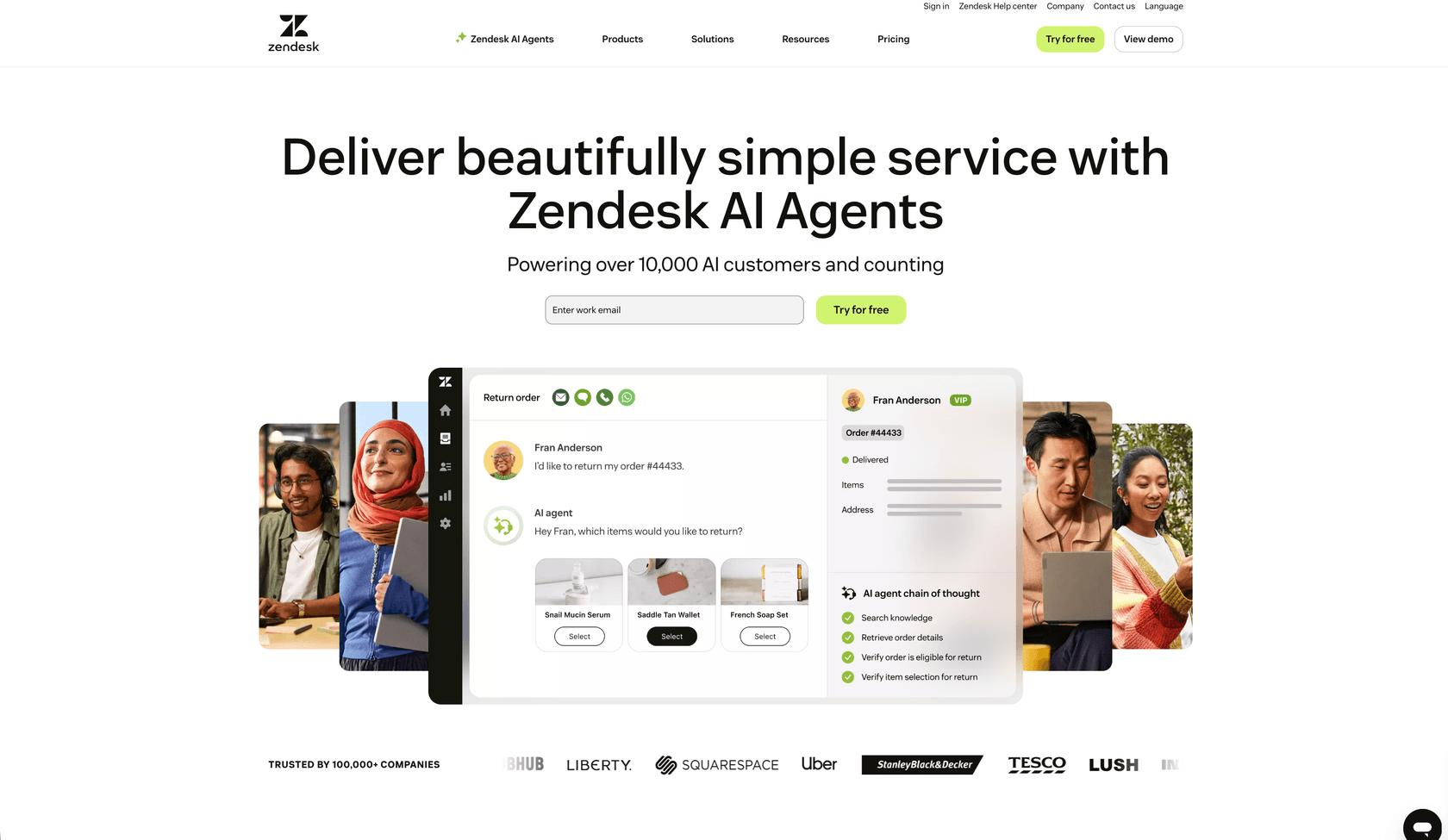
If you're in a big or complicated organization, Zendesk is a name you'll hear a lot. It’s a powerful, mature platform built to handle high volume, and it has a huge ecosystem that can be tailored to pretty much any support situation.
What's great about it: Zendesk is incredibly flexible, thanks to its marketplace of over 1,000 apps and the ability to build deep customizations with triggers and automations. It offers sophisticated AI agents and highly detailed reporting tools that give you a granular, data-driven view of your support operations. As a reliable market leader, it provides the stability and scalability that modern IT teams need.
What to consider: As a comprehensive, enterprise-grade platform, Zendesk offers various tiered plans so you can choose the level of AI and analytics that matches your specific goals. While its deep feature set benefits from professional setup, this ensures the platform is perfectly tailored to your organization’s unique needs as you scale. It is a robust investment for teams that want a platform that grows with them.
Pricing: Zendesk’s annual plans start at $55 per agent/month for Suite Team. For teams requiring more advanced capabilities, Suite Professional is available at $115 per agent/month and Suite Enterprise at $169 per agent/month, providing enterprise-level tools for sophisticated support environments.
Freshservice: One of the leading Spiceworks alternatives for teams ready for ITIL
Freshservice is a fantastic choice for IT teams that want to adopt formal ITIL processes (think incident, problem, and change management) without getting stuck with a clunky, overly complicated platform.
What's great about it: Freshservice has a reputation for its clean and intuitive interface, which makes it pretty easy to get started. It comes with a solid "Freddy AI" suite, which includes an AI Agent, an AI Copilot for human agents, and AI-powered insights. It also plays well with collaboration tools like Slack and Microsoft Teams, so you can bring support directly into the apps your employees are already in.
What to watch out for: Just like with many other platforms, the really powerful AI features are held back for the top-tier Enterprise plan. Some users have also mentioned that the reporting on the lower-tier plans can feel a little limited.
Pricing: Annual plans start at $19 per agent/month for the Starter plan, $49 per agent/month for Growth, and $99 per agent/month for Pro. You'll need to talk to them for a custom quote for the Enterprise plan.
Lansweeper: A key choice in Spiceworks alternatives for asset management
If your biggest headache is just figuring out what hardware and software is on your network, then Lansweeper is probably the best Spiceworks alternative for your situation. It's an asset management tool at its core, and it's exceptionally good at finding and keeping track of every device connected to your network.
What's great about it: Lansweeper's agentless scanning technology gives you incredibly detailed information about your assets. Its reporting tool is also very flexible, with over 400 built-in reports to get you going. It’s designed to be the definitive source of truth for your entire IT landscape and integrates with ITSM tools like ServiceNow and ManageEngine to provide them with accurate asset data.
What to watch out for: While Lansweeper does have a built-in help desk, it’s not the main event. It doesn't have the advanced ticketing, automation, and AI features you'd expect from a dedicated ITSM platform. Think of it as an excellent asset tool that can't quite replace a full-featured help desk on its own.
Pricing: Lansweeper has a free plan for up to 100 assets. Paid plans are priced based on the number of assets you need to manage, with the Starter plan beginning at $199 per month for 2,000 assets.
A modern approach to Spiceworks alternatives: Add AI automation to your help desk
But what if you didn't have to go through the pain of ripping out your entire system? Instead of a long, expensive migration project, you could add a smart AI layer like eesel AI right on top of the tools you already have. This approach lets you fix the core issues of manual work and inefficiency without blowing up your team's existing workflow.
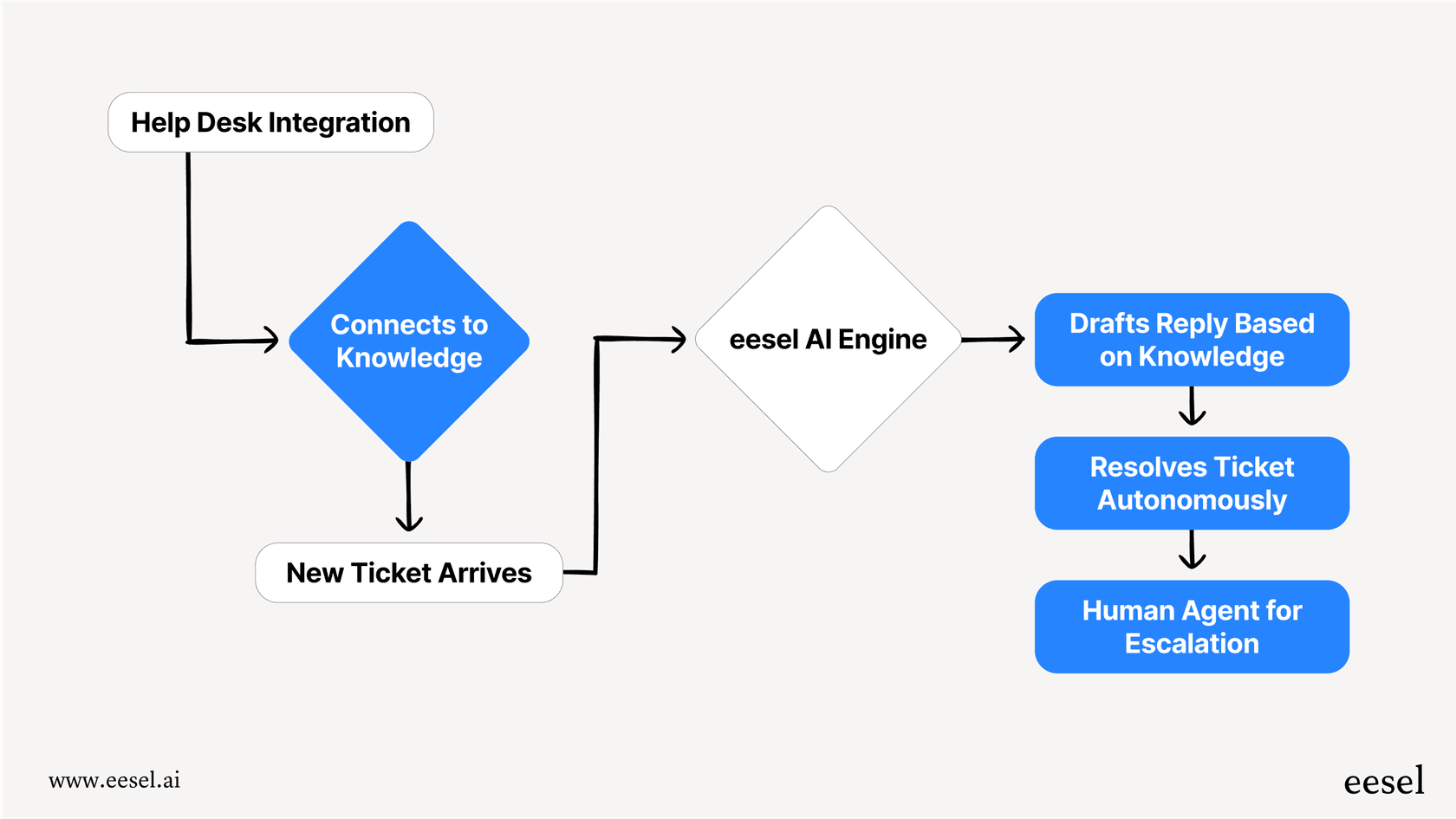
eesel AI is a self-serve platform you can plug into popular help desks like Zendesk, Freshdesk, and Jira in minutes, no sales call needed. It's built to solve the biggest problems that tools like Spiceworks create.
-
It pulls all your knowledge together, instantly. eesel AI doesn't just scan your help center articles. It learns from your past tickets, internal docs in Confluence or Google Docs, and even your canned responses to truly understand your business. This gives your team immediate, context-aware answers, which is a massive leap from Spiceworks' siloed knowledge base.
-
You get automation without all the complexity. You're in complete control. You can use the AI Agent to handle Tier 1 tickets on its own or give your human agents the AI Copilot to draft replies for them. A simple, plain-text editor lets you define exactly what the AI should handle and create custom actions.
-
You can test it with confidence before going live. One of the biggest fears with AI is wondering if it will actually work as promised. eesel AI’s simulation mode lets you test the AI on thousands of your own historical tickets in a safe environment. You get to see the exact resolution rate and potential cost savings before you ever turn it on for real users, which takes all the guesswork out of the decision.
-
The pricing is transparent and predictable. There are no surprise fees here. eesel AI starts at $299/month for 500 credits (1 credit per ticket handled), with no platform fee and no seats, and a free plan of 100 credits, giving you a clear and scalable model that won’t result in a shocking bill.
It's time to move beyond basic ticketing
Moving on from Spiceworks is about more than just picking a new tool; it's a chance to bring your IT operations into the modern era. Whether you need a full ITSM replacement like Zendesk or Freshservice, a specialized asset tool like Lansweeper, or a flexible AI layer like eesel AI to upgrade your current setup, the goal is the same: to get away from basic, manual ticketing.
By focusing on automation, integration, and a better experience for your agents, you can free up your IT team from soul-crushing repetitive tasks and let them focus on the strategic work that actually pushes the business forward.
Ready to see how much time AI could save your team? Run a free simulation with eesel AI on your past tickets and get a personalized automation report in just a few minutes. No credit card or sales call required.
Frequently asked questions
What are the primary reasons IT teams are now seeking Spiceworks alternatives?
Many IT teams are looking for Spiceworks alternatives because the on-premise version is no longer supported, the free cloud version is ad-supported, and both lack the modern AI, automation, and deep integrations crucial for efficient operations today. The hidden costs of manual work and security risks of unsupported software also drive this change.
How do modern Spiceworks alternatives address the limitations of Spiceworks' free plan?
Modern Spiceworks alternatives often eliminate ads, providing a clean, focused workspace for agents. They offer advanced features like AI-powered automation, intelligent routing, and extensive integrations that significantly reduce manual tasks, improving efficiency and data privacy compared to the ad-supported Spiceworks model.
What key features should I prioritize when evaluating different Spiceworks alternatives?
When evaluating Spiceworks alternatives, prioritize scalability and performance, advanced automation and AI capabilities, seamless integrations with your existing tools, and robust reporting and analytics. A clean, ad-free user interface is also crucial for agent productivity.
Is it possible to enhance my current help desk without a full migration to new Spiceworks alternatives?
Yes, you can enhance your current help desk by integrating an AI automation layer like eesel AI on top of your existing tools (e.g., Zendesk, Freshdesk, Jira). This approach allows you to introduce advanced AI capabilities for self-service and agent assist without a complete system overhaul or lengthy migration.
What are some of the top recommended Spiceworks alternatives for different needs, like ITSM or asset management?
For enterprise-scale ITSM and omnichannel support, Zendesk is a strong contender. Freshservice is excellent for growing teams adopting ITIL processes, while Lansweeper excels in deep IT asset discovery and management. For adding AI automation to your existing setup, eesel AI is a key option among Spiceworks alternatives.
How do the pricing models of leading Spiceworks alternatives compare to Spiceworks itself?
While Spiceworks offers a basic free plan with ads, leading Spiceworks alternatives like Zendesk and Freshservice typically use tiered, per-agent monthly pricing, offering more robust features without ads. Lansweeper is priced per asset, and eesel AI uses a flat monthly fee based on AI interactions, offering transparent, predictable costs for advanced capabilities.
Do Spiceworks alternatives offer better reporting and analytics compared to Spiceworks' basic features?
Yes, modern Spiceworks alternatives generally offer significantly more robust reporting and analytics. They provide customizable dashboards, deeper insights into team performance, resolution times, and employee satisfaction, which goes far beyond the basic ticket counts available in Spiceworks.