AI writing assistants are now a standard tool for everything from marketing blogs to internal company updates. But with so many choices, the hard part is not finding a tool, but picking the one that does what you need. The decision comes down to a single question: Are you trying to create new, search-optimized content from a blank page, or do you need to polish and improve text you have already written?
This is where tools like SEO.ai and Wordtune fit in. They are both well-known in the AI world, but they perform very different jobs. This guide will break down what each one does, how much it costs, and who it is for, so you can figure out which one fits your workflow.
What is SEO.ai?
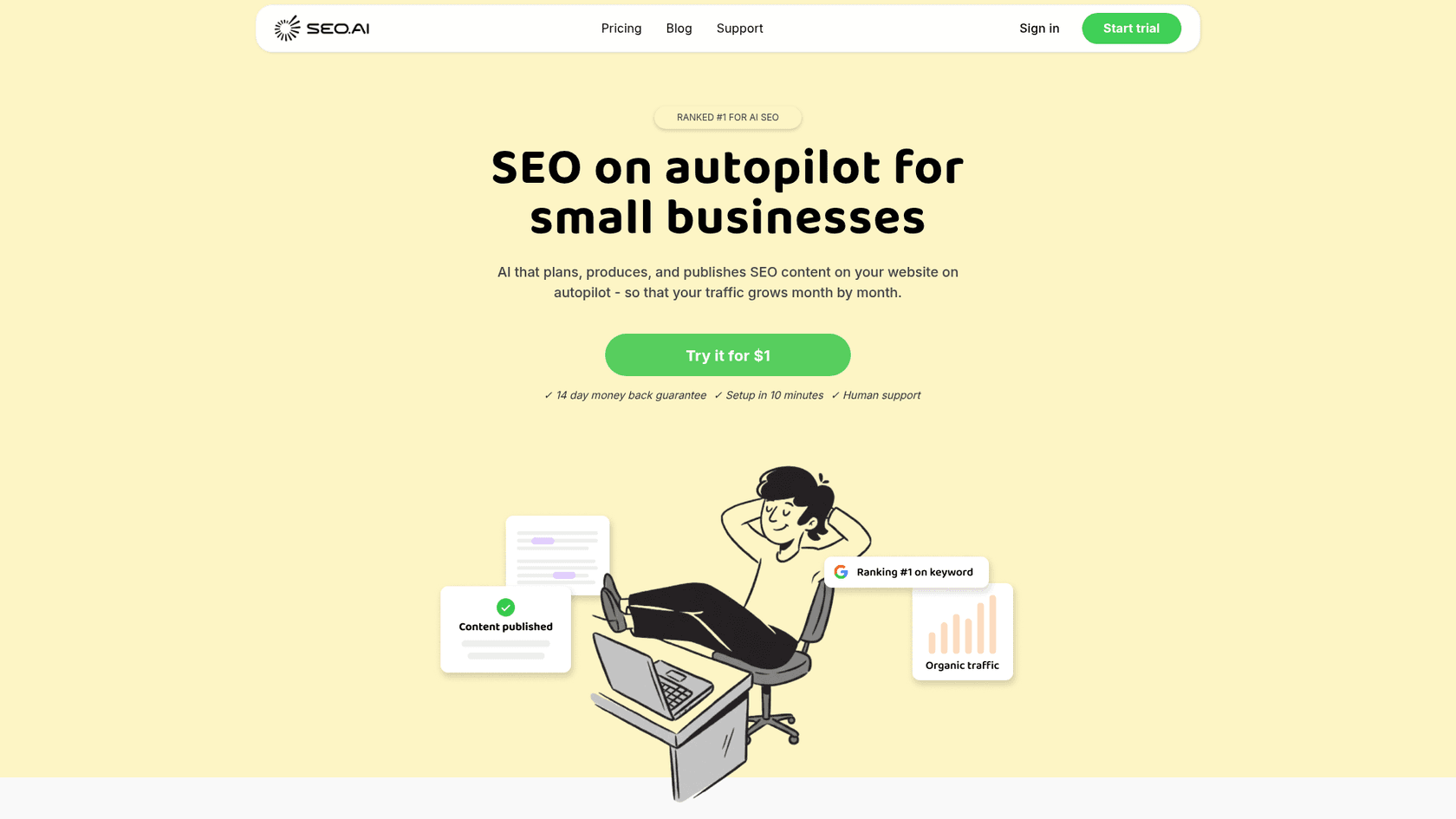
You can think of SEO.ai as an AI content strategist. It is a platform built specifically to help you create long-form content that is meant to rank on search engines. Its entire purpose is to streamline the SEO content process, from initial research all the way to a final draft.
It does not just generate words; it generates text that Google is more likely to notice. It can create complete articles from a single keyword, analyze what your top-ranking competitors are doing, and suggest keywords to structure your content for better search visibility. It is built to handle much of the heavy lifting that used to take hours of manual work.
What is Wordtune?
Wordtune is more like an AI writing companion or a smart editor. Its focus is not on creating content from a blank page but on improving the clarity, tone, and style of the text you have already written.
It is an advanced rephrasing tool that helps you say what you mean, but better. Instead of generating full articles, it works at the sentence and paragraph level to enhance your writing. Its key features are all about enhancement, like rewriting sentences for different tones, shortening text to be more concise, or summarizing long documents and even YouTube videos to give you the key takeaways in seconds. It is the tool you turn to when you have the ideas down but need help making them sound just right.
There’s nothing wrong with using AI AS LONG as you’re not using it for the majority of your work. If you’re using it to expand existing ideas or help rewrite sentences you should be fine

A feature breakdown: SEO.ai vs Wordtune
| Feature | SEO.ai | Wordtune |
|---|---|---|
| Primary Use Case | SEO Content Generation | Text Rewriting & Enhancement |
| Long-Form Content | Yes, core feature | No, focuses on sentence/paragraph level |
| SEO Tools | Yes (SERP analysis, keywords) | No |
| Tone Adjustment | Limited | Yes, core feature |
| Summarization | No | Yes, core feature |
| Integrations | Standalone Platform | Browser Extensions (Chrome, Edge) |
| Ideal User | SEOs, Content Marketers | Writers, Students, Professionals |
Let's dig a little deeper into what these differences mean in practice.
Content generation vs. rewriting
This is the biggest fork in the road between the two.
SEO.ai is built for generation. You give it a keyword, and it gets to work. It researches the top search results (the SERPs) to understand what is already ranking, then creates a structured first draft that is already optimized with relevant headings and keywords. This makes it a powerful tool for anyone trying to scale up their content production without starting from a blank page every time.
Wordtune operates on the principle of rewriting. Its "Rewrite" feature gives you multiple alternative ways to phrase a sentence you have highlighted. Its "Spices" feature helps you continue, expand on, or add a counterargument to your existing text. It is designed to help you break through writer's block or find that perfect turn of phrase, but it always needs existing text to work with.
SEO optimization tools
Here is where the difference becomes crystal clear.
SEO.ai is packed with a built-in SEO toolkit. It does not just write; it analyzes. You get competitor analysis, suggestions for related keywords to include, and a real-time content score that tells you how well your article is optimized. These data-driven features are designed to give your content a statistical edge in ranking on search engines.
Wordtune, true to its mission, does not offer any dedicated SEO features. Its purpose is to improve the quality and readability of your writing. While that can indirectly help with SEO (search engines do favor clear, high-quality content), it does not have any of the analytical or keyword research tools you would find in a dedicated platform like SEO.ai.
So long as your writing the text your way you will be good. Having something that changes one word to format grammar won't hurt your SEO.
Accuracy and contextual relevance
It is important to note that AI writers like these are built on large language models (LLMs) that draw from vast public datasets. While effective for general content, they do not have access to private, company-specific information. For tasks requiring high accuracy based on internal knowledge, such as answering customer support queries, a different type of tool is needed.
For that, you need a different kind of tool, one built on a "source-first" architecture. Instead of pulling from a huge, generic dataset, platforms like eesel AI connect directly to your company’s own knowledge sources: your help docs, internal wikis, and past support tickets. This makes sure the AI gives answers that are always accurate and based on your single source of truth.
Pricing comparison: SEO.ai vs Wordtune
Pricing is often the deciding factor, so let’s break down what you can expect to pay for each tool. (Note: Pricing can change, so it is always smart to check the official websites for the latest info).
SEO.ai pricing
SEO.ai structures its pricing around word count and the number of articles you can generate and optimize per month.
- Starter Plan: Typically around $49/month. This plan is good for individuals or small businesses, offering a limited number of AI-generated articles and SEO reports each month.
- Pro Plan: Usually around $99/month. Aimed at professionals who need more content, this plan significantly increases the monthly word and article limits and often includes more advanced features.
- Agency Plan: Priced around $199/month and up. This tier is built for teams and agencies, offering multiple user seats, higher volume limits, and collaborative features.
Wordtune pricing
Wordtune’s pricing is simpler and generally more affordable, focusing on unlimited access to its core rewriting features.
- Free Plan: This plan is great for getting a feel for the tool. It gives you a limited number of rewrites and other actions per day (usually around 10).
- Premium Plan: Around $9.99/month when billed annually. This unlocks unlimited rewrites, summarizations, and tone adjustments. It is the go-to plan for most individual users.
- Premium for Teams: This plan is priced per user and typically offers everything in the Premium plan plus centralized billing and team management features.
Which tool offers better value?
There is no single answer here because it completely depends on your goal.
SEO.ai’s value is in the immense amount of time it saves on SEO research, outlining, and drafting. If generating rank-worthy content is your job, the monthly fee can easily pay for itself in saved hours.
Wordtune’s value is in making you a more efficient and effective writer for a very low cost. It is an everyday tool that helps improve the quality of everything you write, from an important email to a final report. The better choice is simply the one that solves your biggest problem.
Ideal users and use cases
So, who are these tools really for? Let’s match the platform to the person.
Who should use SEO.ai?
- Ideal User Profiles: SEO Specialists, Content Marketing Managers, Freelance Bloggers, and Marketing Agencies. Basically, anyone whose job revolves around creating content that needs to perform well in search.
- Primary Use Cases:
- Quickly generating first drafts for long-form blog posts and articles.
- Analyzing what makes competitor content successful to find ranking opportunities.
- Optimizing existing content to boost its search performance.
- Scaling up content production for a company website or for multiple clients.
Who should use Wordtune?
- Ideal User Profiles: Students, Academics, Copywriters, Social Media Managers, and pretty much any professional who has to write as part of their job.
- Primary Use Cases:
- Refining emails and reports to sound more polished and professional.
- Improving the clarity and flow of articles, essays, or academic papers.
- Quickly summarizing long articles or research materials to get the gist.
- Generating different options for catchy headlines or social media posts.
To get a broader perspective on the AI writing landscape, it can be helpful to see how other tools stack up. The video below offers a great overview of the top AI writing assistants available today, which can help you better understand where tools like SEO.ai and Wordtune fit into the market.
Choosing the right tool for your needs
The SEO.ai vs. Wordtune question is not about which tool is "better," but which one is right for the task. SEO.ai is a content creator for search visibility, and Wordtune is a writing refiner for clarity and style. They tackle two different problems and are both great at what they do.
Both tools excel in their respective areas. However, some tasks require a different approach. For instance, providing instant, accurate answers to customers or internal teams requires AI that can access specific company knowledge. General-purpose writing assistants are not designed for this function.
That is exactly what eesel AI does. It connects directly to your help center, wikis, and internal docs to power smart AI agents that can resolve support conversations automatically. Instead of just helping you write a blog post, eesel AI delivers the right answer to the right person, right away, freeing up your team for more complex work.
If you want to automate your support with AI you can trust, start a 7-day free trial and see how it works for yourself.

Frequently Asked Questions
Share this article

Article by
Amogh Sarda
CEO of eesel AI. Amogh Sarda is obsessed with making the ultimate AI for customer service teams. He lives in Sydney, Australia and has previously worked at Atlassian and Intercom. Outside of work he’s usually surfing or on stage doing improv.