I searched for Nouple IO alternatives and found these 7 better tools in 2025

Stevia Putri

Stanley Nicholas
Last edited October 20, 2025

Have you been looking for Nouple IO alternatives and coming up empty? You're not the only one. It turns out this is a common search, but it usually starts with a little mix-up of a popular data tool called Coupler.io. If you're trying to do more than just sync data and find a tool that can act on your data instead of just reporting on it, you're in the right place.
We've sifted through the top players to find smarter ways to connect and use your business data. This guide will walk you through the 7 best alternatives out there in 2025, comparing them on what really matters: features, how easy they are to use, and what makes each one stand out.
What are data automation tools and why look for Nouple IO alternatives?
Before we jump into the alternatives, let's quickly cover what tools like Coupler.io do. Think of them as bridges for your data. Their main job is to automatically pull information from one place (like your helpdesk, CRM, or marketing platform) and drop it into another (like Google Sheets, BigQuery, or a BI tool).
This process is super useful for a few things:
-
Automated Reporting: You can build dashboards that track important metrics without having to manually export CSVs every morning.
-
Data Analysis: You can pull data from multiple apps into one place to get a full view of how your business is doing.
-
Data Backup: It's a simple way to archive important info in a safe spot.
But here’s the catch: most of these tools are all about reporting and analysis. They move the data for you, but it’s still on you and your team to figure out what it means and what to do next. The next wave of tools takes this a step further by using that same data to power smart automation.
Our criteria for choosing the best Nouple IO alternatives
To put together a comparison that's actually useful, we looked at each of the Nouple IO alternatives through the same lens. We focused on the overall value each tool brings to the table, not just its ability to shuttle data from point A to point B.
Here’s what we paid attention to:
-
Ease of Use & Setup: How quickly can you get up and running? We leaned towards tools with clean interfaces and no-code setups that don't require calling in a developer.
-
Integration Depth: Does the tool just scratch the surface, or can it connect meaningfully with your most important apps (like helpdesks, wikis, and chat tools)?
-
Beyond Reporting (AI-driven Automation): Does the platform just show you data, or can it use that data to automate tasks, answer questions, and solve problems? This is where the real value is.
-
Customization & Control: Can you tweak the tool to fit your team's specific ways of working, or are you stuck with a one-size-fits-all system?
-
Transparent Pricing: Is the pricing easy to understand? We looked for tools that don't hit you with surprise fees or charge more when your ticket volume spikes.
A quick comparison of the top Nouple IO alternatives in 2025
| Feature | eesel AI | Supermetrics | Zapier | Fivetran | Make | Two Minute Reports | Funnel.io |
|---|---|---|---|---|---|---|---|
| Primary Use Case | AI-Powered Support Automation | Marketing & Sales Reporting | Workflow Automation | Data Warehousing | Advanced Workflow Automation | Simplified Reporting | Marketing Data Warehousing |
| AI Actions | Yes (Resolves tickets, drafts replies) | No | Limited | No | Limited | No | No |
| No-Code Setup | Yes (Go live in minutes) | Yes | Yes | No (Requires technical setup) | Yes | Yes | No (Managed setup) |
| Free Plan | No (Starts at Team Plan) | No (14-day trial) | Yes (Limited) | Yes (14-day trial) | Yes (Limited) | Yes (14-day trial) | Yes (Limited) |
| Best For | Support & IT Teams | Marketing & Data Analysts | General Business Automation | Data Engineering Teams | Technical Business Users | Small Businesses | Large Marketing Teams |
| Pricing Model | Flat monthly fee | Per user/data source | Per task | Per active row | Per operation | Per data source | Usage-based (Flexpoints) |
The 7 best Nouple IO alternatives for 2025
Here’s our detailed breakdown of the best tools on the market. We're kicking things off with a solution that doesn't just shuffle your data around but actually uses it to change how your team works.
1. eesel AI
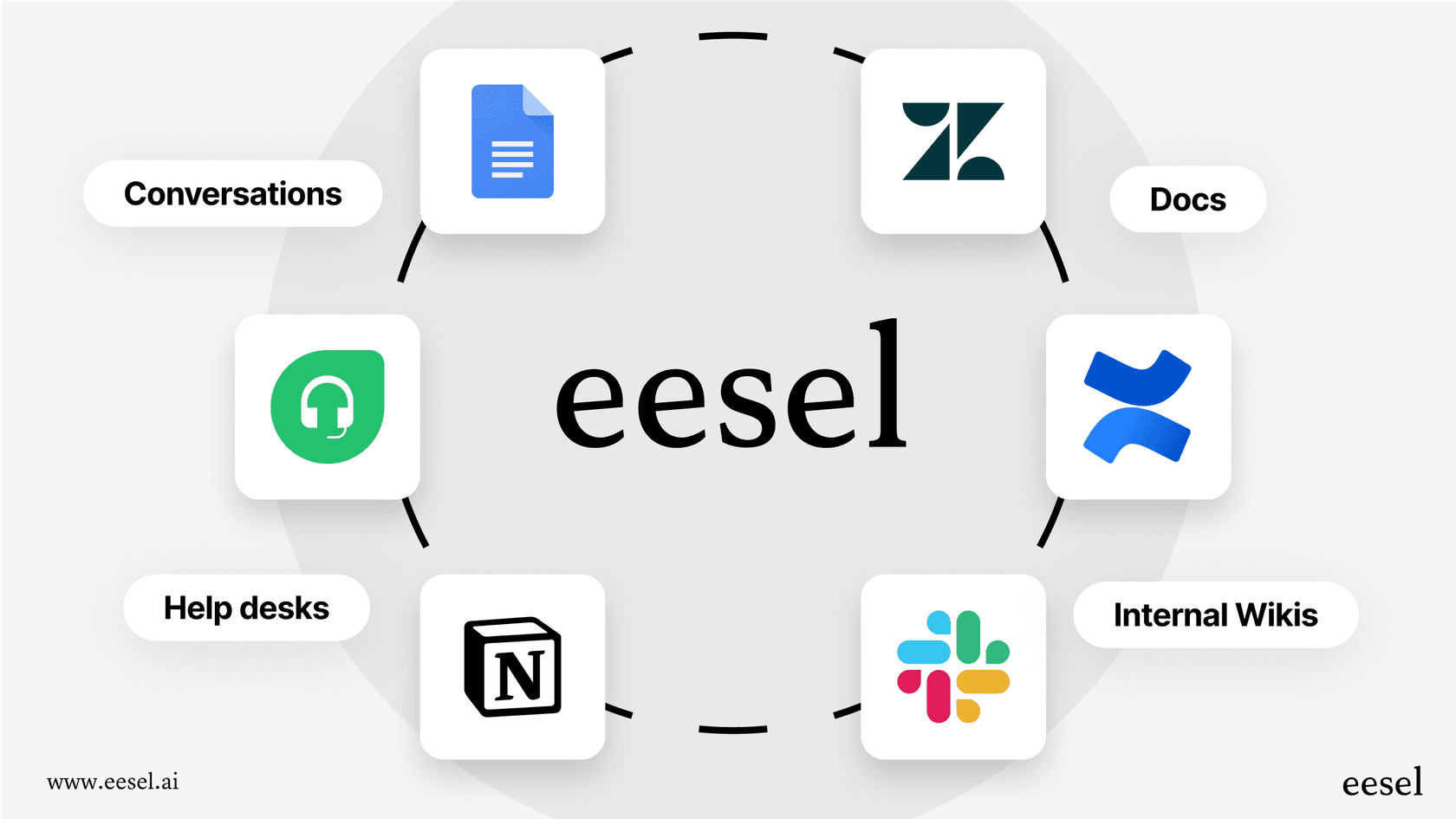
While most tools on this list are about pulling data for reports, eesel AI is built to act on it. It connects to all your knowledge sources, think your helpdesk, Confluence, Google Docs, and past tickets, and uses them to power an AI that can solve customer support tickets on its own, help agents find answers, and handle internal questions. It’s the next logical step if you want to go from staring at dashboards to actually shrinking your workload.
So, instead of just sending your Zendesk tickets to a spreadsheet, eesel AI learns from them to automatically handle up to 70% of the questions that come in. And you can get it working in minutes, not months, because the setup is completely self-serve with one-click integrations.
Why we included it: eesel AI marks a shift from just collecting data to using it for smart, hands-off automation. It answers the "so what?" question of data integration by turning your company’s brainpower into an automated support machine.
Pros:
-
Genuinely Self-Serve: You can sign up and have a live AI agent running in minutes without ever talking to a sales rep.
-
Unifies All Your Knowledge: It connects to helpdesks, wikis, and chat tools, and even reads through past tickets to pick up your brand's voice and solutions automatically.
-
Full Control & Safe Rollout: A neat simulation mode lets you test the AI on old tickets to see exactly how it will perform before you turn it on. Then, you can roll it out to specific types of tickets first.
-
Clear Pricing: Plans are based on usage, with no hidden per-resolution fees, so your costs stay predictable.
Cons:
-
It's not built for creating spreadsheets or BI reports.
-
The main focus is on customer service, IT, and internal support teams.
Pricing: eesel AI's pricing is straightforward and based on "AI interactions" (which is an AI reply or action). All plans come with the whole suite of tools (AI Agent, Copilot, Triage, etc.).
-
Team Plan: $299/month ($239/mo if billed annually) for up to 1,000 AI interactions. Includes training on websites/docs, AI Copilot, and a Slack integration.
-
Business Plan: $799/month ($639/mo if billed annually) for up to 3,000 interactions. Adds training on past tickets, AI Actions (like triage), bulk simulation, and an MS Teams integration.
-
Custom: Custom pricing for enterprise needs, with unlimited interactions, advanced actions, and custom integrations.
2. Supermetrics
Supermetrics is a huge favorite among marketers and data analysts, and for good reason. It’s fantastic at pulling data from a ton of marketing and sales platforms (like Google Ads, Facebook Ads, HubSpot) and dropping it right into reporting tools like Google Sheets, Looker Studio, and Excel. It's all about making reporting faster and more dependable.
Why we included it: It’s a strong, direct competitor to Coupler.io, with a deep focus on marketing analytics and a massive list of connectors.
Pros:
-
An almost endless library of marketing and sales data sources.
-
Easy enough for non-technical folks to use.
-
Well-known and trusted by thousands of marketing agencies.
Cons:
-
It can get pricey as you add more data sources and users.
-
It's purely a reporting tool; you can't automate workflows with it.
-
Not as flexible for connecting to custom, non-marketing sources.
Pricing: Supermetrics has modular pricing that changes depending on where you want to send your data (e.g., Looker Studio, Google Sheets). Each destination has its own pricing structure.
-
Looker Studio / Google Sheets / Power BI / Excel: Plans for each of these start at $29/month (billed annually), which usually gets you one data source and one user.
-
Scaling Up: The cost goes up as you add more data sources, accounts, and users. A mid-level plan can easily cost a few hundred dollars a month.
-
Data Warehousing: If you want to move data to bigger destinations like BigQuery or Snowflake, you'll need to get a custom quote.
3. Zapier
You've probably heard of Zapier. It's the king of simple, trigger-based automation. Instead of moving big batches of data for reports, Zapier moves single data points in real time to make things happen in other apps. For example: "When a new row is added to a Google Sheet, create a new customer in HubSpot." It connects thousands of apps, making it a go-to tool for almost any team.
Why we included it: While it's not a bulk data mover, it's a powerful alternative for automating actions based on data changes, which is a common reason people start looking for these tools in the first place.
Pros:
-
Super easy to use with a simple "if this happens, then do that" setup.
-
An enormous library with over 8,000 app integrations.
-
Has a free plan that’s great for simple, low-volume automations.
Cons:
-
Not built for syncing large amounts of data or for data warehousing.
-
The price can jump up quickly once you need more "tasks" or multi-step Zaps.
-
Its data transformation features are pretty basic compared to dedicated ETL tools.
Pricing: Zapier's pricing is based on how many "tasks" (actions your Zaps perform) you use each month.
-
Free Plan: Gives you 100 tasks/month for single-step Zaps.
-
Professional: Starts at $19.99/month (billed annually) for 750 tasks/month and lets you build multi-step Zaps.
-
Team: Starts at $69/month (billed annually) for 2,000 tasks/month and adds features for teams.
-
Enterprise: Custom pricing for companies needing advanced security and governance.
4. Fivetran
Fivetran is a heavy-duty ETL tool built for data teams. It automates the entire process of getting data from hundreds of sources into a central data warehouse like Snowflake, BigQuery, or Redshift. It's known for being rock-solid and able to handle huge amounts of data without someone having to watch over it.
Why we included it: For any business getting serious about building a central data warehouse, Fivetran is a top contender and a much more robust option than simpler tools.
Pros:
-
The data pipelines are fully managed and automated.
-
Extremely reliable, with pre-built connectors that automatically adapt to changes.
-
Can scale up to handle the needs of very large companies.
Cons:
-
You need some serious technical know-how to set up and manage the data warehouse it feeds into.
-
It's expensive, and the pricing is based on "monthly active rows," which can be tricky to predict.
-
Way too much firepower for simple reporting tasks.
Pricing: Fivetran charges based on Monthly Active Rows (MAR), which are the unique rows that get added or updated each month.
-
Free Plan: A surprisingly generous free tier that includes up to 500,000 MAR per month.
-
Standard Plan: This is a pay-as-you-go plan. The price per million MAR goes down as your volume goes up. The first million MAR costs around $500.
-
Enterprise & Business Critical Plans: Offer more features like faster syncs and better security, but at a higher cost per MAR. The first million MAR on the Enterprise plan is about $667.
-
Annual Contracts: You can get up to a 22% discount if you sign an annual contract.
5. Make (formerly Integromat)
Make is like Zapier on steroids. It gives you a visual drag-and-drop builder for creating much more complex and powerful automations. You can add branching logic, handle errors, and do some advanced data tinkering. It's a great pick for anyone who feels limited by Zapier's simplicity.
Why we included it: It neatly fills the gap between simple automation (Zapier) and heavy-duty data pipelines, offering a ton of flexibility for a good price.
Pros:
-
A powerful visual editor for building out complex, multi-step workflows.
-
Often more affordable than Zapier if you have a high volume of tasks.
-
Comes with advanced features like routers, iterators, and aggregators.
Cons:
-
It takes a bit more time to learn than Zapier.
-
The visual interface can get a little messy with really complicated workflows.
Pricing: Make's pricing is based on "credits" (one credit is usually one action).
-
Free Plan: Includes 1,000 credits/month.
-
Core: Starts at $9/month (billed annually) for 10,000 credits/month.
-
Pro: Starts at $16/month (billed annually) for 10,000 credits/month, adding priority execution.
-
Teams: Starts at $29/month (billed annually) for 10,000 credits/month, with collaboration features.
-
Enterprise: Custom pricing for advanced security and support needs.
6. Two Minute Reports
Just like the name says, Two Minute Reports is all about speed and simplicity. It's a direct competitor to Coupler.io and Supermetrics, built to help you quickly whip up marketing reports in Google Sheets and Looker Studio. It has a clean interface and a decent selection of marketing-focused connectors.
Why we included it: It’s a solid, user-friendly alternative for teams whose only goal is to make their marketing reporting less of a chore.
Pros:
-
Very easy to learn and set up.
-
Affordable pricing that works well for small businesses and freelancers.
-
Offers customizable report templates to help you get started fast.
Cons:
-
Has a smaller library of integrations compared to Supermetrics or Zapier.
-
You can only send data to Google Sheets and Looker Studio.
Pricing: Two Minute Reports has separate pricing for its Looker Studio and Google Sheets products.
-
Lite: Starts at $9/month (billed annually) for 2 connections and 1 user.
-
Basic: Starts at $49/month (billed annually) for 10 connections and 4 users.
-
Pro: Starts at $99/month (billed annually) for 50 connections and 10 users.
-
Business: Starts at $499/month (billed annually) for 200 connections and 15 users.
7. Funnel.io
Funnel.io is a marketing data platform that does more than just collect data from over 600 sources. It also cleans, maps, and organizes it before sending it to its final destination. It's designed to give marketers data that's ready for analysis, saving them from the headache of manual data prep.
Why we included it: It handles the "transform" part of the process better than most, making it a great choice for marketing teams dealing with messy data from lots of different channels.
Pros:
-
Automates the tedious work of cleaning up and organizing data.
-
A huge library of marketing data connectors.
-
Can store your historical data, even if you stop using the source platform.
Cons:
-
It can be expensive, and its pricing model based on "Flexpoints" is a bit unusual.
-
The setup is usually more hands-on and might require help from their team.
Pricing: Funnel uses a capacity-based model called "Flexpoints." Your plan and how much you use it determine the final price.
-
Free Plan: Includes 400 flexpoints, up to 4 connectors, and 1 destination.
-
Starter Plan: Custom pricing, starts from 500 flexpoints and unlocks 121 "Starter" connectors.
-
Business & Enterprise Plans: Custom pricing. These plans unlock the full library of 500+ connectors and advanced features. You'll need to talk to their sales team to get a quote.
How to choose the right Nouple IO alternatives for you
With all these options, picking the right one comes down to what you’re trying to achieve. Just ask yourself one simple question: "Do I want to report on my data, or do I want to act on it?"
-
If your main goal is reporting and analysis, tools like Supermetrics, Two Minute Reports, or Funnel.io are fantastic choices. They're built to get your marketing and sales data into spreadsheets and BI tools so you can build the dashboards you need to see what's going on.
-
If your goal is to automate simple, repetitive tasks between different apps, Zapier or Make will be your best friends. They're perfect for linking your systems together and getting rid of manual data entry.
-
If your goal is to automate complex support tasks and lighten your team's workload, then you've probably outgrown simple data connectors. A platform like eesel AI is designed for this exact problem. It uses the data you already have, not for a spreadsheet, but to power an AI that resolves customer issues for you. It's a solution that directly boosts your team's efficiency and keeps customers happy.
Start by figuring out the biggest pain point in your workflow. Is it the hours spent building reports, or the hours spent answering the same customer questions again and again? Your answer will point you to the right tool.
The future of Nouple IO alternatives: Automated action, not just reports
While tools that make reporting easier are definitely helpful, the real edge comes from turning your data into action. Moving numbers into a spreadsheet is a good first step, but using your company's collective knowledge to automatically solve customer problems is what really moves the needle.
If you're ready to look past the dashboards and start automating your frontline support, give eesel AI a try. You can connect your knowledge sources and build your first AI agent in just a few minutes, and our simulation tools let you see the potential impact on your ticket queue with zero risk. It’s time to stop just reporting on problems, and start solving them automatically.

Frequently asked questions
Many users searching for "Nouple IO alternatives" are actually looking for alternatives to Coupler.io, a popular data automation tool. This guide addresses that common misspelling and provides robust options for data integration and AI-driven automation.
The best way to choose among the Nouple IO alternatives is to first decide if you want to simply report on your data or actively use it for automation. Tools like Supermetrics are for reporting, while eesel AI focuses on automating actions and support.
Yes, several Nouple IO alternatives offer good value for small businesses. Zapier and Make have free or affordable plans for workflow automation, and Two Minute Reports is cost-effective for marketing reporting.
Basic data connectors among the Nouple IO alternatives primarily focus on moving data between systems for reporting and analysis. AI-powered alternatives, like eesel AI, go further by using that data to automate tasks, resolve support tickets, or answer questions directly.
Yes, many of the Nouple IO alternatives listed, such as Zapier, Make, Fivetran, and Funnel.io, offer free plans or trial periods. This allows you to test their capabilities before committing to a paid subscription.
Most of these Nouple IO alternatives pride themselves on extensive integration capabilities. Tools like Zapier and Make connect to thousands of apps, while others like Supermetrics and Fivetran offer deep connections to specific data sources, especially marketing and data warehousing platforms.
Adopting these Nouple IO alternatives can lead to significant benefits beyond reporting, such as reduced manual workload, faster customer support resolution, and more efficient internal operations. AI-driven tools, in particular, can automate decision-making and task execution based on your data.
Share this article

Article by
Stevia Putri
Stevia Putri is a marketing generalist at eesel AI, where she helps turn powerful AI tools into stories that resonate. She’s driven by curiosity, clarity, and the human side of technology.