A practical guide to keyword clustering

Stevia Putri

Katelin Teen
Last edited January 27, 2026
After completing your keyword research, you likely have a large list of terms. If you're targeting one keyword per page, it might be time to update your strategy.
This is where keyword clustering comes into play. It’s a method for grouping keywords based on search intent, allowing you to create one piece of content that can rank for multiple related terms. We'll cover what keyword clustering is, why it matters for SEO, and how to do it.
Once your clusters are organized, the next step is content creation. Tools like the eesel AI blog writer can help bridge the gap between strategy and execution by turning a keyword cluster into a complete article.
What is keyword clustering?
Keyword clustering is grouping search terms that have a similar search intent. The idea is to target them all on one comprehensive page. Instead of a "one keyword, one page" rule, this approach lets you create a single, more authoritative piece of content that answers several related questions at once.
Think of it like organizing a library. You wouldn't have separate books for "classic cars," "vintage automobiles," and "old-fashioned cars." You would have one well-organized section covering the whole topic. It’s a better experience for visitors because everything they need is in one spot.
The methodology for this has evolved. It used to be about matching shared words, but now it’s based on analyzing the search engine results pages (SERPs). This approach lets you see how Google itself groups topics, which makes your content strategy more informed. As Semrush explains, moving from simple word matching to SERP analysis is what makes clustering effective today. You're using data, not guessing.
Why keyword clustering is essential for modern SEO
Keyword clustering is more than just organizing a spreadsheet; it’s a strategic approach to SEO. You stop chasing individual keyword rankings and start building real topical authority. When you create content that covers a subject from all angles, you become a go-to resource, not just another page optimized for one term.
First, it aligns with how search engines work. Google's algorithms are now sophisticated enough to prioritize topics and user intent over exact keyword matches. When someone searches, Google tries to understand the underlying reason. Clustering helps you create content that demonstrates a deeper understanding of the topic, which is what search engines reward.
It also helps you build topical authority. One comprehensive page covering a topic from multiple angles (using all the keywords in your cluster) signals to search engines that you are knowledgeable. This makes it easier to rank for your main keyword and many related long-tail terms simultaneously. You're concentrating your authority into one strong asset instead of diluting it across many smaller pages.
This method also makes content creation more efficient. Instead of producing dozens of similar, thin articles for slight keyword variations ("best dog shampoo," "top dog shampoo," "dog shampoo reviews"), you can invest your effort into one valuable pillar page. It's a more sustainable approach to content marketing.
Finally, it stops keyword cannibalization. This occurs when multiple pages on your site compete for the same keyword, confusing search engines and potentially harming the rankings of all competing pages. Clustering resolves this by assigning each group of related keywords to a single, clear destination page, ensuring your efforts are not counterproductive.
The different methods of keyword clustering
There are a few ways to group keywords, each with its own advantages. Understanding the differences can help you choose the right tools and strategy.
SERP-based keyword clustering
This is the most accurate method used today. It works by looking at the top search results on Google. The logic is straightforward: if Google shows the same URLs for two different keywords, it sees them as having the same search intent. That means they belong in the same cluster. For instance, if the top results for "natural dog shampoo" and "organic dog shampoo" are nearly identical, you should target both on one page. It’s a reliable approach because you're using Google's own logic to guide your strategy.
Lemma-based keyword clustering
This older method groups keywords that share a root word, or "lemma" (like "run," "running," and "runner"). It can be useful for basic organization, but its main drawback is that it doesn't account for search intent. For example, Semrush points out that "apple cider vinegar for dog shampoo" (a DIY query) and "apple cider vinegar shampoo for dogs" (a commercial query) share root words but have completely different user goals. SERP-based clustering would separate these because the search results would differ, while lemma-based clustering might group them, leading to mismatched content.
Manual vs. automated keyword clustering
You could attempt to cluster keywords by hand in a spreadsheet. This gives you total control but is time-consuming and difficult to scale. Manually checking the SERPs for thousands of keywords is not practical.
Automated clustering tools use software to analyze SERPs for you, making the process fast and accurate. This allows you to build out a large-scale content plan in hours instead of weeks.
How to use keyword clustering to create content
Once your clusters are ready, the next step is turning them into content that performs. Many tools can group your keywords, but fewer can help you write the article itself. Here, we'll look at tools for both organizing the clusters and creating the content.
Content creation with eesel AI blog writer
After creating keyword groups, the next step is to produce the content. The eesel AI blog writer is designed to automate the content creation process.
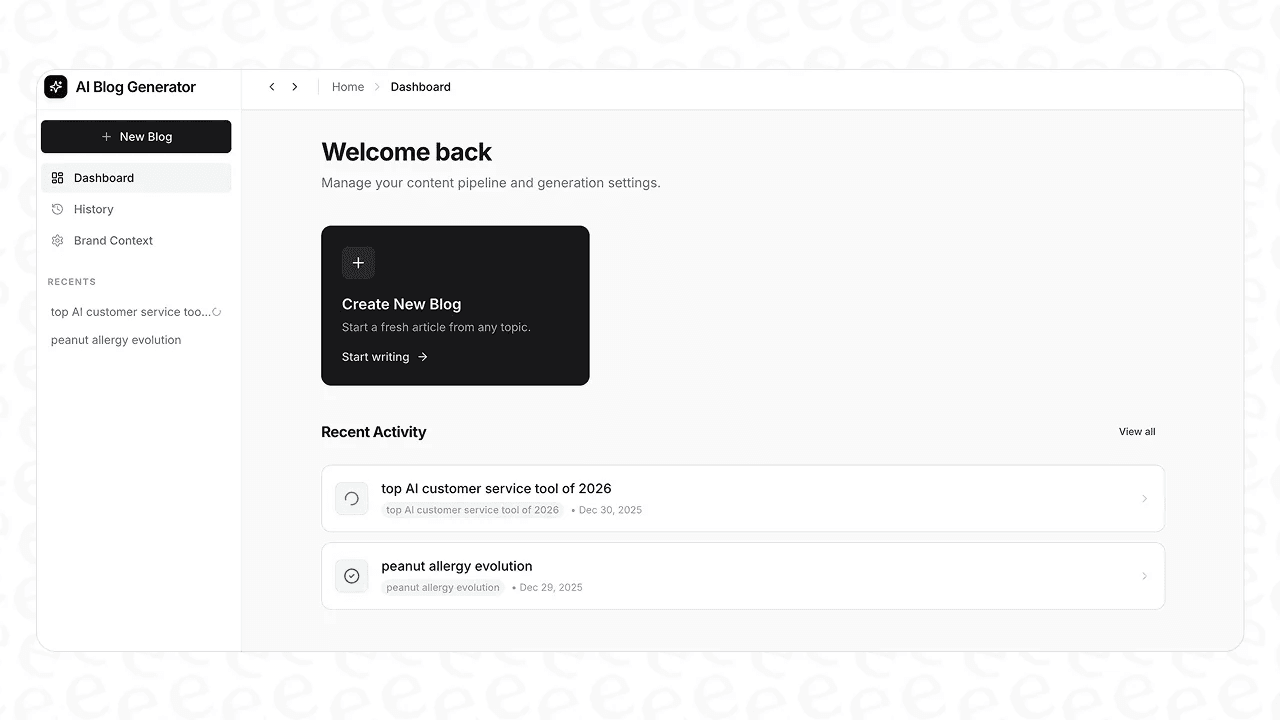
You can use the main keyword from a cluster to generate a full, SEO-optimized blog post. This helps bridge the gap between a keyword spreadsheet and a published article.
Key features include:
- Context-aware research: The tool researches the topic to build a comprehensive article that can naturally include other keywords from your cluster. This helps create in-depth content.
- Automatic asset generation: eesel AI can create and add relevant images, infographics, and tables. It also incorporates social proof by finding quotes from Reddit and embedding relevant YouTube videos to increase engagement.
- Human-first tone: The output is designed to be readable and engaging for human audiences.
- Simple pricing: The tool is free to try. The paid plan is $99 for 50 blog generations per month, offering a scalable solution for content production.
Tools for the keyword clustering phase
These tools are focused on the keyword grouping part of the workflow. They’re great for analysis and planning, after which you would proceed to create the content for each identified cluster.
Semrush
Semrush's Keyword Strategy Builder automates clustering by analyzing SERP overlap. You can provide a list of seed keywords or upload an existing one. The tool then groups terms into topics suitable for pillar pages and subpages, providing metrics like search volume and average keyword difficulty for each cluster.
This feature is available with a Semrush subscription, and the Starter plan at $165.17 per month when billed annually. It provides the data and structure needed for your content plan, with the writing phase as the next step in the workflow.
Keyword Insights
Keyword Insights is a specialized tool for SERP-based clustering and search intent analysis. It uses machine learning to determine the intent behind each keyword, which helps in deciding whether a cluster is best for a blog post or a product page. It also includes a competitor visibility map to identify content gaps.
Plans start at $58 per month for 10,000 credits, with a 7-day trial available for $1. The tool is designed for analysis and can generate content briefs to guide the writing process.
SE Ranking
SE Ranking offers a Keyword Grouper tool that clusters keywords based on SERP similarity. A notable feature is the adjustable grouping accuracy. A "soft" method compares keywords to the highest-volume term in a potential cluster, while a "hard" method compares all keywords to each other for more precise grouping.
The Keyword Grouper is an add-on to a subscription. An Essential plan starts at $65 per month, with an additional cost of $0.004 per query check for clustering. This tool is useful for organizing keywords before content creation.
For a practical guide on how to identify keywords and group them effectively using AI, the following video offers a step-by-step walkthrough of the process.
Final thoughts on keyword clustering
Keyword clustering is an effective approach to SEO. By focusing on topics instead of single keywords, you can create content that aligns with how search engines operate and helps build topical authority. This method allows you to produce more valuable content for your audience while avoiding issues like keyword cannibalization.
As we head into 2026, understanding search intent is central to getting content ranked. Tools like Semrush, Keyword Insights, and SE Ranking are useful for planning your strategy. The final step is turning that plan into published content.
Ready to turn your keyword clusters into articles? Try the eesel AI blog writer for free and generate your first publish-ready article in just a few minutes.

Frequently Asked Questions
Share this article

Article by
Stevia Putri
Stevia Putri is a marketing generalist at eesel AI, where she helps turn powerful AI tools into stories that resonate. She’s driven by curiosity, clarity, and the human side of technology.