In-house blog writer vs freelance: A complete guide to scaling your content

Stevia Putri

Katelin Teen
Last edited January 20, 2026
Expert Verified

Trying to scale content marketing can be a challenge. Consistently producing high-quality blog posts to attract traffic and build a brand often leads to a common debate for marketing leaders: whether to hire an in-house vs freelance writer.
This decision impacts budget, brand voice, and scalability. While the traditional choice is between these two models, another option involves using AI tools to automate parts of the workflow. This guide explores the pros and cons of in-house and freelance writers and examines how tools like the eesel AI blog writer can supplement content strategy.
Defining the roles
Before we get into the details, let's make sure we're on the same page about what these roles actually are. They both write blogs, but how they work is worlds apart.
What is an in-house writer?
An in-house blog writer is a full-time or part-time employee on your company's payroll. They are a dedicated member of your marketing team who lives and breathes your brand every day.
Here’s what that means:
- Deep Integration: They're part of your company culture. They sit in on meetings, chat with the product team, and get the inside jokes. This immersion gives them a level of brand and product knowledge that's tough to beat, leading to a consistent writing voice.
- Total Focus: They work only for you. Their attention isn't divided among five different clients with five different brand guides. This focus translates to direct communication and a real commitment to your content strategy.
- Long-Term Investment: Hiring an in-house writer is about building an asset. You're investing in someone who will grow with the company and become a true subject matter expert over time.
What is a freelance writer?
A freelance writer is an independent contractor. Think of them as self-employed pros you hire on a project-by-project basis to tackle specific writing tasks. They’re like the special ops of the content world.
Key characteristics include:
- Flexible Cost: You pay them per project, per word, or by the hour. No salary, no benefits, no overhead. This financial flexibility is a huge advantage for businesses that don't need a writer on staff full-time.
- On-Demand Talent: Need to crank out a dozen articles for a product launch? You can instantly scale your team by bringing on a few freelancers. When the project is over, you can scale back just as fast.
- Niche Expertise: Freelancers often specialize in certain industries. If you need a technical post about crypto regulations or a detailed article on surgical robotics, there's probably a freelance expert who has already written a hundred of them.

Core differences: A data-driven comparison
Let's look at the real-world impact of choosing one over the other. This isn't just about personal preference; it's about hard numbers and practical realities.
Cost and commitment
This is usually the first question on everyone's mind, and for good reason. The financial difference is pretty stark.
- In-House: Hiring a full-time writer is a big financial step. The average salary for a writer in the US is around $69,510 per year. But that's not the whole story.
- The Hidden Costs: On top of the salary, you have to add benefits (health insurance, retirement), payroll taxes, software licenses, a laptop, and training. These "hidden" costs can easily tack on another $22,000 per year, pushing the true annual cost for one writer over $80,000.
- Freelance: With freelancers, you pay for what you need. There’s no overhead. However, rates can be all over the place.
- The Going Rates: You might find writers for as low as $0.10 per word for simple blog posts, but for specialized B2B or technical content, you could be looking at $1.00 per word or more. A single, well-researched 1,500-word blog post can easily run you between $250 and $800.
- The Management Tax: Don't forget to factor in your team's time. Finding, vetting, onboarding, and managing freelancers takes work. As many managers on forums like Reddit will tell you, that management time is a real cost that you need to account for.
Quality and brand consistency
- In-House: This is where the in-house model really shines. An in-house writer is fully immersed in your company. They know your product inside and out. The result is content that is consistently on-brand, accurate, and in line with your bigger goals.
- Freelance: Quality can be a mixed bag. The best freelancers are fantastic, but they're often juggling multiple clients and can't possibly have the same deep understanding of your brand as a full-time employee. To get consistency, you need incredibly detailed briefs, a solid editing process, and a good feedback loop.
Scalability and flexibility
- In-House: An in-house writer offers stability, but they aren't very flexible. One person can only write so much. If you suddenly need to triple your content output for a big campaign, you can't just magically triple their capacity. Scaling up means a long, expensive hiring process. Scaling down is even tougher.
- Freelance: Flexibility is the freelancer's superpower. It's the ideal model for businesses with project-based needs. You can hire ten freelancers for a month-long content push and then go back to one or two for ongoing work. This on-demand approach gives you amazing agility.
Control and communication
- In-House: You have direct oversight, and communication is easy. Your writer is right there (physically or virtually), ready for quick questions, brainstorming, and last-minute changes. This is a big deal for content that involves sensitive internal information.
- Freelance: Communication needs to be more structured. Since freelancers are juggling multiple clients, they work on their own schedules. You can't just tap them on the shoulder. It takes clear project management, scheduled check-ins, and well-documented feedback to keep everything on track.
| Feature | In-House Blog Writer | Freelance Writer |
|---|---|---|
| Cost Structure | ~$80,000+ annual salary with benefits and overhead | Variable per-project ($250-$800+) or per-word ($0.10-$1.00+) |
| Brand Consistency | High (deep cultural immersion) | Variable (requires strong briefs and management) |
| Scalability | Low (slow to hire or scale down) | High (easy to scale up or down on demand) |
| Management | Direct (part of the internal team) | Indirect (external contractor requiring oversight) |
When to choose an in-house writer
Hiring a full-time writer is the right call when:
- You need consistent brand storytelling. If your brand has a very specific voice and your content depends heavily on internal knowledge, an in-house writer is your best bet. They become the keeper of your brand's story.
- You have a high and steady volume of content. If you plan on publishing multiple articles, case studies, and whitepapers every week, a dedicated in-house writer is often more cost-effective and efficient in the long run than managing a bunch of freelancers.
- Your content needs access to sensitive internal data. When your blog posts require input from your engineering, product, or sales teams, an in-house writer can navigate those internal relationships and get information much more easily than an outsider.
When to choose a freelance writer
Going with freelancers is the smart move when:
- You need specialized, niche expertise. Need an article on the details of quantum computing or a deep dive into InsurTech compliance? It's much easier and cheaper to hire a freelancer who's already an expert than to train a generalist in-house writer.
- Your content needs are project-based or fluctuate. For startups launching a new product or businesses with seasonal campaigns, freelancers give you ultimate flexibility. You can create a burst of content exactly when you need it with no long-term commitment.
- You have a limited budget. If an $80,000+ annual salary is just not in the cards, freelancers can create content professionally. You can start small, with one or two articles a month, and scale up as your budget allows.
A third option: Automating content with the eesel AI blog writer
The in-house vs freelance debate often presents a trade-off between deep brand consistency (in-house) and on-demand scale (freelance). AI-powered tools offer a way to bridge this gap. The eesel AI blog writer, for example, is a tool designed to automate the content workflow. It aims to provide the brand alignment of an in-house writer combined with the speed and scale associated with a freelance model.
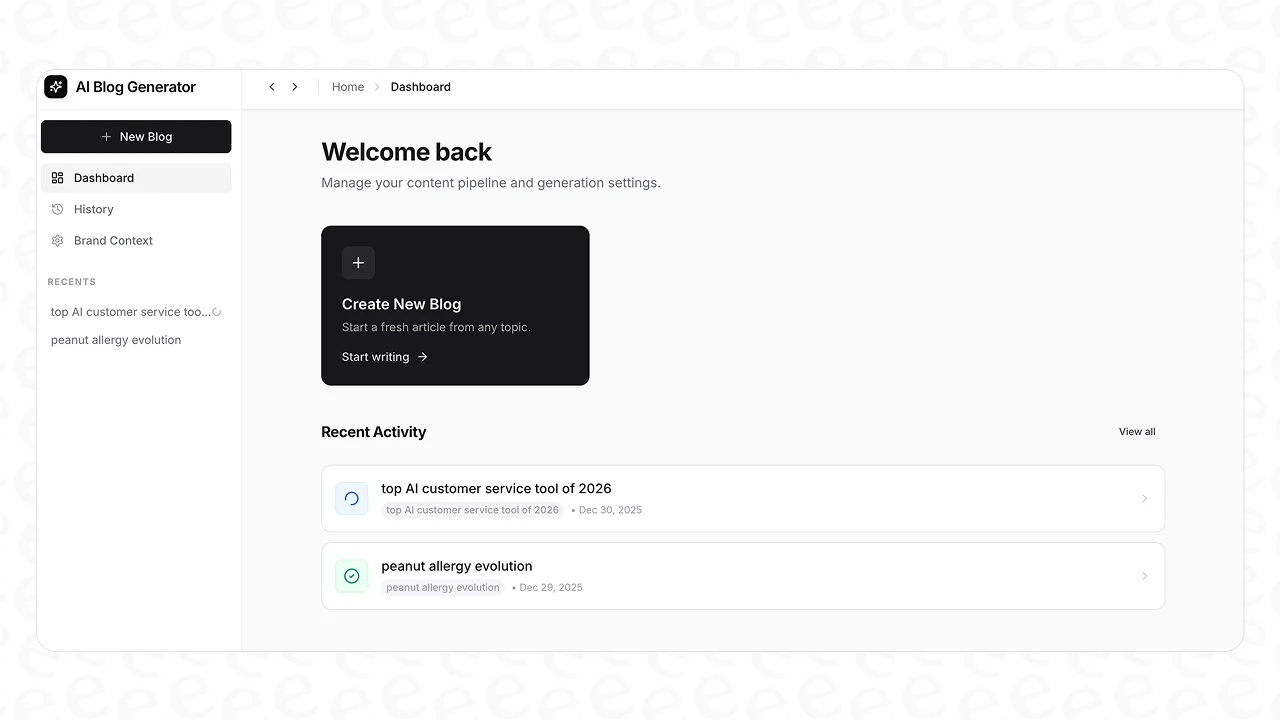
Here’s how it tackles the core challenges we've been discussing:
- Context-aware research: The eesel AI blog writer can learn a brand's voice, messaging, and product details from a website to generate content that aligns with the company's style.
- Publish-ready content: It produces a structured blog post, including headings, subheadings, AI-generated images, data tables, and embedded media like Reddit quotes and YouTube videos.
- SEO and AEO optimization: Articles are structured for search engines and AI Answer Engines like Google AI Overviews and Perplexity.
- Cost-effective scalability: The platform allows for generating content at scale. For example, it offers plans like 50 blog posts for $99, providing a cost-effective way to increase content output.
For example, the eesel AI team used this tool to grow its own blog impressions from 700 to 750,000 per day in three months by publishing over 1,000 optimized posts.
Making the right choice
Ultimately, there is no single right answer in the in-house vs. freelance debate. In-house writers offer brand depth at a high fixed cost, while freelancers provide on-demand expertise and scalability but require more management. The best choice depends on a company's stage, budget, and content goals.
However, the conversation is expanding beyond these two options. New tools are changing content creation workflows. The focus is shifting from who writes the content to how to create effective content efficiently and at scale.
To see this approach in action, you can generate your first article for free with the eesel AI blog writer.
Frequently Asked Questions

Share this post
Article by
Stevia Putri
Stevia Putri is a marketing generalist at eesel AI, where she helps turn powerful AI tools into stories that resonate. She’s driven by curiosity, clarity, and the human side of technology.