How to write shorter blogs that still rank and engage

Stevia Putri
Last edited January 20, 2026
You’ve probably heard the advice: "If you want to rank on Google, write long-form content." It’s the kind of tip that makes you feel like you need to cancel your weekend and chain yourself to a keyboard. The pressure is on, especially when you learn the average blog post now takes nearly 3.5 hours to write.
But here's the problem with that thinking. Chasing a high word count often leads writers to add "fluff." We pad intros, repeat ourselves, and toss in details that don't add much, all to hit some magic number. The result? A watered-down message that makes readers hit the back button.
The real secret to ranking isn't length, it's value density. A sharp, focused blog post that gets straight to the point will almost always beat a long, rambling one because it solves the reader's problem faster. It’s about quality, not just quantity.
Does blog post length matter for SEO?
Let's get into this whole word count thing. It’s a classic mix-up of correlation and causation, and knowing the difference is what will help you create content that actually connects with people.
What the data says about long-form content
To be fair, there's a reason "longer is better" became such a popular piece of advice. On the surface, the data seems to support it. Studies from places like Orbit Media consistently show that bloggers who write longer posts (2,000+ words) report getting better results. Another study found that long-form content (3,000+ words) can generate more backlinks and leads.
There are some good reasons for this. Longer content gives you more room for keywords, internal links, and deep explanations. A comprehensive post can signal to both readers and search engines that you know your stuff.
Why word count is not a direct ranking factor
But here’s the most important part: while there's a connection, Google doesn't actually care how many words are on your page. Their own people have been very clear about this. John Mueller, a Search Advocate at Google, said it plainly: "Word count is not a ranking factor."
So, what does Google look for? Helpful, high-quality content that gives the user what they were searching for. They look for signs of E-E-A-T (Experience, Expertise, Authoritativeness, and Trust). A 500-word article that perfectly answers a question is always going to be better than a 2,000-word post that hides the answer in a sea of text.
Sometimes that takes a lot of words, but many times, it doesn't. Your focus should always be on topical coverage, not just word count.Content needs to be long enough to cover the topic, answer the question, or fulfill the intent of the search. If that’s 500 words, then it’s 500 words. If it’s 2000 words, it’s 2000 words.

When to go short vs. when to go long
Here’s a simple way to break it down:
| Feature | Short-Form Blog (Under 1,000 words) | Long-Form Blog (Over 1,500 words) |
|---|---|---|
| Best For | Quick answers, news, announcements, specific tips | In-depth guides, pillar content, complex topics |
| Goal | Address a single, narrow user intent quickly | Establish topical authority, cover a subject exhaustively |
| Reader Expectation | Fast, scannable, immediately actionable information | A comprehensive resource for learning and research |
| SEO Strategy | Target long-tail keywords, featured snippets | Target broad, competitive keywords |
Strategic planning for concise content
The trick to writing concise content that still makes an impact starts long before you type a single word. It’s all in the planning.
Start with a single, clear objective
Every blog post should have one, and only one, main goal. Before you start writing, ask yourself: "What is the one thing I want the reader to know or do after they finish this post?"
Having a clear objective is your best defense against fluff. It’s your North Star, keeping you from wandering off-topic or adding information that doesn't serve the main point. If a section doesn't directly support that one goal, it probably needs to be cut.
Satisfy user intent, not just target keywords
It’s easy to get obsessed with keywords, but what’s more important is understanding the intent behind them. What is the person searching for really trying to do? Are they looking for a quick definition ("what is value density?") or a step-by-step guide ("how to write shorter blogs?")?
Answering the right question is the fastest way to deliver value.
Pro tip
A great way to figure out user intent is to check Google's 'People Also Ask' section for your target keyword. This gives you a direct look into the specific questions people are trying to answer, helping you focus your content on what they actually need.
Create a focused outline
An outline is your best friend when it comes to writing concisely. It’s the blueprint that makes sure your post is logical, focused, and free of tangents.
Before you write, map out your H2s and H3s. Then, look at it with a critical eye. Does every section directly contribute to your main objective? If you find yourself adding sections just for the sake of it, it's time to cut them.
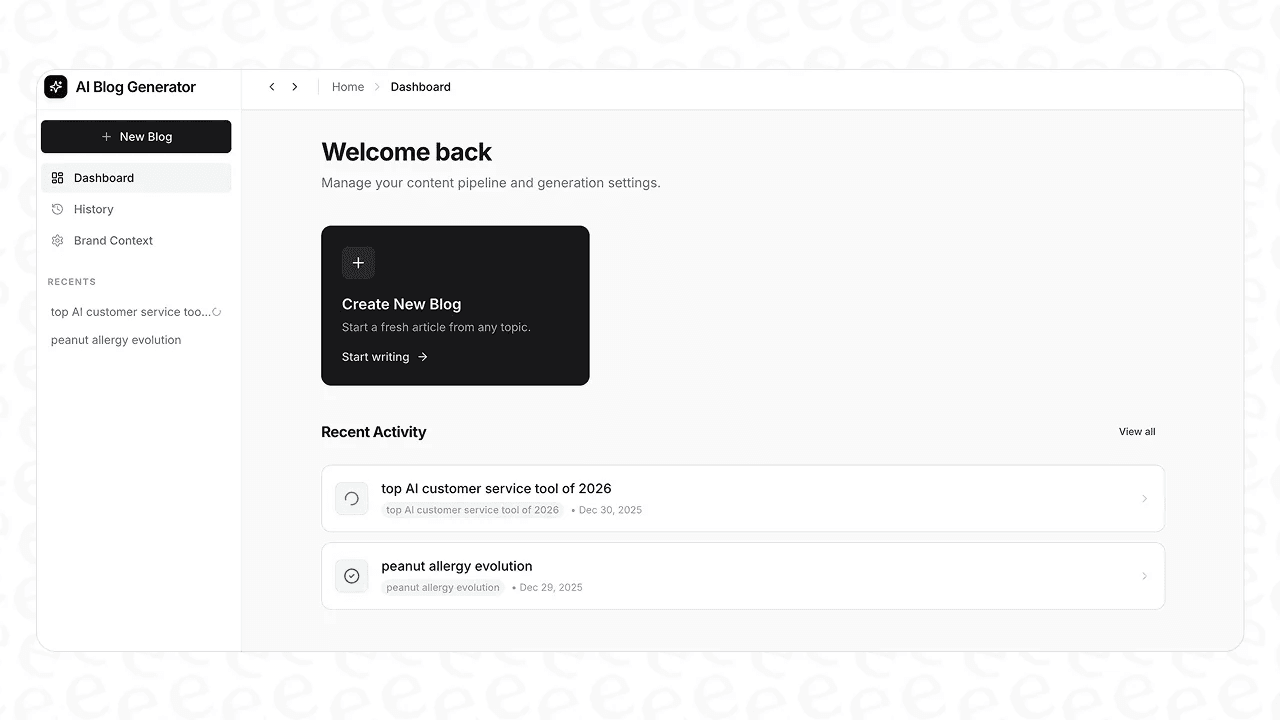
This is where modern tools can really help. Instead of staring at a blank page, you can use something like the eesel AI blog writer to generate a complete, structured draft from just a keyword. It gives you a solid outline from the start, so you can spend your time refining the message instead of building the structure from the ground up.
Practical techniques for concise writing
Once you have a solid plan, it's time to write. But the work isn't over. The editing process is where you really sharpen your content and make every word count.
Write first, then edit for clarity
The key to efficient writing is to separate the creative and analytical parts of your brain. Get your first draft down on paper without stopping to edit. Just let the ideas flow.
- Cut weak intros: Ditch phrases like "In this article, we are going to..." or "Today, I want to talk about..." and just get to the point.
- Eliminate redundancy: If you've already made a point, you don't need to say it again in three different ways. Trust your reader to understand it the first time.
- Use simple language: Swap complex words for simpler ones and break up long, winding sentences. Clear communication is always more effective than trying to sound smart.
- Apply the "Need It or Skip It" Test: Read every single sentence and ask, "Does my reader absolutely need this to understand the main point?" If the answer is no, hit delete.
Use visuals and formatting to increase value density
Value doesn't just come from text. A well-chosen image, a clear table, or a helpful infographic can often explain a complex idea much better than a few paragraphs of text.
The data backs this up. According to Orbit Media, bloggers who include 7 or more images in their posts are 2.3 times more likely to report strong results.
Using visuals is a great way to make shorter content feel richer and more substantial. You're delivering the same amount of value (or more) in a more engaging, scannable format that respects your reader's time.
Writing shorter blogs faster with the eesel AI blog writer
Creating concise, value-packed content consistently is tough. You have to do the research, structure your thoughts, write clearly, and then edit ruthlessly. This is where an AI content generation platform can completely change your workflow.
Move from a blank page to a complete draft in minutes
The hardest part of writing is often just getting started. The eesel AI blog writer gets rid of that friction. It’s the exact tool we used here at eesel to grow our blog from 700 to 750,000 impressions a day in just 3 months.
Generate value-adding assets automatically
eesel AI doesn't just write text; it builds a complete, media-rich blog post. It automatically includes relevant assets like AI-generated images, infographics, and data tables that help explain your points visually.
For a deeper dive into how content length impacts SEO and how to determine the right length for your posts, check out this helpful video from Elna at Twins Mommy.
It even pulls in real, relevant Reddit quotes and YouTube videos to add social proof and different perspectives to your content, all without you having to do a thing. This is a huge time-saver and an easy way to boost the value of your posts without adding to the word count.
Refine and shorten your content with AI editing
Once you have your draft, eesel AI helps you polish it. You can highlight any section of the text and use simple commands to refine it. Ask it to "make this more concise," "simplify the language," or "rewrite this in a more casual tone."
It’s the perfect tool for applying that "all killer, no filler" mindset. You can quickly tighten up your writing, cut out the fluff, and make sure every word on the page is working for you.
Quality over quantity
Let's put the "longer is better" myth to bed. Writing shorter blogs isn't about cutting corners; it's a strategic choice to respect your reader's time and deliver as much value as efficiently as possible.
At the end of the day, Google rewards content that solves a problem and satisfies what the user was looking for, no matter how many words it takes. By adopting a focused strategy and using the right tools, you can create powerful, concise content that ranks well and serves your audience. If you want to generate high-quality, concise content more efficiently, consider trying the eesel AI blog writer for free.

Frequently Asked Questions
Share this article

Article by
Stevia Putri
Stevia Putri is a marketing generalist at eesel AI, where she helps turn powerful AI tools into stories that resonate. She’s driven by curiosity, clarity, and the human side of technology.