A practical guide on how to write faster blogs

Stevia Putri
Last edited January 20, 2026
The pressure on content marketers to constantly publish is no joke. You need a steady stream of high-quality, engaging content, but good writing just takes time. It often feels like a choice between burning out or pushing out rushed, sloppy articles that nobody reads. And if your content does not rank or convert, what is the point?
The secret to writing faster is not about typing speed. It is about having a better process for preparation, drafting, and using the right tech.
Master the preparation phase to write blogs faster
Create a document for all your ideas
You know that feeling of staring at a blinking cursor on a blank page? It is awful. The trick is to separate the act of coming up with ideas from the act of writing.
Keep a running list of topics, angles, and random thoughts in a simple tool you always have open, like Google Docs or Notion. Whenever inspiration strikes, for example, in a meeting, on a walk, or while reading another article, just jot it down. This way, when it is time to write, you are not trying to invent a topic from scratch. You can just pick one from your list and start outlining.
Build a solid outline before writing
An outline is your article's roadmap. It keeps you from wandering off on tangents and makes sure the flow is logical, which is great for both readers and search engines.
Start by mapping out your H2 and H3 subheadings. A great tip is to look at Google's "People Also Ask" section for your target keyword. These are questions your audience is actively asking, so structuring your article around them is a smart way to deliver value. This approach breaks the huge task of "writing a blog post" into small, manageable chunks, letting you focus on one section at a time.
IMO opinion, AI is like most tools. Garbage in, garbage out. You can’t throw a Kw at it and expect a week written article. You still need to research proper KWs. You need to study the SERPs. You still need to perfect a great outline. Once all that is done, AI is a crutch, it can assist you. Stuck in your outline, but have a general idea what you want to write. Throw it into AI. Maybe you like the results, maybe you don’t. But it will usually prompt you. Just my two cents.

Gather all your research and references first
Nothing kills your writing flow like having to stop every few minutes to look up a statistic or find a source link.
Before you start drafting, gather all your research and references first. Paste them directly into your outline under the relevant sections. When you sit down to write, everything you need is right there. No more getting lost in a mess of browser tabs.
Accelerate your drafting process
Separate writing from editing
This is probably the biggest mistake that slows writers down. Trying to write and edit at the same time is like driving with one foot on the gas and one on the brake. It uses two different parts of your brain and leads to a frustrating, stop-and-start process.
Give yourself permission to write a messy first draft. Seriously. Do not worry about typos, clunky sentences, or awkward phrasing. Just get the ideas out of your head and onto the page. You will silence your inner critic, stay in your creative flow, and have a complete draft to work with much faster.
My two cents is yes. I use Active Inspiration (A.I.) software to 'break me out' of the blank page freeze. The issue is when the content is 70% AI or more. AI should really be used as an Assistive Interface for writing great content, not producing mechanical bastardized word slop by running and rerunning paragraphs through GPT-3. So, yes get it, but only if you are going to use it correctly. Otherwise, it's a waste of your money and Google will make you regret it.
Use placeholders for missing information
Ever get stuck because you cannot remember a specific number or think of the perfect word? Do not let it throw you off track.
Instead of stopping, just drop in a simple placeholder like [find stat about X] or [better word for Y] and keep going. You can easily find and fill these in during the editing phase later. This simple trick protects your focus and helps you get to the end of the draft without getting bogged down by tiny details.
Consider unconventional drafting methods
If you find yourself just staring at the screen, remember that typing is not the only way to get a draft done. For many people, talking is much faster and more natural than writing.
Try using the built-in voice typing feature in Google Docs. Just start speaking your ideas as if you were explaining them to a friend. You can generate a lot of text in a short amount of time, and it often comes out with a more natural, conversational tone. It might feel a bit weird at first, but it can be a great way to break through writer's block.
Write faster blogs with full-cycle AI automation
From manual steps to a one-click workflow
Think about the typical blogging process. You manually research the SERPs, build an outline, write a draft, search for stock photos, create custom graphics, find a relevant video, and then spend forever optimizing it all for SEO. It is a marathon that can easily take hours, if not days.
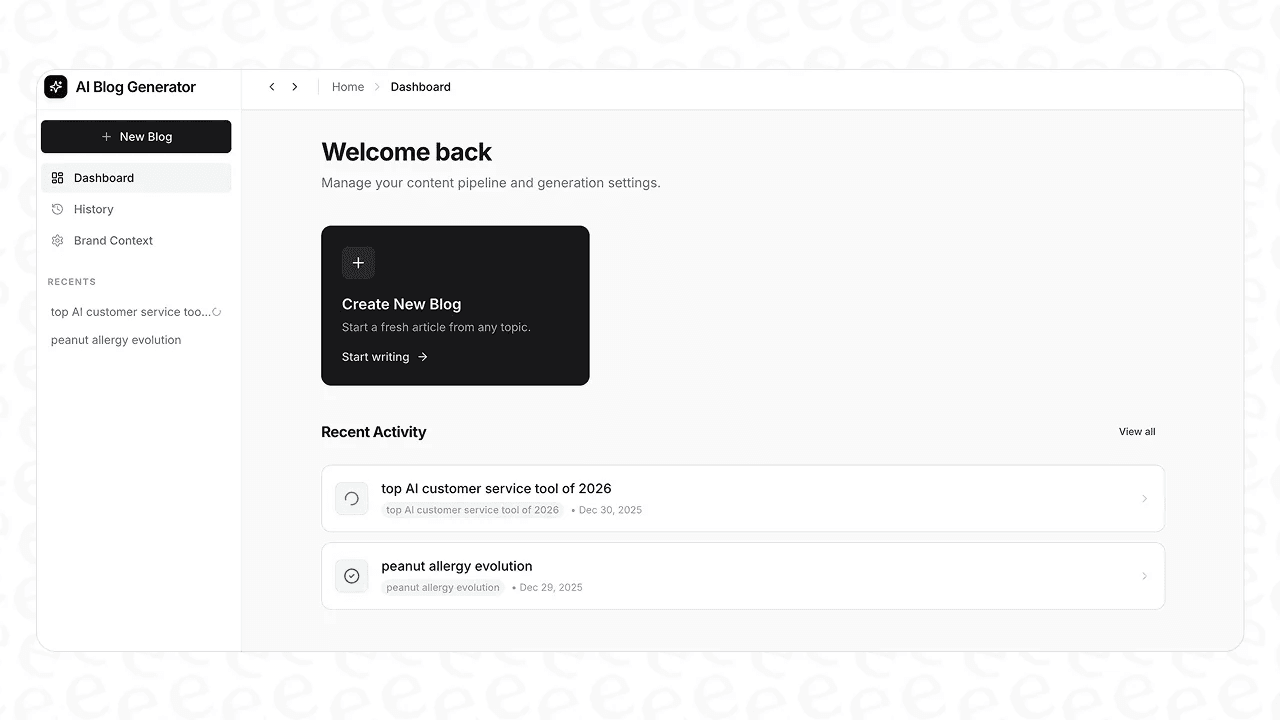
Now, imagine a different approach. With the eesel AI blog writer, you can combine all those steps into a single click. You give it a keyword, and it gives you back a complete, publish-ready post in minutes.
Go beyond text with automatic asset generation
This is where AI automation can be particularly effective. The eesel AI blog writer does not just write; it builds a complete content experience. It automatically includes AI-generated images, custom infographics, and data tables. It even embeds relevant YouTube videos and real Reddit quotes, adding valuable social proof and context to your articles. This saves you hours of searching for media and lets you publish a rich, engaging article right away.
Automate research and SEO with context-aware AI
Even the most efficient writers can get bogged down by research and SEO. Making sure your content is accurate, well-supported, and optimized to rank is a critical part of the job.
An advanced AI platform can handle this for you. eesel AI’s context-aware research automatically pulls the right information based on the blog type. Writing a comparison post? It will fetch pricing data. A product review? It will find the technical specs. Beyond that, it handles SEO fundamentals like keyword placement in headings and meta data, and it is even optimized for AI Answer Engines (AEO). This ensures your content is ready to perform well in new search formats like Google's AI Overviews, connecting your writing speed directly to business results.
While AI automation offers a complete workflow overhaul, sometimes seeing these speed-writing principles in action can provide that extra spark of inspiration. For a more hands-on look at how experts structure their writing process to maximize speed without sacrificing quality, this video from Neil Patel offers some excellent hacks.
A new workflow for writing faster blogs
What is the main takeaway? Writing faster is about using a smart process that separates preparation, drafting, and editing. Get your ideas, outline, and research sorted out first so you can fly through the first draft without getting sidetracked.
A significant change in workflow comes from using AI. These tools are not here to replace writers. They are here to boost our abilities by handling the repetitive, time-consuming tasks. This frees you up to focus on what humans do best: high-level strategy, creating unique insights, and promoting your content.
The best way to get your head around this shift is to see it for yourself. Watching an entire blog post, complete with images, videos, and SEO, come to life in minutes is a real eye-opener.
Ready to stop spending days on a single blog post? Generate your first complete blog for free with the eesel AI blog writer.

Frequently Asked Questions
Share this article

Article by
Stevia Putri
Stevia Putri is a marketing generalist at eesel AI, where she helps turn powerful AI tools into stories that resonate. She’s driven by curiosity, clarity, and the human side of technology.
