How to manage content workflows: A practical guide

Stevia Putri

Katelin Teen
Last edited January 15, 2026
Ever feel like your content creation process is held together with duct tape and a prayer? You're definitely not alone. We've all been there: the missed deadlines, the never-ending email chains for feedback, and the quality that swings wildly from one blog post to the next. It's a frustrating cycle, and for many teams, it's just the default way of doing things. But it doesn't have to be.
The fix is a solid content workflow. It’s what transforms that chaotic scramble into a predictable, scalable system for pumping out great content, time after time. And that's a bigger deal than ever. With AI answer engines on the rise, search volume is predicted to drop 25% by 2026. That means only the best, most well-structured content is going to cut through the noise.
This is something we got a little obsessed with at eesel. We needed to scale our content, but we couldn't let chaos take over. So, we used our own AI platform to streamline everything. The results were pretty wild. We went from 700 to over 750,000 daily impressions in just three months.
In this guide, we’ll walk you through everything you need to build a workflow that actually works. We’ll cover the core pieces, how to overcome the bottlenecks that are probably slowing you down, and how new tools can automate the heavy lifting for you.
What is a content workflow?
This isn't just for huge enterprise teams with dozens of writers. A documented workflow is critical for teams of any size because it delivers four key things: consistency in your brand voice, efficiency by cutting out the "what's next?" guesswork, scalability to produce more content without more chaos, and clear accountability so everyone knows who is responsible for what.
The three essential components of a content workflow
People: Defining clear roles and responsibilities
You can have the best process in the world, but if no one knows who’s supposed to do what, tasks will inevitably fall through the cracks. Clear ownership is a must. Even on a small team, everyone needs to understand their part in the process.
Here are the common roles you’ll find in a content team:
- Content Strategist: The architect. They plan the editorial calendar, dig into keyword research, and define the goals for each piece of content. They answer the "why" behind what you create.
- Writer/Creator: The builder. This is the person doing the research, writing the drafts, and producing the primary content.
- Editor/Proofreader: The quality inspector. They’re checking for accuracy, clarity, grammar, and making sure everything aligns with the brand voice and style guide.
- Designer: The visual expert. They create the graphics, charts, and infographics that bring the content to life and make it more engaging.
- SEO Specialist: The optimizer. They ensure the content is structured to rank well in search engines and, increasingly, for AI answer engines like Google’s AI Overview.
- Project Manager: The conductor. This person oversees the entire workflow from start to finish, keeping everything on track and making sure deadlines are met.
Before anyone even starts, we always make sure they know *exactly* what they're accountable for at each stage of the project. Writers do the research and drafting, editors fact-check, etc. It's helped lessen delays (so far)

On smaller teams, it’s super common for one person to wear multiple hats (hello, writer-editor-SEO-specialist!). That’s totally fine, but it makes having a documented process even more critical so nothing gets missed when you’re switching between roles.
Process: Mapping the stages of content production
- Ideation & Planning: This is where it all begins. It involves brainstorming topics, doing keyword research to see what people are actually searching for, and creating detailed content briefs. A good brief is a writer's best friend, outlining the topic, target audience, keywords, and angle.
- Creation: The core production phase. This is when the writer gets to writing, the designer starts creating visuals, or the video team starts recording.
- Review & Editing: The first pass for quality control. An editor reviews the draft for substance, style, and grammar. This is where you make sure the piece is actually good, not just grammatically correct.
- Approval: The final sign-off. Key stakeholders (like a department head or legal team) give the content the green light before it goes live.
- Publishing: Time to go live. This involves uploading to your CMS, doing final SEO checks, and hitting that publish button.
- Promotion: The work isn't done once it's published. This stage involves distributing the content across your channels, whether that’s social media, email newsletters, or outreach.
To manage all this, teams usually use one of two models. A task-based workflow is like a strict checklist where each step must be completed before the next one starts, which is great for complex projects. A status-based workflow is more flexible, where content moves through broader stages like "In Progress" or "In Review." This works well for more agile teams that are used to working together.
Tools: Choosing the technology that powers your process
Your tools are what make the process run smoothly. They’re the technology that supports your people and process. The main categories you’ll need are project management software to track everything, collaboration tools for communication, and a new, powerful category: AI platforms that can automate content generation, saving you a massive amount of time.
Common workflow bottlenecks and how to solve them
Even with the best intentions, workflows can get stuck. Let's talk about the most common bottlenecks that derail content production and how to solve them.
The endless review and approval loop
The Problem: You’ve seen it before. A piece of content gets passed around for feedback and gets stuck in limbo for weeks. Too many people are weighing in with vague comments like "this needs more punch" or "I just don't like it," and publication gets delayed indefinitely.
Biggest improvement for us was ditching scattered google docs and spreadsheets and moving to a system where feedback is left directly on specific parts of the content. It cut our review cycles in half and made collaboration way less painful.
The Fix:
- Limit your reviewers. You don't need the entire company to sign off on a blog post. Limit reviewers to only the essential people, like one editor for quality and one final stakeholder for approval.
- Set firm deadlines for feedback. Use your project management tool to give reviewers a clear deadline (like 48 hours). If they miss it, the content moves on without them.
- Demand actionable comments. Coach your team to provide specific, constructive feedback. Instead of "I don't like it," ask for comments like, "This section needs a customer example to make the point clearer."
Inconsistent quality and off-brand messaging
The Problem: You have multiple writers, and every article sounds like it was written by a different company. The tone is all over the place, the formatting is inconsistent, and the overall quality is a mixed bag.
The Fix:
- Create a detailed content style guide. This is your brand’s content bible. It should define your tone of voice, grammar rules, formatting preferences, and anything else that makes your content uniquely yours.
- Use standardized content briefs. Don’t leave things up to interpretation. Create a detailed brief template for every single assignment. This ensures every writer starts with the same clear instructions and goals.
Manual, time-consuming content generation
The Problem: Your writers are spending a huge chunk of their time on things that aren't actually writing. They're bogged down with manual research, hunting for statistics, sourcing quotes, and trying to find or create visuals. The actual writing becomes a fraction of their work, which slows the entire workflow to a crawl.
The Fix: This is the biggest bottleneck of all, and it requires a modern solution. You need to adopt a full-cycle automation platform that handles the research, drafting, and asset creation in one single step. This is where AI can completely transform your process.
Automating your workflow with a full-cycle platform
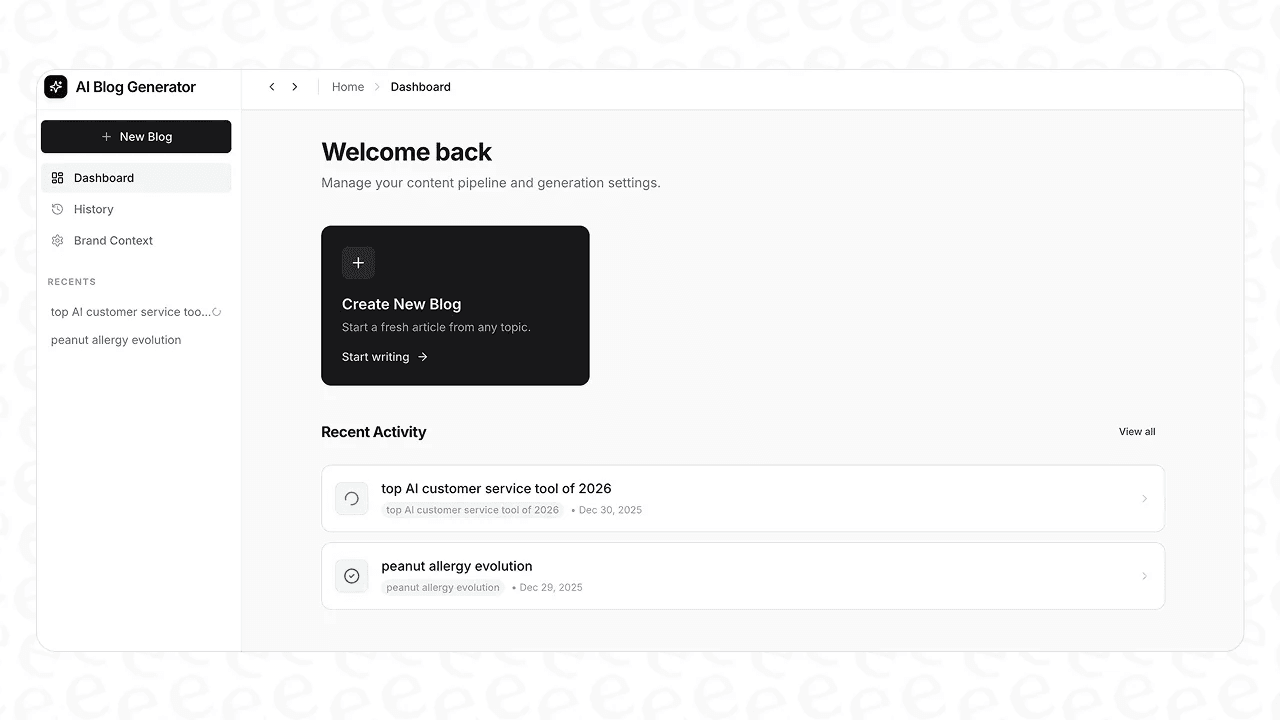
- Context-Aware Research: Instead of you spending hours digging for data, the AI automatically pulls relevant information based on search intent. If you're writing a comparison post, it finds pricing data. For a product review, it finds the technical specs. It even adds external citations and internal links, which strengthens your content's authority and SEO.
- Automatic Asset Generation: The hunt for visuals is over. The platform creates AI-generated images, infographics, and tables directly within the blog post. This solves the design bottleneck and ensures every post is visually engaging without needing a designer’s input for every draft.
- Authentic Social Proof: Generic AI content often feels flat because it lacks a human touch. The eesel AI blog writer solves this by finding and embedding real quotes from Reddit and relevant YouTube videos. This adds a layer of credibility and authenticity that you just can't get from a standard AI writer.
- Built for Modern Search: It doesn't just write for old-school SEO. It produces a fully structured article that’s optimized for both traditional search and the emerging world of AEO (Answer Engine Optimization). This means your content is ready to be featured in AI-powered search results, future-proofing your strategy.
It is completely free to try. You can generate a full post and see the quality for yourself without any commitment, making it easy to test how it could fit into your existing process.
Choosing the right tools for your workflow
While a powerful AI generator can handle the heaviest lift (the creation), you'll still need a few other tools to manage the end-to-end process. Think of your AI writer as the engine and these other tools as the chassis that holds everything together.
Here’s a look at a simple, well-rounded content stack:
| Tool Category | Purpose | Examples |
|---|---|---|
| AI Content Generation | Generating a complete, publish-ready blog post from a single keyword. | eesel AI blog writer |
| Project Management | Tracking tasks, deadlines, and progress across the team. | Asana, Trello, Notion |
| Collaboration | Real-time communication and document sharing for reviews. | Slack, Google Docs |
| SEO & Research | Keyword research and competitive performance analysis. | Ahrefs, SEMrush |
By combining the eesel AI blog writer with a solid project management tool and a way to collaborate, you create a powerful, streamlined system that covers all your bases.
For a more visual guide on setting up your process, the video below provides a step-by-step walkthrough of building a content workflow from scratch, covering the key habits and tools needed for success.
From chaos to a well-oiled content machine
Building an effective content workflow doesn't have to be complicated. It all comes down to having clear roles for your people, a documented process for them to follow, and the right technology to support them.
By tackling the most common bottlenecks head-on, especially the massive time sink of manual content creation, you can transform a chaotic, stressful process into a streamlined and scalable operation. You’ll be able to produce more high-quality content, meet your deadlines consistently, and finally get ahead.
Ready to build a workflow that actually scales? Start by automating the heaviest lift. Generate your first complete blog post for free with the eesel AI blog writer and see your process transform.

Frequently Asked Questions
Share this article

Article by
Stevia Putri
Stevia Putri is a marketing generalist at eesel AI, where she helps turn powerful AI tools into stories that resonate. She’s driven by curiosity, clarity, and the human side of technology.
