

Knowing what keywords your site currently ranks for is a huge piece of any good SEO strategy. It’s like having a map that shows you exactly where you’re winning and where you could be doing better. Without this data, creating content can feel like you're just guessing: you’re putting in the work, but you can’t be sure you’re connecting with the right audience.
This guide will walk you through three main methods for uncovering your keyword rankings, from quick manual checks to the powerful data you can get from SEO platforms.
And once you have that information? That’s when you can really start making moves. We’ll also cover how you can act on that data, turning opportunities into content that climbs the ranks. That’s where a tool like the eesel AI blog writer can help, closing the gap between knowing what to do and actually getting it done.
What is a keyword ranking and why does it matter?
Let's start with the basics. A "keyword ranking" is simply your website's position on a search engine results page (SERP) for a specific search query. If someone searches "best coffee grinders" and your blog post shows up as the third result, your ranking for that keyword is #3.
It sounds simple, but rankings are always changing. They can shift daily (or even hourly) because of Google's algorithm updates, new content from competitors, and changes in what people are searching for.
I’ve been frustrated with the daily grind of checking where my site ranks for certain keywords. Doing it manually takes forever, and most paid tools feel like overkill (or too pricey for small projects).
Plus, today's SERP is more than just a list of ten blue links. You're competing with AI Overviews, "People Also Ask" boxes, video carousels, and image packs. As a Search Engine Journal analysis notes, the rise of AI Overviews means a single page can appear in multiple spots on the same results page, which makes the idea of a single "position" a lot more complicated.
Even with all this complexity, the goal is the same: rank on the first page, and as close to the top as you can. The higher you are, the more clicks you get.
Why you need to know which keywords your site ranks for
Tracking your keyword rankings isn't just for bragging rights. It gives you real, useful data that can shape your marketing strategy and lead to actual growth.
Measure the impact of your SEO efforts
How do you know if all the time you spend creating content, optimizing pages, and building links is actually working? Your keyword rankings are the most direct report card you can get. When you see your position for a target keyword climb from page three to page one, you can connect that improvement to a bump in organic traffic and, eventually, more conversions.
Understand your audience and search intent
The keywords you rank for offer a direct look into your audience's mind. They show you what people are actually searching for when they find you. Sometimes, you’ll discover you’re ranking for terms you never even planned to target. These happy accidents are goldmines, revealing new content opportunities and helping you align your strategy with what your users really need.
Conduct more effective competitor analysis
You might think you know who your competitors are, but your organic search competitors can be a different group entirely. Knowing your rankings helps you identify the specific sites that are competing with you on a certain topic. You can then analyze their top-ranking pages to get a clear roadmap of what it takes to rank higher, such as what kind of content they're creating, what questions they're answering, and how they’re structuring their articles.
Find and optimize "striking distance" keywords
This is one of the biggest low-hanging fruit opportunities in SEO. "Striking distance" keywords are terms where you're already ranking, but you're stuck at the bottom of page one or somewhere on page two. You're so close to getting a lot more traffic. These pages often don't need a complete rewrite. A simple content refresh, a few on-page SEO tweaks, or adding some internal links can be enough to push them onto the first page and bring in a lot more traffic.
How to find out what keywords your site ranks for: Three core methods
Alright, let's get into the practical side of things. Here are three methods to uncover your keyword rankings, starting with the simplest and moving up to the most powerful.
Method 1: Manual checking in incognito mode
This is the quick-and-dirty method. It’s as simple as it sounds: you open a private or incognito browser window and manually type your target keywords into Google to see where your site shows up.
How to do it:
- Open a new Incognito window in Chrome (or a Private window in Safari/Firefox).
- Go to google.com.
- Type in a keyword you think you should be ranking for.
- Scroll through the results to find your website.
Limitations:
- Time-consuming: This is fine for checking one or two keywords, but it’s not practical for tracking dozens or hundreds of terms.
- Inaccurate: Even in incognito mode, your results can still be influenced by your location and past search history. The ranking you see might not be what everyone else sees.
- Lacks historical data: You can't see how your rankings have changed over time. Was this page always at position #8, or did it just drop from #2? You have no way of knowing.
Method 2: Using Google Search Console for foundational data
If you’re serious about SEO, you need to be using Google Search Console (GSC). It’s a completely free tool from Google that gives you a direct look at how your site is performing in search, using their own data.
How to use it:
Once your site is verified, head to the "Performance" report and then click on "Search results." You’ll see four key metrics: Clicks, Impressions, Average CTR, and Average position. To see your keywords, just look at the "Queries" tab below the graph. This will give you a list of all the search terms your site has appeared for.
Key limitations to be aware of:
- "Average" position can be misleading: That "Average position" metric isn't as simple as it seems. It’s an average across every single time your site appeared for a query. Your page might rank #4 in the main results but also show up in an image pack at position #20, leading to a weird, skewed average that doesn’t reflect your true visibility.
Best move is to pair GSC API averages with a cheap SERP API and pipe it into a Google Sheet on a daily trigger... GSC API fills the gaps (trend and queries you missed), but remember it’s delayed and an average.
 Reddit
 - Data limits: GSC only keeps performance data for the last 16 months. More importantly, the interface and any data exports are capped at 1,000 rows. For larger sites with thousands of ranking keywords, this means you're only seeing a small part of the picture.
- Data delay: The data in GSC is usually a day or two behind, so you can’t use it for real-time monitoring after an algorithm update or a big content push.
Method 3: Leveraging paid SEO platforms for precise tracking
For the most accurate, detailed, and actionable data, you’ll want to invest in a paid SEO tool. Platforms like Semrush and Ahrefs go far beyond GSC, offering precise rank tracking, deep competitive analysis, and years of historical data.
yes! tools like SEMrush, Ahrefs, or Google Search Console can help you track and analyze your keyword rankings over time with comparing month-by-month results....
Tool Spotlights:
- Semrush: Often seen as an all-in-one marketing platform, Semrush’s Position Tracking tool is a powerful feature. It provides daily updates on your keyword rankings, letting you react quickly to changes. It can also track your keywords across different search engines, including Google, Bing, and even ChatGPT Search. Pricing for their Pro plan, which lets you track up to 500 keywords, starts at $139.95 per month.
A screenshot of the Semrush homepage, which helps answer how I find out what keywords my site ranks for. - Ahrefs: Known for its top-notch backlink data, Ahrefs also offers a robust Rank Tracker. It monitors your keywords across more than 190 locations and can track your position within 19 different SERP features (like featured snippets and "People Also Ask" boxes). A key difference is that its default update frequency on the Lite (($129/mo)) and Standard plans is weekly; daily updates are available as a paid add-on. They recently introduced a more accessible Starter plan at $29/month that lets you track up to 40 keywords.
A screenshot of the Ahrefs homepage, which helps answer how I find out what keywords my site ranks for.
Here's a quick breakdown of how the three methods stack up:
| Feature | Manual Check | Google Search Console | Paid Tools (Semrush/Ahrefs) |
|---|---|---|---|
| Cost | Free | Free | Ahrefs starts at $29/mo; Semrush starts at $139.95/mo |
| Accuracy | Low (affected by location) | Medium (average positions, skewed by SERP features) | High (real-time, location-specific snapshots) |
| Update Frequency | Manual | Delayed by 1-2 days | Semrush: Daily; Ahrefs: Weekly (default) |
| Historical Data | None | Up to 16 months | Extensive (years of data available) |
| Competitor Tracking | Manual | No | Yes (advanced features) |
Turning insights into content with the eesel AI blog writer
Here's the deal: data is useless if you don't act on it. Finding out you rank #12 for a high-value keyword is a great insight. But it's just an insight. You still have to do the work of updating that old post or creating a new, better piece of content to claim a top spot. For many teams, this is the biggest bottleneck.
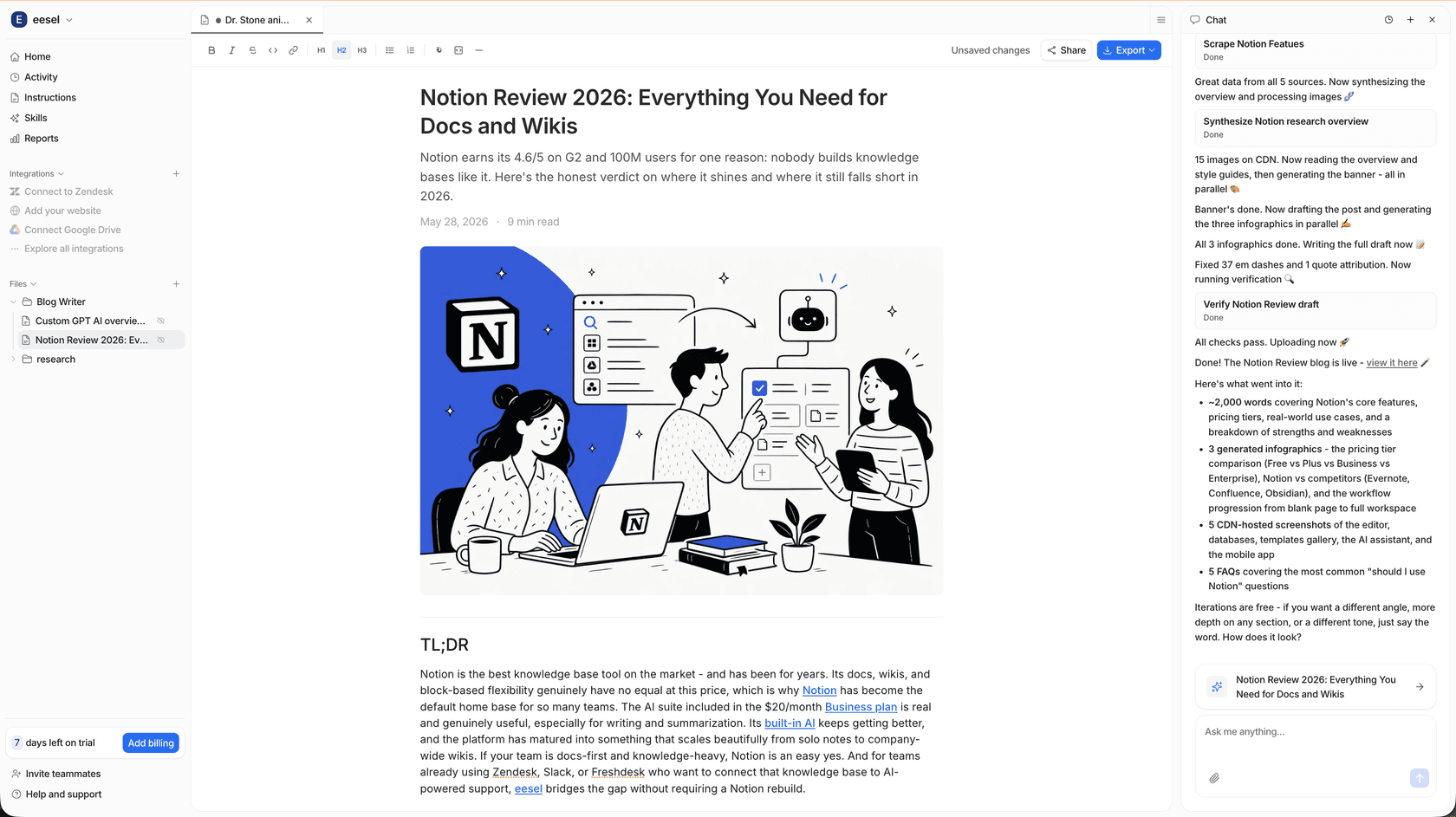
Here’s how it works. You take one of those "striking distance" keywords you found in GSC or Semrush and pop it into the eesel AI platform. Instead of giving you a rough text draft that you have to spend hours editing, it generates a complete, publish-ready blog post that’s optimized to rank for that exact keyword.
It’s different because it’s built for SEO from the start:
- Context-Aware Research: It doesn't just write about a topic; it analyzes the keyword's intent to pull in relevant data, fresh statistics, and helpful examples that people are looking for.
- Automatic Assets: It creates AI-generated images, comparison tables, and infographics right inside the post, saving you hours of manual work.
- Authentic Social Proof: To build trust, it can pull in real, relevant Reddit quotes and embed helpful YouTube videos directly into the content.
The eesel AI blog writer is the engine that lets you scale your content strategy based on real data. It's the exact tool we used to grow our own site from 700 to 750,000 daily impressions in just three months. The best part? It’s completely free to try.
For a more visual guide on different ways to check your rankings, this video offers a simple walkthrough of both free and paid methods.
From tracking to improving your rankings
So there you have it. You now know three solid methods for finding out what keywords your site ranks for, from quick manual checks and the essential free data in Google Search Console to the precision of paid tools like Semrush and Ahrefs.
But remember, the goal isn't just to watch your positions on a chart. It’s to actively improve them. Real SEO success comes from a consistent cycle: analyze your data, find your opportunities, and then publish high-quality, targeted content that earns you the top spots.
You now know how to find your ranking keywords. Ready to create content that will improve the search results for them? Generate your first blog post and see the difference for yourself.