


The rapid growth of AI has led to a surge in SEO tools that promise to automate tasks and improve search engine rankings. With many options available, it can be challenging to identify which platforms deliver on their promises. This guide provides a practical overview of six effective AI tools for SEO. It focuses on platforms that assist with researching, writing, optimizing, and tracking content for both traditional search engines and emerging AI answer engines.
What are AI tools for SEO?
Simply put, AI SEO tools are pieces of software that use artificial intelligence to help with or completely automate search engine optimization tasks. This can be anything from grouping keywords together to generating a full-length article from a single idea.
The main difference from traditional tools is the shift from just getting data to getting action. Traditional tools like Ahrefs or Moz are useful for providing numbers, charts, and keyword lists. AI tools take it a step further. They interpret that data and help you do something with it, like telling you exactly what terms to include in your article or even writing the first draft for you.
This is not just about the classic search results on Google. A new consideration is Generative Engine Optimization (GEO). Understanding what the main goal of generative AI is will help you stay ahead of this trend. This practice is about making sure your content gets cited and featured in AI-powered answers from platforms like Google AI Overviews, ChatGPT, and Perplexity. The top tools are already helping users optimize for this new reality.
How we selected the tools for this list
This list is not sponsored. The tools were selected based on their ability to improve SEO workflows. Each tool was evaluated against several key criteria.
-
Real-world application: The tools were assessed based on their practical use in a day-to-day workflow. A tool needed to genuinely save time or improve results.
-
Solving a specific problem: Each tool on this list excels at a specific part of the SEO process, whether that’s content generation, on-page optimization, or AI visibility tracking.
-
Content quality: For tools that generate content, the output had to be useful and require minimal editing to sound human.
-
Actionable insights: The tools needed to provide clear, practical recommendations that could be acted on immediately, rather than just a pile of generic data.
A comparison of the top AI tools for SEO
Here is a quick look at the top contenders and what they do best. This should give you a high-level overview to help you decide where to start.
| Tool | Best For | Key AI Feature | Starting Price |
|---|---|---|---|
| eesel AI blog writer | Automated, publish-ready SEO blogs with rich media | Automatic asset & social proof integration | Free to try ($99/50 blogs) |
| Surfer SEO | On-page optimization & AI visibility tracking | AI Tracker for ChatGPT, AIO, Perplexity | Starts at $79/month |
| Semrush | All-in-one SEO and AI search visibility suite | AI Visibility Toolkit & Semrush One | Starts at $165.17/month |
| SE Ranking | Tracking visibility in Google AI Overviews & other LLMs | AI Overviews & ChatGPT Tracker | Starts at $52/month |
| Clearscope | Optimizing human-written content for topical authority | AI-powered topical coverage & term suggestions | Starts at $129/month |
| Writesonic | Tracking & optimizing for Generative Engine Optimization (GEO) | AI Search Visibility Tracking | Starts at $199/month |
The 6 best AI tools for SEO
Here is a full breakdown of each tool, what it does best, where it shines, and where it has limitations.
1. eesel AI blog writer
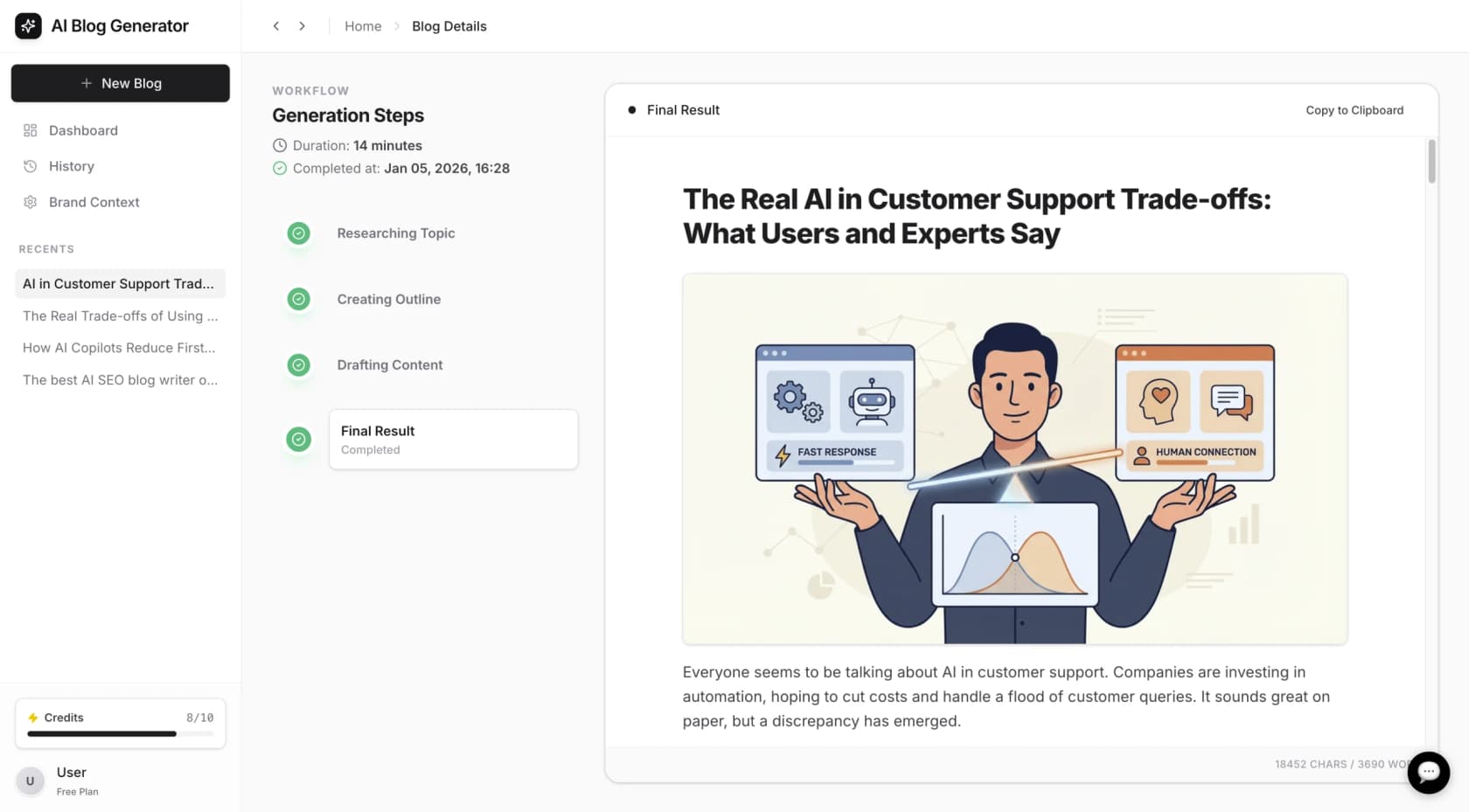
The eesel AI blog writer is a tool designed to turn a single keyword into a complete, media-rich, and SEO-optimized blog post.
Pros and cons
It goes beyond text generation by automatically embedding assets like images and infographics, finding relevant YouTube videos, and pulling in real Reddit quotes to add social proof. The content is also optimized for AI answer engines (AEO). The main limitation is that it’s focused on blog content generation and is not an all-in-one suite for technical audits or backlink analysis.
Pricing
It is free to try. After that, the paid plan is a credit system at $99 for 50 blogs.
2. Surfer SEO
Surfer is a tool for refining and optimizing content that has already been written. Its Content Editor gives real-time feedback on keyword usage, structure, and readability based on top-ranking content. Its AI Tracker feature is useful for monitoring a brand's visibility in AI-generated results from platforms like ChatGPT, Google AI Overviews, and Perplexity by scraping real answers.
Pros and cons
Surfer is effective at guiding human writers to create well-optimized content. It functions as a "human-in-the-loop" tool. On the other hand, its own AI content generator can sometimes be less nuanced than specialized writers, and the cost can be a consideration for solo creators or small teams.
If you're doing those traffic levels I would opt for both, semrush for kw research and general data then surfer for fine tuning your page copy
Pricing
The Essential plan starts at $79/month when paid annually. The AI Tracker is included in higher-tier plans or can be bought as an add-on.
3. Semrush
Semrush is a comprehensive SEO platform that has integrated AI into its toolkit. Semrush One is their all-in-one solution for both traditional SEO and AI search. It includes an AI Visibility Toolkit that helps track a brand's presence in AI answers.
Pros and cons
The biggest advantage of Semrush is the breadth of its features. It covers everything from keyword research and competitor analysis to social media tracking. Its data is robust and widely used. The potential downside is that its complexity can be overwhelming for those new to SEO, and it has a premium price tag.
I use SEMRush primarily now and it doesn’t really have any guided writing whatsoever. It’s more for people who at least have an idea what to do.
Pricing
The Semrush One "Starter" plan costs $165.17/month when billed annually.
4. SE Ranking
SE Ranking has built a solid suite of AI search visibility tools, with a notable feature being its AI Overviews Tracker. This feature is designed to help monitor how often a site appears in Google's new AI-generated answers. It also lets you track your visibility in other engines like ChatGPT, Perplexity, and Gemini.
Pros and cons
SE Ranking provides granular, actionable data on AI Overview presence, which is helpful for tracking performance in changing SERPs. On the other hand, its content creation features are not as advanced as some dedicated writing tools. For more specialized help, you might explore how to generate SEO-optimized FAQs and how to get real-time SEO recommendations.
Pricing
The Essential plan starts at $52/month when billed annually.
5. Clearscope
Clearscope is a premium content optimization tool that helps writers cover a topic comprehensively. It uses natural language processing (NLP) to identify important terms and themes based on top-ranking content, which helps build topical authority. It also has features for tracking visibility across Google and AI chatbots.
Pros and cons
Clearscope is effective for taking human-written content and improving its optimization. It helps avoid keyword stuffing and ensures comprehensive topic coverage. The tool integrates directly into Google Docs and WordPress. The main consideration is the high price point, and it’s an optimization tool, not an article generator.
Pricing
The Essentials plan starts at $129/month.
6. Writesonic
Writesonic has positioned itself as an AI Search Visibility and Optimization Platform. Its core focus is Generative Engine Optimization (GEO), helping users track and improve their brand's presence in AI search engines like ChatGPT and Perplexity. Its Chatsonic feature pulls in real-time data from Google to inform its analysis.
Pros and cons
Writesonic’s strength is its deep analytics for AI search. You can see your visibility score, share of voice, and citation sources. The platform is built for marketers focused on performance in the new era of AI search. A potential catch is that its most powerful GEO features are only available on higher-tier plans.
Pricing
The SEO and GEO features are on the Professional plan and higher, which starts at $199/month when paid annually.
Tips for using AI SEO tools effectively
Just having the tools isn't enough. You have to know how to use them. Here are a few tips that can help.
-
Start with strategy, not automation: AI tools are powerful, but they can't create a good SEO strategy for you. Before you generate a single word, make sure you know your audience, your target keywords, and your ultimate goals.
-
Use AI as a research assistant and first-drafter: Let AI handle some of the heavy lifting. Have it gather data, create an outline, and write the first draft. This can free you up to spend time on higher-level strategic work.
AI works best when used for research, outlining, and speeding up drafts while the real ranking power still comes from expertise, strategy, and links.
 Reddit
 -
Always add human expertise (E-E-A-T): The best AI-assisted content is always edited and polished by a human. Add your own experience, unique insights, and brand voice to make the content stand out and build trust with your readers.
-
Fact-check everything: Even the best AI tools can get things wrong or pull outdated information. Always take a few minutes to verify any stats, claims, or technical details before you publish.
-
Create a workflow: The real magic happens when you connect these tools. For example, you could use Semrush for keyword research, generate the full article with the eesel AI blog writer, and then do a final optimization pass with Surfer SEO or Clearscope.
The trick isn’t just “using AI tools” it’s connecting them into a workflow: research → creation → optimization → distribution → visibility in LLMs.
Reddit
To see how these tools stack up against each other in real-world scenarios, it can be helpful to watch a comparative review. The following video provides a tier list of popular AI SEO tools, offering insights into which ones deliver the most value.
Choosing the right AI tool for SEO
AI has become an integral part of modern SEO workflows. The right tools can act as powerful assistants, amplifying efforts without replacing the need for human strategy, creativity, and expertise.
The "best" tool depends on specific goals, whether that involves scaling content production, refining existing pages, or monitoring visibility in the evolving search landscape. For teams looking to scale their content efforts, a capable content generator can be a valuable starting point.
Frequently asked questions
What are the best AI tools for SEO for a small business on a budget?
For small businesses, SE Ranking is a great option with its accessible starting price of around $52/month. For content generation, the eesel AI blog writer is also very budget-friendly, as it offers a free trial and a credit-based system ($99 for 50 articles) that avoids a recurring monthly subscription.
Can AI tools for SEO replace a human content writer?
Not entirely. Think of them as powerful assistants, not replacements. They are excellent for handling research, outlining, and first drafts, which saves a massive amount of time. However, you still need a human to provide unique insights, add personal experience (E-E-A-T), fact-check, and ensure the final content matches your brand's voice.
How do I choose the right AI tool for my specific needs?
Start by identifying your biggest SEO bottleneck. If you struggle to produce content at scale, a content generator like the eesel AI blog writer may be a suitable choice. If your content is written but doesn't rank, an on-page optimizer like Surfer SEO or Clearscope is what you need. If you're focused on visibility in AI Overviews, a tracker like SE Ranking or Writesonic is the priority.
Are the free versions of AI SEO tools worth using?
Free trials are definitely worth it to test a tool's quality and see if it fits your workflow. However, most ongoing "free" plans are very limited and won't be sufficient for a serious SEO strategy. They're good for getting a feel for a platform but not for achieving long-term results.
What's the most important feature to look for in an AI SEO tool?
It depends on the tool's purpose. For a content generator, the single most important feature is the quality of the output-it should be well-structured, accurate, and require minimal editing. For optimization and tracking tools, the key is actionable data. The tool should give you clear, specific recommendations you can implement immediately.
Do AI SEO tools help with technical SEO as well?
The tools on this list are primarily focused on content creation, on-page optimization, and AI search visibility. While all-in-one platforms like Semrush have features for technical SEO (like site audits), these tools aren't specifically designed for deep technical analysis. For that, you'd typically use Semrush's auditing tools or other dedicated platforms like Ahrefs or Screaming Frog.