AI writing assistants are pretty common these days for anyone who creates or edits content. Whether you're writing an email or a full article, these tools can help speed things up and clean up your work. Two names you'll often see are Grammarly and Rytr. They might seem similar, but they do different jobs.
The main distinction is simple: Grammarly is for polishing text you've already written, like a high-tech proofreader. Rytr is for creating new, short-form content from the ground up. This article will give you a straightforward comparison of their features, pricing, and where they have limitations, so you can figure out which one fits your needs.
It's worth noting that while both tools are effective for their specific jobs, like fixing a paragraph or brainstorming ad copy, they aren't built for producing long-form content at scale. For that, you might look at a tool like the eesel AI blog writer, which is made to generate a full, publish-ready article from just a keyword.
What is Grammarly?
Grammarly is a writing assistant that checks your text for mistakes in grammar, spelling, punctuation, and style. Think of it as a digital proofreader that gives you feedback as you type, helping you polish your writing. It uses AI to look at your content from different angles, including correctness, clarity, engagement, and delivery, and offers suggestions to make it better.
The platform does more than just fix basic errors. It can suggest different ways to phrase a sentence to make it more direct, recommend tone adjustments (like making your writing sound more formal or confident), and keep your spelling and punctuation consistent. The suggestions are also meant to be educational, as they explain the logic behind each change, which can help you become a better writer over time.
Grammarly is used for a wide variety of writing tasks. People use it for proofreading business emails, checking academic papers, polishing blog posts, and making sure social media updates look professional. Because it's available as a browser extension, desktop app, mobile keyboard, and web editor, it fits into most people's existing writing habits.
What is Rytr?
Rytr is an AI tool designed for generating short-form content quickly. Its main purpose is to produce original text based on prompts you provide, using pre-made templates. This makes it a useful tool for getting past writer's block and speeding up the first draft of a piece of copy. It relies on GPT-based language models to generate text that is relevant and makes sense.
To use it, you typically pick a use case from its template library, which includes options for ad copy, blog ideas, social media captions, and product descriptions. After you choose a template, you give it a short description or a few keywords. Rytr then generates a few different versions of the content that you can edit, mix together, or just use as a starting point.
The platform is especially helpful for marketers, entrepreneurs, and anyone who needs to create a lot of short content on a regular basis. It can help come up with creative ideas, draft marketing materials, and create outlines for longer articles. By handling the initial creation step, Rytr lets you spend more time refining and personalizing the final output.
Feature comparison: Grammarly vs. Rytr
Core functionality
Grammarly is focused on the correction and improvement of text that's already been written. Its system is built to analyze existing content and give you suggestions.
- It runs checks for grammatical mistakes, spelling errors, and punctuation problems, catching everything from simple typos to more complex sentence structure issues.
- Beyond just being correct, it provides suggestions to improve your style and tone. For instance, it can point out passive voice, suggest stronger language, or recommend edits for better readability.
- The paid plans come with a plagiarism checker that scans your text against billions of web pages to help ensure your work is original.
Rytr focuses on generating content based on your input. Its process is designed to create new text, not edit what you already have.
- You start by choosing one of more than 40 use cases, like "Blog Idea & Outline" or "Facebook, Twitter, LinkedIn Ads."
- You then enter keywords, a brief description, and choose a tone. Rytr takes this information and produces multiple content options for you.
- It also has a built-in text editor that lets you rephrase, shorten, or expand on what the AI generated, giving you a space to work on the first drafts.
Content creation capabilities
Grammarly has very limited ability to create content. Its "rewrite for clarity" feature can rephrase sentences to be more concise, but it won't generate new paragraphs or come up with ideas from a prompt. It's a text enhancer, not a text creator.
Rytr's main job is content creation. It's built to generate a wide range of copy from just a little bit of input.
- It has over 40 templates (or use cases) for specific content types, covering everything from AIDA and PAS marketing frameworks to video descriptions and song lyrics.
- To customize the text, users can pick from more than 20 tones, such as "convincing," "humorous," or "formal." The platform can also generate content in over 30 languages.
Integrations and workflow
Grammarly is excellent at fitting into your existing workflow. It makes its suggestions available right where you do your writing.
- It has browser extensions for Chrome, Safari, and Firefox that provide real-time checks in tools like Gmail, Google Docs, and social media platforms.
- It also offers desktop apps for Windows and Mac, an add-in for Microsoft Office, and mobile keyboards for iOS and Android, so you get consistent help across your devices.
Rytr is mainly a standalone web platform. It does, however, have a Chrome extension that lets you use its generation features in other web apps. This means you can generate copy directly in places like Gmail, WordPress, or Slack without having to switch back and forth between tabs.
Limitations of Grammarly and Rytr
While both Grammarly and Rytr are effective for their intended purposes, they have limitations, particularly for content teams focused on scaling production.
The primary limitation of Grammarly is that it's an editor, not a writer. It can't help you research a topic, structure an article, or write something from a blank page. It's made to improve what's already there. If you have no ideas, Grammarly can't help. A writer has to create the first draft before Grammarly can step in to polish it. This makes it a key tool for the final steps of writing, but not for the initial stages of brainstorming and drafting.
Rytr's primary limitation is its design for short-form copy. It can generate blog outlines or paragraphs, but when it comes to long-form content, the output often lacks the depth and smooth flow needed for a finished article. The different sections can feel disconnected and usually need a lot of manual editing to become a complete piece. For anything longer than a few hundred words, it's a starting point, not a final product.
I liked Rytr in pre-chatgpt era. Now I don't use it. And customer support sucks with its 'dark patterns' when it comes to your subscription annual fee. They got my annual subscription fee in advance and when were asked ro a refund THE NEXT day, they just like: 'we don't refund, it's a company's policy... blah-blah-blah-...' Given my previous pre-paid year I didn't use the service almot entirely. Meaning they got 2-year subscription fee almost for nothing...

For teams aiming to grow organic traffic with long-form content, a different type of solution may be required. A tool that can manage the entire process, from research and outlining to drafting, can fill the gaps left by specialized editing and generation tools.
An alternative for long-form content: eesel AI blog writer
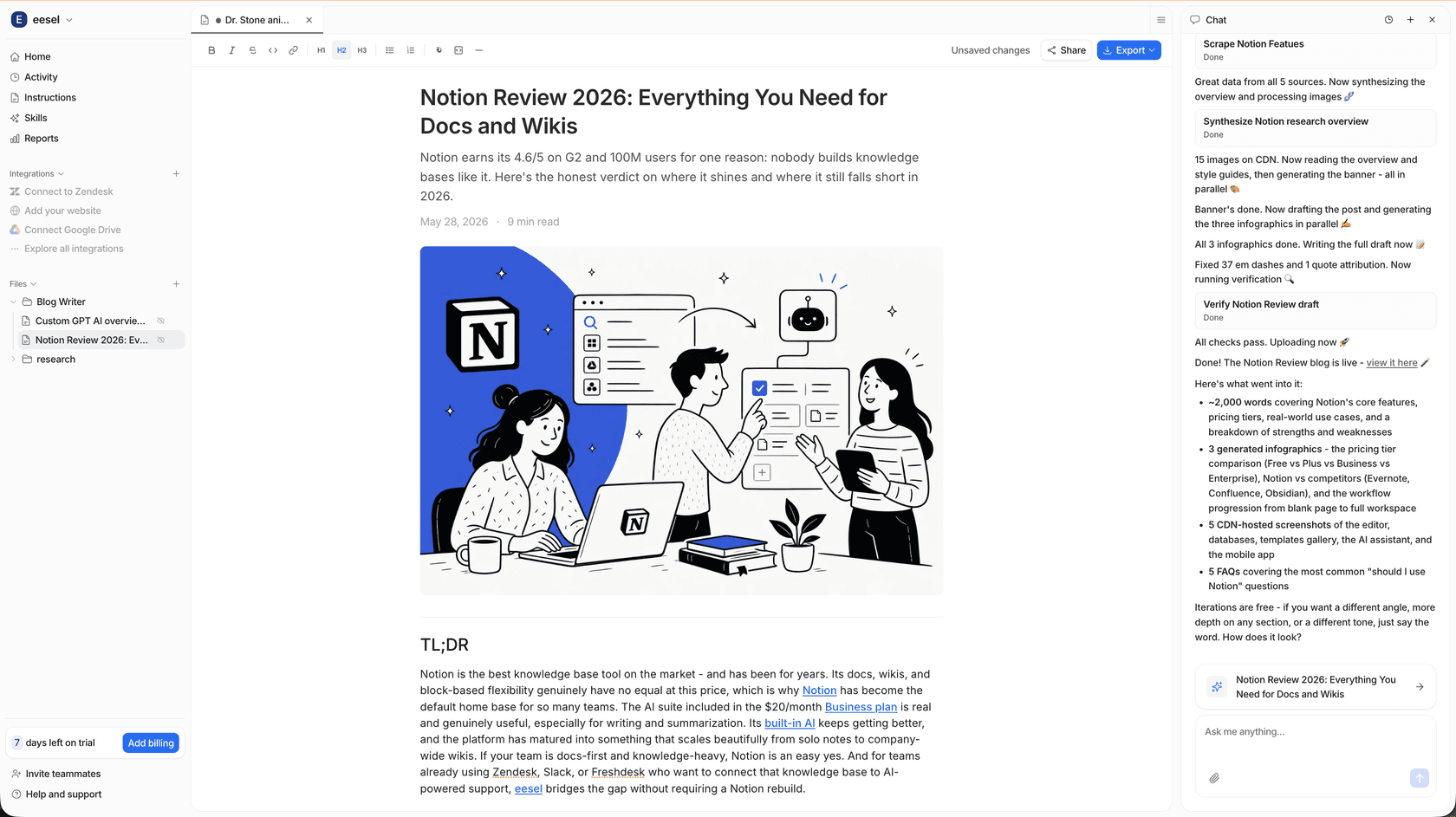
It operates by taking a single keyword and turning it into a complete, SEO-optimized blog post that's ready to publish. Instead of giving you sentence corrections or short snippets of text, it manages everything from research to the final formatted draft. This allows teams to produce more content without lowering the quality.
Here is how it compares to tools like Grammarly and Rytr:
| Feature | Description |
|---|---|
| Complete Structure | Generates a full article with an introduction, logical headings, a conclusion, and FAQs, creating a coherent narrative from start to finish. |
| Context-Aware Research | Conducts deep research based on the topic to ensure the content is informative, accurate, and detailed, moving beyond shallow AI filler. |
| Automatic Assets | Includes AI-generated images, tables, and infographics directly within the post, saving time on visual content creation. |
| Social Proof | Embeds relevant YouTube videos and real quotes from Reddit forums to add authority, credibility, and a human element to the content. |
| SEO & AEO Optimization | The output is optimized not only for traditional search engines (SEO) but also for AI answer engines like Google AI Overview and Perplexity (AEO). |
This approach has produced measurable results. For example, the eesel AI team used the tool to scale daily impressions from 700 to over 750,000 in just three months by publishing more than 1,000 optimized blog posts. This highlights the potential of using a tool that manages the entire content creation process.
Pricing plans: Grammarly vs. Rytr
Both platforms have free plans and paid tiers for those who need more features or higher limits. Here's a look at their pricing.
Grammarly pricing
- Free Plan: Offers basic writing suggestions, including checks for grammar, spelling, and punctuation. It also has a tone detector to give you an idea of how your message might come across.
- Premium Plan (Starts at $12/month, billed annually): Unlocks all features, such as advanced suggestions for style and tone, a plagiarism detector, sentence rewrites for clarity, and vocabulary improvements. This plan is good for people who write a lot for work or school.
- Business Plan (Starts at $15/member/month, billed annually): Has everything in the Premium plan, plus team features like a shared style guide, an analytics dashboard, brand tones, and centralized billing. This plan is for teams of three or more.
Rytr pricing
- Free Plan: Lets you generate up to 10,000 characters (around 1,500-2,000 words) per month. It gives you access to all use cases and tones.
- Saver Plan ($9/month or $90/year): Bumps the monthly limit to 100,000 characters (around 15,000-20,000 words). This plan works well for users with moderate content needs.
- Unlimited Plan ($29/month or $290/year): Gives you unlimited character generation, which is the best choice for users who create a lot of content. It also comes with priority support.
For a more comprehensive look at how these and other AI writing tools compare, check out this video breakdown.
Which tool is right for you?
Deciding between Grammarly and Rytr comes down to what you need to do. They are both useful tools, but they solve different problems.
Choose Grammarly if: Your main goal is to proofread and improve the quality of text you've already written. It works like a powerful editor, helping you fix errors, adjust your tone, and improve clarity. It's the right tool for anyone who wants to make sure their writing is polished and professional.
Choose Rytr if: You need help getting past writer's block and quickly generating ideas or first drafts for short content. It's great for creating ad copy, social media posts, and product descriptions. It's a helpful brainstorming tool and a time-saver for producing a lot of short copy.
For businesses focused on growing organic traffic with long-form blog posts, a tool designed specifically for that purpose may be needed. If you need to produce high-quality, SEO-optimized blog posts at scale, a tool that handles the end-to-end process can be more efficient. You can try the eesel AI blog writer for free to see how it automates the entire process, generating a complete, publish-ready article from a single keyword.