

Why look past Gemini 3.5 Transcribe
Let me be fair first, because Gemini 3.5 Transcribe is a very good model. It's Google's successor to Chirp 3, it reports a 2.6% word error rate on non-streaming English, it auto-detects 85+ languages, and at roughly $0.005 per minute for the file model it undercuts Google's own Cloud Speech-to-Text standard tier. For single-speaker dictation, it's hard to beat. I went deep on all of that in my Gemini 3.5 Transcribe review.
So why switch? Three concrete reasons keep coming up.
Smart transcription rewrites your words. This is the feature Google leans on hardest, and it's also the most common complaint. Smart transcription strips filler words and self-corrections and reformats as it goes, which is lovely for dictating an email and a real problem when the exact wording matters. One developer testing it found that it would "simplify" a sentence and break the meaning, dropping the first half of a precise clause in repeated testing. For legal, medical, research, or compliance work, that's a dealbreaker, not a footnote.
Diarization stalls past three speakers. Google's docs can't agree with themselves: the model page says up to 8 speakers with "3+ experimental," while the launch blog says up to three. The reliable number today is three, and the live streaming model does no diarization at all. If you transcribe six-person meetings, that's a hard limit.
It's not actually the cheapest. At about $0.30 per hour for the file model, Gemini sits at the higher end of the field. Several specialists undercut it, and a few do so while bundling in the diarization and language detection that Gemini charges nothing extra for but that others break out. Here's the shape of it:
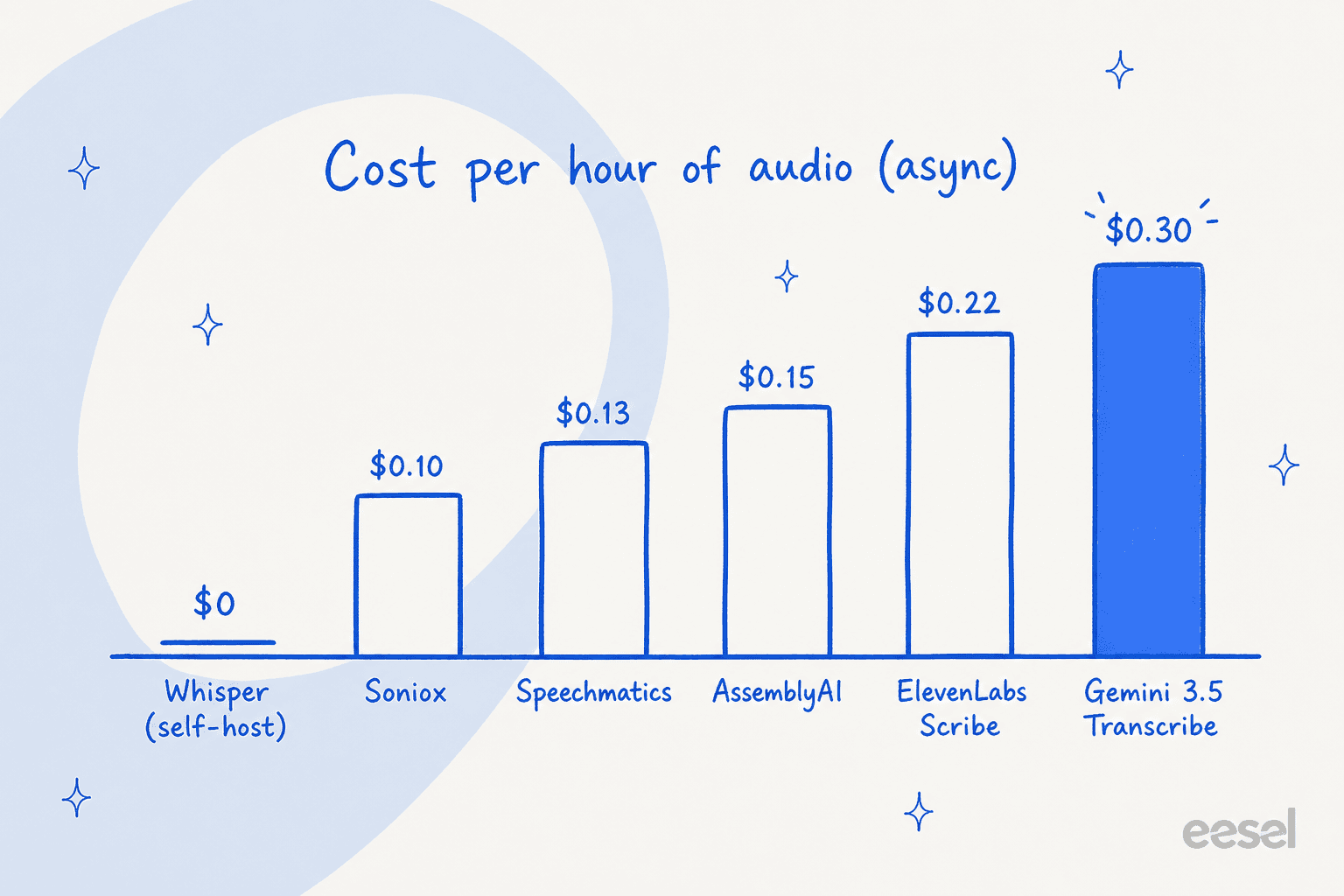
None of this makes Gemini a bad model. It just means that the right pick depends on your audio, and for a lot of real use cases, one of the alternatives below fits better.
How I compared them
I judged each alternative on the dimensions that actually change a build decision: real per-hour cost (not the sticker headline), whether diarization and language detection are bundled or billed as add-ons, language coverage, whether there's a real-time streaming mode, and the free tier you can test on. I read each vendor's own pricing and docs, and leaned on the developers running these models side by side, because a clean benchmark number and your real-world result can be worlds apart.
Here's the summary table before the deep dives. All prices are the vendor's own public pay-as-you-go rates for async (file) transcription unless noted.
| Tool | Async price | Streaming | Languages | Diarization | Free tier | Best for |
|---|---|---|---|---|---|---|
| Whisper | $0 (self-host) | Self-built | 99 | Add-on libs | Open weights | Control, no per-minute fee |
| Deepgram | ~$0.29/hr (Nova-3) | Yes | 30+ | +$0.0020/min | $200 credit | Real-time voice agents |
| AssemblyAI | $0.15/hr (Universal-2) | Yes | 99 | +$0.02/hr | Free PAYG | Audio intelligence |
| ElevenLabs Scribe | $0.22/hr | $0.39/hr | 90+ | Up to 32 speakers | Free tier | Top accuracy, many speakers |
| Speechmatics | from $0.129/hr | from $0.24/hr | 55+ | Included | $100 credit | Accents and dialects |
| Soniox | ~$0.10/hr | ~$0.12/hr | 60+ | Included | Free credit | Cheapest managed API |
| Cloud Speech-to-Text | $0.003/min (batch) | $0.016/min | 125+ | Included | $300 GCP credit | Teams already on GCP |
| Rev AI | $0.20/hr | Yes | 57+ | Included | Free trial | Accuracy across accents, HIPAA |
| Gemini 3.5 Transcribe | ~$0.30/hr | ~$0.54/hr | 85+ | Up to 3 speakers | Free tier | Single-speaker dictation |
1. OpenAI Whisper
Best for: teams that want full control, no per-minute lock-in, or a free starting point.
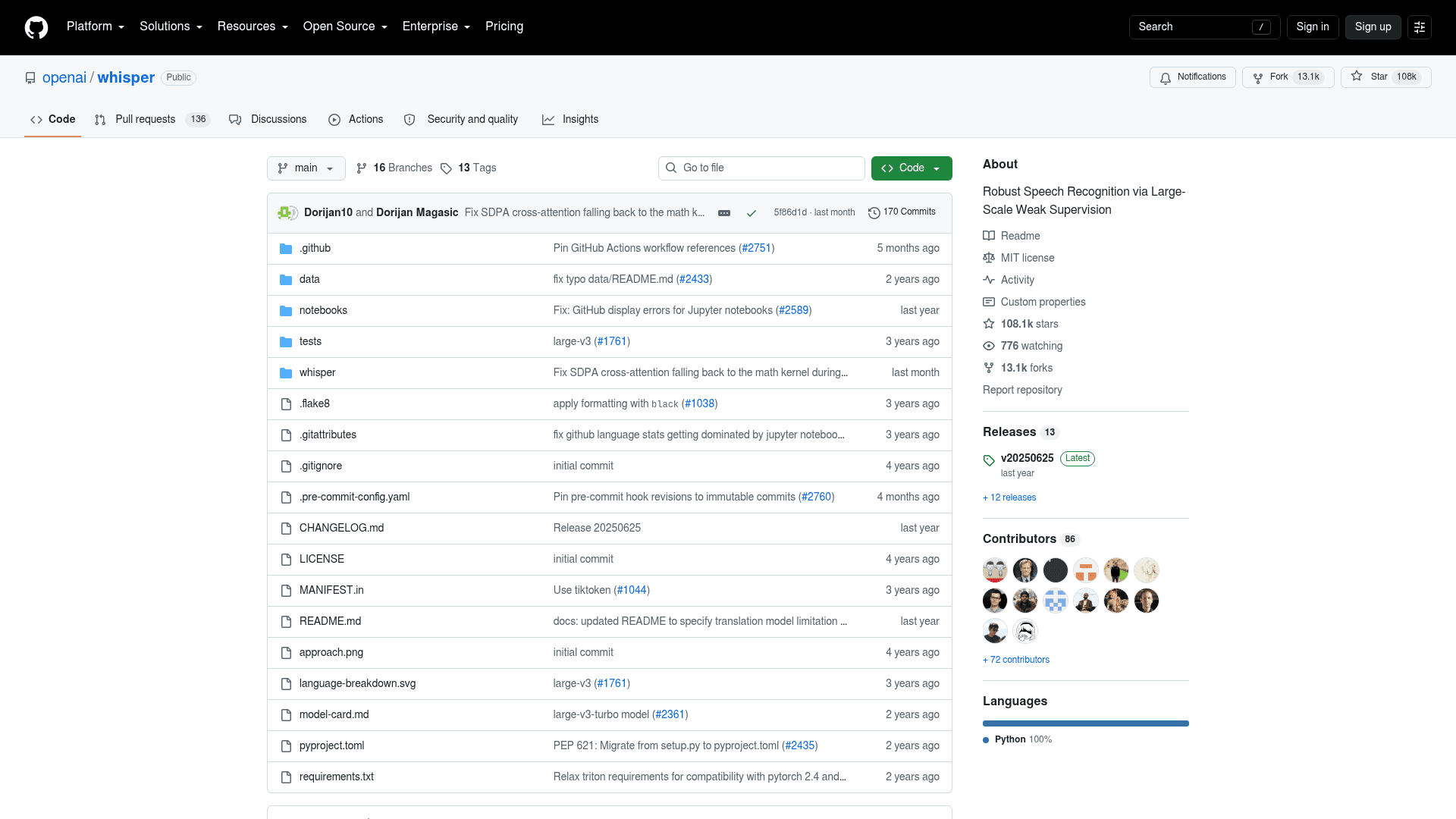
Whisper is the model that reset expectations for open speech-to-text. It's MIT-licensed, sits at over 108,000 GitHub stars, and describes itself as "Robust Speech Recognition via Large-Scale Weak Supervision." Because the weights are open, you can run it on your own hardware for the cost of compute, with no per-minute API bill and no data leaving your infrastructure. That last point is why so many privacy-sensitive teams start here.
It stays a community favorite for good reason:
"Whisper Large-v3 is still the most stable open model across diverse domains. Great accuracy, predictable output, and decent handling of accents."

Pros: Free to self-host, open weights, strong multilingual accuracy, huge ecosystem of tooling and fine-tunes, runs fully offline.
Cons: Self-hosting is real engineering work (GPUs, batching, scaling). Diarization and word-level timestamps aren't built in, so you bolt on extra libraries. Whisper is also known to hallucinate text on silent or noisy segments. If you'd rather not run infrastructure, OpenAI's own managed GPT-Transcribe API runs at about $0.0045 per minute (roughly $0.27 per hour) for async and $0.017 per minute for live streaming.
Verdict: Whisper is the default for anyone who values control and cost over convenience. If you have the engineering muscle to host it, it's effectively free and private. If you don't, the managed OpenAI endpoints get you the same lineage without the ops burden. Many teams run a hybrid, using Whisper for word timestamps and a chat model to correct the text.
2. Deepgram
Best for: real-time voice agents and low-latency streaming at scale.
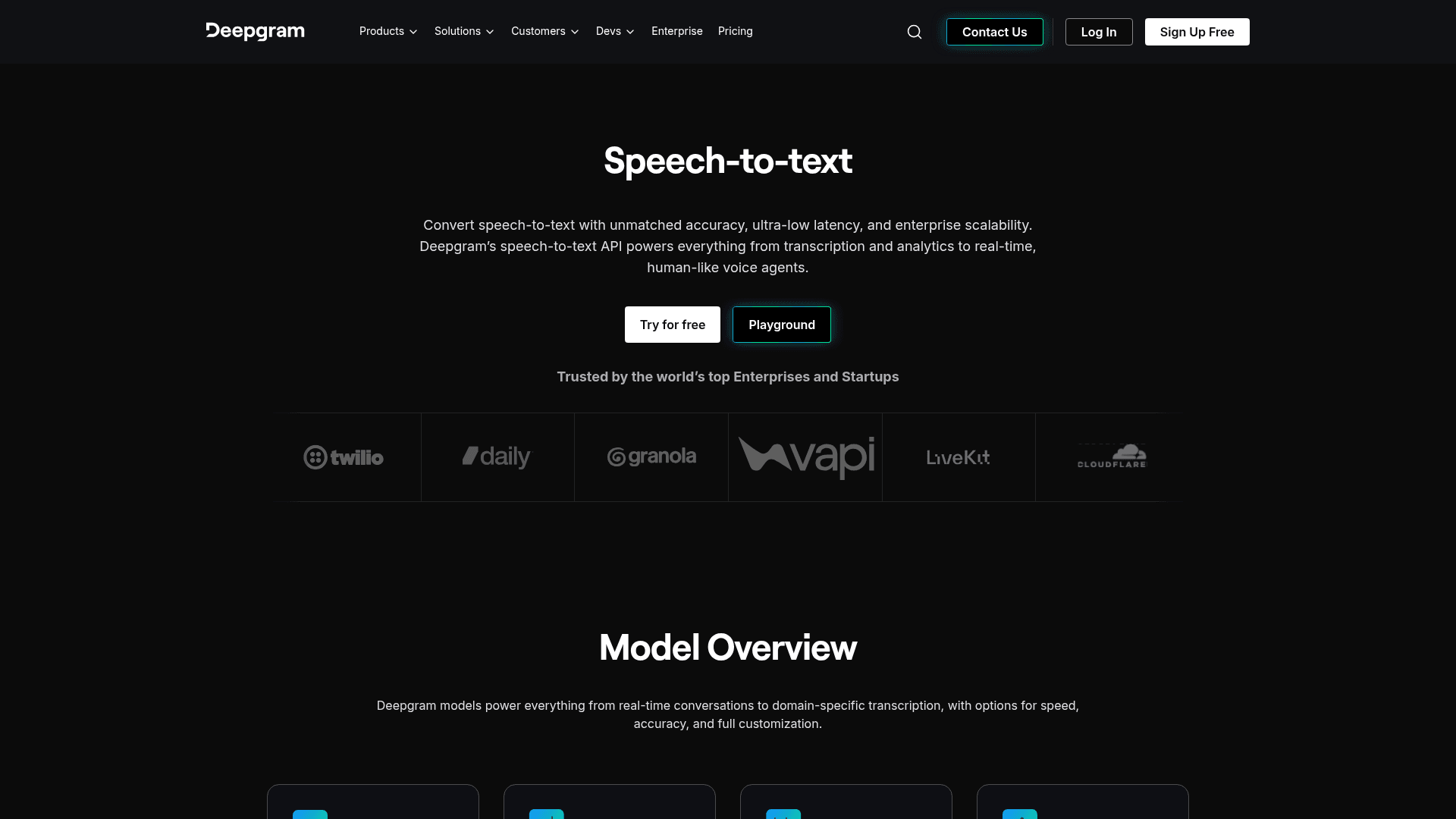
Deepgram is the ASR specialist built for speed. It powers voice infrastructure for the likes of Twilio, Cloudflare, and Vapi, and its whole architecture is tuned for low-latency streaming, which is exactly what a live voice agent needs. Its current Nova-3 model runs at $0.0048 per minute for monolingual streaming (about $0.29 per hour), with a $200 free credit to start.
Developers comparing the field tend to peg Deepgram as the fast one rather than the most accurate one:
"AssemblyAI and Speechmatics too, who both have much greater accuracy - especially in real-time for Speechmatics. Deepgram are only fastest at..."
Pros: Excellent streaming latency, huge concurrency, self-hosting for regulated industries, and a clear per-minute rate card.
Cons: Add-ons stack up: speaker diarization is an extra $0.0020 per minute, and redaction and keyterm prompting cost more on top. Its raw accuracy on hard audio trails the accuracy leaders in some user tests.
Verdict: If you're building real-time voice, Deepgram is the first name on the list. It's the closest thing to Gemini 3.5 Transcribe Live's use case, and it does streaming as a first-class citizen rather than a low-latency compromise. For batch file work where accuracy matters more than speed, I'd test it against AssemblyAI or Scribe before committing.
3. AssemblyAI
Best for: teams that want transcription plus audio intelligence in one API.
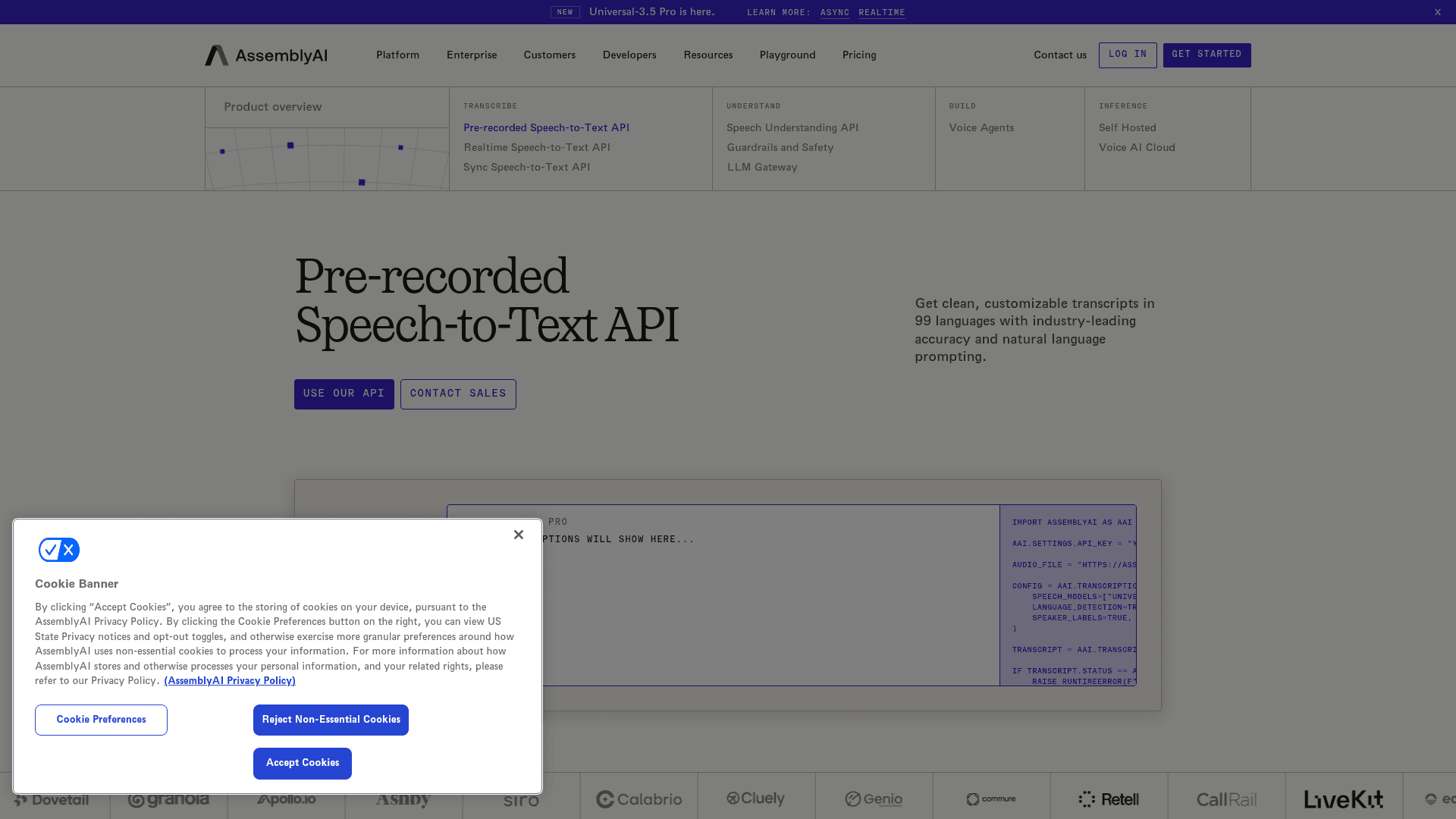
AssemblyAI pairs strong transcription with a deep set of "audio intelligence" features: sentiment, topic detection, summarization, and safety guardrails, all off the same API. Its Universal-2 model runs at $0.15 per hour across 99 languages, and the newer Universal-3.5 Pro at $0.21 per hour adds native code-switching and its most accurate diarization yet across 18 languages. AssemblyAI claims higher word accuracy than Whisper, at 94.1% versus 92.4%.
Pros: High accuracy on files, 99-language coverage on Universal-2, a useful intelligence layer for support ticket work, and self-serve per-hour pricing with a free tier.
Cons: Extras are metered: speaker diarization adds $0.02 per hour and keyterm prompting adds $0.05 per hour on the Pro model. The top Universal-3.5 Pro tier narrows to 18 languages, so wide multilingual work stays on Universal-2.
Verdict: AssemblyAI is the pick when you want more than a raw transcript. If your product needs to summarize calls, flag sentiment, or extract topics, doing it in one call beats stitching a transcription model to a separate LLM step. On plain accuracy it's right up with the leaders, and the free pay-as-you-go tier makes it easy to benchmark against your own audio.
4. ElevenLabs Scribe
Best for: the highest accuracy and heavy multi-speaker audio.
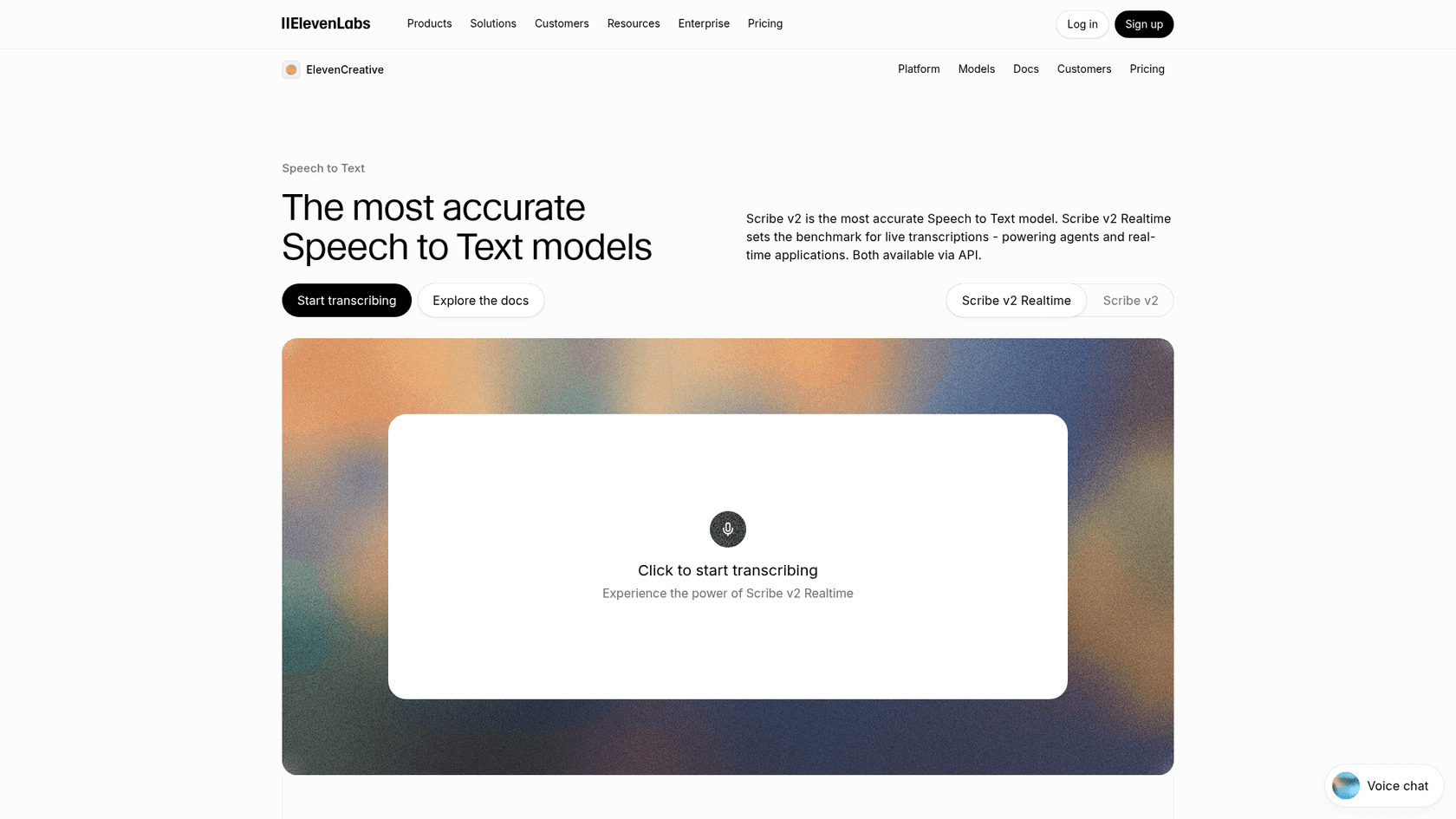
ElevenLabs made its name in voice generation, but Scribe is a serious speech-to-text model in its own right. It advertises 98%+ accuracy, 90+ languages, and the standout number here, diarization up to 32 speakers, which is an order of magnitude past Gemini's three. Scribe v1 and v2 run at $0.22 per hour, with a real-time model, Scribe v2 Realtime, at $0.39 per hour and roughly 150ms latency.
Its price-to-accuracy ratio is what wins people over. One developer running transcription for a living did the math against Gemini:
"I did the math based on our data from customers... and it seems to be $0.12 per hour of input audio... Scribe is $0.22. If the accuracy is close to Scribe, I think it's a good deal."

Pros: Accuracy leader on clean audio, diarization that actually scales to large meetings, wide language coverage, and a real-time option.
Cons: Pricier per hour than Soniox, Speechmatics, or AssemblyAI's base tier. Speech-to-text is one product inside a voice-generation company, so the docs and community lean toward TTS.
Verdict: If your bar is "get the words exactly right, even with a room full of people talking," Scribe is where I'd start. The 32-speaker diarization alone makes it the obvious answer for meeting and panel transcription, the exact place Gemini 3.5 Transcribe struggles most.
5. Speechmatics
Best for: wide accent and dialect coverage, and enterprise deployments.
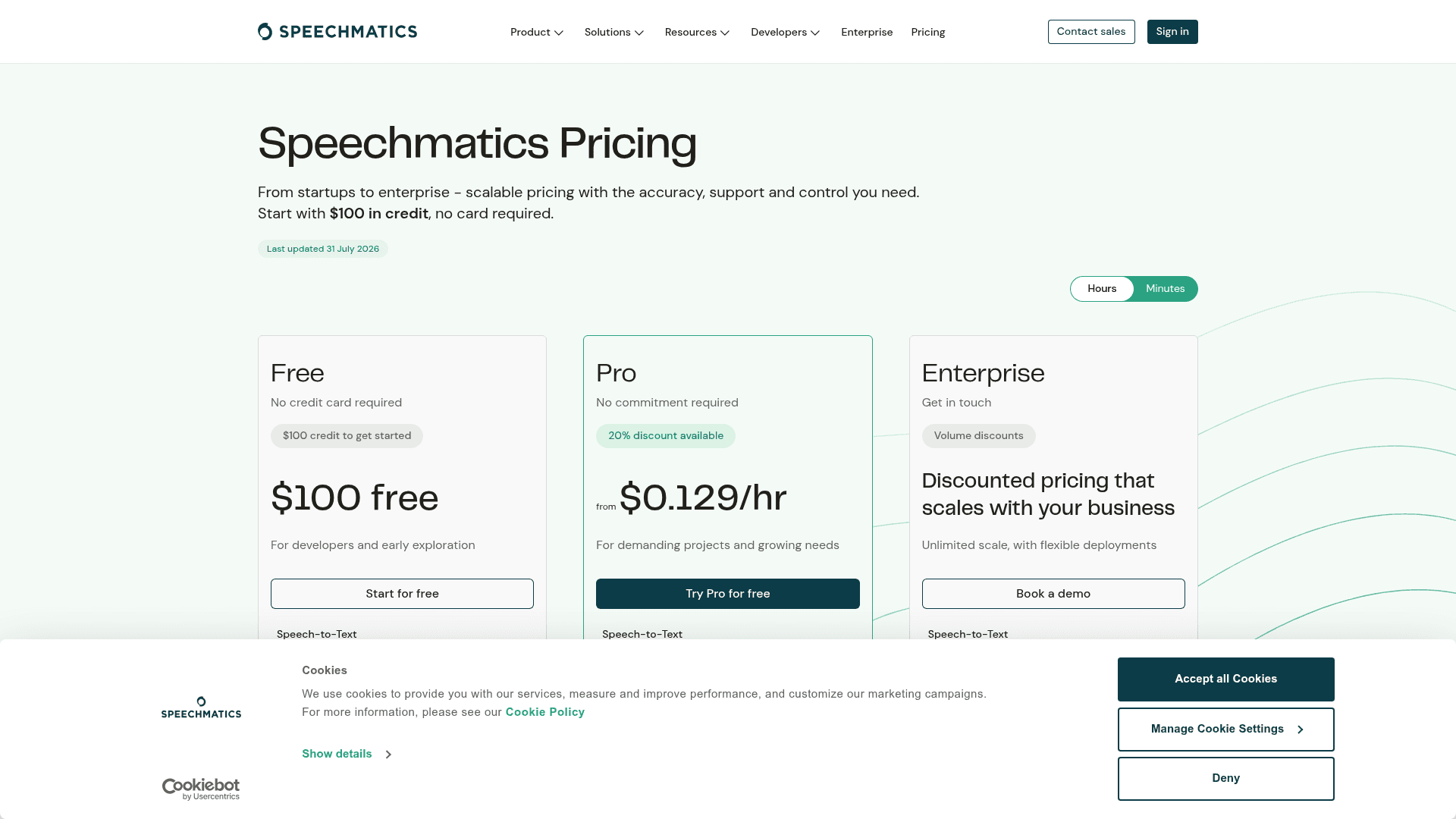
Speechmatics is the accuracy-and-accents specialist. It covers 55+ languages and dialects and pitches itself on transcribing "over 4 billion people" accurately, the kind of accent-coverage claim that matters if your callers don't all speak one standard accent. Its Batch Melia 1 tier starts at $0.129 per hour, with a real-time standard tier at $0.24 per hour, a $100 free credit, and a 20% discount over 500 hours a month.
Users in the accuracy debate consistently name it near the top, especially for real-time, which is the harder problem.
Pros: Strong accent and dialect handling, competitive batch pricing, diarization included rather than billed separately, and on-prem deployment for enterprise.
Cons: The tier structure (Melia 1, Standard, Enhanced, across batch and real-time) takes a minute to parse. The lowest-price Melia 1 tier is where the headline $0.129 sits, so read the tier before you budget.
Verdict: Speechmatics is the one I'd reach for when the audio is linguistically messy: mixed accents, dialects, real-world call-center recordings. If Gemini's Smart transcription is quietly "correcting" a speaker's phrasing you needed kept, a model built around faithful accent handling is the safer bet.
6. Soniox
Best for: the cheapest managed API with features bundled in.
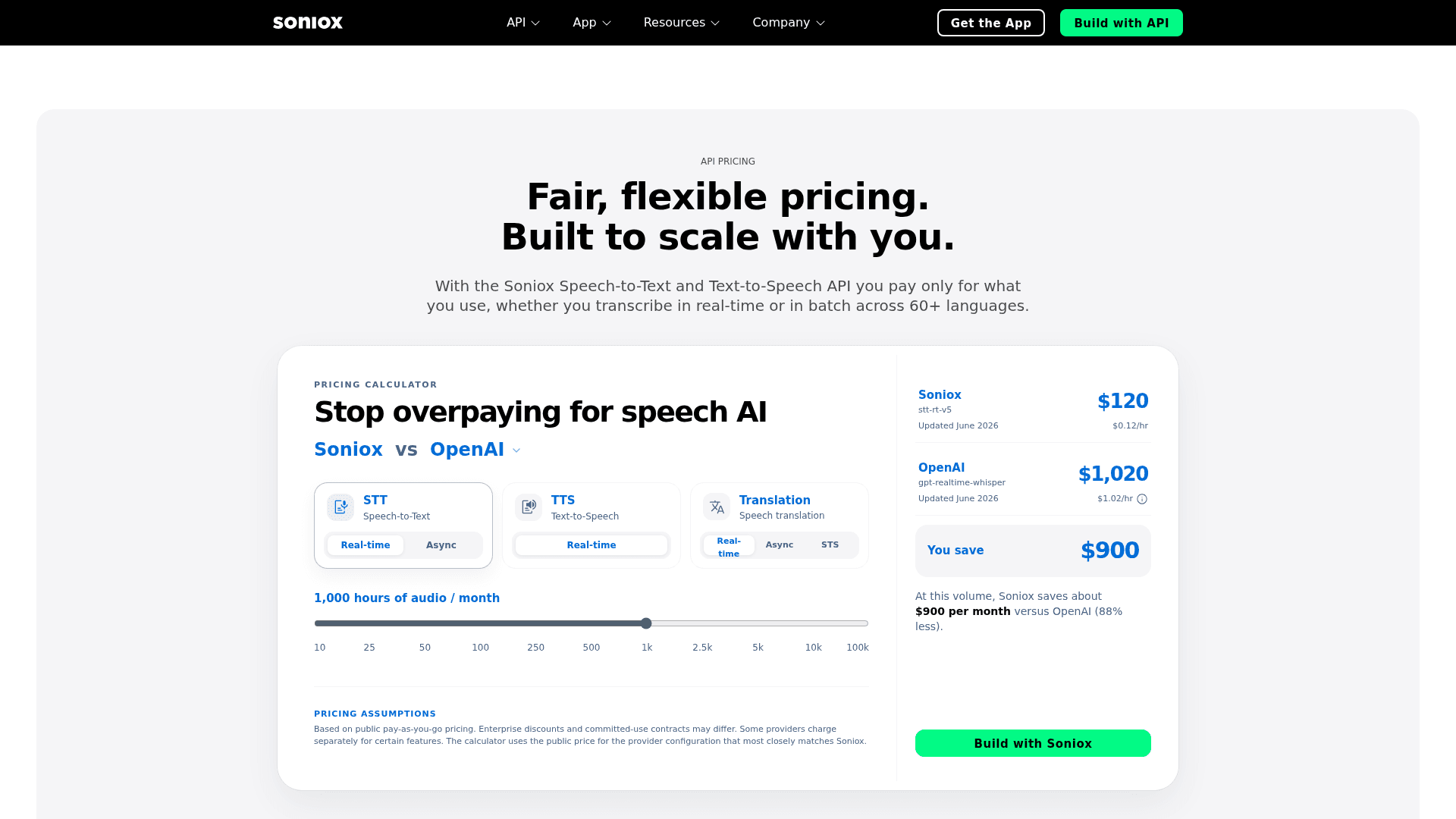
Soniox is the value play, and it doesn't hide it. Speech-to-text is about $0.10 per hour for async and $0.12 per hour for real-time, across 60+ languages. The differentiator isn't just the number: speaker diarization, language identification, smart formatting, and even translation are all bundled into that hourly rate rather than charged as add-ons. Soniox pitches itself as roughly 4.5x cheaper than Google and 8x cheaper than Azure for real-time.
Pros: The lowest managed price here, everything bundled (no diarization or language-detection surcharge), real-time and batch on the same model, and translation across 60+ languages in the same call.
Cons: It's a smaller, newer name than Deepgram or Google, so it has less third-party benchmarking and brand recognition behind it. You'll want to test it on your own audio rather than trust the marketing math.
Verdict: For cost-sensitive transcription at volume, Soniox is the sharpest deal in this roundup. Bundling diarization and translation into a flat $0.10 per hour is a real advantage over Gemini and Deepgram, both of which meter those separately. If the accuracy holds up on your recordings, the savings compound fast at scale.
7. Google Cloud Speech-to-Text (Chirp 3)
Best for: teams already on Google Cloud, and the cheapest batch tier.
Here's the interesting one: Google's Cloud Speech-to-Text is the model Gemini 3.5 Transcribe was built to succeed, and it's still very much alive. Its Chirp 3 foundation model supports 125+ languages, and pricing runs from $0.016 per minute for standard recognition down to $0.003 per minute for dynamic batch, the cheapest batch rate in this whole comparison. New customers also get $300 in Google Cloud credits.
Pros: The cheapest large-batch tier at $0.003 per minute, the broadest language coverage, deep integration with the rest of Google Cloud, and enterprise-grade tooling.
Cons: Standard real-time recognition at $0.016 per minute is pricier than Gemini's own file model. There's more configuration overhead than a single clean endpoint, and Google is clearly steering new work toward Gemini 3.5 Transcribe.
Verdict: If your stack already lives in Google Cloud, or you're running huge batch jobs where $0.003 per minute wins, Chirp 3 is a perfectly rational choice, sometimes a cheaper one than the shiny new Gemini model. Just compare like for like: batch against batch, real-time against real-time.
8. Rev AI
Best for: accuracy across accents, HIPAA compliance, and a human fallback.
Rev AI comes from Rev, the human-transcription company, and it leans on that heritage: its models are trained on 7M+ hours of human-verified speech, and it pitches fairness across "ethnic background, nationality, gender, and accent." It covers 57+ languages, carries SOC 2, HIPAA, GDPR, and PCI compliance with 99.99% uptime, and prices machine transcription at $0.20 per hour, a turbo model at $0.10 per hour, and human transcription at $1.99 per minute when you need a person in the loop.
Pros: Consistent accuracy across accents and challenging audio, a strong compliance posture for regulated industries, and the option to escalate to human transcription for the hardest files.
Cons: The brand is still best known for human transcription, so the developer API gets less community attention than Deepgram or AssemblyAI. Streaming and premium models sit above the $0.10-0.20 base rates.
Verdict: Rev AI is the pick when compliance and fairness across voices are non-negotiable, or when you occasionally need a human-grade transcript for a critical file. The HIPAA coverage and the human escalation path are things most model-only providers can't offer, which makes it a natural fit for healthcare and legal workflows.
How to actually choose
The honest answer is that there's no single winner, only the right fit for your audio. After going through all eight, here's the shortest path to a decision:
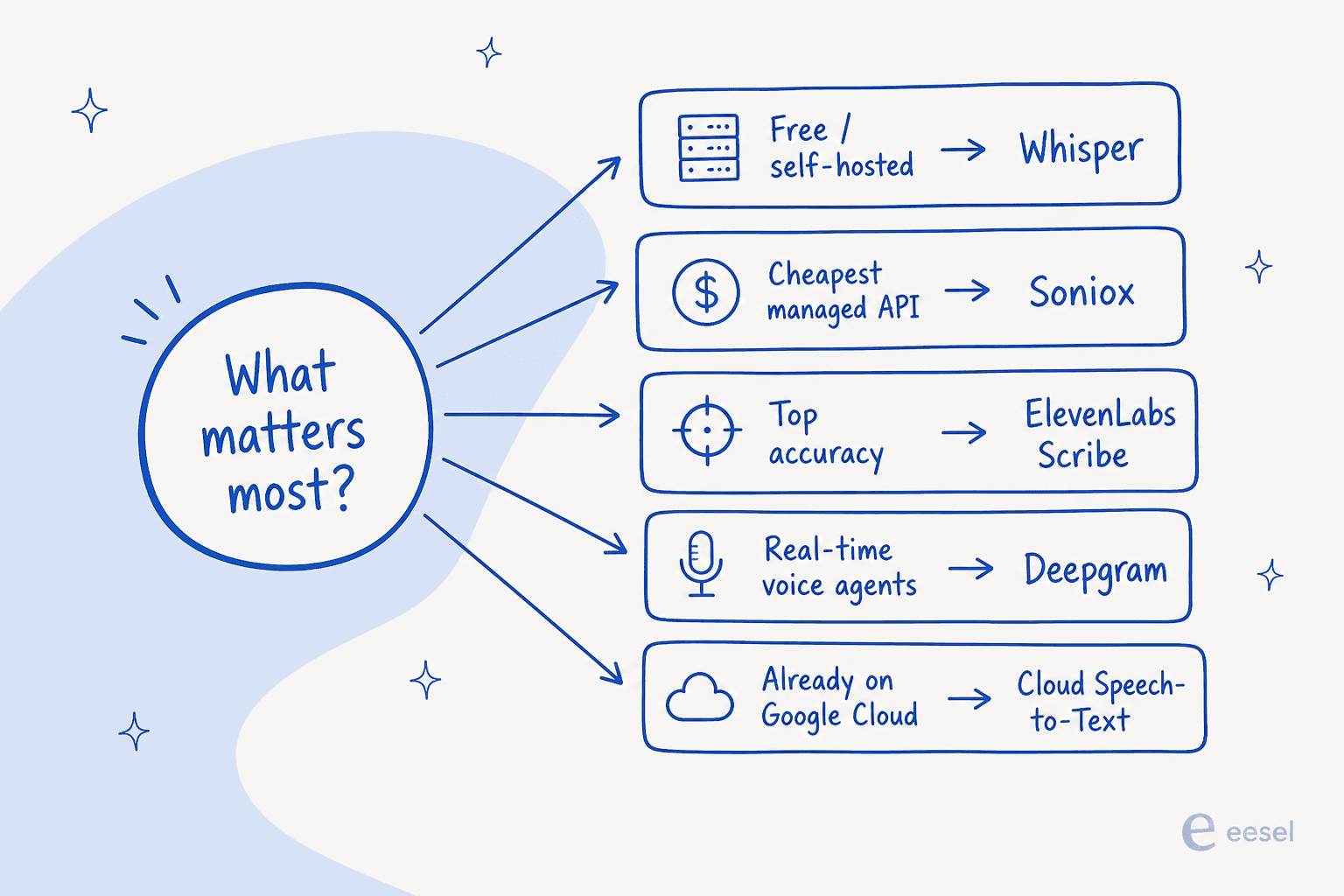
Two rules of thumb from watching people build on these. First, always test two or three on your own recordings before you commit a pipeline. The benchmark WER and the WER on your noisy, accented, cross-talking audio are different animals, a point I hammer in the Gemini 3.5 Transcribe review too. Second, count the add-ons. A headline rate that excludes diarization and language detection isn't comparable to one that bundles them, which is why Soniox at a flat $0.10 per hour can beat a "cheaper" model once you switch the extras on.
Where transcription stops and resolution starts
Here's the part a straight model roundup misses, and it's the one I care most about. Every tool on this list does the same job: it turns audio into text. Even the best of them, doing that job flawlessly, hands you a transcript. And a transcript of a customer's phone call or voice note isn't an answer, it's the start of one.
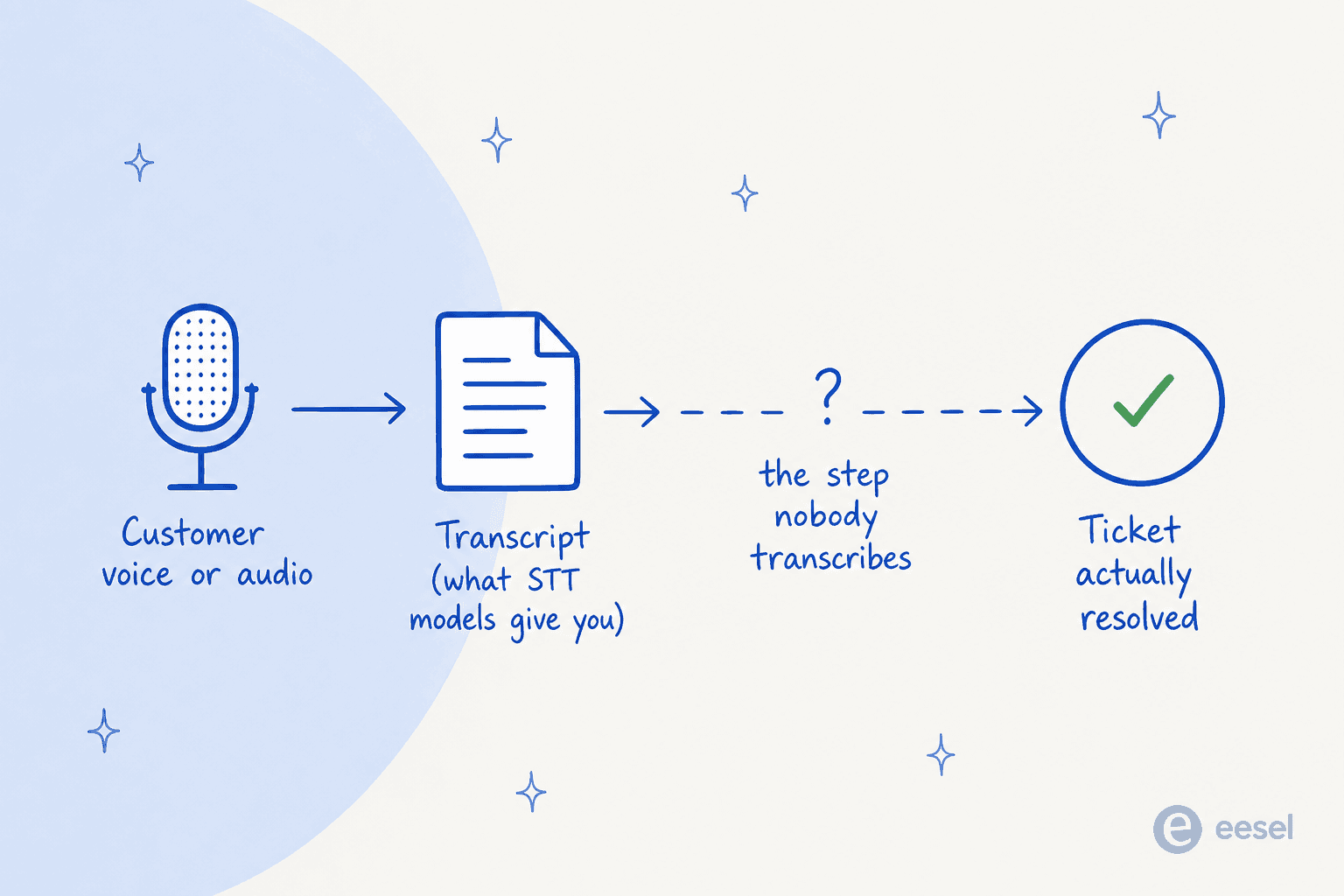
Something still has to read that text, understand what the customer actually needs, pull the right information, and resolve the ticket. That resolution layer is what I work on. I've spent the last few years around AI that sits on live support queues, and the pattern never changes: getting the words right is table stakes, acting on them correctly is the hard part. A transcription model gives you the words. It doesn't know your refund policy, your order system, or the last three tickets that customer opened.
This is the difference between a model and a teammate. Gemini 3.5 Transcribe, Whisper, Deepgram, and the rest are models, brilliant at one narrow job. eesel is a teammate platform: you hire ready-to-work AI teammates for specific jobs, and the current roster includes an AI helpdesk teammate and an AI blog writer. The helpdesk teammate plugs into the helpdesk you already run, Zendesk, Freshdesk, Gorgias, and joins the existing queue, trained on your help center and your past tickets.
Try eesel for voice and chat tickets
If you're comparing transcription models because your team is drowning in voice or chat tickets, remember the transcript is only half the job. The eesel AI helpdesk teammate picks up where a model like Gemini 3.5 Transcribe leaves off: it reads the customer's message, drafts or sends the reply, and closes the loop, across 1,000+ integrations.

The part I'd point to first is simulation mode. Before any AI touches a live customer, you run it against thousands of your own historical tickets and see exactly how it would have responded, the same "test it on your own data first" advice I'd give for any transcription model, built into the product. Pricing is one fixed monthly price, from $299/month for 500 credits (1 credit per ticket or chat) with no per-seat fees, and there's a free plan with 100 credits, no card. It's the difference between a smart transcription of a problem and an actual resolution of it.