


Let's be real for a second. Customer expectations are through the roof. Everyone wants instant, helpful, and personalized answers, but most support teams are stretched thinner than ever, teetering on the edge of burnout. It is a tough spot to be in.
To make things even more complicated, the market for customer experience tools is a jungle. It is packed with platforms all promising to be the silver bullet, making it nearly impossible to figure out which one is right for you without sinking weeks into demos and expensive trials.
So, I decided to cut through the noise. I have spent a ton of time digging into the top platforms, testing them out to give you a clear, no-fluff breakdown of the best customer experience tools for modern teams in 2026. Here is what I found.
What exactly are customer experience tools?
Not too long ago, "customer support tool" just meant a shared inbox for managing tickets. Today, that is just the starting point. Modern customer experience tools are all-in-one platforms designed to manage and improve every single touchpoint a customer has with your brand.
They have evolved from simple ticketing systems into AI-driven platforms that feel less like a clunky piece of software and more like a new teammate. They still handle the basics like omnichannel support across email, chat, social media, and voice, but they do so much more.
The real shift is the AI. We are talking about AI that can act as an AI Copilot drafting replies for your human agents, or even a fully autonomous AI Agent that resolves common questions on its own. These tools also plug into all your other business systems, like your CRM or e-commerce platform, to give you a complete picture of who your customer is and what they need.
How we picked the best customer experience tools for this list
To build this list, I focused on what really matters for teams that need to see an impact right away, not a year from now. Here is the criteria I used:
-
Go live in minutes, not months: I looked at how fast you can actually start using the thing. I prioritized tools that you can get up and running without needing a developer or sitting through weeks of mandatory onboarding. One-click integrations were a must.
-
Collaborative AI that learns: I checked if the AI feels like a smart, helpful teammate that gets better with feedback, or if it is just a rigid, frustrating bot. I looked for tools that learn from your real conversations and let a human stay in the loop.
-
Zero-risk adoption: You should be able to roll out the tool gradually without worrying it is going to go rogue on your customers. I gave extra points to platforms that default to a human-supervised mode and offer a clear, controlled path to full automation.
-
Customization in plain English: I tested how easy it is to tweak the AI's personality, tone, and the specific tasks it handles. The best tools let you do this with simple instructions, not complicated code or endless configuration menus.
-
Predictable, transparent pricing: Nobody likes surprise bills. I favored tools with straightforward pricing that does not rely on confusing "per-resolution" fees that can make your costs skyrocket unexpectedly.
The best customer experience tools at a glance
If you are short on time, here is a quick look at the top contenders and what they do best.
| Tool | Best For | Key AI Feature | Pricing Model | Setup Time |
|---|---|---|---|---|
| eesel AI | Teams wanting a plug-and-play AI teammate | Learns from past tickets & human feedback | Per interaction bundles | Minutes |
| Zendesk | Established teams needing an all-in-one suite | Agentic AI & Copilot for agents | Per agent/month | Days to weeks |
| Freshdesk | The industry standard for growing teams seeking an affordable, scalable help desk | Freddy AI Copilot & AI Agents | Per agent/month (Free tier available) | Hours to days |
| Sprinklr | Enterprise brands managing 30+ social channels | AI-powered social listening & trend analysis | Custom (Enterprise) | Weeks to months |
| HubSpot Service Hub | Businesses seeking a robust, CRM-powered platform | Breeze AI Customer Agent & deep CRM integration | Plans to match every team size | Hours to days |
A detailed look at the 5 best customer experience tools
I spent some time testing these out to see how they actually feel in a day-to-day workflow. Some are better for big corporations, while others are perfect for small teams that just want to get things done.
1. eesel AI
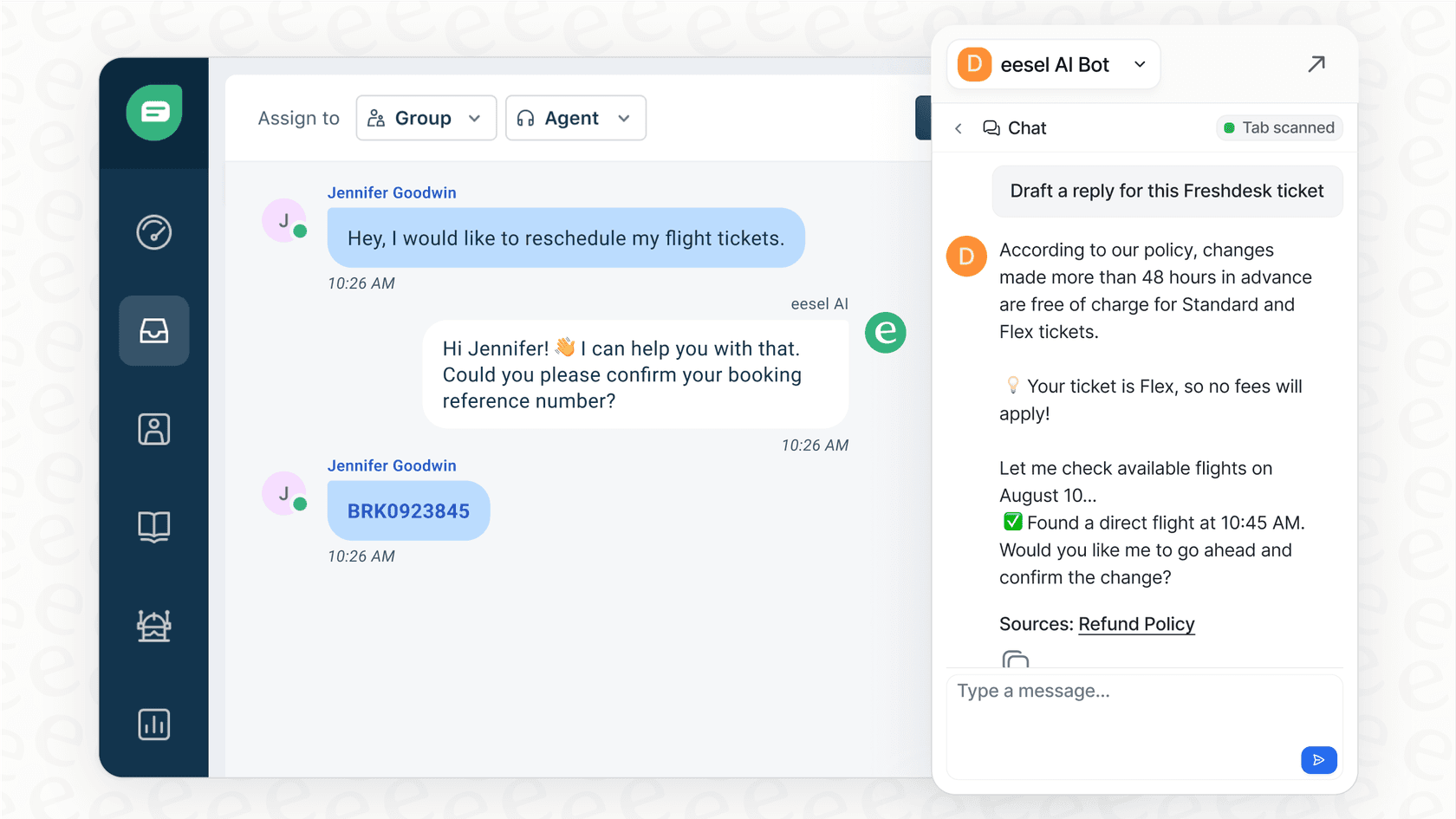
I am putting eesel AI first because it is a totally different way of thinking about support automation. Instead of buying a "tool," it feels like you are hiring a new teammate. It is designed to plug directly into the help desk you already use, whether that is Zendesk, Freshdesk, or something else, and it starts working in minutes. No migration, no lengthy setup. It just reads your past tickets, help center articles, and internal docs and gets to work.
Its biggest selling point is how ridiculously easy and risk-free it is to get started. You can begin with the AI simply drafting replies that your human agents approve or edit. This means you get value from day one without any fear of the AI sending a weird response to a customer. From there, you can gradually give it more responsibility as you build trust. I also love that you can customize what it does using plain English, like telling a coworker, "If someone asks for a refund after 30 days, politely decline and offer store credit."
The only real downside is that because it is a dedicated AI platform, it does not have the massive, sprawling feature set of an all-in-one suite like Zendesk. If you are a huge company looking for a single platform to handle absolutely everything from ticketing to marketing automation, this might not be it. But for adding a powerful AI brain to your existing setup, it is incredible.
- Pricing: The Team plan pricing for up to 1,000 AI interactions. The Business plan is $799/month for 3,000 interactions. The pricing is based on bundles of interactions, not how many agents you have or how many tickets the AI resolves, which makes it super transparent and easy to predict.
2. Zendesk
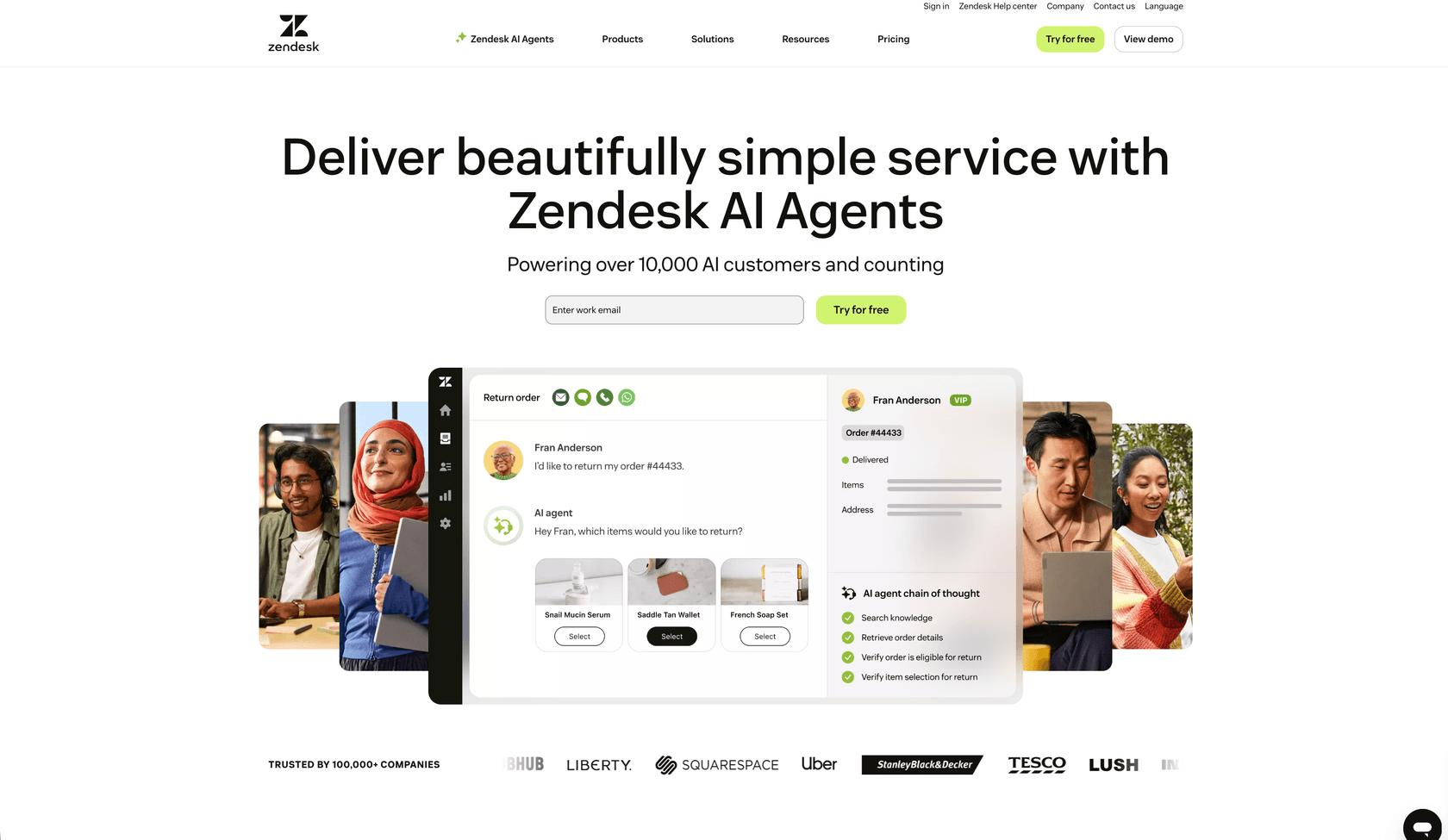
Zendesk is a household name in customer experience, and for good reason. It is a mature, powerful platform that gives you a massive suite of tools for ticketing, messaging, help centers, reporting, and more. Their AI agents are built to handle a high volume of conversations, and its app marketplace is huge.
The main strength of Zendesk is its massive ecosystem and its ability to scale with you. With over 1,000 integrations, it can connect to pretty much any other tool your business uses. Because it is so comprehensive, it offers a sophisticated depth of features that enterprise-grade teams rely on. While a thorough implementation ensures you get the most out of the platform, the results are a highly reliable and polished support operation. Zendesk offers tiered plans to match different team sizes and needs, ensuring that advanced features and AI capabilities are accessible as your requirements evolve.
- Pricing: The Suite Team plan pricing when you bill annually. For more features, the Suite Professional plan jumps to $115 per agent per month.
3. Freshdesk
Freshdesk is a fantastic choice for growing businesses that need a tool that is both powerful and easy to use. It has a clean, intuitive interface and affordable plans that can scale as your team gets bigger. Its AI offering, called Freddy AI, includes an AI Copilot that helps agents with things like summarizing long conversations and an AI Agent that can automate resolutions.
The biggest draw for Freshdesk is its impressive value and accessibility. As a mature and reliable platform, its plans are structured to scale beautifully as you grow, and the intuitive design means new agents can get up to speed in no time. Freshdesk's Freddy AI offers a comprehensive set of features that are built to handle enterprise-level demands. While some advanced AI capabilities are offered as tiered add-ons, this modular approach ensures you only pay for the specific high-powered tools your team needs to succeed.
- Pricing: Freshdesk offers a limited free plan which is great for trying it out. Paid plans pricing for the Growth plan (billed annually).
4. Sprinklr
Sprinklr is in a different league. It is built for huge enterprise companies that need to manage their customer experience across literally dozens of social media and digital channels. Its standout feature is its incredibly powerful AI-driven social listening, which lets brands track conversations and spot trends across more than 30 channels in real time.
The main pro of Sprinklr is its sheer scale and power for managing your brand's digital presence. However, this is an enterprise-level solution with the complexity and price tag to match. It is definitely overkill for most small and medium-sized businesses. Its heavy focus on public-facing social channels also might not be the right fit if most of your customer questions come through private channels like email or one-on-one chat.
- Pricing: Sprinklr does not list its prices publicly. You have to contact their sales team for a custom quote, which is typical for enterprise software tailored to large clients.
5. HubSpot Service Hub
For any business that is looking for a comprehensive support solution, HubSpot Service Hub is an excellent choice. It connects your customer service directly into HubSpot's powerful CRM, giving your team a complete, 360-degree view of every customer's journey. Its AI suite, called Breeze, includes a Customer Agent designed to help teams work more efficiently.
The biggest benefit here is having everything on a single, unified platform. When your support team can see a customer's entire history (from which blog posts they read to what they have purchased) they can provide much better service. HubSpot offers tiered plans to match your team’s size and growth, ensuring businesses can access advanced AI features as they grow. Their professional onboarding process is designed to guarantee long-term success and seamless integration into the HubSpot ecosystem, which is arguably the most mature and trusted marketplace for modern businesses.
- Pricing: HubSpot offers a solid set of free tools. Paid plans for the Service Hub Professional pricing are designed to scale with your business, with professional onboarding available to ensure you get the most out of your investment from day one.
How to choose the right customer experience tools for your team
Feeling a bit overwhelmed? Do not worry. Here is a simple way to think about picking the right tool for you.
-
Start with your biggest pain point first: What is the number one thing slowing your team down? If you are drowning in simple, repetitive tickets, an AI agent that can automate resolutions might be your top priority. If your agents are spending too much time typing out similar replies, an AI copilot that drafts answers for them is a great place to start.
-
Prioritize a fast and risk-free setup: The best tool in the world is useless if your team does not use it. Look for platforms that offer a quick, no-code setup and a human-in-the-loop mode. That way, you can start seeing a return on your investment immediately without worrying about it messing up.
-
Think like you are hiring, not just buying: Does the tool learn and get smarter over time? Can you teach it and correct it as your business changes? The future of customer support is not about rigid, pre-programmed bots. It is about collaborative AI that works and learns alongside your human team.
-
Understand the total cost of ownership: Do not just glance at the monthly sticker price. Dig into the details. Are there hidden costs like per-resolution fees? Will you need to hire a developer to get it running? Are there mandatory, multi-thousand-dollar onboarding packages? A cheaper-looking tool can quickly become more expensive.
To see how different customer service tools stack up in action, this video from Help Scout provides a helpful walkthrough of some of the top options available right now.
[YOUTUBE_VIDEO: https://www.youtube.com/watch?v=NB7EUeFYb_Y]
Why the future of customer experience tools is a teammate
After looking at all these platforms, one thing is crystal clear: the whole idea of customer experience tools is changing.
It is no longer about just automating away tasks with clunky, rigid bots. The real magic happens when you augment your team with intelligent, collaborative AI that actually understands the context of a conversation, learns from feedback, and works right inside the tools you already use.
The best platforms do not feel like another piece of software you have to log into and manage. They feel like a new member of your team: one that is incredibly smart, never gets tired, and frees up your human agents to focus on the complex, high-value conversations that build real customer loyalty.
Ready to hire your first AI teammate? Invite eesel AI and see how it drafts replies to your real support tickets in minutes.

Frequently asked questions
For smaller teams, [eesel AI](https://www.eesel.ai/product/ai-chatbot) and [Freshdesk](https://www.freshworks.com/freshdesk/) are great options. eesel AI offers transparent interaction-based pricing that avoids per-agent costs, while Freshdesk has a free tier and affordable growth plans that scale as you do.
It varies by platform. Tools like eesel AI can be set up in minutes by plugging into your existing help desk. Larger suites like [Zendesk](https://www.zendesk.com/) offer a sophisticated range of features that are built to handle enterprise-level requirements, ensuring a robust and reliable foundation for your support.
Yes, many modern tools are designed to be "plug-and-play." eesel AI, for example, integrates directly with [Zendesk](https://www.zendesk.com/service/ticketing-system/) and [Freshdesk](https://www.freshworks.com/support/), allowing you to add AI capabilities without migrating your entire support operation.
Not necessarily. Many of the best customer experience tools in 2026 are [no-code platforms](https://cx.tools/). You can often connect them to your existing systems using one-click integrations or by simply pointing the AI to your documentation.
[AI-driven tools](https://www.cxnetwork.com/cx-experience/articles/customer-experience-tools) help your team handle higher ticket volumes without burning out. They can draft responses, summarize long threads, and even resolve common questions automatically, leaving humans free to handle more complex issues.
Share this article

Article by
Kenneth Pangan
Writer and marketer for over ten years, Kenneth Pangan splits his time between history, politics, and art with plenty of interruptions from his dogs demanding attention.
