Copy.ai vs Notion AI: Which AI writer should you choose?

Katelin Teen
Last edited January 26, 2026
Blink, and there’s another AI tool promising to revolutionize your workday. It feels like they're popping up everywhere, helping us write faster, organize our thoughts, and just get rid of the boring parts of our jobs. It's a big change, and it's happening fast.
Two of the biggest names you'll hear about are Copy.ai and Notion AI. On the surface, they seem pretty similar since they both use AI to help with text. But once you look closer, you'll see they’re built for completely different things. Copy.ai is a specialized platform made to run your entire go-to-market strategy, from sales emails to big marketing campaigns. Notion AI, on the other hand, is a productivity sidekick that lives inside the Notion workspace you might already be using for notes and projects.
Deciding between them isn’t about which one is better, but which one actually fits what you need to do. This guide will lay out the facts: what they do, who they’re for, and how much they cost. We’ll give you a clear, side-by-side comparison to help you choose the right tool for your work.
And hey, if your main goal is just to crank out high-quality, SEO-friendly blog content that brings in traffic, there are even more specialized tools for that. We'll also introduce the eesel AI blog writer as a great alternative designed specifically for that job.
What is Copy.ai?
Copy.ai calls itself the first AI-native Go-to-Market (GTM) platform. That sounds a bit corporate, but it just means it’s designed to plug AI into every corner of your sales and marketing efforts. Instead of juggling a bunch of different AI tools, Copy.ai aims to be the one-stop shop for your whole revenue team.
Its main purpose is to get sales, marketing, and operations on the same page, working from a unified playbook. It’s less about drafting a single email and more about building automated systems that can handle complex jobs. Think of it as the brain for your company's growth engine.
A few of its key features are built around this GTM idea:
- Prospecting Cockpit: This does more than just find contacts. It helps you research companies you want to target, find the right people to email, and write personalized outreach messages in way less time.
- Content Creation: It's focused on creating content that helps the sales process, like SEO-focused blog posts, thought leadership articles, and social media content.
- Inbound Lead Processing: When a new lead signs up, Copy.ai can automatically find more info about them and start an engagement sequence.
- Account-Based Marketing (ABM): It lets you create super-relevant marketing materials for specific companies you're targeting, making your ABM campaigns much more effective.
At its heart, Copy.ai is about turning your company's best practices into automated workflows and giving your revenue teams one platform to do their work.
What is Notion AI?
Notion AI is a totally different animal. It's an AI assistant built right into the Notion all-in-one workspace. If you're one of the millions who use Notion to organize everything from personal to-do lists to your company's knowledge base, Notion AI is meant to feel like a natural part of that.
It's not focused on external marketing or sales; it's all about making you more productive internally. It helps you write, brainstorm, edit, and summarize your thoughts without ever leaving the page you're on. It’s about making the work you already do in Notion a little faster and a lot smarter.
Here are a few features that show how integrated it is:
- AI Meeting Notes: You can automatically transcribe meetings, and Notion AI will whip up a clean summary with key takeaways and action items, all perfectly formatted on a Notion page.
- Enterprise Search: It can pull answers not just from your Notion pages but also from connected apps like Slack, Google Drive, and Figma. It becomes a single search bar for all your company's knowledge.
- Autofill Databases: If you use Notion's databases, you can have AI automatically fill in columns with summaries, insights, or data pulled from other fields.
The real value of Notion AI is its convenience. It’s right where your work already is, trying to be your "AI everything app" for thinking, planning, and creating.
Core focus and use cases in the Copy.ai vs Notion AI comparison
Copy.ai: The GTM and marketing specialist
Copy.ai is built for a very specific person: anyone whose job is to bring in money. This includes marketing teams, sales reps, and content creators focused on growth.
Ideal User: If your day involves finding leads, running campaigns, or creating content to attract customers, Copy.ai is for you.
Use Cases:
- High-Volume Copy Generation: Need to write 50 different versions of ad copy for a Facebook campaign? Or generate hundreds of product descriptions for an e-commerce site? Copy.ai has a ton of free tools built for these kinds of repetitive marketing tasks.
- Automated GTM Workflows: Using its no-code Workflow builder, you can set up complex, multi-step processes. For instance, you could build a workflow that finds new leads on LinkedIn, enriches their profiles with company info, and then drafts a personalized connection request.
- Powering Sales Prospecting: A sales rep can use Copy.ai to quickly scan a company’s latest earnings report, identify key challenges, and write a tailored outreach email that mentions those specific points, all in a few minutes.
Notion AI: The integrated productivity booster
Notion AI is for a much wider audience, but its biggest fans are those already deep in the Notion world. If Notion is your second brain, Notion AI is the assistant that keeps it tidy.
Ideal User: Existing Notion users, students, project managers, and any team using Notion as their central hub for docs, projects, and collaboration.
Use Cases:
- Actionable Meeting Summaries: You just wrapped an hour-long brainstorming session and have a page full of messy notes. With one click, Notion AI can turn that chaos into a clean summary with a bulleted list of action items and assign them to people.
- Kickstarting Projects: Say you're a product manager. You can use Notion AI to brainstorm new product ideas, generate a project outline, and create a timeline, all right inside your project planning doc.
- Instant Internal Answers: Instead of pinging a coworker on Slack to ask, "What's our expense report policy?" you can use Notion AI's Q&A feature to get an immediate answer pulled from your company's internal wiki.
Feature deep dive: A side-by-side comparison
To make it even clearer, let's put these two tools side-by-side. This table gives you a quick overview of where each one shines.
| Feature | Copy.ai | Notion AI |
|---|---|---|
| Primary Goal | Go-to-Market (GTM) workflow automation | Integrated workspace productivity |
| Best For | Sales & Marketing Teams | Existing Notion users, general productivity |
| Key Strength | Specialized, customizable GTM workflows | Seamless integration within the Notion ecosystem |
| Content Output | Sales emails, ad copy, SEO drafts, social posts | Summaries, outlines, internal docs, meeting notes |
| Ease of Use | 4.6 / 5 (according to users) | 4.3 / 5 (according to users) |
| Integrations | 2,000+ via Zapier, plus direct and API access | Deeply integrated with Notion; connects to apps like Slack & GitHub via AI connectors |
A look at content generation and templates
When it comes to creating content, their approaches are completely different.
-
Copy.ai: This is where Copy.ai's specialization is obvious. It offers a huge library of free, purpose-built generators for almost any marketing task you can imagine, from writing Google Ad copy to crafting cold sales emails. It's all about creating external-facing content designed to persuade people. Their "Content Agent Studio" even lets you build reusable content engines that automatically stick to your brand voice, which is a massive time-saver for marketing teams.
-
Notion AI: Notion AI's strength is in working with the content you already have. It’s great for summarizing a long document, expanding on a few bullet points to create a first draft, or translating a block of text. It's less focused on generating brand-new marketing copy and more on helping you shape your internal documents and ideas.
Workflow and user experience
The way you interact with each tool also says a lot about their core philosophies.
-
Copy.ai: The experience is built around its powerful, no-code Workflow builder. It feels like a command center where you can link different actions together to automate complex GTM tasks. You can set it up to research a lead, write an email, and schedule a follow-up, all on its own. It’s a solid, standalone platform that you log into for specific jobs.
-
Notion AI: The entire workflow is designed to be invisible and keep you inside Notion. You trigger the AI by hitting the spacebar or typing "/" on any page. This makes it feel incredibly smooth for tasks like turning meeting notes into action items or quickly drafting a project brief. It’s perfect for heavy Notion users who want AI help without switching apps, but it’s not really a tool you’d use by itself.
Copy.ai vs Notion AI: A pricing breakdown
The pricing models for Copy.ai and Notion AI clearly show who they're targeting. One is priced for business teams, while the other is an affordable add-on for people and teams already using a platform.
Copy.ai pricing
Copy.ai has a tiered structure that scales up with features and automation power.
- Free Version: While there isn't a permanent free plan for the whole platform, Copy.ai offers a bunch of completely free AI writing generator tools that are great for one-off tasks like creating a business name or writing a product description.
- Chat Plan: This plan starts at $29 per month and is for up to 5 users. It gives you unlimited words in the chat and access to different language models.
- Agents Plan: For teams that need automation, this plan starts at $249 per month for up to 10 users. It includes 10,000 workflow credits, which are used to run the automated GTM processes.
- Enterprise: For larger companies, there's custom pricing that includes advanced security, API access, and dedicated support.
Notion AI pricing
Notion AI’s pricing is much simpler since it's sold as an add-on to their existing workspace plans.
- Included in Plans: If you're on the Notion Business Plan (starting at $20 per user, per month) or the Enterprise Plan, Notion AI is already included.
- Free Trial: All Notion plans, including the free one, come with a limited number of free AI actions so you can try it out.
- Add-on: For users on the Free or Plus plans, you can add Notion AI for $10 per user per month. If you pay annually, the price drops to $8 per user per month, giving you unlimited access.
Potential limitations to consider
No tool is perfect for everyone. Based on user feedback and a look at their features, here are some points to keep in mind for each platform.
Limitations of Copy.ai
- Robotic Tone: A common complaint from users is that the AI-generated content can sometimes sound "too robotic" and lacks a natural, human feel. This usually means you’ll need to spend a good amount of time editing the output before it's ready to be seen by customers.
- Narrow Focus: Its specialization in GTM is both a strength and a weakness. It’s excellent for sales and marketing, but it’s not built for general productivity. If you need a tool to summarize meeting notes or help organize a personal project, Copy.ai is not the one.
- Higher Cost for Automation: The Chat plan is affordable, but the real power of Copy.ai is in its workflow automation. To get those features, you have to jump to the Agents plan, which is a big price hike and might be too much for smaller teams or solo entrepreneurs.
Limitations of Notion AI
- Not a Marketing Specialist: Notion AI is a generalist. It doesn't have the specialized templates, workflows, and optimization features needed for creating marketing content at scale. Its output isn't automatically optimized for things like SEO or conversions, so you can't just ask it to write a blog post and expect it to rank.
- Learning Curve: While the basic AI functions are simple, Notion itself is a deep platform. Some users find that when they try to add a new block, they’re hit with a "long scroll of options," which can feel like a lot if you're not already a power user.
- Dependent on the Notion Ecosystem: This is its greatest strength and its biggest weakness. Notion AI is fantastic if you live in Notion. But if your team uses Google Docs, Asana, or another tool as your main workspace, its value is significantly reduced.
It can't work as a standalone AI writer.You don’t have to build your whole life in Notion. Don’t try to replicate systems that already work really well for you.

An alternative for SEO blog content: The eesel AI blog writer
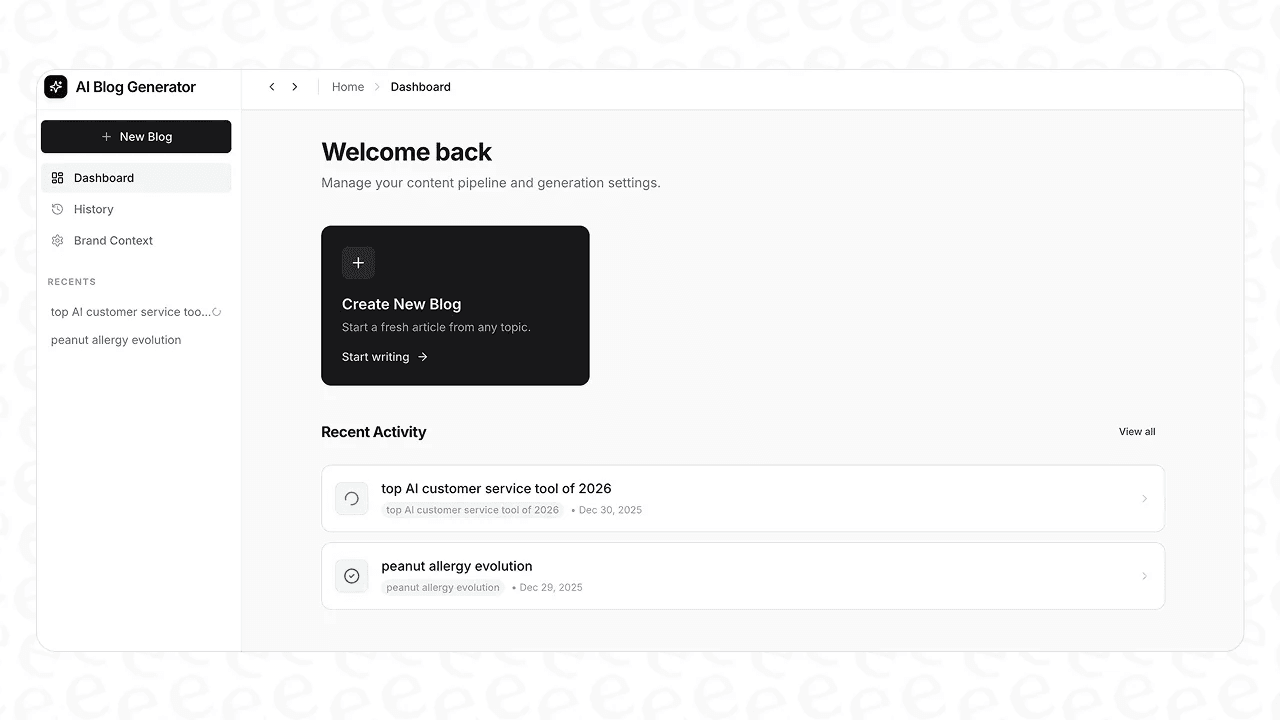
It’s designed with one specific goal: to turn a single keyword into a complete, SEO-optimized blog post that’s ready to go live.
Here’s how it’s different:
- Unlike Notion AI’s general-purpose writer, the eesel AI blog writer is a specialized tool built from the ground up to generate content that ranks on search engines.
- Unlike the drafts from Copy.ai, the eesel AI blog writer generates complete blog posts with everything you need: headings, FAQs, a human tone, and all the necessary assets included right away.
It's packed with unique features that are useful for content teams:
- Context-Aware Research: If you’re writing a comparison post, it automatically finds pricing data. For a product review, it pulls in technical specs. It understands the type of blog you’re writing and does the research for you.
- Automatic Assets: It doesn’t just give you text. It generates relevant images and infographics, creates tables, and even finds real Reddit quotes and YouTube videos to embed in your post, which helps with reader engagement.
- Answer Engine Optimization (AEO): The content is structured to perform well not just in traditional search results but also in Google’s AI Overviews and other AI answer engines, which is becoming more and more important.
- Proven Results: We used this exact tool to grow our own blog from 700 to 750,000 daily impressions in just three months by publishing over 1,000 optimized posts.
It's completely free to try. You can generate your first blog post in minutes and see the quality for yourself.
Copy.ai vs Notion AI: Which is right for you?
At the end of the day, the choice between Copy.ai and Notion AI is pretty simple once you know what you're looking for.
- Choose Copy.ai if you're a marketing or sales pro looking for a powerful platform to automate your GTM content and workflows at scale. It’s a specialist tool for revenue-focused teams.
- Choose Notion AI if you're already a heavy Notion user and want a seamless AI assistant to boost your productivity for internal tasks like summarizing notes and drafting documents.
But if neither of those sounds quite right, there's a third, more focused option:
- Choose the eesel AI blog writer if your main goal is to efficiently produce high-quality, SEO-optimized blog content that is ready to publish and designed from the ground up to attract organic traffic.
Give the eesel AI blog writer a spin for free and see how quickly you can go from a single keyword to a complete, traffic-driving article.

Frequently Asked Questions
Share this article

Article by
Katelin Teen
Katelin is an operations specialist at eesel where she uses her psychology training and education experience to optimize B2B SaaS processes. Outside of work, she unwinds with story-driven games, writing, and keeping up with latest tech innovations.