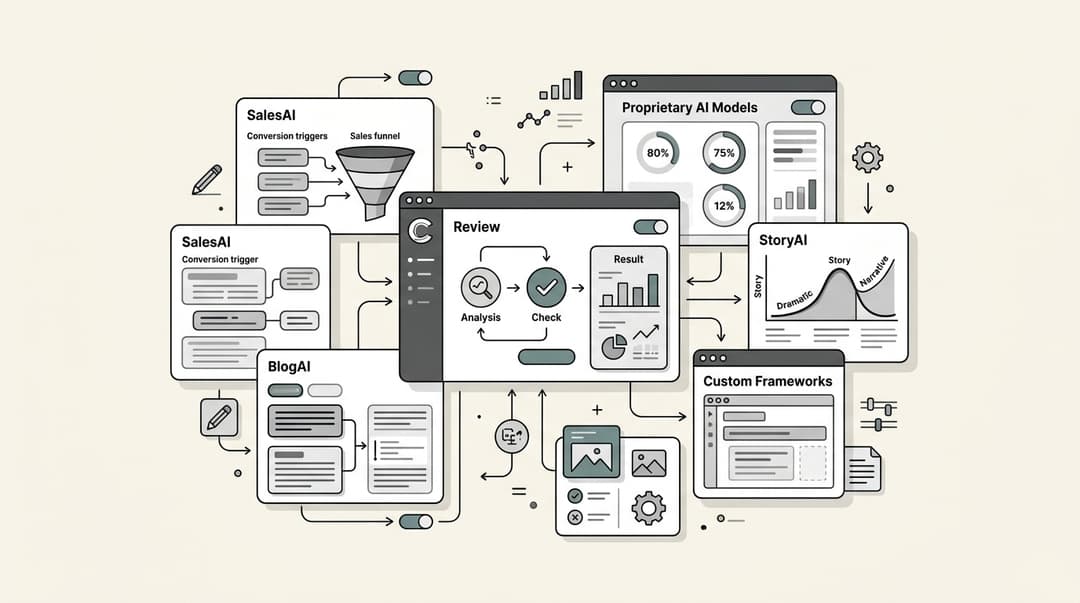
Copy AI vs Anyword: Which AI writer is right for you?

Stevia Putri

Katelin Teen
Last edited January 6, 2026
Trying to pick the right AI writing assistant can be a headache. There are dozens of tools out there, all promising the world, but they're often designed for completely different tasks. Take two of the biggest names, Copy.ai and Anyword. They might seem similar at first glance, but they’ve grown into tools that solve very different problems. One focuses on automating your entire go-to-market plan, while the other is highly focused on predicting how well your copy will actually perform.
This guide is here to cut through the noise. We'll compare them on everything from features and philosophy to who they're for and how much they cost. By the end, you should know exactly which one makes sense for you.
Understanding Copy.ai
Copy.ai isn't just for writing copy anymore. It's now calling itself the first AI-Native Go-to-Market (GTM) Platform. A better way to think about it is as a central hub for your marketing, sales, and ops teams. Their main goal is to get rid of "GTM Bloat", the challenge of managing multiple apps and manual tasks that can slow down operations.
At its heart, Copy.ai is built around Workflows. These are automations that can manage entire processes from beginning to end. For instance, you could use the Prospecting Cockpit to find and contact leads, set up automated content pipelines, or handle new inquiries the second they come in. It connects with over 2,000 other apps, so the idea is to bring your tech stack together. It’s less about writing faster and more about swapping out a bunch of separate tools for one platform that syncs up your team and smooths out operations.
Understanding Anyword
Anyword comes at it from a totally different angle. It’s a "performance writing" platform, meaning its job isn't just to generate text, but to tell you how well that text will resonate with your audience before you publish it. It’s built for marketers who live by the numbers and need to justify the ROI of every word.
Its signature feature is the Predictive Performance Score. As you write, Anyword grades your copy variations and predicts their conversion potential, claiming an impressive 82% accuracy. You can even train it on your company’s past campaign data, which lets it build custom AI models that know what kind of messaging clicks with your audience. The whole point is to stop the guesswork. Instead of throwing copy at the wall to see what sticks, you use data from past A/B tests to create new copy that's already optimized. Anyword says this can boost results by 30%, which is a pretty big deal for performance-driven teams.
Workflow automation vs. performance analytics
This is where you can really see the difference between Copy.ai and Anyword. It’s a classic dilemma: do you want massive operational efficiency, or do you want data-driven precision on every single message?
Copy.ai's approach: A GTM platform for automation
Copy.ai is thinking about the big picture. It’s set up to be an operational "assembly line" for your entire go-to-market strategy. It’s not just about writing one email; it’s about automating the whole chain of events that kicks off when a new lead appears. For example, a workflow can slash your speed-to-lead time by automatically enriching a new contact's info, researching their company, and firing off a personalized email, all in a matter of seconds.
Its main advantage is its sheer scope. It's made to manage everything from prospecting and account-based marketing to sales enablement and deal coaching. This makes it a solid choice for larger teams trying to consolidate their tools, connect data between departments, and scale up their operations. If your sales and marketing teams feel like they're juggling a dozen apps that don’t sync up, Copy.ai wants to be the glue that holds it all together.
The comprehensive scope is reflected in its marketing language, using terms like "GTM AI Platform" and "GTM Bloat". This extensive functionality might be more than needed for smaller teams or individuals seeking a simple writing tool without requiring a full workflow overhaul.
Anyword's approach: A data-scientist for your copy
Anyword, on the other hand, is like having a data analyst looking over your shoulder as you type. Everything it does centers on the Predictive Performance Score. This feature gives you instant feedback on different versions of your ads, emails, social posts, and landing pages. It doesn't just give a vague score; it can predict how your copy might perform with different audience segments and on channels like Meta, Google, and LinkedIn.
This is what makes it so valuable for performance marketers. It’s for anyone who needs to back up their content choices with data. It's ideal for A/B testing ad copy, tweaking headlines on a landing page, or just getting some confidence that your message will land before you put money behind it. You can even use it with other tools like ChatGPT to add a performance-scoring layer to content you've created somewhere else.
The trade-off is that its focus is much tighter than Copy.ai's. It’s a specialized tool for short-form, conversion-focused writing. If you need a general content writer or a complete business automation system, Anyword isn't it. It’s a scalpel, not a Swiss Army knife.
A deep dive into content creation and quality
So, when it comes to the actual writing, how do they compare? Let's see how they handle everything from long blog posts to short ad copy.
Long-form content and blog generation
Both tools can create articles and blog posts, but they go about it in different ways.
-
Copy.ai: The platform is geared toward producing high-quality SEO content quickly. It’s built for speed, letting you generate a first draft in just a few seconds. You can even give it an interview transcript and have it create a full article. But the output is definitely a "draft." It almost always needs a good amount of human editing to match your brand voice, check facts, and make it genuinely interesting.
-
Anyword: Anyword's Blog Wizard feels more like a partnership. You guide the AI through the process, starting with an an outline and then generating each section one by one. This gives you a bit more control over the final piece. It also has a built-in plagiarism checker, which is a nice feature for making sure your content is original.
-
The common gap: While both tools are decent at generating text, you still need to perform post-generation tasks. Turning a text-only draft into a finished blog post takes time. You have to find or create visuals, look for relevant data, add expert quotes, and format everything so it's easy to read.
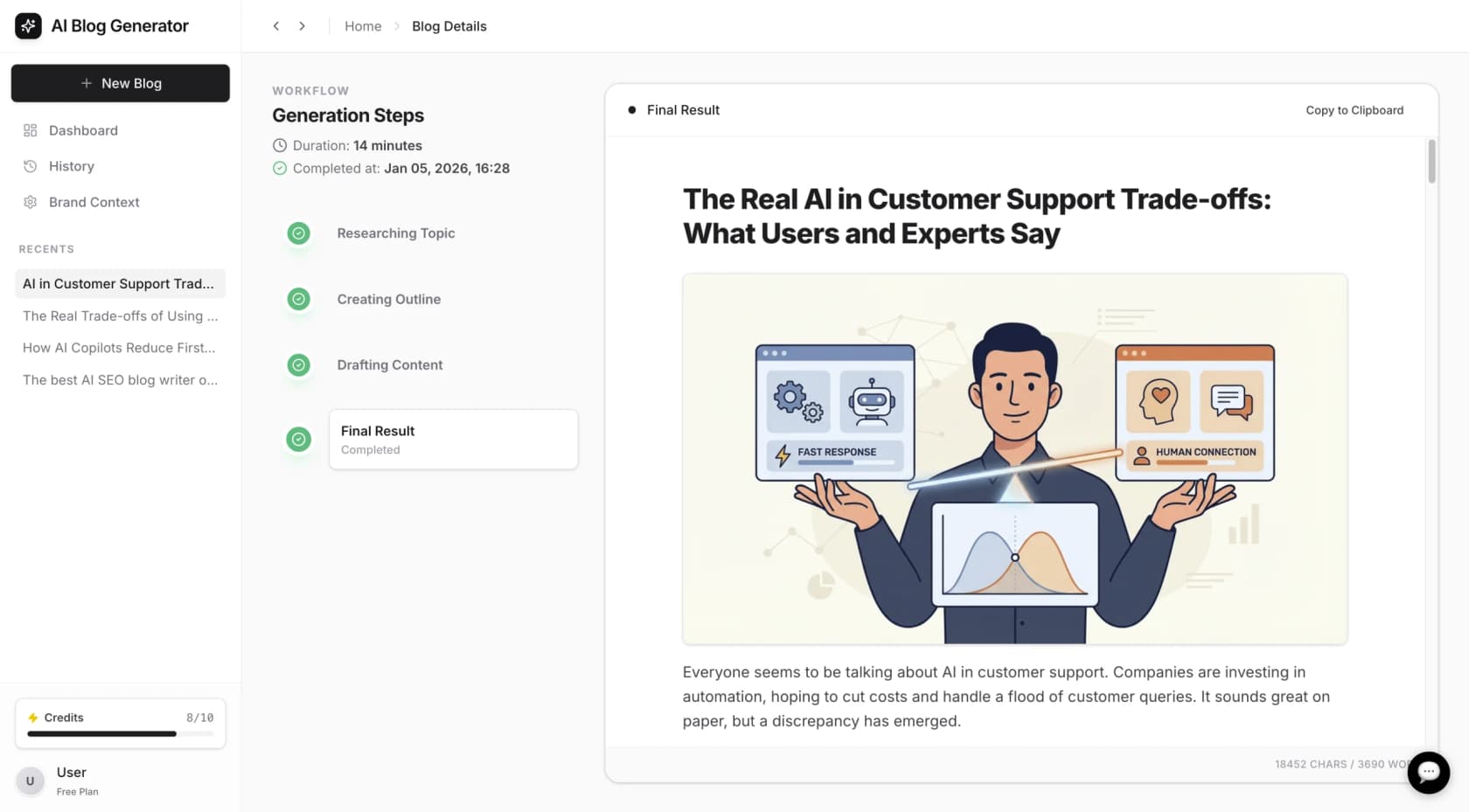
For teams looking for a more end-to-end solution, an alternative like the eesel AI blog writer focuses on generating a complete article. Instead of just a wall of text, it generates a full, SEO-optimized article that includes assets like images and tables, source links, and even real quotes from Reddit to add a human touch. It’s designed to cut down on the post-writing work so you can get from keyword to published article much more quickly.
Ad copy and short-form content
This is where the unique personalities of each platform really come out.
-
Anyword: This is Anyword's bread and butter. Its data-first approach is perfect for optimizing short copy. It has over 100 marketing templates for different ad platforms, from Facebook ads to email subject lines. The Predictive Performance Score is the main attraction, as it helps marketers choose the winning copy before a campaign goes live, which can save a lot of time and money.
-
Copy.ai: Copy.ai is also good at this, but its strength is more in generating a ton of creative options fast. It’s a great brainstorming tool for social media captions, product descriptions, and ad variations. Its real power comes when you use it inside its GTM workflows, like creating personalized outreach for Account Based Marketing campaigns.
I use copy.ai for inspiration, and to get my ideas flowing.. as for negatives.. sometimes the copy seems generic.

Pricing compared: What you get for your money
Both platforms have shifted from simple word-count pricing to more complex models that reflect what they do best. Here’s a look at how they stack up.
Copy.ai pricing plans
Copy.ai's pricing is tiered based on whether you get access to its automation features.
-
Chat Plan: This plan starts at $29 per month (or $24/month billed annually) for 5 seats. It gives you unlimited words in the Chat interface but does not include the Workflow automation features.
-
Higher Tiers: To get the full GTM platform, you'll need a higher-tier plan like Growth ($1,000/mo), Expansion ($2,000/mo), or Scale ($3,000/mo). These plans are priced by the number of seats and "Workflow credits," which you use up each time you run an automation.
-
Enterprise Plan: This is a custom-priced plan for big companies that need full API access, unlimited workflows, and extra support.
Anyword pricing plans
Anyword's pricing is all about its main feature: performance predictions.
-
Starter Plan: This one starts at $49 per month (or $39/month billed annually) for one person. You get unlimited word generation, but you're limited to only 50 performance predictions per month.
-
Data-Driven Plan: For $99 per month, you get 3 seats and up to 100 performance predictions.
-
Business/Enterprise: These are custom-priced plans that unlock the best features, like custom AI models trained on your own data, more predictions, and direct integrations with your marketing tools.
The key thing to notice is that while both platforms offer "unlimited words," the real value is what they measure. With Copy.ai, you're paying for automation via workflow credits. With Anyword, you're paying for its core feature, the performance predictions.
For a more visual breakdown of how these tools stack up, this video offers a side-by-side comparison of their features and ideal use cases.
The verdict: Is there a better alternative?
So, which tool is better in the Copy.ai vs Anyword comparison? The answer depends on your specific goals.
Choose Copy.ai if you need an all-in-one GTM automation platform. If you want to streamline processes across sales, marketing, and operations and bring your tech stack together, Copy.ai is made for you.
Choose Anyword if your main goal is to optimize conversion-focused copy with data. If you're a performance marketer who needs to prove the ROI of every campaign and get the most out of your ads and landing pages, Anyword is your personal data scientist.
However, this choice between automation and analytics can present a challenge for content marketing teams. Their biggest challenge isn't just writing text faster; it's creating high-quality, SEO-friendly blog content at scale that actually ranks and brings in traffic without sounding robotic.
This is where a different type of tool may be a better fit. Instead of just giving you text, the eesel AI blog writer is built to turn a single keyword into a complete, publish-ready blog post.
Here’s what makes it different:
-
Includes complete assets: The AI finds and adds relevant visuals, such as images, tables, and videos, directly into the article.
-
Integrates social proof: It incorporates relevant discussions from sources like Reddit to add a human perspective to the content.
-
SEO results: The eesel AI blog writer is the tool we used to grow our organic traffic from 700 to 750,000 daily impressions in three months by publishing over 1,000 optimized blogs.
For teams focused on growing through content that’s made to rank and connect with readers, the eesel AI blog writer offers a more direct route from keyword to published article. It's completely free to try, so you can see the quality for yourself.

Frequently asked questions
The main difference is their core purpose. Copy.ai is an automation platform for your entire go-to-market strategy (sales, marketing, ops), while Anyword is a performance writing tool focused on predicting how well your copy will convert before you publish it.
Anyword is the clear choice for performance marketers. Its Predictive Performance Score is designed specifically to help you optimize ad copy, landing pages, and emails for higher conversion rates using data-driven insights.
Yes, Copy.ai is built for this. Its Workflow feature is designed to connect different apps and automate complex processes across your sales and marketing teams, making it ideal for scaling operations.
Their pricing models are based on their core features. Copy.ai's higher-tier plans are priced based on "workflow credits" for automation. Anyword's plans are limited by the number of "performance predictions" you can run each month.
Both tools can generate blog drafts, but they require a lot of manual work to get them ready to publish. For teams focused on scaling SEO content, an alternative like the eesel AI blog writer might be more efficient as it creates a complete, publish-ready article with images, quotes, and sources included.
Absolutely. You could use Copy.ai to automate a content pipeline and then use Anyword to refine and score the short-form copy (like social media posts or ads) that promotes the content. They solve different problems, so they can be complementary.
Share this article

Article by
Stevia Putri
Stevia Putri is a marketing generalist at eesel AI, where she helps turn powerful AI tools into stories that resonate. She’s driven by curiosity, clarity, and the human side of technology.