

If you’re on a marketing or SEO team, you know the feeling. You need a steady stream of high-quality, well-researched, and SEO-friendly articles to have any hope of staying competitive. But actually producing that content takes a staggering amount of time and effort.
This is where a content AI blog post wizard tool can step in. Think of it as a powerful assistant that can take a simple keyword and help you spin it into a full article in a fraction of the usual time.
In this guide, we'll walk through what these tools are, the features that actually matter, and how to pick the right one for your team. We'll look at how a modern AI blog wizard can be much more than a text generator, becoming a real part of your content strategy.
What is a content AI blog post wizard tool?
A content AI blog post wizard tool is a smart application that helps automate the entire process of creating a blog post. Unlike a basic AI writer that just spits out paragraphs when you give it a prompt, a wizard guides you (or itself) through all the key steps: from the initial research and outlining to drafting, formatting, and getting it ready for search engines.
It's less of a simple writing tool and more of an automated content strategist. You give it a topic or a target keyword, and it does the heavy lifting. The tool will often analyze top-ranking articles for that keyword, figure out the important themes and common questions, structure the article with logical headings, and then write the content in a surprisingly natural tone. The whole point is to give you a draft that’s nearly ready to publish, saving you hours of manual work.
Key features to look for in a content AI blog post wizard tool
Not all AI blog tools are built the same. Some are great for generating a few paragraphs of text, while others have a whole toolkit of features designed to produce content that actually ranks and keeps readers on the page. Here’s what you should be looking for.
Deep research and SERP analysis
A good AI blog writer doesn't just pull ideas out of thin air. It should start by analyzing the current top-ranking pages on Google (the SERPs) for your keyword. This helps it understand what people are looking for, what subtopics are covered, and how the best articles are structured. This bit of reverse-engineering makes sure the content it creates is both relevant and thorough. Instead of you spending hours scrolling through search results, the tool does the strategic prep work for you, creating an outline that’s already on the right track.
Automatic asset and link integration
A great blog post is more than just a wall of text. The best tools understand this and automatically add relevant media to make articles more readable and engaging, which search engines tend to like.
Finding the right YouTube video to embed or the perfect internal link to add is one of those tedious tasks that can really slow you down. A top-tier tool can handle this for you, suggesting or even automatically adding internal links to your other blog posts to improve your site's structure. It should also be able to cite credible external sources to build authority and trust. Some of the more advanced tools can even pull in real quotes from forums like Reddit, which adds a layer of authenticity and makes the article feel more connected to real-world conversations.
Genuine human-like tone and quality
This is the big one. It's where a lot of AI tools stumble, producing robotic or generic "AI slop." The internet is already overflowing with low-quality, machine-generated articles that don't help anyone. You need a tool that has been fine-tuned to write in a natural, conversational style. The goal is to get a draft that needs very little editing and sounds like it was written by someone who knows their stuff and actually cares about the topic, not just a machine filling a page with words.
Built-in SEO and AEO optimization
A wizard tool should be designed with search engines in mind from the start. This goes beyond just repeating your keyword over and over.
For SEO, it should naturally place your target keyword in the title, headings, and body of the article. Just as importantly, it should also generate an optimized meta title and meta description to help you get more clicks from the search results page.
For AEO (Answer Engine Optimization), it's all about making your content answer questions directly. As search becomes more conversational, this is incredibly important. A modern tool will often include an FAQ section that answers common questions on your topic, optimizing the content for voice search and Google's "People Also Ask" snippets.
A look at popular content AI blog post wizard tools
The market for AI writing assistants is getting pretty crowded, and it can be tough to tell them apart. While many tools promise to create content, what they actually deliver can vary a lot. Let's look at a couple of options.
General-purpose AI writers like GetGenie and Anyword
Tools like GetGenie.ai have features like a "One-click Blog" that streamlines the process inside WordPress. It will generate a title, intro, and outline before writing the rest. Anyword has a different angle, focusing on training its AI on your own top-performing content to match your brand voice, and it gives you an instant SEO score.
These tools are helpful, but they often act more like assistants that still need a lot of direction. The research might not be as in-depth as a tool that does a full SERP analysis for every article. They also tend to focus on generating the text, leaving it up to you to find and add rich media like videos or quotes from real people. They help you write faster, but they don't always hand you a finished product.
The eesel AI alternative: A comprehensive approach
While other tools help you write, the eesel AI Blog Writer was built to be a complete content machine. We developed it to solve the biggest problem our own content team faced: creating deeply researched, SEO-optimized, and engaging content at scale without spending all day on it.
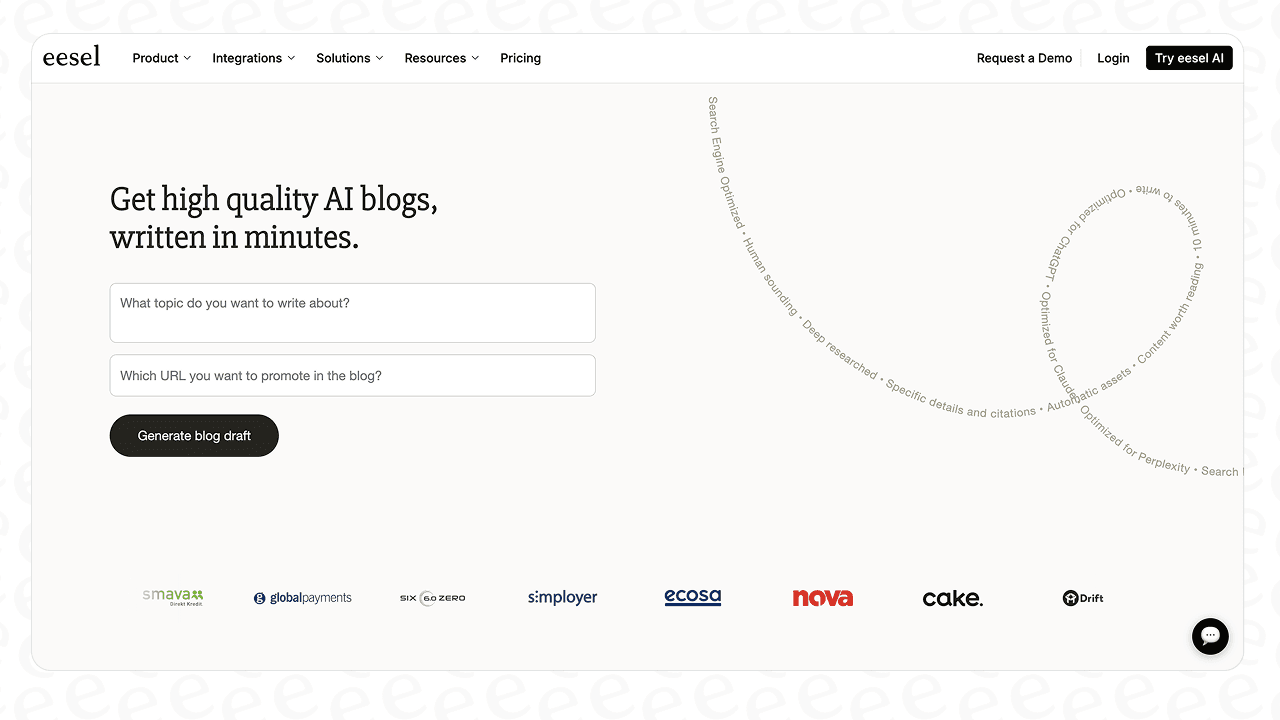
You give it a single keyword, and it handles the rest:
-
Deep SERP Analysis: It studies the top results for your keyword to build a data-driven outline that’s designed to compete.
-
Automatic Asset Integration: It finds and embeds relevant YouTube videos and authentic Reddit quotes to add depth and a human touch.
-
Full SEO & AEO Package: It generates a fully optimized blog with the right heading structure, natural keyword placement, a FAQ section, a meta description, and even social media posts to share it.
-
Proven Results: We don’t just offer this tool, we use it ourselves at eesel AI. This is the exact tool that helped our blog grow from 700 to 750,000 impressions per day in just three months. This isn't just a theory, it's a proven way to drive organic growth.
Our goal isn't just to assist you; it's to automate the 90% of the work that keeps you from scaling your content.
Understanding AI blog wizard pricing and scalability
Let's talk about cost. Pricing for these AI tools can be a bit of a minefield, and it's important to know what you're getting into so you don't hit a wall later.
Common pricing models
Most tools run on a subscription model with different tiers. For instance, AIWizard.pro offers a free plan with a 2,000-word monthly limit, and its paid plans increase the word and image caps for a monthly fee. You might pay $6.90/month for 100,000 words or $16.90/month for 300,000 words. This is a common setup, but it can be limiting. Hitting your word count in the middle of the month can bring your whole content schedule to a halt unless you upgrade, which makes your budget unpredictable.
The hidden costs and limitations
Word counts aren't the only catch. Some plans might limit how many articles you can create, lock away "pro" templates, or put a cap on how many SEO reports you can run. These little limitations add friction and can stop you from producing content as quickly as you want. What looks like a cheap plan at first can get expensive or just plain inefficient as your team grows.
eesel AI's approach: Free and feedback-driven
The eesel AI Blog Writer is currently free to use. We're actively looking for feedback from content creators and marketers like you to help us make it even better. This lets you experience the full power of a comprehensive blog wizard without worrying about word counts or locked features. It’s a completely risk-free way to boost your content strategy and see the results for yourself.
Choosing the right content AI blog post wizard tool for real results
A content AI blog post wizard tool can make a huge difference for your SEO and content marketing, but only if you choose the right one. Don't settle for a basic text generator that creates generic content you have to spend hours rewriting. Look for a solution that automates the whole workflow, from the deep research and SEO work to adding interesting assets and writing in a human-like voice.
By focusing on tools that deliver high-quality drafts, you can save a ton of time, publish more consistently, and get the kind of results we did.
Ready to see what a real AI content engine can do?
Try the AI Blog Writer that took our site from 700 to 750k daily impressions. It’s free, and we’re looking for your feedback to make it the best AI content tool out there. Get started with the eesel AI Blog Writer today!
Frequently asked questions
What exactly is a content AI blog post wizard tool, and how does it differ from a standard AI writer?
A content AI blog post wizard tool is an advanced application that automates the entire blog post creation process, from research and outlining to drafting and SEO optimization. Unlike a basic AI writer that just generates text, a wizard guides the full workflow to produce a near-publishable draft.
What are the most crucial features I should look for when evaluating a content AI blog post wizard tool?
Prioritize tools with deep research capabilities, including SERP analysis, and automatic integration of assets like videos and internal links. Crucially, look for genuine human-like tone and quality, along with built-in SEO and AEO optimization to ensure content performs well in search.
Can a content AI blog post wizard tool truly generate content that sounds human and engaging, not robotic?
Yes, the best content AI blog post wizard tools are fine-tuned to write in a natural, conversational style, avoiding generic "AI slop." The goal is to produce drafts that require minimal editing and sound like they were written by an expert, providing real value to readers.
How does a content AI blog post wizard tool optimize content for search engines and answer engines?
A robust content AI blog post wizard tool naturally places your target keyword in key areas like titles and headings, and generates optimized meta descriptions. For AEO, it often includes FAQ sections to directly answer common questions, improving visibility for voice search and "People Also Ask" snippets.
Will using a content AI blog post wizard tool genuinely help my team scale content creation and save time?
Absolutely. By automating deep research, outlining, drafting, and optimization, a comprehensive content AI blog post wizard tool can reduce content production time by hours per article. This allows your team to publish more consistently and achieve significant organic growth.