Trying to pick an AI content tool can feel like scrolling through Netflix for an hour: too many options, and they all seem promising. Two names you will see everywhere are Claude and Writesonic. You have Claude, the AI assistant from Anthropic that writes with a surprisingly human touch. Then there is Writesonic, a platform designed to get your content ranking on Google and showing up in AI search.
So, which one do you go with? This guide will help you sort it out. We will lay out a clear Claude vs Writesonic comparison, looking at what each one does best, who they are for, and what they will cost you. The idea is to help you find the right fit for what you actually need to do.
A successful content workflow often involves using a tool that builds on your own expertise. That is why we created the eesel AI blog writer. It is made to produce high-quality, publish-ready articles that sound like your brand, helping you avoid the generic AI-generated content that is becoming more common online.
What is Claude?
Think of Claude as a smart creative partner. It was developed by Anthropic as a next-gen AI assistant to help with complex and creative tasks. Its main selling point is its knack for generating nuanced, natural-sounding text that often reads like a person wrote it.
Its core strengths are its advanced conversational abilities and sophisticated writing style. You can feed it long, complicated documents, and it can analyze, summarize, and chat with you about them. This makes it a fantastic sidekick for writers, researchers, developers, and any professional who needs a quality assistant for drafting, brainstorming, and exploring ideas where the quality of the writing really counts.
Here are a few of its key features:
- Large context window: Paid plans offer a huge 200K token context window. In simple terms, that means it can process and remember information from documents up to about 500 pages long.
- Integrations: It works well with tools you are probably already using, connecting to Google Workspace, Slack, and even Excel to fit into your current workflow.
- Multi-platform access: You can use Claude on the web, iOS, and Android, and there is a Chrome extension for browser-based tasks.
The main downside? Claude has daily usage limits, even on its paid plans. And since it is a general-purpose AI, it lacks the specialized SEO and marketing tools needed to create content designed to rank in search engines.
What is Writesonic?
If Claude is your creative partner, Writesonic is the all-in-one marketing engine. It is an AI platform built for marketers, SEO pros, and anyone focused on getting their brand noticed. Its main objective is to boost your visibility not just on traditional search engines (SEO), but also on AI search platforms like ChatGPT and Gemini, a new area called Generative Engine Optimization (GEO).
Writesonic's strength is its complete toolkit. It is loaded with features to help you produce a high volume of search-optimized content efficiently. This makes it a great choice for marketing teams, SEO specialists, and agencies focused on driving organic traffic, climbing search rankings, and monitoring their brand’s presence in AI-powered search results.
Here is a peek at what it offers:
- AI visibility tracking: This feature shows you how your brand is mentioned across platforms like ChatGPT, Perplexity, and Google AI Overviews.
- SEO & content engine: It comes with an AI Article Writer, keyword research tools using Google Keyword Planner data, and a content optimizer that gives an SEO score.
- SEO site audits: You can scan your website to find and fix technical SEO issues with AI-driven suggestions.
The trade-off is that the output may require human editing to add a unique brand voice and avoid a generic feel. It is good at producing a solid first draft, but you will likely need an expert to give it that final polish.
Claude vs. Writesonic: A feature comparison
Content quality
- Claude: It excels at producing sophisticated, natural-sounding prose that often needs very little editing for tone. It is a fantastic creative partner, but you will need to be a skilled prompter to get it to generate strategic, SEO-focused content.
- Writesonic: The content it produces is structurally optimized for search engines right away. However, it can sound formulaic and often needs a human touch to add personality and fix any stiffness to match your brand's voice.
At the end, I ended up not using their content because it didn’t meet my personal quality standards. You get a full article with images that actually look nice, but they didn’t match my brand style, so I deleted them. Writesonic also pulled quotes from competitor websites. Since those weren’t real expert quotes, I removed them as well.

Core purpose and audience
- Claude: This is a general-purpose AI assistant for individuals and teams who need a top-tier collaborator for creative writing, coding, or in-depth document analysis.
- Writesonic: This is a specialized platform for marketing and SEO teams. Their main goal is to drive traffic and improve rankings, and track brand visibility in the new world of AI search.
Research and SEO capabilities
- Claude: It does not have any native SEO tools. Its research skills are limited to analyzing documents you provide and performing web searches, but it lacks a built-in strategic SEO framework.
- Writesonic: This is where it really shines. The platform is a complete marketing suite with tools for keyword research, competitor analysis, content optimization, technical site audits, and even tracking brand mentions in AI search.
Workflow and ease of use
- Claude: It has a simple, conversational chat interface that is easy to jump into. However, creating high-quality, specific content requires learning some advanced prompt engineering.
- Writesonic: It offers a template-driven workflow that is very friendly for beginners who want to generate first drafts quickly. The only potential issue is that the sheer number of features can feel a bit overwhelming at first.
| Feature | Claude | Writesonic |
|---|---|---|
| Best For | Creative writing & document analysis | SEO content & AI search visibility |
| Writing Quality | Highly nuanced, human-like prose | Structured for SEO, can be formulaic |
| SEO Tools | None | Comprehensive SEO & GEO suite |
| Ease of Use | Simple interface, requires prompt skill | Template-driven, feature-rich dashboard |
| Key Strength | Sophisticated text generation | All-in-one marketing & visibility platform |
Pricing breakdown: Claude vs. Writesonic
Claude pricing
- Free: You can use it for free, but with daily usage limits that change depending on server traffic.
- Pro: $20/month (or $17/month annually) gets you 5x more usage and access to the latest models.
- Max: Starts at $100/month for much higher usage limits and priority access.
- Team: Starts at $25 per seat/month (paid annually) with a 5-member minimum.
Writesonic pricing
- Free Trial: You can test out the platform before buying.
- Lite: $49/month (or $39/month annually) for individuals and freelancers.
- Standard: $99/month (or $79/month annually) for small teams.
- Professional: $249/month (or $199/month annually) for growing brands. This is the first plan that includes AI Search Visibility (GEO) tracking.
- Advanced: $499/month (or $399/month annually) for scaling teams that need deeper GEO insights.
Value proposition
- Claude: It is a great value for individuals and teams who need a top-notch writing assistant for creative, technical, or analytical work and are not focused on SEO.
- Writesonic: It offers solid value for businesses and marketing agencies that can leverage its full suite of SEO, content, and AI search visibility tools to justify the higher cost.
An alternative approach: The eesel AI blog writer
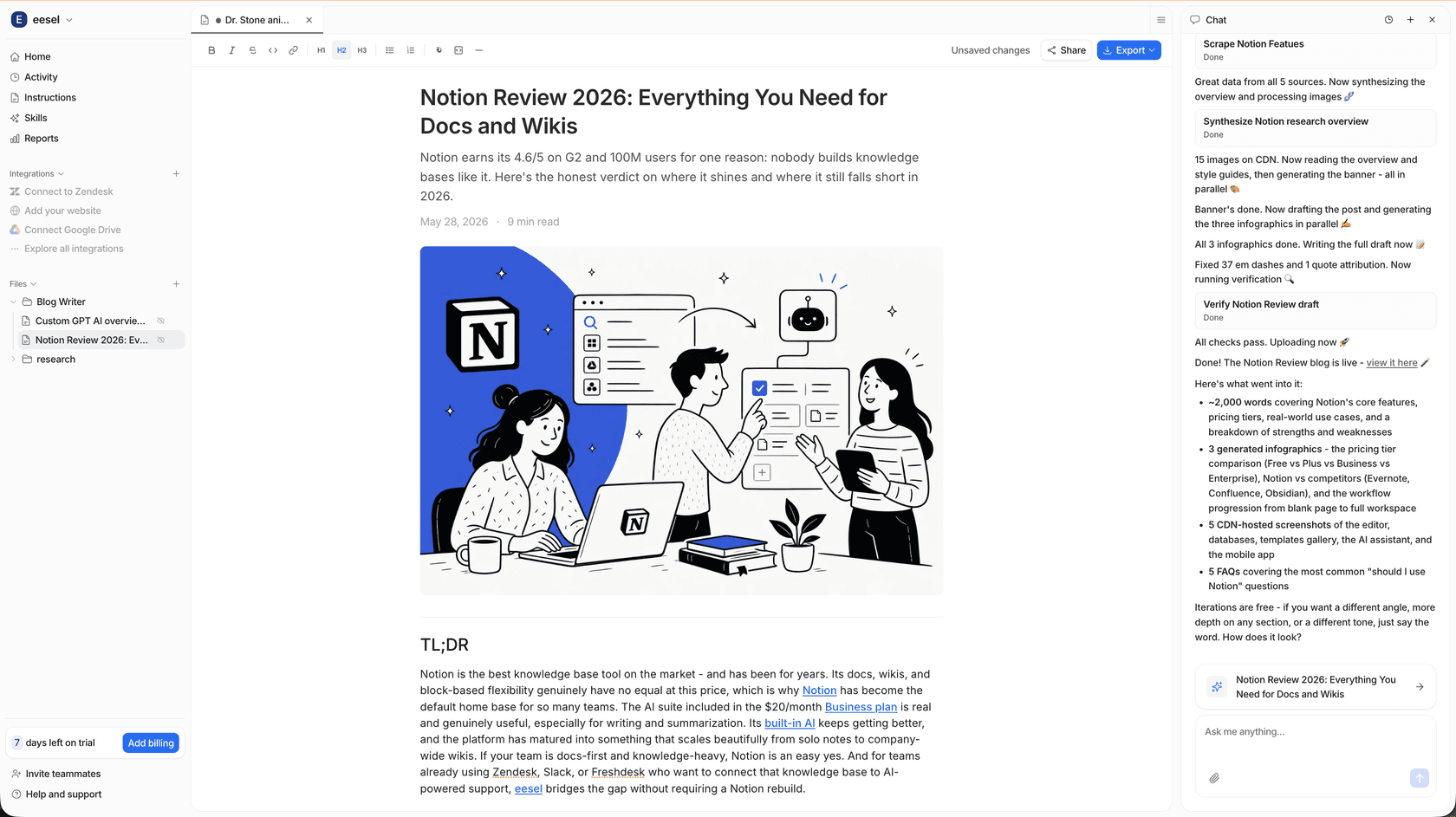
The eesel AI blog writer is built to do just that. It is designed to create content that is genuinely yours and ready to publish.
Here is what makes it different:
- Starts with your expertise: eesel AI learns your brand voice automatically by scanning your website. You can then add specific context and guidelines to ensure the final article is a perfect match for your brand.
- Generates a complete post, not just text: It does not just give you a wall of text. It creates a fully structured, publish-ready article with AI-generated images, infographics, and tables. It even finds and embeds relevant YouTube videos and real Reddit quotes to add social proof.
- Built for modern search (SEO & AEO): The content is optimized for Google (SEO) and also for AI Answer Engines like Google AI Overviews and Perplexity. It is the same tool we used to grow our own traffic from 700 to 750,000 impressions in just three months.
- Context-aware research: It is smart enough to know what kind of information a post needs. For instance, if you are writing a comparison post, it will automatically find and include relevant pricing data.
The best part? It is completely free to try. You can head over to https://eesel.ai/ai-blog-writer and generate your first high-quality, publish-ready blog post in minutes.
For a more dynamic look at how these tools perform, a video comparison can be invaluable. The video below offers a direct walkthrough of Writesonic and Claude, highlighting their user interfaces and content outputs side-by-side.
Final verdict: When to choose Claude vs. Writesonic
Let us wrap this up with a clear recommendation for each tool.
- Choose Claude if: You are a writer, developer, or researcher who needs top-quality writing for long, complex documents. If you enjoy crafting prompts and want a creative AI partner, Claude is your best bet.
- Choose Writesonic if: You are a marketer or SEO specialist with one main goal: produce content at scale that ranks on Google and gets your brand seen in AI search. If you need an all-in-one platform for traffic and visibility, Writesonic is built for you.
- Consider eesel AI if: You want to reduce heavy editing and generic content. The eesel AI blog writer is perfect if you want to create complete, publish-ready blog posts that reflect your brand's expertise and are optimized for modern search, all in one go.
Finding the right AI tool
At the end of the day, the best AI tool is the one that fits your goals and workflow. Claude is a powerful writing assistant, and Writesonic is a comprehensive platform for SEO and AI visibility. Both can be effective but may require human guidance and editing to get the final product just right.
This is where a human-led tool like the eesel AI blog writer offers a different way forward. It is designed to amplify your expertise, not replace it, helping you create authentic, high-quality content more efficiently.
You can generate a complete, SEO-optimized blog post for free with the eesel AI blog writer and see the difference for yourself.
Frequently Asked Questions
What is the main difference in the Claude vs Writesonic comparison for a marketing team?
In the Claude vs Writesonic debate, which tool is better for creative writing?
How does pricing factor into the Claude vs Writesonic decision for a freelancer?
When considering Claude vs Writesonic, which one has better SEO features?
If I am new to AI tools, which is easier to use in the Claude vs Writesonic matchup?


Article by
Rama Adi Nugraha
Rama is a software engineer at eesel AI with two years of experience writing about B2B SaaS, AI tools, and customer support technology. Based in Bali, Indonesia, he brings a developer's perspective to product comparisons — cutting through marketing copy to what the integrations and APIs actually do.