What Claude Artifacts are
Artifacts are substantial, self-contained things Claude creates for you to reuse or edit: documents, code, single-page HTML sites, SVGs, diagrams, flowcharts, and interactive React components. In Claude and Claude Desktop, the Artifact opens in a dedicated window to the right of the conversation. You can ask for changes, switch versions, and, for a Markdown document, select text and ask Claude to edit that exact passage. Anthropic’s current help article describes those controls.
To use Artifacts, turn on Code execution and file creation in Claude’s capabilities settings. That setting is required on individual plans; Team and Enterprise owners can enable it for the organization. An Artifact made in a chat does not automatically appear in the sidebar. Publishing adds it to your Artifacts space.
Five Claude app ideas that fit Artifacts
1. A calculator or estimator
Ask for a small tool with named inputs, visible assumptions, validation, and a plain-language explanation of the output. A project-cost estimator or capacity planner is a good fit when the formula is known and someone can check it.
Test empty fields, zero, very large values, unexpected text, rounding, and the formula against a hand-worked example. A polished interface does not prove the calculation is right.
2. A single-page site or prototype
Artifacts can make a landing-page draft, internal directory, event page, or a compact product prototype. Give Claude the audience, the one job the page must do, the content that is approved, and the states it needs to handle.
Treat the result as a prototype until you have separately checked mobile layout, links, accessibility, analytics, authentication, security, and hosting. An Artifact can demonstrate an interaction; it does not automatically supply a production release process.
3. A data visualizer
Use an approved CSV or a small, understood dataset to build a chart or exploration tool. Tell Claude what every column means, the time zone and date range, the required aggregation, and the question the chart should answer.
Then compare the output with the source data. Check filters, labels, totals, missing values, and whether a rate has been confused with a count. This is especially important when a visual may influence a decision.
4. A learning activity
A quiz, flashcard app, coding tutor, or guided study tool works well when the subject matter has a clear owner. Artifacts are suited to an interactive experience that adapts its wording or questions as the person uses it.
Keep the first version narrow. Have a subject-matter reviewer test correct answers, wrong answers, scoring, and the feedback users see. Do not publish a study tool just because the interaction feels convincing.
Anthropic’s public flashcard Artifact is a useful example of this category. Open the official example.
5. An AI-powered or connected app
AI-powered Artifacts can let a user interact with Claude inside the app. The app runs on Anthropic’s infrastructure, and each user authenticates with their own Claude account. Their use counts against their own Claude limits, not the creator’s.
Current Artifacts can also use MCP on supported Pro, Max, Team, and Enterprise web and desktop plans. MCP can connect an Artifact to tools such as Asana, Google Calendar, or Slack, but each user authenticates a server and approves tool access for themselves. An organization admin can allow or disable Artifact MCP access, but does not choose a user’s individual servers. Anthropic’s MCP guidance is the source for those plan and approval details.
Persistent storage is also available on those supported plans for published Artifacts. Choose personal storage when each person should see only their own data, and shared storage only when everyone should see the same data. Storage is text-only, limited to 20 MB per Artifact, and cannot be tested successfully until the Artifact is published. Unpublishing permanently deletes its stored data, as the current support guidance explains.
Publish publicly or share inside your organization
Free, Pro, and Max users can publish an Artifact and copy a public link. Anyone can use its ordinary features; an AI-powered feature asks the visitor to sign in. Team and Enterprise users instead share Artifacts within their organization, where viewers sign in and project-created Artifacts also require project access. Anthropic’s sharing documentation distinguishes these two paths.
For a public Artifact, confirm the exact version, click Publish, and then copy the link. You can allow an Artifact to be embedded only on domains you list in its Allowed domains field. If you unpublish it, the link is revoked, the same Artifact cannot be published again, and any persistent-storage data is deleted.
For an internal Artifact, click Share and then Share & copy link. Check the originating conversation first: internal viewers can also access attachments and files from that conversation. Cowork Artifacts have their own rules, so do not assume that a Claude or Claude Desktop sharing control applies to Cowork.
Artifacts in Claude Code are a separate sharing surface
Claude Code has a separate Artifact viewer and sharing flow. The screenshot below comes from Anthropic’s Claude Code Artifacts documentation, not from the Claude or Claude Desktop Artifact flow described above. Do not use its audience or version controls to infer the public-publishing or internal-sharing rules for the five app types in this guide.

Claude Code’s Artifact viewer and Share menu, shown in Anthropic’s Artifacts documentation.
A release checklist for a Claude app
Before sharing, name the owner and answer these questions:
- What is the one job this Artifact does, and what should it never claim or do?
- Which Artifact version was tested, with which inputs and expected results?
- Does it use Claude, MCP, personal storage, or shared storage? If so, has the user-facing permission and data behavior been reviewed?
- Is the selected path public publishing or internal sharing, and is the link intended for that audience?
- If it is public, have you checked the allowed embed domains? If it is internal, have you checked the conversation attachments?
- Can the owner revoke the link or unshare it, and do they understand the storage consequence of unpublishing?
Use eesel CLI to review a Claude Artifact
If a content lead wants a second set of eyes on an approved Artifact brief, they can use the eesel CLI from a terminal. It operates the same eesel teammate and workspace as the dashboard, rather than creating a separate reviewer. That makes it useful for a person, a script, or a coding agent such as Claude Code, Codex, or Cursor.
First, the owner writes a brief containing the Artifact’s purpose, approved source links, audience, limitations, test cases, and claims it must not make. For an estimator, include the approved formula and rounding rule alongside the current app’s calculation excerpt and displayed copy. If the example’s annual estimate should be monthly price × 12, the teammate can flag a different multiplier or a missing “not a quote” disclaimer. The owner can ask the eesel blog-writing teammate to propose corrected copy and a test checklist. Its JSON response is readable by a script or coding agent, but does not replace running the calculator.
The CLI needs Node.js 18.17 or newer. Use the existing workspace and replace the placeholder with an actual non-production teammate’s name or ID. Before starting, its owner confirms in the dashboard that consequential actions are unavailable or disabled for this review. Read the setup and billing before authorizing the upload and paid chat.
# Sign in once, then inspect the existing workspace and teammate.
npx @eesel/cli login
npx @eesel/cli status --agent "<your blog-writing teammate>"
npx @eesel/cli instructions --agent "<your blog-writing teammate>"
npx @eesel/cli files ls --agent "<your blog-writing teammate>"
npx @eesel/cli billing --agent "<your blog-writing teammate>"

# Preview the upload request before making a workspace change.
npx @eesel/cli files upload ./artifact-release-brief.md --agent "<your blog-writing teammate>" --dry-run

# After the owner approves the brief upload, run the review task.
npx @eesel/cli files upload ./artifact-release-brief.md --agent "<your blog-writing teammate>"
npx @eesel/cli files ls --agent "<your blog-writing teammate>"
npx @eesel/cli chat "Check the estimator formula, annual-price multiplier, rounding rule, and not-a-quote disclaimer against artifact-release-brief.md. Return unsupported claims, missing test cases, data and sharing risks, and a release checklist. Do not contact anyone or take external actions." --agent "<your blog-writing teammate>"
Confirm that the uploaded file is listed before starting chat. Its filename in the prompt is a natural-language request, not a special attachment selector. The owner still tests the Artifact in Claude and checks the real share link. --dry-run previews a write, while prerequisite reads still run. A prompt that says “do not take external actions” is not a permission control; any later external work needs separate authorization and verification in the connected service.
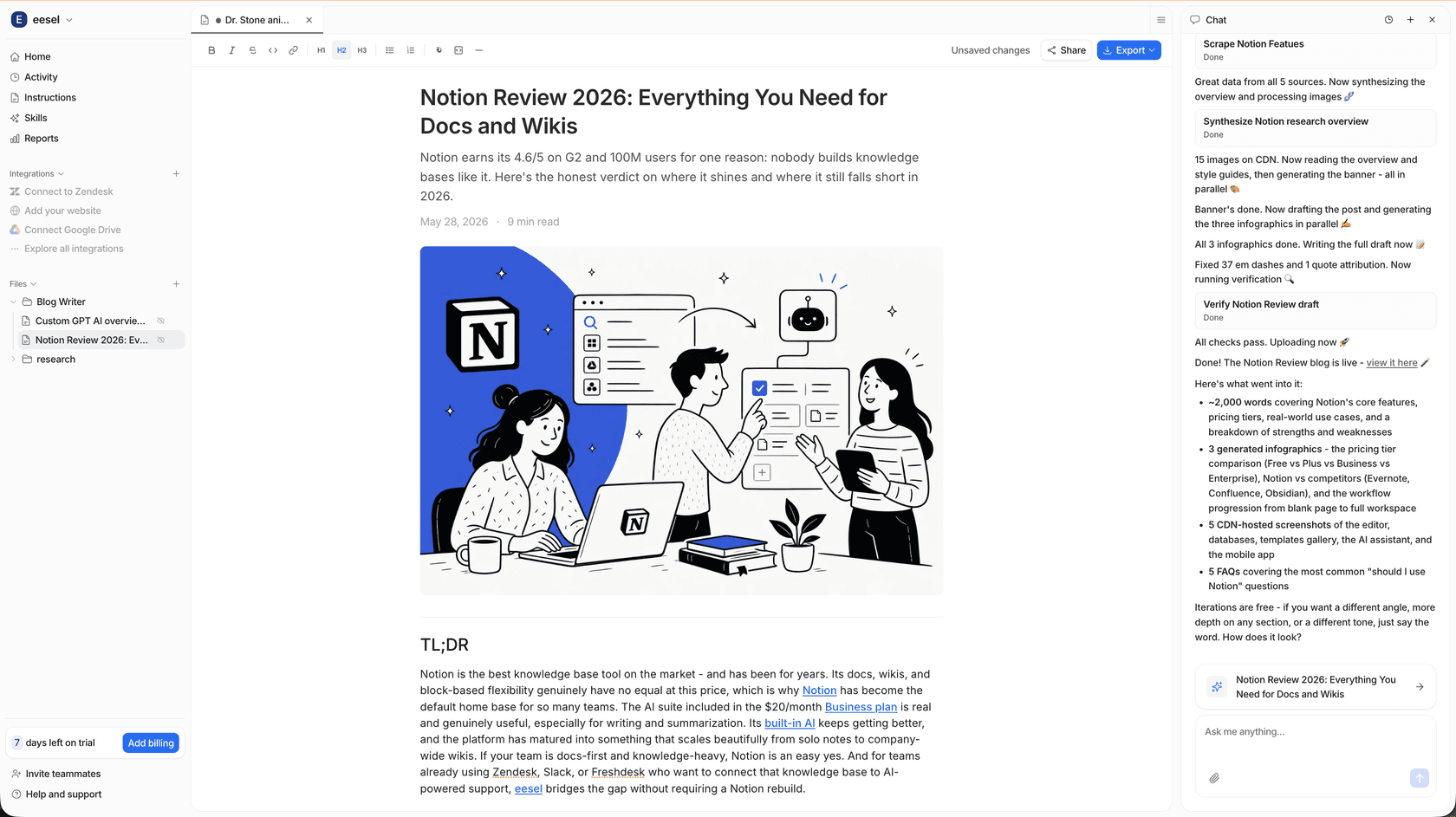
The eesel editorial workspace, with an article editor and teammate conversation.
Sources
- What are Artifacts and how do I use them?
- Publish and share Artifacts
- Build and share AI-powered apps with Claude
- Turn ideas into interactive AI-powered apps
- Claude Code Artifacts
- The eesel CLI
Use eesel CLI after you test the Artifact
eesel’s AI blog writer is a ready-to-work teammate for content teams, not a replacement for the person who owns an app release. Use the dashboard or CLI to review an approved brief against its sources and test plan, then test the Artifact itself before you publish or share it. Try eesel or book a demo.
Frequently asked questions
What are Claude AI apps?
Claude AI apps are usually interactive Claude Artifacts: standalone tools, visualizations, or experiences that Claude creates in a dedicated artifact window.
What can I build with Claude Artifacts?
You can build calculators, single-page sites, data visualizations, learning experiences, and apps that use Claude, MCP tools, or persistent storage when your plan and settings support them.
Do I need to code to make a Claude Artifact?
No. You can describe the job in conversation and iterate on the result. You still need to test its behavior, data, and sharing settings before others use it.
Can I publish a Claude Artifact publicly?
Free, Pro, and Max users can publish an Artifact publicly. Team and Enterprise users can share Artifacts inside their organization, where viewers must sign in.
Do Claude Artifacts support MCP and persistent storage?
Yes, on supported plans and surfaces. MCP access requires each user to authenticate and approve tools; persistent storage is for published Artifacts and has personal and shared modes.
What happens when I unpublish a Claude Artifact?
The public link stops working. The same Artifact cannot be published again, and any associated persistent-storage data is permanently deleted.
How can eesel CLI help review a Claude app?
eesel CLI gives a content owner and a coding agent another way to use the same eesel workspace and teammate as the dashboard. They can upload an approved brief, request a review, and inspect the result, while a person tests the actual Artifact and controls any external action.