The current vocabulary: plugins, apps, and GPTs
OpenAI's Plugins guide describes plugins as workflow packages. Some include several apps; others contain skills only and need no external app connection. The directory and available features can vary by plan, workspace, role, region, and the ChatGPT or Codex surface.
An app is different. It connects ChatGPT to an external service so it can retrieve information or perform supported actions. An app may offer interactive in-chat UI, search, deep research, sync, write actions, or some combination. The directory listing is the current place to see what a particular app can do, not a guarantee that every account can use it.
A GPT is a configurable ChatGPT experience with instructions, knowledge, capabilities, and potentially apps or actions. OpenAI currently restricts new GPT creation and publishing on personal Free, Go, Plus, and Pro accounts. Business, Enterprise, and Edu users can create, edit, and publish GPTs when their workspace settings and permissions allow it. A GPT can use apps or API actions, but not both at the same time.
Five ways to extend an AI workflow
There is no universal replacement for the historical marketplace. These five options solve different jobs. The useful comparison is the work, the connection, and the review responsibility, not a claim that we tested every option or that one is always best.
1. eesel: a ready-to-work teammate for a defined queue
eesel is an AI teammate platform with helpdesk and blog-writer teammates. For support, connect approved knowledge and the helpdesk where customers already ask questions, then configure which work the teammate handles and which requests need a person. The CLI lets a developer or coding agent inspect that setup without requiring the support owner to leave the dashboard workflow.
Its pricing is one fixed monthly price with no seat fee: 1 credit covers one ticket or chat, however many replies it takes, and plans start at $299 a month for 500 credits. A free plan includes 100 credits, and paying a year upfront gets two months free. Everything is included, and add-ons such as SSO or data residency are priced separately.
2. Managed-workspace Custom GPTs: reusable guided conversations
A Custom GPT fits a Business, Enterprise, or Edu workspace that needs a reusable ChatGPT experience with instructions and reference material. It is not currently a new-GPT route for personal Free, Go, Plus, or Pro accounts. Use Preview with representative prompts before publishing, and remember that a GPT can use apps or actions, not both at once. It is strongest when the job is a guided conversation rather than a full queue workflow.

3. Zapier: configured cross-app automation
Zapier is a distinct automation platform, not a ChatGPT plugin. Its current product pages describe workflows, agents, MCP, SDK, and connections across many apps. It can be useful when the central requirement is a defined trigger and sequence between services. Review its current pricing and every step's credentials, trigger data, retries, and action scope before treating a template as a production workflow.
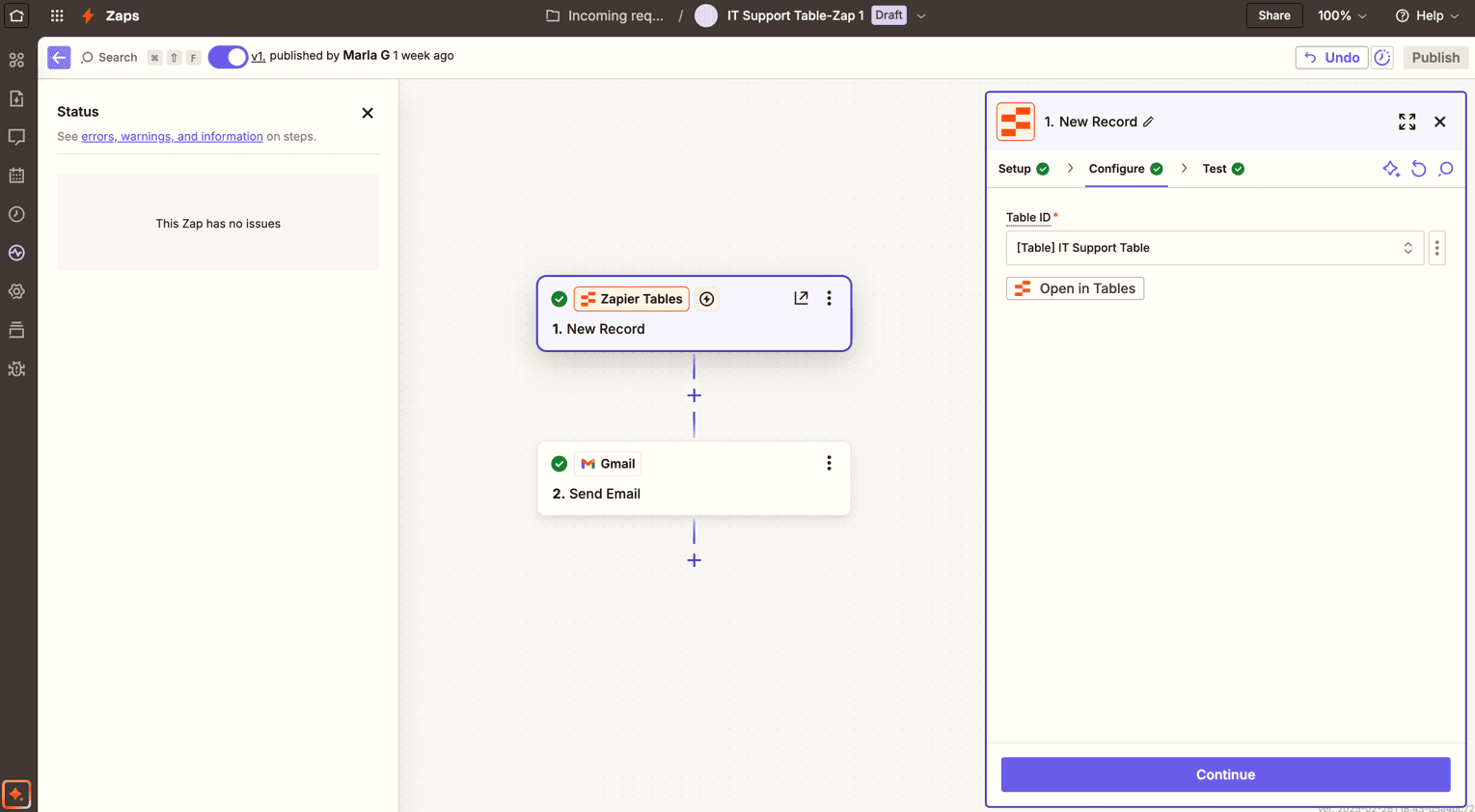
For example, a new approved record in a table can trigger a prepared email step. You configure the field mapping and test data before turning it on. The free plan includes 100 tasks per month and two-step workflows; multi-step workflows require a paid plan. Task volume and any add-ons affect the comparison, so a starting subscription price alone is not the full cost.
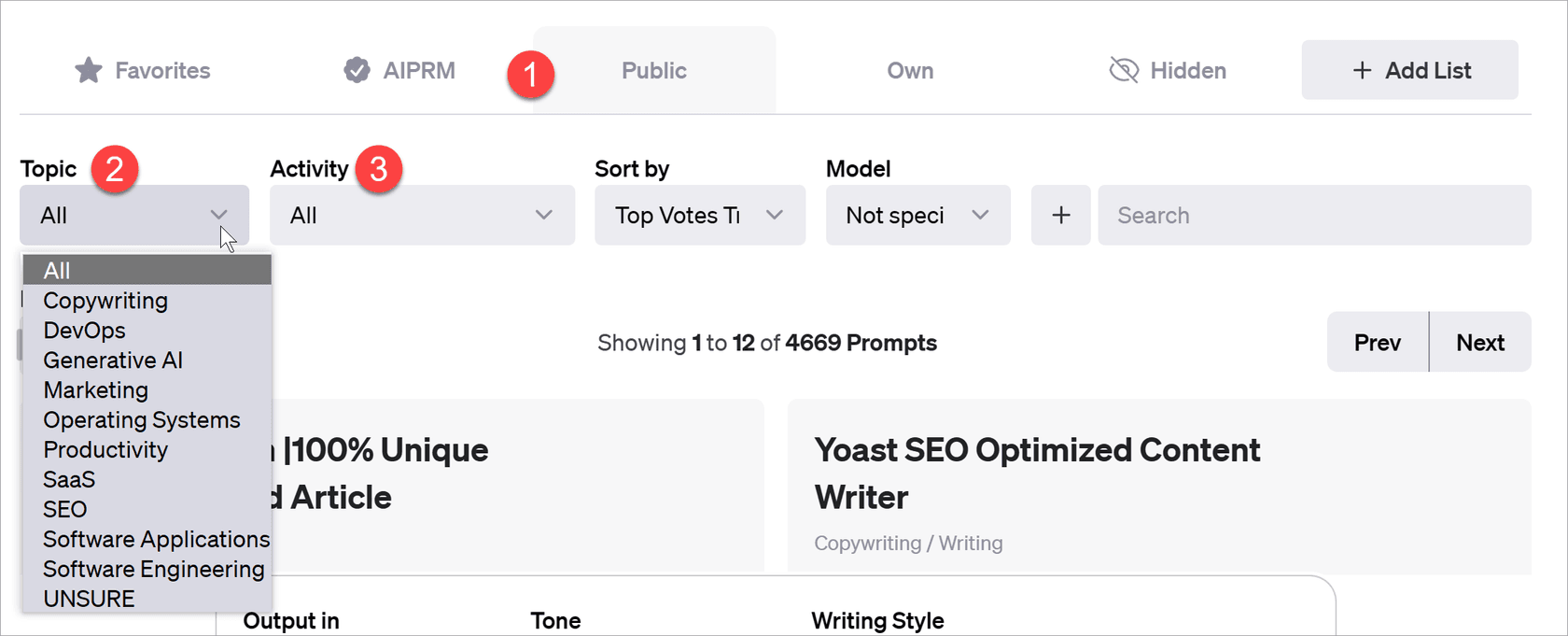
4. AIPRM: a prompt-library layer
AIPRM is a prompt-management and template product, not a replacement for an authorized app connection. It can help a person start repeated writing or research conversations from consistent prompts. It does not by itself establish a knowledge source, a workspace action policy, or an external-system handoff. Its pricing page is the place to confirm current plan terms.
A practical use is keeping a private prompt for turning an approved product brief into three email drafts. Choose the template, supply the brief, and check the output against it. AIPRM offers a free version; paid plans raise quotas for features such as private templates and lists. Its community prompts are not all tested by AIPRM, so popularity is a starting point for evaluation, not evidence that a prompt is reliable for your task.
5. AskYourPDF: focused document questions
AskYourPDF is a document-focused service for asking questions of uploaded files. That focus can suit a one-off report or a bounded PDF review. It is not automatically a company knowledge system: a team should still check document ownership, freshness, sharing, data handling, and the answer's references. Confirm current allowances and plans on AskYourPDF's pricing page before buying.
Upload an approved report, ask where it states a particular requirement, and compare the answer with that passage. The free tier currently allows one document per day and 50 questions per day. With annual billing selected, the page lists Premium at $11.99 per month and Pro at $14.99 per month; those are annual-billing equivalents, not monthly-contract quotes.

The selection is therefore practical: choose a managed GPT for a reusable ChatGPT conversation, an app or plugin where current directory setup supports the required capability, Zapier for an explicitly designed cross-app workflow, AIPRM for prompt reuse, AskYourPDF for a contained document task, or a ready-to-work eesel teammate for a scoped helpdesk job. Each needs its own source, permission, and outcome review.
What installation does and does not do
Installing a plugin can begin an app connection or setup flow. It does not bypass the external provider's authorization or the workspace's controls. If a required app needs individual sign-in, the member must select the intended provider account and review the permissions before connecting. If an app supports sync, an eligible workspace administrator may need to configure it.
That means a short evaluation should answer five concrete questions:
| Question | Why it matters |
|---|---|
| What does the plugin package? | It may provide skills, apps, or both. |
| Which app is required? | An app-backed capability cannot work until its own setup is complete. |
| Which account and source are used? | A connected account and a synced source can have different access paths. |
| Can it write? | Search, sync, and external actions are separate capabilities. |
| Who can enable or use it? | Plan, workspace, role, region, and administrator settings can all matter. |
OpenAI says an OpenAI Verified plugin is reviewed for quality, reliability, and usefulness. That badge is not a substitute for the organization's own privacy, security, or vendor review. Likewise, information sent to an app is subject to that provider's own terms and privacy policies.
App permissions deserve a separate review
For Business workspaces, apps are enabled by default, but administrators can manage workspace-wide availability, review action controls, disable an app, and limit the provider accounts members may use. Enterprise and Edu have different defaults and can use more role-based controls. Do not turn a plan-level default into a claim that every app is already approved for every person.
An app may have actions, but action permission is a separate decision. Current OpenAI controls can allow read actions, a custom action set, or other available permission levels. For non-sync apps, admins can use parameter constraints to limit what a model may send in an action. Provider authorization, workspace restrictions, and safety protections still apply separately.
This matters for a support workflow. A helpdesk search app may be appropriate for finding an approved policy, while an action that changes an account needs a tighter boundary. Start with the narrowest useful configuration. Then test a normal request and a request that should be handed to a person before enabling anything consequential.
Choose the smallest useful building block
The old marketplace question was often “which add-on should I install?” The better current question is “what is the smallest capability that solves this job with an owner and a review path?” That gives three common answers:
| Need | Starting point | Review before rollout |
|---|---|---|
| Find or cite information from a service | An app with search or, where available, sync | The provider account, source scope, member access, and returned citations. |
| Repeat a guided chat task | A managed-workspace GPT | Instructions, knowledge files, Preview results, sharing, and whether apps or actions are needed. |
| Bundle a workflow for ChatGPT or Codex | A plugin | Included skills/apps, setup requirements, surface availability, and the underlying app controls. |
For example, a team that wants people to ask about an approved returns policy does not automatically need a write-capable app. A source-aware, read-oriented setup may be enough. A team that needs an account change should specify the allowed action, the approval moment, and the exception path. This reduces the chance that a convenient directory installation turns into an unexamined production permission.
The same approach prevents a common evaluation error: treating an app's polished interactive interface as evidence that it has the right source coverage or authority to change a record. Interface, search, sync, action, and account connection are separate things to check in the app's current listing and workspace settings.
It also makes the evaluation portable. A normal question tests whether the information is useful. A boundary question tests whether the system stops and explains the handoff. A real-channel check tests the configuration people will actually use. Those are different evidence sources; do not replace one with another.
Where a managed GPT fits
For a managed workspace with permission to create GPTs, a GPT can be useful when a team needs repeatable instructions and reference material in a familiar ChatGPT experience. Put behavior and rules in instructions; use knowledge for reference material. OpenAI recommends testing a GPT in Preview after adding files rather than assuming an upload is used correctly.
A GPT is not a shortcut around app governance. Its apps and actions are subject to availability and setup, and it cannot use apps and API actions at the same time. A team choosing between a plugin, app, or GPT should start with the job: answer from a controlled source, complete a defined action, or give a group a reusable guided conversation. The right container follows that answer.
For a managed workspace, document the intended users, source owner, data boundaries, permitted actions, and reviewer alongside the configuration. That gives the next owner enough context to maintain it.
Review an app and source choice with eesel CLI
The eesel CLI lets a person at a terminal, a script, or a coding agent such as Claude Code, Codex, or Cursor operate the same eesel teammate and workspace as the dashboard. With Node.js 18.17 or newer, inspection and setup commands are free; CLI chats are billed work.
Suppose a support owner wants a teammate to answer return-policy questions, but not issue refunds. Ask Claude Code or Codex to compare the existing knowledge sources and available app actions with that job. Use an existing teammate's name in place of Policy helper:
npx @eesel/cli integrations sources --agent "Policy helper"
npx @eesel/cli instructions --agent "Policy helper"
For a connected app that supports the CLI's long-tail action discovery, use its actual app name to list available action descriptions. This is not a universal command for every native helpdesk integration. Do not invent an action key or run a customer-facing action during evaluation:
npx @eesel/cli integrations INTEGRATION_FROM_OUTPUT actions --agent "Policy helper"
The coding agent reads the JSON output and reports the gap: for example, the returns-policy source is available but has not been copied, while a refund action is unnecessary for answering eligibility questions. The owner can approve importing only the supported policy source and scope. Preview the proposed write with --dry-run, apply only the approved configuration, and check download status for indexed content, not just a job receipt. An action description tells you what an action does; it does not prove the customer's account permissions or justify enabling it.
Before using a customer channel, the owner approves two paid tests on a non-production teammate with consequential actions disabled or absent. In separate fresh chats, ask what the approved policy says about an unopened item, then ask the teammate to issue a refund despite missing purchase information. Check that the first answer cites the right policy and the second gathers missing information or explains the configured human handoff without issuing anything. A fresh chat separates context, not permissions. Finally, verify the permitted helpdesk or Slack handoff itself; a CLI answer does not prove that channel is configured.
Keep app decisions close to the work with eesel CLI
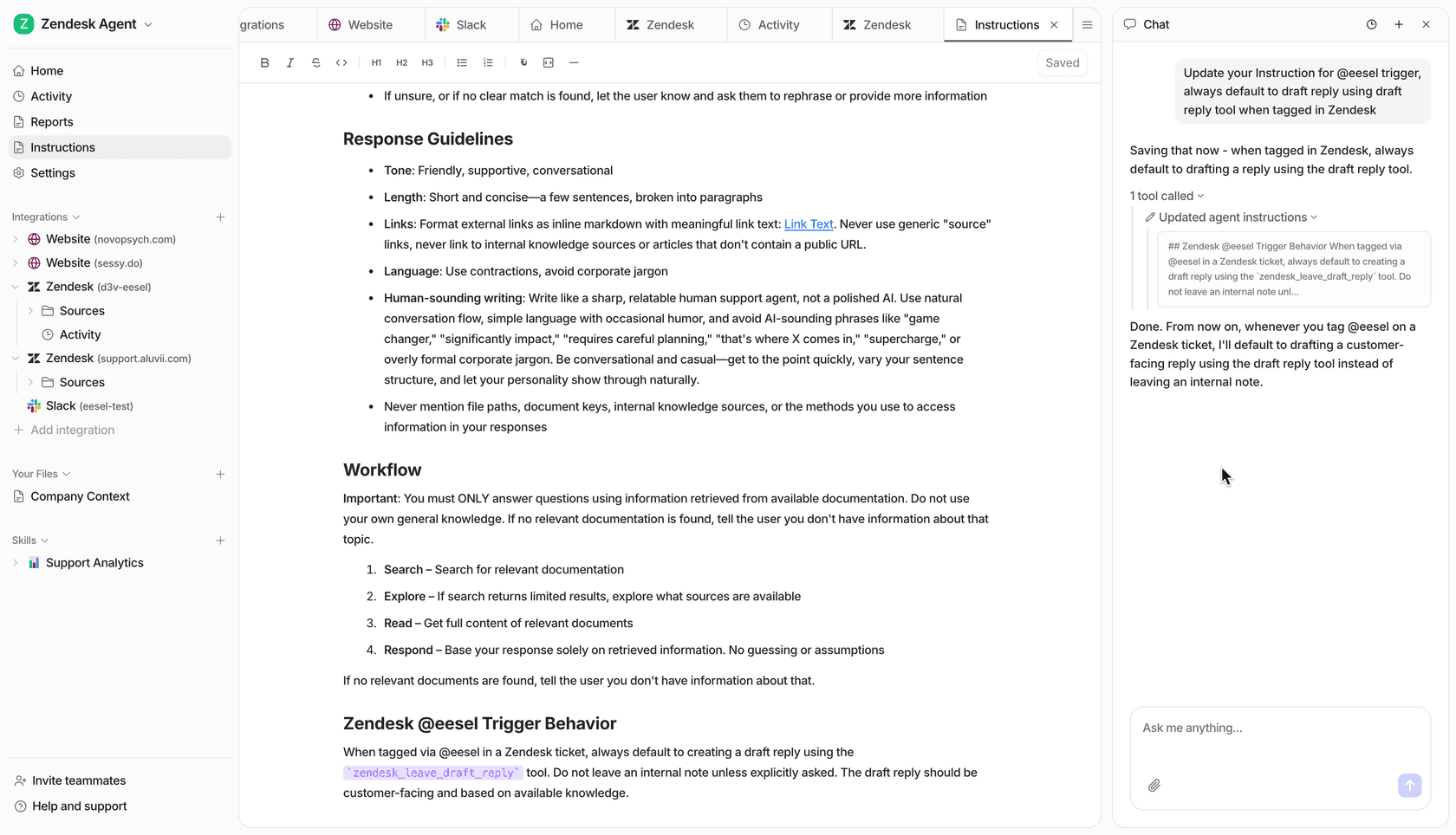
The screenshot shows a teammate's instruction document and a chat-driven draft-reply update in the eesel dashboard. The CLI gives a person or coding agent a matching way to inspect and review that same setup. Try eesel when you want to evaluate a narrow support workflow with your own approved sources.
Sources
Frequently asked questions
What is the ChatGPT plugin marketplace now?
OpenAI’s current Plugins Directory is a place to discover workflow capabilities across ChatGPT and Codex. A plugin can package skills, apps, or app templates; it is not automatically an authorized connection to an external account.
What is the difference between a plugin and an app?
A plugin packages capabilities into a workflow. An app connects ChatGPT or Codex to an external service for supported data access or actions. A plugin may include one or more apps, or only skills with no app connection.
Does installing a plugin give it access to company data?
No. Installation can start setup, but cannot bypass provider authorization or workspace permissions. Required apps still need to be available, enabled for the applicable role, and connected where required.
Can a ChatGPT app take actions?
Some apps support actions. Which actions can run and when ChatGPT asks for approval depend on the app, account, workspace controls, saved permission settings, and the risk of the action. Lower-risk changes may proceed without another confirmation; some sensitive actions require approval or are blocked.
Can personal ChatGPT users create a new GPT?
No. OpenAI currently says Free, Go, Plus, and Pro personal accounts cannot create or publish new GPTs. Existing GPTs may remain editable when plan and permission requirements allow; eligible managed workspaces can create GPTs according to their settings.
What should a Business admin check before enabling an app?
Check the app’s capabilities, required account authorization, workspace availability, allowed actions, source or sync scope, member access, and provider terms. An OpenAI Verified badge does not replace a privacy, security, or vendor review.
How can eesel CLI help review an integration choice?
A person or coding agent can use eesel CLI to inspect connected sources and supported action descriptions for the same teammate as the dashboard. It can identify missing policy content, propose an owner-approved import, and help run paid, isolated tests before a separate channel check.