A guide to the blog writing market

Amogh Sarda

Katelin Teen
Last edited January 20, 2026
If you want to show up on Google, you need a blog. It's your direct line to customers, the engine for your SEO, and how you prove you're an expert in your field. A solid blog builds trust, brings in leads, and keeps your brand on people's radar.
The only problem? Pumping out high-quality, SEO-optimized content on a regular basis is a huge amount of work. It costs time and money to get from a blank page to a post that actually ranks.
That's why the blog writing market exists. It started with companies trying to do it all themselves. Then came the wave of freelance writers and content agencies. Now, AI has flipped the script. New platforms like the eesel AI blog writer are changing the market by automating the whole content workflow, not just the writing.
What is the blog writing market?
What are we talking about when we say "blog writing market"? It's basically the whole ecosystem of services, tools, and people that businesses use to get their blogs written, optimized, and published. The main goal is to create content that pulls in the right audience from search engines and turns them into customers.
It’s not just about the words on the page, though. A successful blog post has a whole production line behind it. The market covers every step:
- Content Strategy: This is the big-picture planning. It involves keyword research, figuring out what your audience is searching for, and brainstorming topics that will get clicks.
- Content Creation: This is the core of the work, where you thoroughly research the topic and write the actual article.
- SEO & Optimization: This is what helps your content get found by search engines. It includes using the right keywords in your headings and structuring the article in a way Google prefers.
- Editing & Design: Nobody likes reading a wall of text full of typos. This step is about polishing the copy and creating visuals like custom images or charts to make the content more engaging.
- Publishing & Promotion: Hitting "publish" is only the beginning. This final step involves getting your content live on your site and making sure people see it.
Key players in the traditional blog writing market
Before AI tools really took off, you had a few standard options. Each has its own pros and cons when it comes to cost, speed, and how much control you have.
In-house writers and content teams
This is the old-school way: you hire full-time employees to handle your company blog. They're completely immersed in your brand.
- Pros: Your in-house team knows your product and brand better than anyone. You have total control over the quality, tone, and direction of your content.
- Cons: It’s expensive. You're not just paying a salary; you're also covering benefits, equipment, and software. It's hard to scale up, since you can't just double your output without hiring more people. Plus, your team might get tired of writing about the same things all the time.
- Best for: Large companies with big budgets and established marketing teams that need tight control over their brand message.
Freelance blog writers

Here, you bring on independent writers for specific projects or on a monthly retainer. You can find them on platforms like Upwork and countless other content marketplaces.
- Pros: You get access to a huge pool of talent, often with specialized knowledge in specific niches. It's much cheaper than a full-time hire, and you can scale your content production up or down as needed.
- Cons: The quality can be inconsistent. Finding a great writer who is also reliably available can feel like a full-time job. You'll spend a lot of time checking writers' backgrounds, creating detailed briefs, and editing their submissions. Maintaining a consistent brand voice with multiple writers is a real challenge.
- Pricing: Rates vary wildly. New writers might charge around $0.15 to $0.25 per word, but you tend to get what you pay for. Top-tier, experienced freelancers can command $1.00 per word or more.
Content marketing agencies

This is the all-inclusive, "done for you" package. You hand over your entire blog strategy and execution to a specialized agency.
- Pros: You get a full team of experts, including strategists, writers, editors, and designers, who already have proven SEO processes. It’s a hands-off experience, which lets you focus on other areas of your business.
- Cons: This is easily the most expensive option. Agencies can be slow to deliver content because of their internal workflows. And sometimes, they may not have the deep, subtle understanding of your business that an in-house person would.
- Pricing: Don't expect a bargain. Agency retainers usually start around $3,500-$5,000 per month for a basic plan. High-end agencies like Siege Media often require a minimum commitment starting at $8,000 per month.
The rise of AI and its impact on the blog writing market
The arrival of powerful generative AI has totally shaken up the blog writing world. It's not just another tool; it's a new way of creating content that's making everyone rethink their process.
The first wave: AI as a writing assistant
They were interesting, but they only handled one small part of the process. They give you a first draft, but you're still left with a ton of work. The output from these tools often requires significant editing to align with a specific brand voice and may lack depth. The content generated may also require manual fact-checking and source citation, as these tools might not provide verifiable information or references. They need a lot of editing and guidance to produce something publishable.
You can write with ChatGPT in less than a minute, but don't expect it to have any real impact on leads, branding (I am assuming your website doesnt have strong SEO as you mentioned marketing is a new endeavor)

From basic text generators to a complete content platform
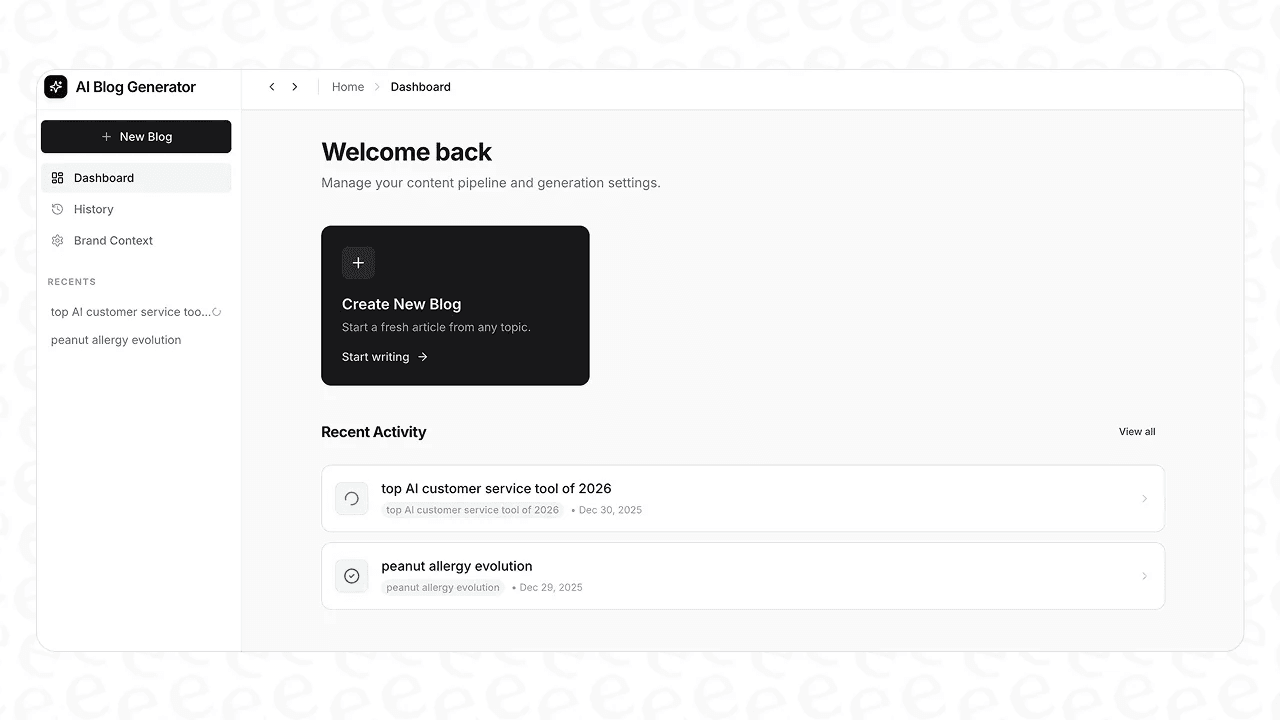
Here's how it stands apart:
- One-Click Workflow: You provide a keyword, and it handles the rest. It automates the research, structuring, writing, editing, and even asset creation you'd typically do by hand.
- Deep Research with Citations: The platform's content is researched. It automatically adds internal links to your other posts and external citations to sources, which helps build trust and improve your SEO.
- Automatic Asset Generation: This feature is designed to save time. It automatically creates and embeds relevant images, infographics, and data tables. It even includes relevant YouTube videos and real Reddit quotes to add social proof and a human touch.
- Proven Results: We practice what we preach. We used this exact tool to grow our own blog from 700 to 750,000 daily impressions in just three months by publishing over 1,000 optimized posts.
How to choose the right solution for your business in the blog writing market
Alright, you've got options. How do you choose? It really just boils down to being realistic about your company's needs, budget, and who's available to manage it all.
Assess your goals, budget, and internal resources
Before you spend any money, ask yourself a few questions:
- Goals: What are you trying to do? Are you aiming for in-depth, authoritative thought leadership articles? Or do you need a high volume of posts to generate leads and drive SEO traffic? Your goal will help you find the right solution.
- Budget: What can you actually afford to spend every month? This is the quickest way to narrow your options. If you have a large budget, an agency or in-house team could work. If you're running lean, freelancers or an AI platform are probably your best bet.
- Resources: Who on your team can oversee this? Do you have an editor to polish freelance articles or an SEO strategist to guide the content? The less time you have for management, the more you need a complete, hands-off solution.
Compare your options: A practical breakdown
To make it even clearer, here’s a quick comparison of how the different approaches perform on the metrics that matter most.
| Approach | Monthly Cost | Speed to Publish | Management Overhead | Scalability |
|---|---|---|---|---|
| In-House Team | High | Slow | High | Low |
| Freelancers | Medium | Medium | High | Medium |
| Agencies | Very High | Slow | Low | Medium |
| eesel AI | Low | Very Fast | Very Low | Very High |
To truly understand the potential of AI in content creation, it's helpful to see it in action. The video below provides a practical guide on how to leverage AI tools to write high-quality blog posts, moving beyond basic drafts to create content that engages and converts.
The future of the blog writing market
The blog writing market has plenty of options, but SEO success really boils down to three things: efficiency, quality, and scale. Traditional methods can be challenging to scale to meet modern content marketing demands.
The market is clearly shifting from tools that handle single tasks (like writing) to integrated platforms that manage the entire content workflow, from keyword to published post.
This is where things are headed, and platforms like the eesel AI blog writer are leading the way. They give businesses of all sizes the ability to produce high-quality, SEO-optimized content at a speed and scale that was impossible just a few years ago.
See how eesel AI grew its own blog from 700 to 750,000 daily impressions. Try the eesel AI blog writer for free and generate your first publish-ready post in minutes.

Frequently Asked Questions
Share this article

Article by
Amogh Sarda
CEO of eesel AI. Amogh Sarda is obsessed with making the ultimate AI for customer service teams. He lives in Sydney, Australia and has previously worked at Atlassian and Intercom. Outside of work he’s usually surfing or on stage doing improv.