The state of the blog writing industry: A complete overview

Stevia Putri

Katelin Teen
Last edited January 20, 2026
Let's kick things off with a pretty wild stat: there are over 600 million blogs out there on the internet. And every day, more than 6 million new posts go live. That’s an almost unbelievable amount of content.
This puts anyone working in the blog writing industry in a tough spot. The demand for new content is through the roof, but so is the competition. To make it even trickier, a flood of basic AI tools has filled the web with generic, robotic-sounding content, making it harder than ever for genuinely good writing to get noticed.
In this guide, we'll walk through the entire blog writing landscape, including who the key players are, the different ways to get content made, and the strategies you need to actually get results.
What defines the blog writing industry today?
Blogging has changed a lot since its early days as a space for online personal diaries. What began as a hobby is now a central piece of business strategy. For many B2B companies, it’s a top source of ROI, right alongside paid social media, according to HubSpot's latest marketing report.
It's become a real engine for business growth. Blogging is the foundation of SEO, a great tool for generating leads, and one of the best ways to build brand awareness and establish yourself as an authority.
It's also incredibly crowded. We're all dealing with "content shock," a term for when there is simply more content being produced than people can possibly consume. This means just hitting "publish" and hoping for the best is a losing game.
Readers have also come to expect more. The era of 500-word fluff pieces is over. The average blog post is now around 1,400 words long. People want depth, quality, and a mix of media like images, charts, and videos to hold their attention.
Finally, AI is now standard equipment. Artificial intelligence isn't some far-off concept anymore; it's a daily part of the content workflow for a lot of teams. This has changed the game from how fast you can write to how well you can use AI to produce strategic, high-quality content.
The three primary content creation models
Businesses usually go one of three ways to get their blog content created. Each path has its own set of benefits, drawbacks, and costs. Let's look at the main models.
Freelance blog writers
This is usually the first stop for companies just starting to explore content marketing. Freelancers are independent writers you hire on a contract basis for specific projects or a certain number of articles each month.
- Pros: You get a ton of flexibility and can often find writers with specialized knowledge in very specific niches, whether you're in SaaS, e-commerce, or healthcare.
- Cons: Managing freelancers can be a job in itself. Their availability isn't always consistent, and finding someone who delivers consistent quality can take some trial and error.
- Pricing: Rates are all over the map, depending on experience and niche. A newer writer might charge less, but experienced pros in technical fields like fintech or B2B software can charge much higher prices. You can expect to see rates anywhere from $0.25 to over $0.80 per word.
Blog writing services and agencies
When you need to produce more content, agencies are a common choice. These companies offer a full-service package, taking care of everything from content strategy and keyword research to writing, editing, and sometimes even promoting the content.
- Pros: Agencies provide a managed, scalable system. You get a steady stream of content without the headache of managing individual writers.
- Cons: This option is more expensive. Agencies can sometimes miss the subtle nuances of your brand's voice, and they might not be as nimble for quick turnarounds as a dedicated freelancer.
- Pricing: Most agencies operate on a monthly retainer. Depending on the volume of articles and the scope of work, retainers usually start around $6,000 and can easily climb to $10,000 or more per month.
In-house content teams
For companies that are all-in on content, building an in-house team is the end goal. This involves hiring full-time writers, editors, and strategists who live and breathe your brand.
- Pros: An in-house team will have a deep, unmatched understanding of your product, customers, and brand voice. Their success is directly tied to your marketing goals.
- Cons: This is the most expensive route by a long shot. You have to factor in salaries, benefits, and other overhead. It's also harder to scale up or down quickly, since hiring and training new people takes time.
Here's a quick comparison of the three models:
| Model | Best For | Typical Cost | Key Advantage |
|---|---|---|---|
| Freelancers | Startups & SMBs needing specific expertise. | $0.25 - $0.80+ per word | Flexibility |
| Agencies | Mid-size to enterprise companies needing scale. | $6,000 - $10,000+ / month retainer | Managed Process |
| In-House | Established companies with large budgets. | Full-time salaries + benefits | Deep Brand Knowledge |
How AI is reshaping the blog writing industry
Generative AI showed up with a big promise: to solve the content scaling problem for good. But the reality has been more complex. The first wave of AI tools introduced a new challenge: a large volume of low-quality, generic content.
Google and other search engines have wised up. Their ranking algorithms now heavily favor high-quality content that shows what they call E-E-A-T: Expertise, Experience, Authoritativeness, and Trustworthiness. The main point is that they prioritize helpful and accurate content, regardless of whether it is written by a human or an AI.
- Limited real-time information. Most generic AI models have a knowledge cut-off date, which means they can't give you real-time data or talk about recent news. That's a massive issue when you're trying to create timely, relevant content.
- Generic output. Because these models are trained on the internet as it exists, their writing tends to be a predictable mix of what's already been said. The tone can feel robotic and it lacks any real point of view.
- Potential for inaccuracies. AI models are known to "hallucinate" and confidently state incorrect information as fact. This means every single piece of content needs to be rigorously fact-checked, which requires significant time.
- Text-only generation. A good blog post is more than just a block of text. Basic AI writers don't create images, infographics, tables, or embed videos. You're stuck finding all those important assets on your own.
The industry is now making a smart pivot. We're moving away from using AI as a simple "word generator" and starting to use it as a complete "AI content generation platform," a tool that manages the whole process of research, writing, creating assets, and optimizing for search.
Succeeding with the right AI platform
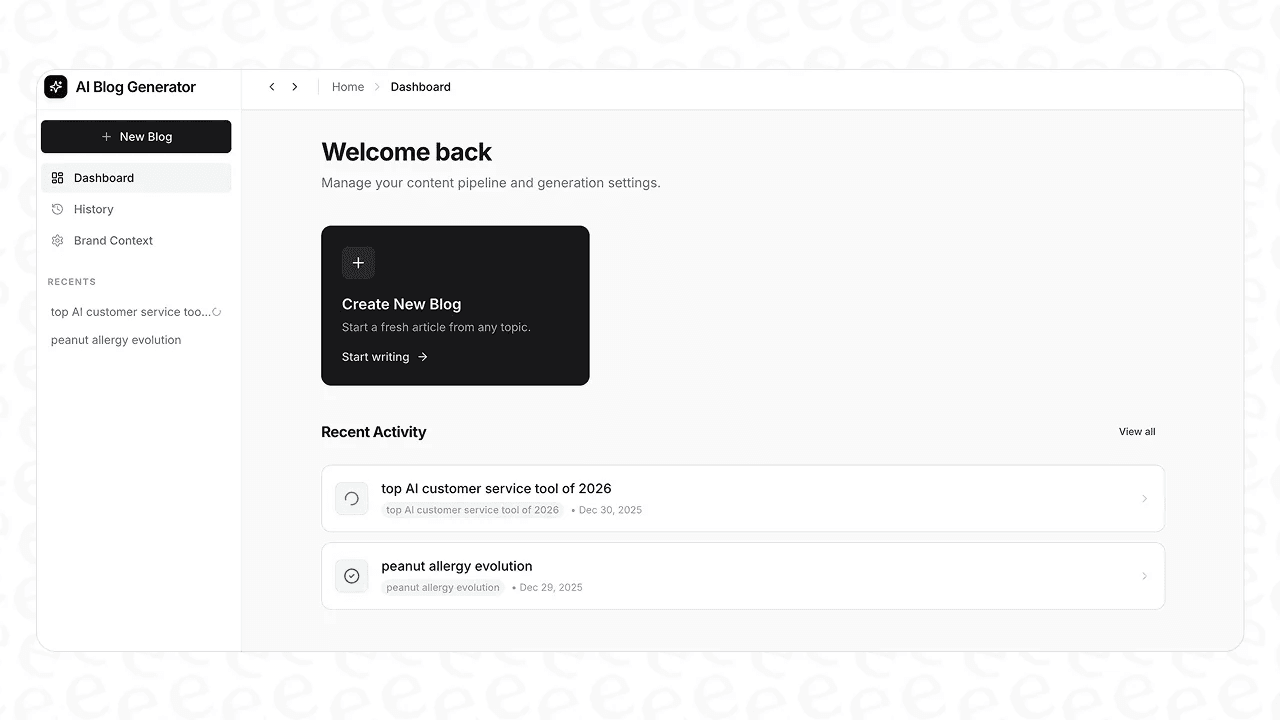
This is exactly where a tool like the eesel AI blog writer fits in. It's not just another AI that churns out text. It's a context-aware platform designed specifically to turn a single keyword into a complete, publish-ready, and SEO-optimized blog post that meets the high standards of today's readers and search engines.
And we have the results to prove it. We used this exact tool to grow our organic traffic from a humble 700 impressions per day to over 750,000 in just three months by publishing over 1,000 high-quality blogs.
Go beyond text with automatic asset generation
Modern readers don't have a lot of patience. You need visuals to break up the text and make complicated information easier to understand. The eesel AI blog writer automatically creates and embeds these assets for you. It can generate custom images, infographics, and data tables right inside the article, saving you hours of work and making your content much more engaging.
Tap into real conversations with social proof integration
One of the clearest signs of generic AI content is its lack of real-world human experience. To fix this, our platform has a unique feature that finds and embeds relevant Reddit quotes and YouTube videos related to your topic. This adds a layer of authenticity and social proof to your content, building trust with your audience in a way that generic AI just can't.
Achieve a genuinely human tone by learning your brand
Your brand has a specific voice, and your content should sound like it. The eesel AI blog writer learns your brand's tone and style by looking at your website. This helps it generate content that sounds like it came from you. It can even make natural, contextual mentions of your own products or services where it makes sense, without coming across as a pushy sales pitch.
Optimize for the future with answer engine optimization (AEO)
SEO is evolving. Gartner predicts that by 2026, 25% of organic search traffic will shift to AI chatbots and answer engines. This means your content needs to be ready not just for Google's blue links, but also for being featured in AI-powered summaries like Google AI Overviews and Perplexity. The eesel AI blog writer structures content for this new world, formatting it to be easily understood and cited by AI answer engines, making sure your content stays visible as search continues to change.
Key strategies for success
- Focus on a specific niche. The time of the generalist blog is pretty much over. To build authority and attract a dedicated audience, you need to specialize. Pick a niche you know inside and out and go deep.
- Create cornerstone content. These are long, in-depth guides on the most important topics in your field. A single piece of cornerstone content can attract valuable backlinks and drive steady search traffic for years.
- Prioritize user experience and readability. Nobody wants to read a huge wall of text. Use short paragraphs, clear headings, bullet points, and lots of white space. A good tool like the eesel AI blog writer handles this for you, formatting content for how people actually read online.
- Develop a consistent publishing schedule. Consistency tells search engines that your site is a reliable source of fresh information. It also gives your audience a reason to check back regularly. Find a rhythm you can maintain, whether it's once a week or once a month.
The future of the blog writing industry
The blog writing industry isn't going anywhere. But it is changing, and the standard for what it takes to succeed is much higher now. Generic, low-effort content just won't get you very far anymore.
It's still fine. Because of AI, most content is trash and Google is going to choose what is valuable. You can use AI to your advantage to streamline your craft as well. You had to get with the times and use it to your advantage, not bend over because the environment changes.

The way forward isn't about picking between human creativity and AI efficiency. It's about combining them. The best content strategies will blend human-led strategy and expertise with powerful AI platforms that can deliver quality at scale.
The future of content belongs to those who consistently create valuable, well-researched, and engaging articles that serve both their readers and the constantly changing algorithms of modern search and answer engines.
Scale your content without sacrificing quality
You've seen the challenges and the opportunities in the blog writing industry. If you're tired of creating content that just disappears into the noise and are ready to start publishing articles that drive real traffic, it might be time for a new approach.
Start generating complete, SEO-optimized blog posts with the eesel AI blog writer. It’s the same tool we used to grow our own organic traffic by over 1000x, and it’s built for this new era of content creation.
Generate your first blog completely free and see the difference for yourself.

Frequently Asked Questions
Share this article

Article by
Stevia Putri
Stevia Putri is a marketing generalist at eesel AI, where she helps turn powerful AI tools into stories that resonate. She’s driven by curiosity, clarity, and the human side of technology.