
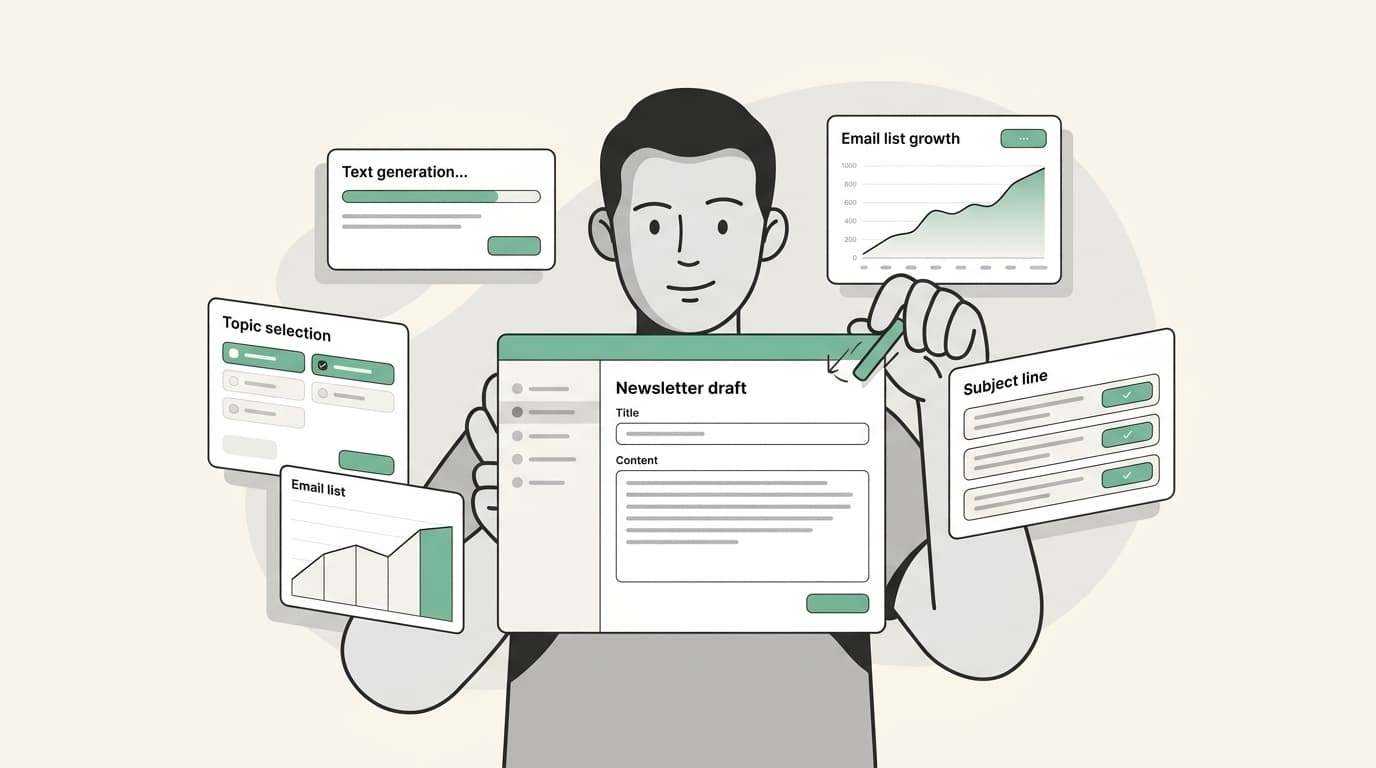
Most AI newsletter tools are just glorified text boxes that require constant hand-holding and repetitive prompting. We tested seven of the most popular platforms in 2026 to see which ones actually understand your brand and which ones just add more work to your plate.
The landscape of email marketing has shifted rapidly over the last two years. While early generative AI could spit out a basic template, the new generation of tools functions more like a dedicated hire than a software package. Whether you're a solo creator or managing a global marketing team, the "blank page" problem should no longer exist. But as we found in our testing, the gap between a tool that "writes text" and one that "writes for you" is massive.
In this guide, we break down the top seven tools based on their ability to learn your voice, automate research, and ultimately get your newsletter out the door faster without sacrificing quality.

What are AI writing tools for newsletters?
At their core, AI writing tools for newsletters are platforms designed to handle the heavy lifting of content creation, from initial research to the final call to action. While many people think of generic chat boxes when they hear "AI," the tools specifically built for email operators are far more integrated.
These tools generally fall into two categories. First, there are AI writing assistants, which function as sophisticated editors that help refine your phrasing or generate subject lines. Second, there are platform-native tools that live directly inside your email service provider (ESP), allowing you to generate content without leaving your workflow.
The biggest change in 2026 is the evolution from simple grammar checkers to autonomous teammates. In the past, you had to provide a detailed prompt for every paragraph. Today, the best tools onboard your entire brand, reading your past newsletters and internal documents to write with 94% voice accuracy.
The key difference between a standalone Large Language Model (LLM) and a purpose-built newsletter tool is context. A generic LLM knows how to write, but it doesn't know your business, your customers, or your specific newsletter style. Purpose-built tools bridge that gap by connecting directly to your knowledge base.
Why use AI for your newsletter content in 2026?
If you're still writing every word of your newsletter from scratch, you're likely spending five to ten hours per week on a task that could take minutes. In 2026, the primary reason to use AI isn't just to "generate text," it's to slash your time-to-publish.
Efficiency and speed
By automating the research and drafting phases, creators are seeing a significant reduction in the time it takes to move from a concept to a finished email. Instead of staring at a cursor, you start with a 90% finished draft that already contains relevant facts and your brand's unique perspective.
Personalization at scale
The old "one-size-fits-all" newsletter is dying. Modern AI tools allow you to use subscriber data to drive engagement through deep personalization. We're no longer just talking about "First Name" tags. AI can now adjust the actual content of the newsletter based on a subscriber's interests or their stage in the customer journey.
Overcoming writer's block
Even the best writers hit a wall. AI provides a consistent starting point, ensuring that your publishing schedule never slips because you couldn't find the right "hook." For teams, this consistency is vital, it ensures that every newsletter sounds like it came from the same brand, regardless of who is managing the account.
Cost-effectiveness
For many small businesses and startups, hiring a full-service content agency isn't feasible. AI tools provide high-quality drafting capabilities at a fraction of the cost, often paying for themselves in the first month through saved billable hours. If you're looking to save even more, you might want to check out our list of the best AI email writers for free.
How we chose the best AI writing tools
To find the best AI writing tools for newsletters, we didn't just look at feature lists. We put each platform through a rigorous testing process based on four specific criteria.
- Integration: How well does it fit into your existing workflow? We preferred tools that either live inside an ESP or connect directly to your documentation tools (like Notion or Google Docs).
- Brand Voice Accuracy: Can it actually sound like you? We tested how well each tool could mimic a specific style after being "fed" five previous newsletters.
- Research Capabilities: Does it provide actual value, or is it just fluff? We looked for tools that could use web search or internal docs to pull in fresh, accurate data.
- Ease of Use: How quickly can a new user get a high-quality result? The goal is high ROI with minimal friction.
Bottom line? We focused on tools that provide an immediate productivity boost without requiring a month of "training".
Top 7 AI writing tools for newsletters compared
Before diving into the details, here is a high-level look at how the top seven tools compare in 2026.
| Tool | Best For | Key Feature | Pricing |
|---|---|---|---|
| eesel AI | Autonomous "Teammates" | Brand voice matching (94%) | $4 per blog post |
| beehiiv | Newsletter Operators | Native AI editor blocks | Included in paid plans |
| Claude | Structured Reasoning | 200k context window | Free / $20 per month |
| Jasper | Marketing Teams | 50+ campaign templates | From $59 per month |
| MailerLite | Small Businesses | AI-powered Smart Sending | From $9 per month |
| HubSpot | B2B / CRM Users | Data-driven personalization | From $9 per month |
| Grammarly | Quality & Editing | Context-aware AI agents | Free / $12 per month |
For a deeper dive into how these tools stack up against each other, you can read our full AI blog writer comparison.
7 best AI writing tools for newsletters in 2026
Let's break down the specific strengths and weaknesses of each platform based on our testing.
1. eesel AI
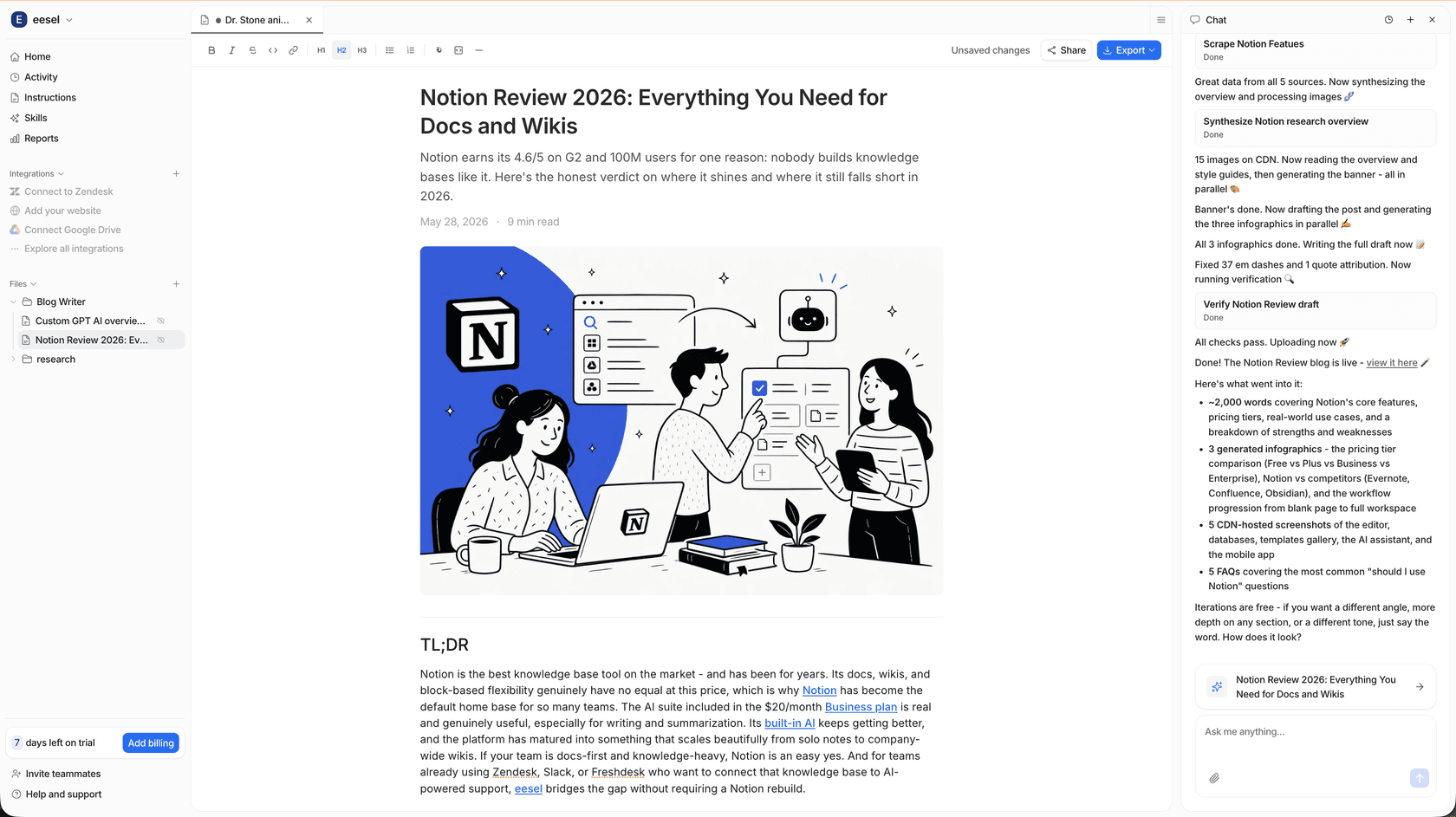
We positioned eesel AI at the top of this list because it represents the biggest shift in how we think about AI in 2026. Most tools are software you configure, but we built our AI Content Writer to be a teammate you hire.
Instead of staring at a prompt box, you connect our tool to your brand's knowledge (Zendesk tickets, Notion pages, Google Docs, or your site). Our AI then onboards on that data in minutes, learning your specific tone, product facts, and preferred style. In our research, we found that this approach achieves a 94% voice match accuracy from the very first draft.
Key features:
- Autonomous Research: We use web search and your internal documentation to draft content that is factually grounded.
- Brand Voice Matching: We don't just "guess" your tone, we analyze your history to ensure every newsletter sounds like you.
- Asset Generation: We automatically include relevant images, charts, and diagrams to accompany your text.
Pros:
- True autonomy: It handles the full research and writing cycle, not just one paragraph at a time.
- Deep context: Because it reads your existing docs, it knows things a generic AI never could.
Cons:
- Outcome focused: It might be overkill if you just need to rephrase a single sentence.
Pricing:
| Plan | Price | Details |
|---|---|---|
| Free Plan | $0 | 100 free credits (no credit card) |
| Blog post | $4 / draft | Research, writing and SEO audit per draft |
| Teammate (support) | From $299 / month | 500 credits, 1 credit per ticket or chat |
| Add-ons | From $199 / month | SSO and MFA, plus priority support from $299 / month |
Our AI Content Writer is the best choice if you want to eliminate the drafting phase entirely and move straight to editing a high-quality "human-sounding" piece.
2. beehiiv
beehiiv is purpose-built for newsletter operators. Unlike generic writing tools, their AI is baked directly into the editor where you write and send your emails. This makes it an incredibly smooth experience for creators who want to "co-write" with an AI without switching tabs.
Key features:
- AI Writing Assistant: You can describe what you want, set the tone, and generate a draft immediately.
- Smart Editor: Helps simplify, shorten, or extend sentences to match your audience.
- AI Image Tools: Allows you to create headers and dividers that match your template's fonts and layout.
Pros:
- Native integration: The AI lives exactly where your newsletter is sent.
- Tone control: You can switch from sarcastic to serious in a couple of clicks.
Cons:
- Platform locked: You have to use beehiiv as your ESP to access these features.
Pricing:
| Plan | Price | AI Features |
|---|---|---|
| Free | $0 | Basic tools |
| Scale | $43 / month | Advanced AI features included |
| Max | $96 / month | Full feature set |
3. Claude
Claude remains the gold standard for pure writing quality and reasoning. Developed by Anthropic, Claude is exceptional at grasping nuance and humor, making it feel less "robotic" than many competitors. For newsletter writers who have long research documents, its 200k token context window is a massive advantage.
Key features:
- Artifacts: A dedicated window that appears alongside your chat, allowing you to see and edit your newsletter designs or copy in real-time.
- Project Knowledge: You can upload your style guide and past newsletters to ensure the outputs remain on-brand.
- High-Quality Vision: It can transcribe text from imperfect images or interpret complex charts to help you write data-driven newsletter sections.
Pros:
- Human-like reasoning: It's often better at handling complex, multi-step instructions than other LLMs.
- Large context window: You can paste an entire book's worth of research into a single prompt.
Cons:
- Workflow friction: You have to manually copy and paste everything into your email editor.
Pricing:
| Plan | Price | Limits |
|---|---|---|
| Free | $0 | Access to all Claude models with usage limits |
| Pro | $20 / month | More usage than Free, all models |
| Max | From $100 / month | 5x or 20x more usage than Pro |
| Team | $25 / user / month | Collaborative tools and higher limits |
4. Jasper
Jasper is a comprehensive AI marketing platform designed for teams that need to scale their output across multiple channels. It offers over 50 specialized templates, including several specifically for email subject lines and body copy. What sets Jasper apart is its focus on brand governance.
Key features:
- Jasper IQ: A centralized hub where you store your Brand Voice, Style Guide, and "Knowledge Assets" so the AI always uses the correct facts.
- Campaigns: You can turn a single brief into an entire multi-channel campaign, including a newsletter, social posts, and a blog article.
- Browser Extension: It works everywhere you write, from WordPress to HubSpot.
Pros:
- Template variety: Great if you need help with short-form marketing copy like Facebook ads or Google descriptions.
- Team collaboration: Built-in features for assigning work and status tracking.
Cons:
- Higher cost: It is significantly more expensive than standalone AI assistants.
Pricing:
| Plan | Price | Features |
|---|---|---|
| Pro | $59 / seat / month (annual) | 1 seat, 2 Brand Voices, 5 Knowledge assets |
| Business | Custom | Unlimited voices, API access, SSO |
5. MailerLite
MailerLite focuses on "Smart" features that make email marketing easier for small businesses. Their AI writing assistant is built to help you perfect your messaging without a steep learning curve. They also incorporate AI into the delivery side with their Smart Sending feature.
Key features:
- AI Subject Line Generator: Suggests subject lines based on your content, which MailerLite claims can increase open rates by 13.7%.
- Smart Sending: An AI-powered tool that learns each subscriber's habits to deliver your email at the optimal moment for them.
- Canva Integration: Allows you to bring AI-generated images directly into your email layout.
Pros:
- Ease of use: One of the most intuitive interfaces on the market for non-technical users.
- Affordable: Very competitive pricing for businesses just starting to scale.
Cons:
- Limited depth: The writing tools are more focused on short-form sections than generating long, deeply researched newsletters.
Pricing:
| Plan | Price | Subscribers |
|---|---|---|
| Free | $0 | Up to 500 (12,000 emails/mo) |
| Growing Business | $9 / month (annual) | Unlimited subs, unlimited emails |
| Advanced | $18 / month (annual) | Unlimited subs, unlimited emails + AI writer |
6. HubSpot
HubSpot recently launched "Breeze," their collection of AI tools built into the entire customer platform. For newsletter writers, the primary advantage is data. Because HubSpot knows your customer's deal stage and history, its AI can draft newsletter sections that are incredibly relevant to the recipient.
Key features:
- Breeze Assistant: A companion that pulls from your CRM data and knowledge base to give relevant writing guidance.
- Content Remix: A tool that takes one piece of content (like a blog post) and automatically turns it into newsletter snippets and social posts.
- Breeze Agents: Specialized AI "teammates" for prospecting and data analysis that can help inform your newsletter's content strategy.
Pros:
- Data-driven: It can use actual CRM data to personalize your email content at a deep level.
- Omni-channel: Ensures your newsletter matches the tone of your sales and support messages.
Cons:
- Complexity: The platform is vast and can be overwhelming for solo creators.
Pricing:
| Plan | Price | CRM Contacts |
|---|---|---|
| Starter | $9 / seat / month (annual) | 1,000 marketing contacts |
| Professional | $800 / month (annual) | 2,000 marketing contacts |
| Enterprise | $3,600 / month (annual) | 10,000 marketing contacts |
7. Grammarly
While primarily known as a grammar checker, Grammarly has evolved into a powerful AI writing partner. Their "Grammarly Go" agents help ensure your newsletter is not only correct but also resonates with your target audience. It's best for the final polish pass to ensure professional quality.
Key features:
- Reader Reactions: You can set a target reader (like a "skeptical executive") and get instant feedback on how they might perceive your text.
- Humanizer: An agent that adjusts your AI-assisted writing to sound more natural and engaging.
- Specialized Agents: Includes a dedicated Proofreader and Paraphraser for quick edits.
Pros:
- Workflow integration: Since it's a Chrome extension, it works inside almost any ESP editor.
- Consistency: It's great for teams that need to maintain a single, professional voice across multiple writers.
Cons:
- Prompt limits: The Pro plan is limited to 2,000 AI prompts per month, which might be tight for heavy users.
Pricing:
| Plan | Price | AI Prompts |
|---|---|---|
| Free | $0 | 100 prompts / month |
| Pro | $12 / seat / month | 2,000 prompts / month |
| Enterprise | Contact Sales | Unlimited prompts |
How to choose the right AI writing tool for your newsletter
Which one you need depends on your specific goals and your current tech stack. Let's break it down by use case.
Solo creators vs. marketing teams
If you're a solo creator, you likely need a tool that handles the "blank page" problem for you. A tool like eesel AI is ideal here because it does the research and drafting autonomously. On the other hand, marketing teams in larger organizations might prioritize brand governance, making a tool like Jasper or HubSpot more appropriate.
ESP-native vs. standalone tools
If you're happy with your current email service provider, a standalone tool like Claude or eesel AI gives you more flexibility to use that content across other channels. However, if you're looking to simplify your life, choosing an ESP with native AI features (like beehiiv or MailerLite) eliminates the need for copy-pasting.
Drafting from prompts vs. autonomous research
This is the most important distinction. Most AI tools require you to provide a prompt to get a result. This still takes work. If you want to move away from "prompting" entirely, you need a tool that conducts autonomous research by reading your documentation and previous work.
Here's the short version: if you want a tool that helps you write, pick Grammarly or Claude. If you want a teammate that writes for you, pick eesel AI.
Start writing your newsletter with eesel AI today
We believe that the best AI writing tools for newsletters shouldn't feel like another piece of software you have to manage. They should feel like a partner that understands your brand and takes work off your plate.
Our AI Content Writer was built on this philosophy. By onboarding on your specific knowledge base, we ensure that every draft is 94% accurate to your brand voice and factually grounded in your business data. Whether you're looking to scale your content production or simply get your weekends back, we're here to help.
Ready to see how a true AI teammate can transform your newsletter strategy? You can try eesel AI for free today and have your first autonomous draft ready in minutes. For more information on how we compare to other platforms, see our comprehensive guide to AI writing software.