How to effectively assign conversations to teammates and teams: A step-by-step guide

Kenneth Pangan
Written by

Kenneth Pangan

Reviewed by

Katelin Teen

Last edited October 27, 2025

Expert Verified

How to effectively assign conversations to teammates and teams: A step-by-step guide

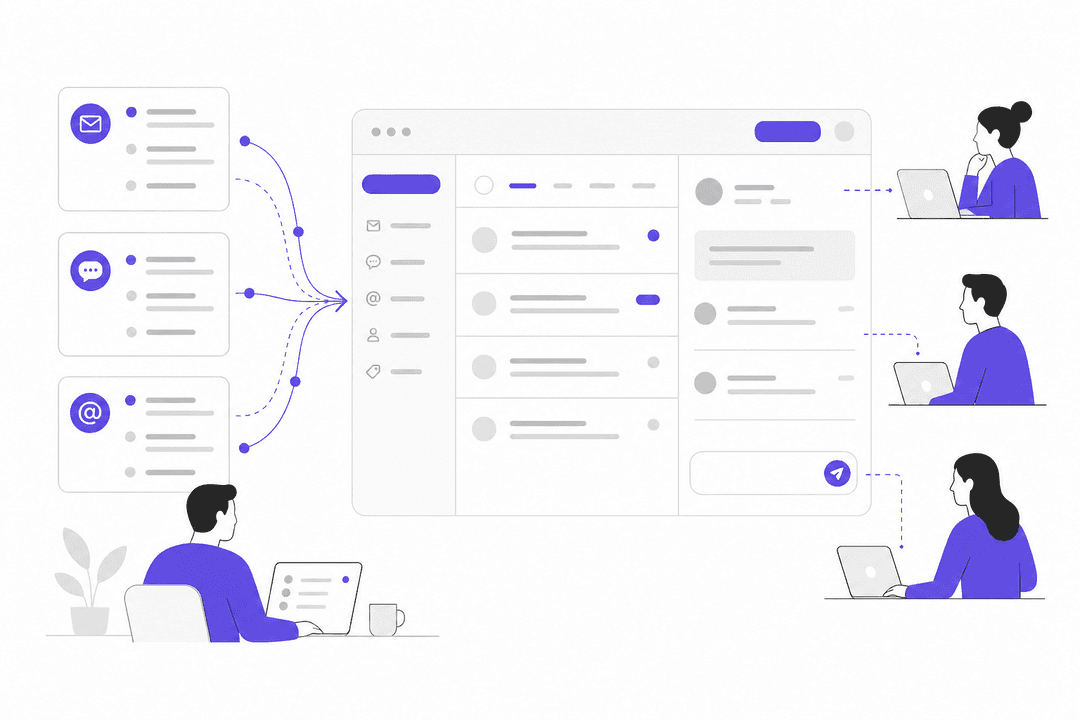
Let's be real, the shared team inbox can turn into the digital wild west in a hurry. Conversations slip through the cracks, two people accidentally reply to the same customer (always awkward), and important questions sit unanswered for way too long. It's a recipe for stressed-out agents and unhappy customers.

Taming this chaos isn't about working harder, it's about working smarter. Figuring out how to effectively assign conversations to teammates and teams is the first real step toward building a support system that’s organized, efficient, and genuinely helpful.

In this guide, we’ll walk through the three main ways to get the right conversation to the right person. We'll cover the old-school manual handoff for unique cases, the classic rule-based routing for when you need predictability, and the smart AI-powered approach for when you're ready for things to just work.

What you'll need before you start

Before you can build a slick assignment system, you just need a few things in place. Don't worry, this is the easy part. You'll need:

  • A central helpdesk. This is your home base. Whether you're using a tool like Intercom, Zendesk, or Freshdesk, you need one spot where all your conversations live.

  • Defined teams and roles. It sounds basic, but you need to know who handles what. Make sure you have clear groups, like "Tier 1 Support," "Billing," or "Technical Escalations."

  • A general idea of your common questions. You don't need a perfect breakdown, just a rough sense of the kinds of things your customers ask about most often. This will be your starting point for any automation you set up.

3 methods to assign conversations

The best way to route conversations really comes down to your team's size, how many tickets you get, and how tricky they usually are. Let's break down the options, from the simplest to the smartest.

Method 1: Manual assignment for one-off situations

This is as straightforward as it gets. Think of it as the digital version of tapping a coworker on the shoulder and saying, "Hey, can you take a look at this?" An agent simply opens a ticket and passes it along to another person or a specific team.

When is this a good idea?

  • When a really tricky issue comes in that needs a specific expert’s eyes.

  • When you have to escalate a conversation to a manager for a final say.

  • When you're handing off your queue to a colleague at the end of your shift.

How it works (in most tools):

  1. Open the conversation you need to reassign.

  2. Find the "Assign" or "Owner" button or dropdown menu (it's usually somewhere near the top).

  3. Pick the right teammate or team from the list. The conversation then moves out of the main queue and into theirs. Simple as that.

Manual assignment is great for those occasional curveballs. The problem is, it's purely reactive. It works for a few tickets here and there, but it doesn't scale. As your ticket volume grows, you'll need someone whose whole job is to just watch the unassigned queue and play traffic cop, which quickly becomes a major bottleneck.

Method 2: Rule-based automation

This is where most teams that are starting to grow begin. You set up simple "if-then" rules inside your helpdesk to automatically route incoming conversations based on criteria you define. It’s a definite improvement over doing everything by hand.

graph TD A[Incoming Email] --> B{Contains 'billing'?}; B -->|Yes| C[Assign to Billing Team]; B -->|No| D{Contains 'bug'?}; D -->|Yes| E[Assign to Tech Support]; D -->|No| F[Assign to General Queue];

You can build rules based on all sorts of things:

  • Channel: If a message comes from email, send it to the Support team. If it comes from live chat, send it to the Sales team.

  • Keywords: If the subject line or message contains "invoice," "billing," or "refund," automatically assign it to the Billing team.

  • Customer Info: If the conversation is from a customer tagged as "VIP," send it straight to their dedicated account manager.

How it works (in most tools):

  1. Find the automation section in your helpdesk (it might be called "Workflows," "Rules," "Triggers," or something along those lines).

  2. Create a new rule and define the conditions (the "if" this happens part).

  3. Then, set the actions that should follow (the "then" do this part), like "Assign to Technical Support team."

While rules are a step in the right direction, they come with some serious headaches.

They're fragile Rules depend on customers using the exact keywords you've predicted. A simple typo, a different phrasing ("payment issue" instead of "billing problem"), or a message in another language can cause the rule to fail. When that happens, the ticket is left stranded in the unassigned queue.

They get messy, fast A few rules are fine. But teams often find themselves buried under dozens, or even hundreds, of overlapping and sometimes conflicting rules. Trying to figure out why a ticket went to the wrong place can feel like a full-time detective job.

They can't read the room A rule can't tell the difference between a curious prospect asking about your refund policy and an angry customer demanding their money back. Both messages might contain the word "refund," so they both get sent to the same place, even though the urgency and intent are completely different.

Method 3: AI-powered intelligent triage

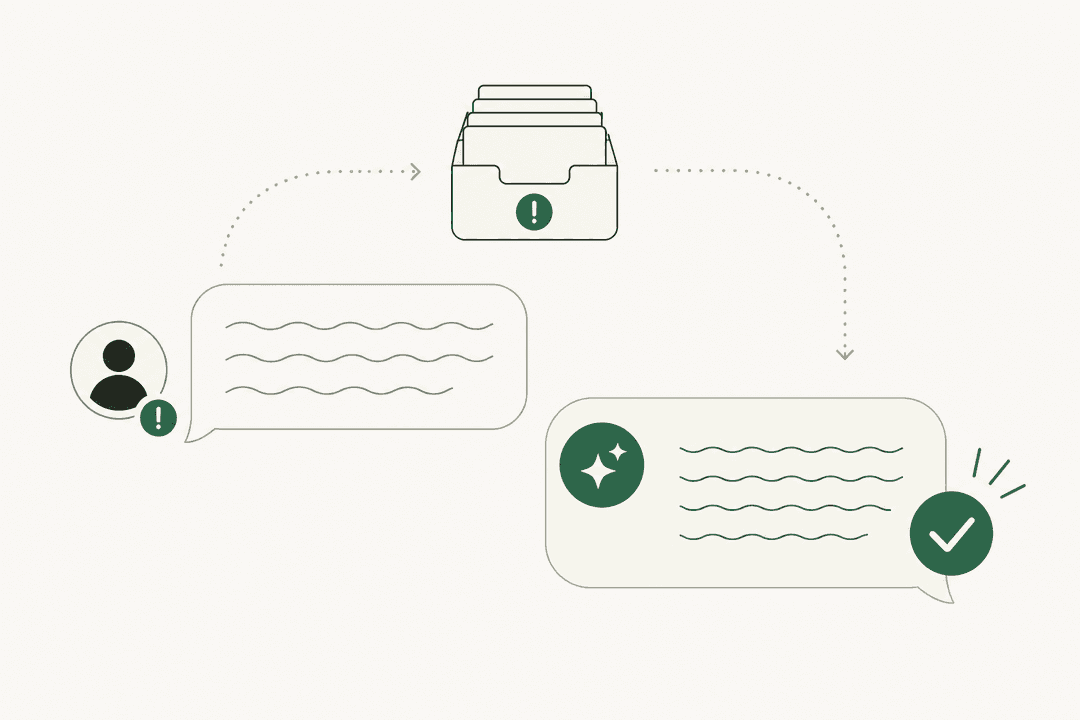
This is the modern way to handle routing. Instead of relying on fragile keywords, you use an AI layer that understands the actual intent and context of a conversation to send it to the right place, dynamically and accurately. The best part is that these AI tools don't force you to switch helpdesks; they plug right into the software you already use and make it smarter.

This is exactly what we built at eesel AI. Our AI Triage product is designed to automate your inbox triage without the headaches of old-school, rule-based systems.

It’s different because it actually learns how your team works. Instead of you writing rules, eesel AI analyzes thousands of your past support tickets to understand your business. It learns how your team talks, what kinds of problems you solve, and how you categorize things, so it gets your unique context right from the start.

Because it learns from you, it understands intent, not just keywords. eesel AI can tell the difference between a user reporting a critical bug, a customer asking for a new feature, and someone just giving feedback. It routes each of these to the right place, engineering, product, or customer success, all on its own.

And you're always in control. You decide which types of conversations the AI should handle. You can start small by letting it assign simple, repetitive tickets while your team handles the rest. As you get comfortable, you can let it do more, like adding tags, setting the priority, or even closing tickets that don't need a human response. The best part? You get all this without a months-long setup project. eesel AI connects to your helpdesk in minutes.

Best practices for assigning conversations

No matter which method you pick, a few good habits will help keep things running smoothly.

Define clear ownership Make sure every agent and every team knows exactly what they're responsible for. When there’s confusion about who owns what, conversations get dropped.

Have a safety net Create a default inbox (like "Unassigned" or "General Inquiries") that catches any conversation that doesn't match a rule or can't be assigned for some reason. Just make sure someone is responsible for checking this queue regularly.

Write it down If you're using rule-based automation, keep a simple document that explains what each rule does. This will save you a world of pain when you need to troubleshoot or make changes down the road.

Review and adjust Your business changes, and your routing logic should too. Take a look at your assignment rules and team structures at least once a quarter to make sure they still make sense for how you work today.

Test before you go live This one is huge. Changing how your conversations are routed can have big, unintended consequences. This is where modern tools have a massive advantage. Platforms like eesel AI have a simulation mode that lets you test your AI triage setup on thousands of your own historical tickets. You can see exactly how it would have performed, get an accurate forecast of its performance, and fine-tune its behavior with zero risk before it ever touches a live customer conversation.

The simulation mode in eesel AI, which allows teams to safely test how the AI will assign conversations to teammates and teams.

A better way to assign conversations

The evolution of support is clear: teams are moving away from slow manual work and brittle rules and toward intelligent, context-aware automation. An AI-driven approach simply solves the core problems of the older methods.

The difference becomes pretty clear when you put them side-by-side:

FeatureTraditional Rule-Based Assignmenteesel AI Triage
LogicKeyword-based (e.g., "billing")Intent-based (understands context)
SetupYou have to build every rule by handOne-click setup, learns from your data
MaintenanceRequires constant manual updatesLearns and gets smarter on its own
AccuracyProne to errors if keywords are missedHigh accuracy by learning from past tickets
TestingLive testing (which is risky)Risk-free simulation on historical data
CapabilitiesAssigns to teams/agentsAssigns, tags, sets priority, closes tickets

Stop sorting and start solving

At the end of the day, your team's job is to help customers, not play air traffic control with the inbox. A smart system for conversation assignment is how you free them up to do that.

By moving from manual processes to intelligent AI-powered triage, your team can handle more work, respond faster, and provide more accurate support. It’s a win for your agents, who get to focus on meaningful conversations, and a win for your customers, who get the help they need without the long wait.

Ready to automate your inbox triage with an AI that learns from your team? Try eesel AI for free and see how you can intelligently assign conversations to teammates and teams in just a few minutes.


Frequently asked questions

Effectively assigning conversations prevents chaos in a shared inbox, reduces response times, and ensures customers get help from the right expert quickly. This leads to less stress for agents and significantly higher customer satisfaction.

Manual assignment is instant. Rule-based systems require time to define conditions and actions, which can grow complex. AI solutions, like eesel AI, connect in minutes and learn from your historical data, significantly reducing manual setup time for intelligent routing.

For very small teams with low volume, manual assignment can suffice for unique cases. As your ticket volume grows, rule-based systems are a common first step. For truly efficient and scalable routing, AI-powered triage is ideal for teams of any size.

With advanced AI solutions, you remain in control and can fine-tune its behavior. Platforms often include a simulation mode to test performance on historical data, allowing for adjustments and accuracy improvements before the AI handles live customer conversations.

Yes, with most AI tools, you can control which types of conversations the AI should handle and how it learns over time. You can start by letting it assign simple, repetitive tickets and gradually expand its responsibilities as you gain confidence and see its performance.

Primarily, you will need a central helpdesk system (such as Zendesk, or Freshdesk) where all customer conversations are managed. It is also beneficial to have clearly defined teams and roles within your organization.

AI understands the context and intent of a conversation rather than just relying on exact keywords, making it far more accurate and resilient to misspellings or varied phrasing. It also learns from your team's past actions, reducing the constant manual maintenance required by rule-based systems.

Share this post

Kenneth undefined

Article by

Kenneth Pangan

Writer and marketer for over ten years, Kenneth Pangan splits his time between history, politics, and art with plenty of interruptions from his dogs demanding attention.