I tested dozens of platforms to find the best 6 AI tools for sales and marketing in 2026

Kenneth Pangan
Last edited January 7, 2026

By 2026, the distinction between sales and marketing has become less clear, merging into one long conversation with the customer. Trying to manage this manually just isn't practical anymore. Customers want content that speaks to them, quick answers, and real value, which is where artificial intelligence fits in. AI tools for sales and marketing have shifted from being a nice-to-have to a core part of any business plan.
These tools handle the repetitive work, find useful patterns in data, and help teams scale their efforts without letting quality slip. From identifying the right leads to writing effective outreach messages, AI is changing the sales and marketing landscape. This guide is the result of testing dozens of platforms to find the ones that actually make a difference. For instance, at eesel, we used our own eesel AI blog writer and saw our daily impressions grow from 700 to 750,000 in three months. We’ll look at the top 6 options that can help your team work more efficiently and increase revenue.
What are AI tools for sales and marketing?
AI tools for sales and marketing are software platforms that use technologies like machine learning to automate and improve parts of the sales and marketing process. They do more than just run simple scripts; they analyze data, spot trends, and offer smart suggestions to help teams be more effective.
Their capabilities cover the entire customer journey. For marketing, they can generate SEO-friendly blog posts, craft personalized email campaigns, and handle social media. For sales, they can score leads to find the most promising prospects, analyze sales calls to provide coaching feedback, and automate data entry in your CRM.
The main idea is to take repetitive tasks off your team's plate. By managing the administrative work, AI lets sales and marketing professionals concentrate on activities that need a human, like building relationships, closing deals, and thinking about brand strategy. These tools help businesses connect with customers better and grow their revenue.
How we selected the best AI tools for sales and marketing
To put this list together, we looked past the feature sheets and marketing buzz. We judged each tool on practical criteria that matter to sales and marketing teams in 2026.
-
Real-world impact: We focused on tools that solve a real problem and provide a clear return, whether that’s saving time, improving lead quality, or boosting conversion rates.
-
Ease of use: A tool isn't helpful if it’s too hard to use. We picked platforms with straightforward interfaces that teams can start using without needing a lot of technical help.
-
Integration capabilities: A modern tech stack is all connected. We selected tools that work well with common platforms like CRMs (Salesforce, HubSpot), email, and communication apps like Slack.
-
Specialized function: We looked for tools that are excellent at one specific thing, from analyzing conversations and coaching email writing to enriching data and generating content. This ensures each one is a top-tier solution in its category.
-
Factual accuracy and reliability: For tools that create content or provide data, we checked their ability to produce accurate and reliable information that sounds human and can be trusted in a business context.
A quick comparison of the top AI tools for sales and marketing
Before getting into the specifics, here’s a brief overview of the top AI tools for sales and marketing that we recommend for 2026.
| Tool | Best For | Starting Price | Key Strength |
|---|---|---|---|
| eesel AI blog writer | AI content marketing | Free to try ($99/50 blogs) | Generating complete, SEO-optimized blogs with assets |
| Gong | Revenue intelligence | Custom | Deep call analysis and AI-powered forecasting |
| Lavender | Email optimization | Free plan available ($29/user/month) | Real-time email coaching to increase reply rates |
| Clay | Prospecting & enrichment | Free plan available ($149/month) | Combining 150+ data sources for custom workflows |
| Fireflies.ai | Meeting transcription | Free plan available ($10/user/month) | Automated notes with a strong data privacy policy |
| SPOTIO | Field sales engagement | Custom | Mobile-first AI assistant for outside sales reps |
The 6 best AI tools for sales and marketing in 2026
Here is our detailed review of the platforms that are making a real impact on sales and marketing teams.
1. eesel AI blog writer
The eesel AI blog writer is a tool designed to take a single keyword and turn it into a complete, SEO-optimized blog post that's ready to publish. It does more than just generate text; it also includes media assets, data tables, and social proof. At eesel, we used this exact tool to grow our daily impressions in just three months by publishing over 1,000 optimized blogs.
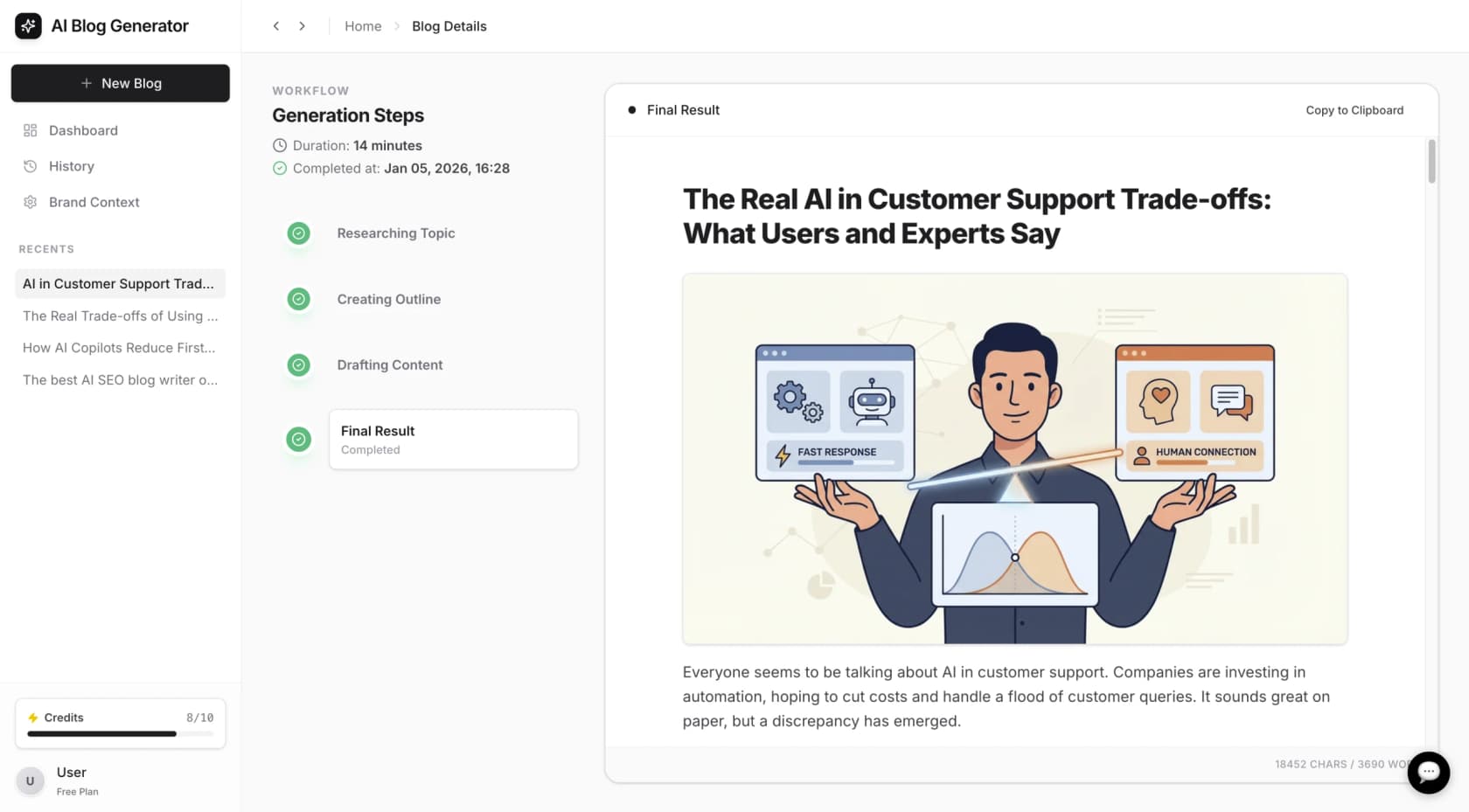
Its key strengths are its context-aware research, which finds relevant data for different types of blogs, and its ability to create content that reads naturally. It automatically adds assets like AI-generated images, infographics, and relevant YouTube videos. The inclusion of real Reddit quotes adds a layer of authenticity. Its main drawback is that it's specialized for blog content, so if you need an AI writer for social media or ad copy, you might need something else.
Pricing:
-
Free Trial: You can generate a blog for free to see the quality for yourself.
-
Paid: $99 for 50 blog credits.
2. Gong
Gong is a revenue intelligence platform that records and analyzes sales conversations from calls, meetings, and emails. It positions itself as a "Revenue AI OS" that unifies customer insights. The AI provides feedback on what top performers do differently, flags risks in deals, and helps sales managers coach their teams better. Gong is used by over 5,000 companies, including LinkedIn, ADP, and Google.
The platform's main strengths are its ability to highlight specific moments for coaching and provide accurate forecasts based on actual customer conversations. It can also track mentions of competitors and identify objections. The downside is that Gong is an enterprise-level platform, and its pricing can be a considerable expense, which might not be suitable for smaller teams.
Pricing:
- Gong’s pricing is custom, based on user licenses plus a platform fee. You need to contact their sales team.
3. Lavender
Lavender is a real-time AI email coach that helps sales reps write more effective emails that get more replies. It works directly within your inbox (Gmail or Outlook) and other platforms like Salesloft and HubSpot. It scores your email based on data from billions of sales emails and offers suggestions to improve tone, clarity, and length. It’s like having a personal coach for every message you write.
Lavender's biggest advantage is its simplicity and instant feedback, which helps reps develop better writing habits. Its Personalization Assistant researches your recipient and suggests relevant opening lines, which saves time. However, the constant suggestions might lead to messages that are too simple for more complex sales discussions. It's also focused only on email and doesn't help with other communication channels.
Pricing (billed monthly):
-
Basic: Free (for up to 5 email analyses per month).
-
Starter: $29 per month.
-
Individual Pro: $49 per month.
-
Teams: Starts at $99 per seat, per month.
4. Clay
Clay is a sales automation platform that serves as a central point for finding and enriching lead data. It stands out by integrating with over 150 data providers. It lets you build "waterfall" enrichment workflows, so if one source can't find data, another is automatically checked. As Adam Wall, Head of Sales Operations at Anthropic, said, "We have 3x our enrichment rate."
Like others here have mentioned, Clay is pretty good. It has integrations of over 100 other data providers. However, you’re better off using Clay as more of a supercharged spreadsheet where all of your data can be enriched.

A key feature of Clay is its flexibility. You can create complex workflows without writing code, combining data scraping, AI-powered research with its "Claygent" agent, and lead scoring all in one place. This lets teams create highly personalized outreach at a large scale. The main downside is the learning curve. While it's powerful, setting up advanced workflows can be complicated for teams new to automation.
Pricing (billed monthly):
-
Free: Includes 1,200 credits per year.
-
Starter: Starts at $149 per month.
-
Explorer, Pro, and Enterprise plans are available with more credits and features.
5. Fireflies.ai
Fireflies.ai is an AI meeting assistant that joins your calls on platforms like Zoom and Google Meet, records them, and provides a full transcription. A key feature is its strong commitment to data privacy; Fireflies states that "you own your data." It is also SOC 2, GDPR, and HIPAA.
Fireflies ai for me, just a simple cheap google meets note taker & transcription SaaS, but I have so many meetings I just simply lose track of actions, summaries, agreed next steps & it saves my bacon every week.
Its main strengths are its affordability and strict security policies, making it a reliable choice for sensitive discussions. The ability to apply frameworks like MEDDIC to call transcripts is also a useful feature for sales teams. A potential drawback is that while the transcription is usually accurate, it can have trouble with strong accents or technical jargon, sometimes needing manual edits.
Pricing (billed annually):
-
Free: Limited transcription credits and 800 minutes of storage.
-
Pro: $10 per user, per month.
-
Business: $19 per user, per month.
-
Enterprise: $39 per user, per month.
6. SPOTIO
SPOTIO is a sales engagement platform made for outside sales teams. While many AI sales tools are for inside sales, SPOTIO offers AI features that work in the field. Its "Intelligent Field Sales Assistant" gives reps immediate access to product info, competitor details, and pricing through its mobile app. Customers have reported an average 23% increase in sales revenue.
The main benefit of SPOTIO is its focus on the specific needs of field sales, with features like territory management, route planning, and activity logging with GPS verification. This helps standardize work for teams that are often spread out. The limitation is its narrow focus; it's designed for teams of 5 or more and isn't a fit for companies without an outside sales team.
Pricing:
- SPOTIO offers customizable annual plans and requires a demo to get a price.
Tips for choosing the right AI tools for sales and marketing
With so many options out there, picking the right AI tool can be a challenge. Here are a few tips to help you decide:
-
Start with your biggest problem. Don't just get an AI tool for the sake of it. Figure out the biggest bottleneck in your current process. Is it prospecting time? Low email reply rates? Inaccurate forecasts? Pick a tool that solves that specific problem first.
-
Prioritize integration. The best AI tools work with your other software. Make sure any platform you're considering connects easily with your CRM and other key tools. A tool that doesn't share data will create more work.
-
Involve your team in the decision. The people who will use the tool daily are the best ones to judge how easy it is to use. Run a trial with a small group and get their feedback before rolling it out to everyone.
-
Consider ease of use. Look for tools with a clean interface and good customer support. The quicker your team can get comfortable with it, the sooner you'll see benefits. A complicated tool can slow things down.
For a more visual overview of how these tools work in practice, here's a helpful video that reviews some of the top AI sales tools available today.
The future of sales with AI tools is now
Adopting AI is no longer a matter of if, but when. The tools on this list are changing how sales and marketing teams work, helping them be more effective and more efficient. By automating repetitive work and providing insights from data, AI lets professionals focus on what's most important: building relationships with customers.
Whether you want to improve prospecting, write better emails, or create high-quality content, there's an AI tool that can help. For teams focused on organic growth, a platform like the eesel AI blog writer can be especially useful, turning content creation from a slow process into a scalable way to generate leads. The best approach is to start small, identify your biggest needs, and pick a tool that fits into your current workflow.
Ready to see how AI can change your content strategy? Generate your first SEO-optimized blog post for free.

Frequently asked questions
The primary benefits include automating repetitive tasks like data entry and lead scoring, which frees up your team's time. They also provide data-driven insights to improve decision-making, help create personalized content and outreach at scale, and ultimately allow your team to focus on strategic activities like building customer relationships and closing deals.
For a [small business](https://www.eesel.ai/blog/ai-marketing-tools-for-small-business), start by identifying your most significant pain point, whether it's lead generation, content creation, or email engagement. Look for tools with free trials or affordable entry-level plans, like eesel AI or Fireflies.ai. Prioritize ease of use and ensure the tool integrates with the software you already use, such as your CRM or email client.
Yes, most modern AI tools are designed to [integrate with popular CRMs](https://spotio.com/integration/) like Salesforce and HubSpot, as well as other common platforms like Gmail, Outlook, and Slack. Integration capability is a key factor to consider when choosing a tool, as it ensures a smooth workflow and prevents data from being siloed.
Yes, many platforms offer free plans or trials to help you get started. For example, the eesel AI blog writer lets you generate your first blog for free. Lavender and Fireflies.ai both have free basic plans with certain limitations, which are great for testing the tools before committing to a paid subscription.
One of the biggest challenges is team adoption. If a tool is too complex or doesn't fit well into the existing workflow, your team may not use it consistently, which means you won't see a return on your investment. It's important to involve your team in the selection process and choose tools that are intuitive and solve a clear problem for them.
Share this article

Article by
Kenneth Pangan
Writer and marketer for over ten years, Kenneth Pangan splits his time between history, politics, and art with plenty of interruptions from his dogs demanding attention.
