
Many marketing tools are now "AI-powered," which can make it difficult to distinguish between marketing buzzwords and features that will genuinely improve your workflow. Sifting through the options can be time-consuming.
This guide offers a hands-on review of five of the most popular tools to clarify what is hype and what is genuinely helpful. This review focuses on platforms that deliver effective automation solutions.
At eesel AI, we specialize in this area. We used our own eesel AI blog writer for content marketing, which grew our site from 700 to 750,000 daily impressions in three months. Based on our experience, this guide shares our findings on what effective automation can achieve.
What are AI tools for marketing automation?
Marketing automation refers to software that handles repetitive tasks such as sending email sequences, scheduling social media posts, or nurturing leads. It has been a foundational tool for marketers for years.
Adding AI to the mix turns these tools from basic schedulers into smart assistants. Instead of only following rigid "if this, then that" rules, AI can analyze data to predict optimal outcomes, personalize content dynamically, and manage complex workflows autonomously.
While time-saving is a significant benefit, the primary advantage lies in the results. These tools enable more personalized customer experiences, more effective lead nurturing, and data-driven insights that inform smarter, faster decisions.
How we chose the best AI tools for marketing automation
To make sure this review was actually useful, I judged every tool on the same four things. I wasn't interested in a long list of features; I wanted to see how they held up in a real-world setting.
-
Real automation: How well does the tool actually automate key marketing tasks? I checked its ability to manage email, create content, and handle workflows without needing constant attention.
-
Smart features: Does the AI actually do something intelligent? I looked at predictive sending, autonomous agents, and AI content generation to see if they were genuinely useful or just flashy gimmicks.
-
User-friendliness: How fast can a non-developer marketer get started? A clean interface and a gentle learning curve were non-negotiable.
-
Bang for your buck: Does the price make sense for what you get? I weighed the cost against the features and the potential return on investment.
The best AI tools for marketing automation at a glance
Here’s a quick rundown of the top 5 tools that made the list.
| Tool | Best for | Key AI feature | Starting price |
|---|---|---|---|
| eesel AI blog writer | End-to-end SEO content automation | Generates complete blogs with images, videos, and social proof | Free to try, then $99 for 50 blogs |
| Jasper AI | AI-powered brand copywriting | Brand Voice & Jasper IQ context layer | Pro from $59/month (billed annually) |
| Zapier | Orchestrating workflows between tools | AI Agents that automate tasks across 8,000+ apps | Free plan available; paid from $19.99/month (billed annually) |
| ActiveCampaign | AI-powered email nurturing | Predictive Sending and autonomous marketing | From $15/month (billed annually) |
| HubSpot Marketing Hub | All-in-one CRM and marketing platform | Breeze AI assistant & agents | From $890/month (billed annually) |
A deep dive into the top 5 AI tools for marketing automation
Alright, let's get into the specifics of what makes each of these tools a solid choice.
1. eesel AI blog writer
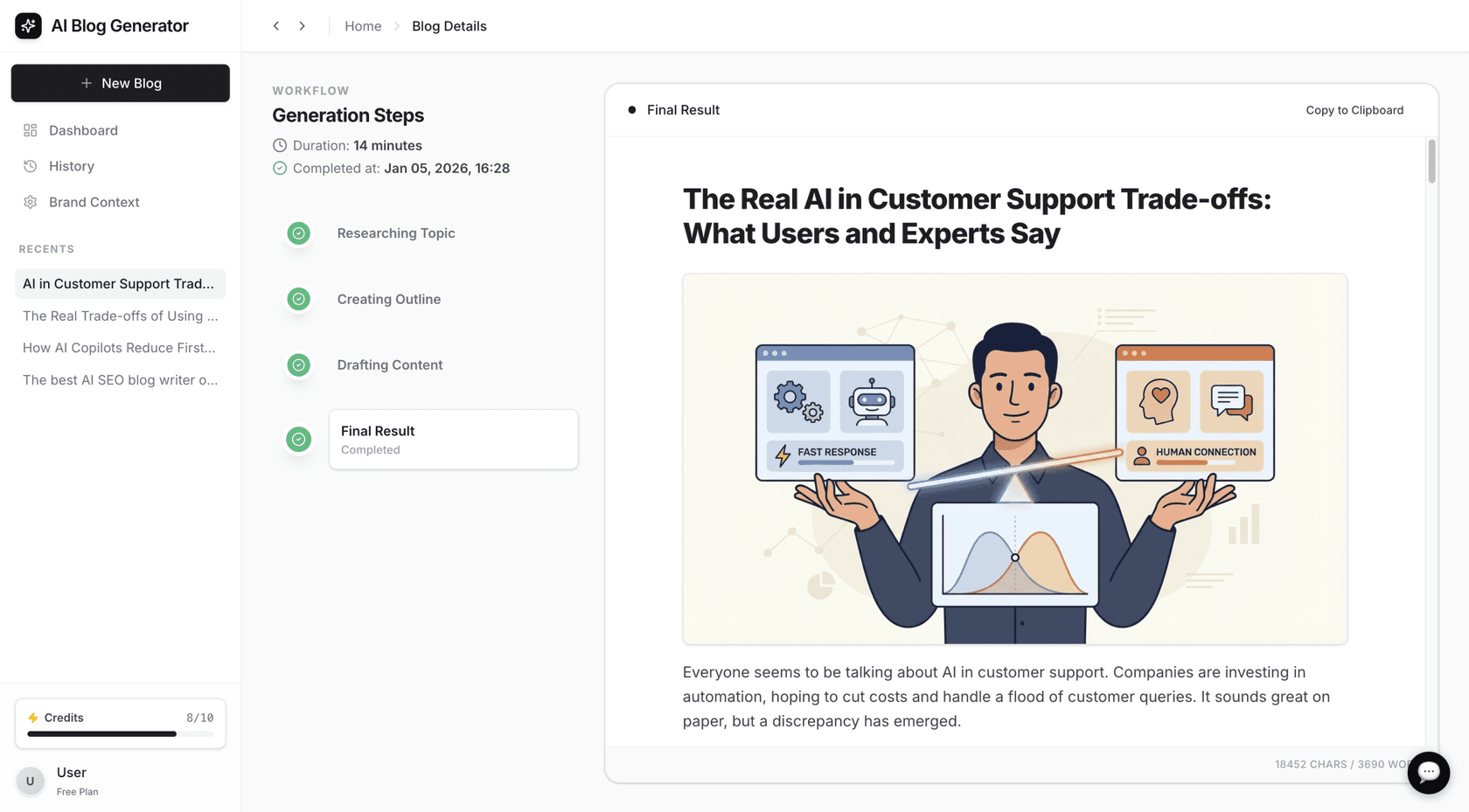
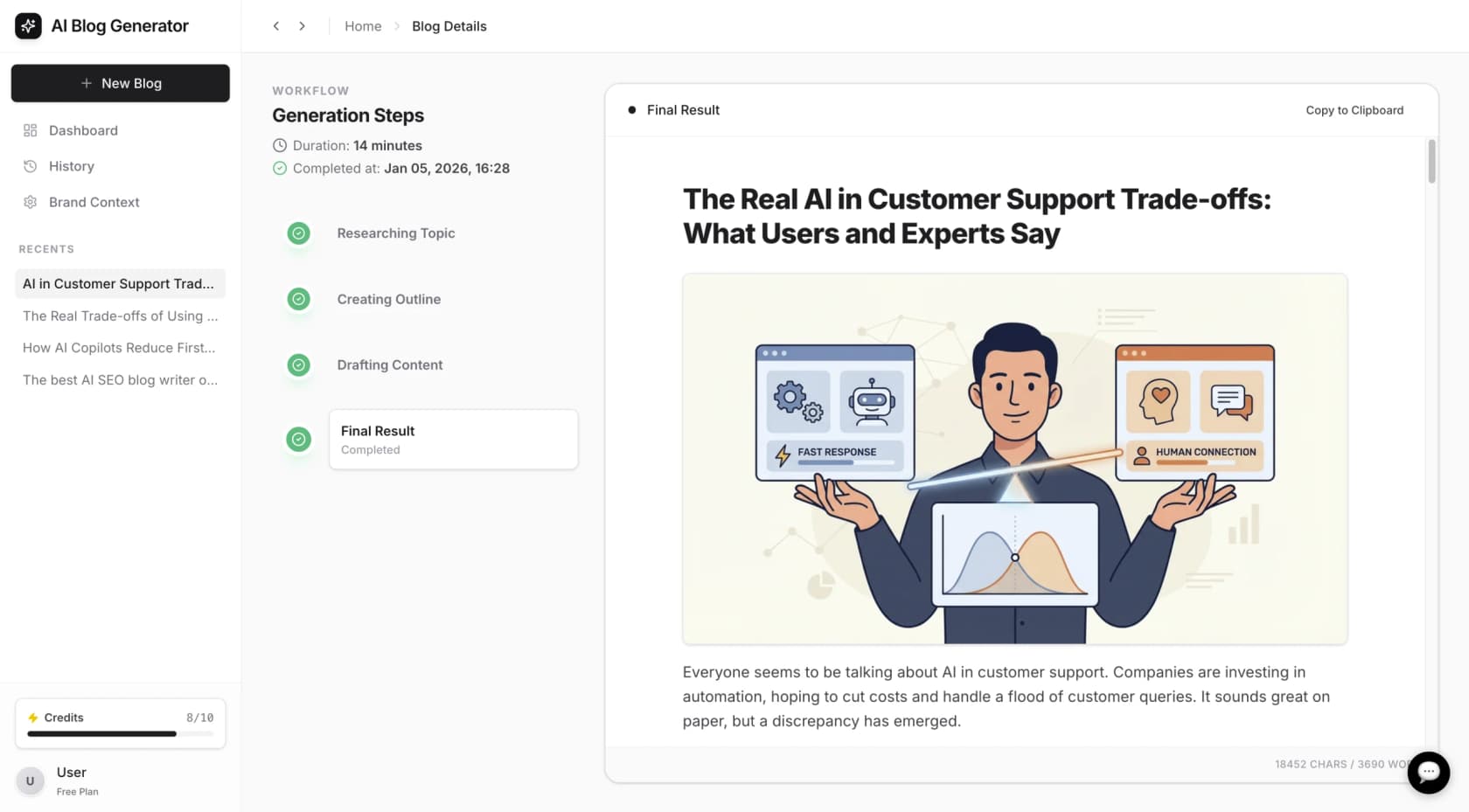
Full disclosure: this is our tool, and it’s the engine that powers our own marketing. The eesel AI blog writer is an AI content platform built to do one thing exceptionally well: turn a single keyword into a complete, SEO-optimized blog post that's ready to publish. It’s how we published over 1,000 articles and grew our site from 700 to 750,000 daily impressions in just three months.
-
Pros: The biggest advantage here is that it doesn't just spit out a text draft. It builds a complete article with proper headings, AI-generated images, tables, and infographics. It even finds and embeds relevant YouTube videos and real Reddit quotes to add social proof and build trust. The research is context-aware, and it’s optimized for AI answer engines (AEO), so the content is high-quality, sounds human, and is designed to rank in 2026.
-
Cons: Keep in mind, this is a specialized tool. It's built to do one thing perfectly: automate content marketing. It’s not an all-in-one platform for managing your email campaigns or running ads, but it is highly effective at solving the content bottleneck.
-
Pricing:
- It's completely free to try, so you can judge the quality of the blogs for yourself.
- The paid plan is straightforward: $99 for 50 blog credits.
2. Jasper AI
Jasper AI is a generative AI platform designed specifically for marketing teams. It’s focused on helping you create on-brand copy for just about anything, from social media posts and ads to full articles. Its intelligence is powered by Jasper IQ, a context layer that gets marketing principles and combines them with your company's brand details.
Yeah, I’ve compared them a few times. Jasper feels more streamlined for marketing use cases , the workflows, templates and brand voice tools make it faster to get publish-ready content. ChatGPT, Claude, and Gemini are great for flexibility, but Jasper’s strength is structure and speed for teams that write a lot.

-
Pros: Jasper's main strength is brand consistency. Its Brand Voice feature is quite good; it scans your style guides and past content to learn and adopt your unique tone. The platform also uses the best large language model (LLM) for whatever task you give it. Plus, it pulls recent data from Google Search, which helps keep the content current.
-
Cons: One consideration with Jasper is its focus on text generation. It doesn't automatically create or add media like images or videos. This means users will need to source and add media like images or videos separately. API access is also limited to the custom-priced Business plan.
-
Pricing:
- Pro: Starts at $59 per month per seat when billed annually.
- Business: Requires custom pricing.
3. Zapier
While it’s not a marketing platform in the usual sense, Zapier has become the essential glue holding modern marketing stacks together. It lets you connect over 8,000 different apps and build automated workflows (they call them "Zaps") without writing any code. They've recently added AI agents that can make decisions and handle complex tasks on their own.
Personally love ChatGPT, Jasper, and Canva’s AI tools , they save me hours on content, visuals, and ideas. Also Zapier for automations and Anyword for ad copy optimization. Simple tools, real impact. 🚀
-
Pros: The primary advantage of Zapier is its flexibility. You can connect pretty much any tool you're already using, from your CRM to your social media scheduler. The new Zapier Agents take this a step further, letting you build smart systems that can route leads, enrich contact data, and trigger actions across your entire tech stack. It's also built with enterprise-grade security, which is a nice bonus.
-
Cons: Zapier doesn't have any of its own marketing channels. It only works by connecting to other services, so your costs can add up since you're paying for both Zapier and the apps it connects to. For new users, building complex, multi-step Zaps can also feel a bit intimidating.
-
Pricing:
- Free: A solid free-forever plan with 100 tasks per month.
- Professional: Starts at $19.99 per month when billed annually.
- Team: Starts at $69 per month when billed annually.
4. ActiveCampaign
ActiveCampaign offers an autonomous marketing platform that combines email marketing, automation, and CRM tools. It is a strong option for businesses that want to create detailed, personalized customer journeys based on how users behave and interact.
-
Pros: ActiveCampaign really stands out with its library of over 950 pre-built automation recipes, which makes getting started much easier. Its AI features are practical. For instance, Predictive Sending learns when each contact is most likely to open an email and sends it at that perfect moment to boost engagement. The built-in CRM also gives you great insights for creating highly targeted segments.
-
Cons: With so many features, the interface can feel a bit crowded for first-timers. Some of the best AI features, like Predictive Sending, are only on the pricier Professional and Enterprise plans, which might be out of reach for smaller businesses.
-
Pricing:
- Starter: Starts at $15 per month when billed annually.
- Plus: Starts at $49 per month when billed annually.
- Pro: Starts at $79 per month when billed annually.
5. HubSpot Marketing Hub
HubSpot is an industry-leading, comprehensive platform for marketing, sales, and service. The Marketing Hub is a top-tier solution for businesses wanting to manage the entire customer journey from one place, with some powerful AI features driven by its assistant, Breeze.
I’ve been sticking with a few solid ones: Jasper for quick content drafts, HubSpot AI for smarter automation and lead scoring, and Surfer SEO for data-driven content ideas. Most of the new “AI tools” are hype, but these three actually replaced hours of manual work.
-
Pros: The tight integration with its powerful and free CRM is a significant advantage. HubSpot's workflow builder is one of the best out there, and its reporting and analytics are top-notch. The new Breeze AI agents, like the Customer Agent and Prospecting Agent, offer impressive potential for automating customer interactions and lead management. As a mature and reliable platform, it powers the growth of thousands of companies worldwide.
-
Cons: As a comprehensive and highly capable solution, HubSpot's pricing reflects the extensive value of its integrated ecosystem. While its most advanced automation and AI tools are found within the Professional and Enterprise tiers, they offer incredible depth for teams that want everything in one place. The Professional plan starts at $890 per month and includes professional onboarding to ensure your team is set up for long-term success.
-
Pricing:
- Professional: Starts at $800 per month (billed annually) plus a professional onboarding fee.
- Enterprise: Starts at $3,600 per month (billed annually) plus an enterprise-grade onboarding process.
Tips for choosing the right AI tools for marketing automation
Here are a few tips to help you choose the right tool.
-
Figure out your biggest problem first. What’s the most time-consuming part of your marketing right now? If it’s lead nurturing, a tool like ActiveCampaign is a solid bet. If you’re just trying to get your existing tools to talk to each other, check out Zapier. And if your main challenge is creating great content consistently, the eesel AI blog writer was built for that exact problem.
-
Think about your budget and team size. Evaluate plans carefully to avoid paying for enterprise features you may not need. Start with a tool that has a free plan or a generous trial so you can see if it works for you before you buy.
-
Check for important integrations. Make sure any tool you pick works well with your current tech stack. It needs to connect smoothly with your CRM, e-commerce platform, and analytics software to be truly useful.
-
Don't ignore ease of use. The most powerful tool is worthless if your team finds it too confusing. Look for a clean interface, helpful documentation, and good customer support.
To see some of these tools in action and get a better sense of how they fit into a modern marketer's workflow, check out this video breakdown of top AI marketing tools.
AI in marketing automation isn't some luxury for big corporations anymore. It's a must-have for any team that wants to keep up. The right tools can save you hundreds of hours, help you deliver more personalized campaigns, and drive better results.
For most teams, the biggest time-sink is content marketing. It’s the foundation of SEO and inbound marketing, and it's the perfect place to start automating.
That’s exactly why we built the eesel AI blog writer. It’s a simple, no-risk first step. Instead of getting tangled up in complex workflows or expensive platforms, you can solve a real problem today. Why not generate your first blog post for free and see the quality for yourself?
Frequently asked questions
What is the main benefit of using AI tools for marketing automation?
The biggest benefit is moving beyond simple scheduling to intelligent decision-making. These tools don't just perform tasks; they analyze data to personalize content, predict customer behavior, and optimize campaigns in real-time, which saves time and leads to much better results.
How do I choose the right AI tools for marketing automation for a small business?
For a small business, focus on your biggest pain point first. Don't pay for a massive all-in-one platform if you only need help with content creation or email. Look for tools with free trials or affordable starting plans, like the eesel AI blog writer, so you can prove their value before committing.
Are free AI tools for marketing automation good enough to start with?
Yes, many free plans are surprisingly powerful and perfect for getting started. Tools like Zapier and eesel AI offer free tiers that let you automate significant parts of your workflow. They're a great way to understand the benefits before upgrading to a paid plan.
Can AI tools for marketing automation replace my entire marketing team?
Not at all. The goal of these tools is to handle repetitive, data-heavy tasks so your human team can focus on what they do best: strategy, creativity, and building relationships. They augment your team, they don't replace it.
What's the difference between standard marketing automation and AI tools for marketing automation?
Standard automation follows fixed rules you set up (e.g., "if a user clicks this link, send them that email"). AI-powered tools are more dynamic. They can learn from user behavior to decide the best time to send an email or what content to show next, adapting their strategy without your manual input.
How can I measure the ROI of AI tools for marketing automation?
Measure ROI by tracking improvements in key metrics. This could be time saved (fewer hours spent on manual tasks), increased lead conversion rates from personalized nurturing, higher open rates from predictive sending, or a jump in organic traffic from automated content creation.