

Technical writing is tough. It’s not just about getting words on a page; it’s about being incredibly precise, knowing your subject inside and out, and making complicated stuff seem simple. One tiny mistake and your reader is gone.
AI writing tools can help with the hard parts. They can help you research, structure, and write technical content way faster and more consistently. The right tool can help you create genuinely useful articles that are ready to publish.
What is an AI technical blog writer?
What separates a regular AI writer from a technical one is how it handles complex details. A good AI technical blog writer can understand and use complex terms correctly, keep the facts straight, and build a logical structure that’s easy for readers to follow. It's a specialized tool for a specialized job.
How we chose the best tools
- Technical Accuracy & Clarity: How well does it handle dense, complex topics? Does it make factual mistakes or produce awkward sentences that are hard to read?
- Feature Set: Does it just write text, or does it do more? We looked for features like automatic asset generation, SEO tools, and helpful integrations.
- Ease of Use: Is the platform easy to figure out? We looked for a clean interface that writers and subject matter experts could use without difficulty.
- Value for Money: Is the price fair for the features you get? We compared the pricing plans to the overall benefits of each tool.
AI technical blog writer tools comparison
If you're in a hurry, this table gives you a quick overview of our top choices.
| Tool | Best For | Key Feature | Pricing |
|---|---|---|---|
| eesel AI blog writer | Generating complete, publish-ready posts | Automatic asset & social proof integration | Free to try, then $99 for 50 blogs |
| Writer | Enterprise-level brand consistency | Centralized style guides & AI agents | 14-day free trial; custom enterprise pricing |
| Clearscope | SEO and Answer Engine Optimization (AEO) | AI-powered content grading & drafting | Starts at $129/month |
| ClickHelp | All-in-one technical documentation platforms | Built-in AI writing assistant (WriteAssist) | Starts at $185/month; AI Suite is an add-on |
| Jasper AI | General-purpose marketing content creation | Wide range of content templates & brand voice | Starts at $59/month (billed yearly) |
The top 5 AI technical blog writer tools reviewed
Ready for a closer look? Let's get into the details of each of our top 5 picks.
1. eesel AI blog writer
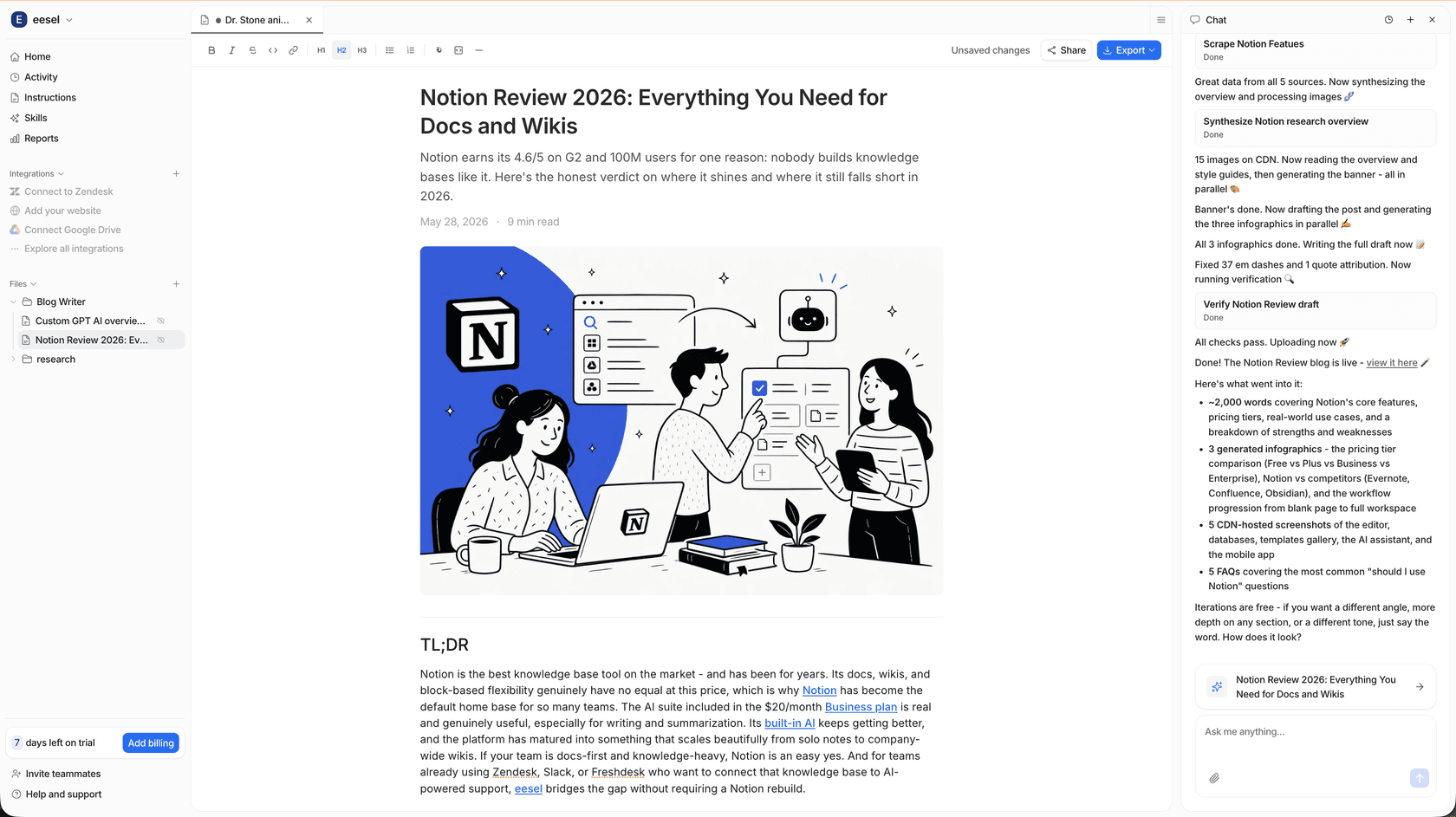
Pros: A key feature of the eesel AI blog writer is that it provides a complete, publish-ready article, not just a first draft. Its research can pull in relevant tech specs for a product review or pricing data for a comparison post. It also automatically creates assets like tables and infographics that make technical content easier to read. Another feature is its ability to pull in real Reddit quotes and relevant YouTube videos, adding authenticity. Its focus on AEO (Answer Engine Optimization) means your content is prepared for the future of search, like Google's AI Overviews.
Cons: For users looking for a simple tool to rephrase a few sentences for social media or a quick email, this platform might be more than needed. The eesel AI blog writer specializes in creating long-form, high-ranking articles from scratch.
Pricing:
- You can try it for free to see the quality for yourself.
- The paid plan is $99 for 50 blog generations.
Who it's for:
This is for content and marketing teams that want to scale up their production of high-quality technical blogs. If your goal is to publish content that ranks well and brings in organic traffic, this is the tool for you.
2. Writer

Writer is aimed at large companies where keeping brand voice consistent is a top priority. It works like a collaborative assistant, ensuring everyone on the team uses the right terms, tone, and style. It’s built on its own family of language models (called Palmyra), which can be important for companies concerned about data privacy and security.
Pros: Writer's main strength is governance. You can create a central library of approved terms, messages, and style guides, which is helpful for teams in highly technical fields. The platform offers security controls that large organizations may require. You can also build custom AI agents to handle specific, repetitive tasks.
Cons: Writer is more of an AI-powered writing assistant than a one-click article generator. It helps human writers with real-time suggestions and corrections, but it doesn't typically create a full article from a single prompt. The writer is still responsible for the initial drafting.
Pricing:
- A 14-day free trial is available.
- Enterprise plan: You'll need to get in touch with them for custom pricing.
Who it's for:
Writer is built for large enterprise teams that need to enforce strict style and terminology rules across all their content, from marketing materials to technical manuals.
3. Clearscope
Clearscope is focused on SEO. Its "AI Draft" feature creates outlines and drafts with SEO and AEO (Answer Engine Optimization) best practices built-in, giving you a head start on ranking.
Pros: Clearscope offers strong content optimization features. The AI-generated drafts are based on an analysis of top-ranking Google content, which can provide a competitive edge. The content grading system provides a clear score and actionable tips on how to make an article more comprehensive and likely to rank.
Cons: At its core, Clearscope is an optimization tool. If you need to generate a first draft quickly, it might be a more powerful solution than required. It focuses more on perfecting the written text for search performance than on generating a complete, visually rich blog post.
Pricing:
- Plans start at $129 per month.
Who it's for:
This tool is for content teams that live and breathe SEO. If your main goal is to outrank competitors on Google, Clearscope provides the data-driven insights you need to get it done.
4. ClickHelp
ClickHelp is a specialized, all-in-one platform for creating, managing, and publishing formal technical documentation like user manuals, knowledge bases, and API docs. It comes with an AI Suite that includes WriteAssist, which acts as a writing assistant within the documentation workflow.
Pros: As a dedicated help authoring tool (HAT), ClickHelp's AI features are well-suited for that purpose. WriteAssist offers contextual suggestions to improve the clarity of technical explanations. Another feature, AnswerGenius, can turn static documentation into an interactive, AI-powered knowledge base. It also supports importing from OpenAPI/Swagger, which is helpful for teams documenting APIs.
Cons: This is a comprehensive help authoring system, not a simple blog writer. It is a solution for managing user manuals from start to finish, so it may not be a practical choice for a marketing team focused only on writing technical blog posts.
Pricing:
- The core platform starts at $185 per month.
- The ClickHelp AI Suite is an additional $300 per month add-on.
Who it's for:
ClickHelp is designed for technical writing teams that manage the entire documentation lifecycle, from writing and reviewing to publishing and hosting.
5. Jasper AI
Jasper AI is one of the more popular and versatile AI writing tools available. It's a multi-tool for content creation. It has a large library of templates, and its Brand IQ feature lets you train it on your company's specific style, voice, and product details.
Pros: Jasper’s flexibility is a key appeal. With over 100 templates, it can be used for blogs, social media, ads, emails, and more. The Brand Voice and Knowledge Base features are useful for technical content, as you can feed it company information to improve the accuracy of the output.
Cons: As a general-purpose tool, Jasper's drafts on highly specific or complex technical topics may sometimes lack depth. They often require editing and fact-checking from a human expert before publication. It also doesn't automatically create or embed media like charts or videos in the same way as more specialized blog writers.
Pricing:
- Pro: Starts at $59 per seat per month (when billed yearly).
- Business: You'll need to contact them for custom pricing.
Who it's for:
Jasper is a solid choice for marketing teams that need a flexible AI writer for various content types and have in-house experts to review and verify the technical accuracy of the drafts.
Pro tips for using an AI technical blog writer effectively
No matter which tool you pick, you'll get better results by following a few simple practices.
Pro tip
Provide good context. The quality of the output depends on the quality of your input. Be specific. Tell the AI about your target audience, key terms to include, the tone you want, and any specific points you need to cover.
Pro tip
Use it as a research assistant. AI can be a fantastic research partner. Before you start writing, ask it to summarize a complex topic, explain jargon simply, or find relevant data. This can save you a ton of time.
Pro tip
Let it build the structure. AI is great at creating logical outlines. Have it generate a skeleton for your article first. You can then adjust the outline before having the AI write each section. This helps ensure the article flows well.
Pro tip
Always verify technical details. This is the most important rule. Never blindly trust an AI's output, especially with technical content. A human subject matter expert should review every fact, figure, and step-by-step process for accuracy before you publish.
I'm finding AI to be a great tool - but not so great of a writer, especially for my blog posts. It generates ideas, builds outlines, and things like that - but it's still not quite trustworthy and does stupid things like making up links when it needs external links - it thinks something 'should' be there.. so it creates 'it.' Lol.

For a practical walkthrough, see how you can combine AI's speed with human strategy to create content that stands out. This video breaks down the entire process, from ideation to a finished, high-quality blog post.
Choosing the right AI technical blog writer
AI has changed how technical writing gets done. It’s no longer just a manual process; it's a partnership between human expertise and machine speed.
The best tool for you depends on your goals. For strict brand consistency across a large company, Writer is a strong option. If your focus is on SEO and outranking competitors, Clearscope is a relevant choice.
For teams whose goal is to generate a complete and engaging technical blog post directly from a keyword, the eesel AI blog writer is a suitable option. It’s built to produce content that’s ready to publish and designed to rank.
You can try it for free and generate your first technical blog in minutes.