Doing SEO as a small business can be challenging when competing against large companies with extensive marketing departments and budgets.
However, AI is changing the landscape. It helps level the playing field by enabling small teams to automate tedious tasks, make smarter decisions, and create content that can rank in search results. With many "AI-powered" tools available, it can be difficult to determine which ones deliver on their promises.
This guide provides a curated list of six AI SEO tools that offer tangible results and are user-friendly. For example, using an AI blog writer can significantly impact content production. One case saw blog traffic grow from 700 to over 750,000 daily impressions in three months by leveraging such a tool.Small biz doesn’t need fancy AI tools. You can do 80% of AI SEO just using ChatGPT, Google Search Console data and APIs smartly. The problem is people buy tools before they understand search intent.

What are AI SEO tools for small businesses?
Think of AI SEO tools as an intelligent assistant for your marketing. They are software platforms that use artificial intelligence to help with, or completely automate, the tasks involved in getting your website found on Google.
This isn't just about writing blog posts faster, though that is a significant benefit. These tools can handle a whole range of tasks: finding the right keywords, analyzing what your competitors are doing, optimizing your content for search engines, and even tracking how often your brand gets mentioned in Google's new AI Overviews.
The goal isn't just to work faster, but to work smarter. For a small business, this means you can tap into data-driven strategies that were previously reserved for larger companies.
How we selected the top AI SEO tools
We didn't just pick the tools with the most features or the flashiest websites. We focused on what truly matters for a small business that needs to see a return on every dollar and hour spent.
Here’s what we looked for:
-
Real-world results: We prioritized tools that have a proven track record or solve a critical, often-overlooked SEO problem in a smart way.
-
Ease of use: No one has time for a steep learning curve. The tools on this list are intuitive and built for people who are marketers or business owners, not necessarily SEO experts.
-
Affordability: We looked for tools with pricing that makes sense for a small business budget. That means flexible plans, fair credit systems, and free trials so you can see the value before you commit.
-
Specific use cases: This isn't a list of six tools that all do the same thing. We picked a mix that excels at different jobs, from content creation to technical SEO, so you can build the right toolkit for your needs.
A comparison of top AI SEO tools for small businesses
Before we get into the details, here’s a quick look at our top picks and what they do best.
| Tool Name | Best For | Key Feature | Pricing Summary |
|---|---|---|---|
| eesel AI blog writer | Generating complete, publish-ready blog posts | Automatic inclusion of assets and social proof | Free to try, then $99 for 50 blog posts |
| Semrush | All-in-one SEO and AI visibility strategy | AI Visibility Toolkit and deep competitor data | Starts at $199/month (or $165.17/mo annually) |
| Surfer SEO | Optimizing human-written content for search | Real-time Content Score and AI search optimization | Starts at $99/month (or $79/mo annually) |
| AI SEO Tracker | Checking AI search visibility without a subscription | One-time $49 report across five AI engines | $49 one-time, tracking from $79/month |
| Rankscale.ai | Specialized AI search engine visibility tracking | Granular prompt and citation analysis | Starts at $20/month |
| Indexly | Unified technical SEO and AI visibility monitoring | Automated indexing and AI mention tracking | Starts at $14/month, with a 7-day free trial |
A detailed look at 6 AI SEO tools for small businesses
Alright, let's get into the nitty-gritty of what makes each of these tools stand out.
1. eesel AI blog writer
For most small businesses, a major SEO bottleneck is consistently creating high-quality content. This is the exact problem the eesel AI blog writer was built to solve.
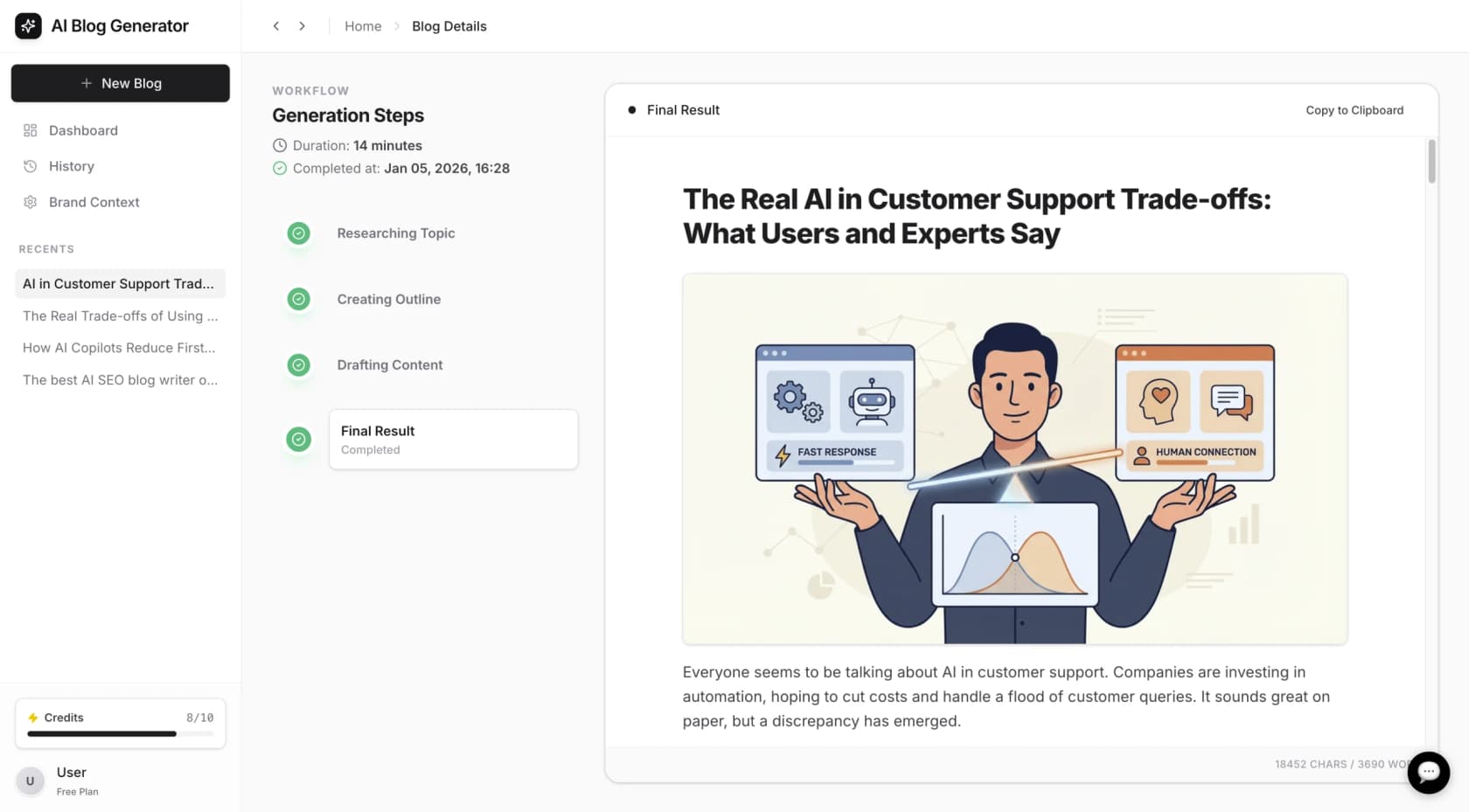
Instead of just producing a rough draft that you have to spend hours editing, it turns a single keyword into a complete, SEO-optimized article that’s ready to publish. It comes with a proper structure, headings, FAQs, and everything else you'd expect.
What sets it apart are a few key things. First, it automatically adds rich media to your posts. This can include AI-generated images, relevant YouTube videos, and even quotes pulled from Reddit forums to add authenticity and social proof. Second, it's context-aware. If you provide your website URL, it can learn your brand's voice and naturally weave in mentions of your products. Finally, the content isn't just optimized for traditional search; it's also designed for AI Answer Engines (AEO), helping you get cited in places like Google AI Overviews.
This type of tool can help scale a blog from low to high traffic. It’s not just about speed; it's about producing quality content at a scale that was previously difficult for a small team.
-
Pros: The speed and quality of the final output are notable. It saves a significant amount of time on research, writing, and formatting.
-
Cons: It’s a specialized tool for content generation. If you're looking for deep backlink analytics or technical site audits, you'll need to pair it with another tool.
-
Pricing: The eesel AI blog writer is free to try. After that, it has a simple credit system: it's $99 for 50 blog posts, making it one of the most cost-effective ways to scale your content.
2. Semrush
For those looking for a single platform to act as the command center for their entire SEO strategy, Semrush is a comprehensive suite that covers almost every aspect of SEO.
While it has many features, their recent AI-focused tools are notable. The Semrush One offering includes an AI Visibility Toolkit that is useful. It shows you how often your brand is showing up in AI-generated results on platforms like ChatGPT, Gemini, Perplexity, and Google's AI Overviews. It also has an AI Search Site Audit that checks for technical issues that might be blocking AI crawlers from accessing your content.
Semrush is suitable for a small business that wants a single source of truth for its SEO data and has the budget to invest in a premium, all-in-one solution. It provides the deep competitor data you need to build a strategy.
-
Pros: It’s powerful and comprehensive, offering reliable data and cutting-edge features for both traditional and AI-powered search.
-
Cons: The sheer number of features can feel overwhelming, and there's a learning curve. It's also one of the more expensive options on this list.
-
Pricing: Semrush One plans start at $199 per month, or $165.17 per month if you pay for a full year upfront.
3. Surfer SEO
If you prefer to write your own content but want to ensure it's optimized to rank, Surfer SEO is useful. Think of it as an AI-powered writing assistant that gives you a data-driven blueprint for creating top-ranking articles.
Here's how it works: you tell it your target keyword, and Surfer analyzes the top-ranking pages for that term. It then gives you a detailed checklist of what to include in your own article, from specific keywords and phrases to the ideal word count and article structure. Its Content Editor provides a real-time Content Score as you write, so you know exactly when your piece is ready to compete. It even has a Coverage Booster that points out important topics your competitors are covering that you might have missed.
Surfer is also built for the new age of search, with a workflow designed to make sure your content is visible in "Google, ChatGPT, and beyond."Surfer - really strong for on-page/content optimization. Helps structure articles to match SERP and AI search expectations, with clear keyword and heading suggestions.
-
Pros: It takes the guesswork out of SEO, turning it into a clear, actionable process. The integration with Google Docs makes for a seamless workflow.
-
Cons: If you lean heavily on its AI writer for generating content, the costs can add up. There's also a slight risk of over-optimization if you follow its suggestions too rigidly and forget about natural flow.
-
Pricing: Surfer SEO's plans begin with the Essential plan at $99 per month, which lets you optimize 30 articles and generate 5 AI-written pieces.
4. AI SEO Tracker
While most AI visibility tools ask for a monthly plan upfront, AI SEO Tracker lets you pay once. You enter a domain, preview three sample prompts for free, and buy a full report for $49. No subscription attached.
The report covers 50 prompts written from your own website, scanned daily for seven days across ChatGPT, Perplexity, Gemini, Copilot, and Google AI Overviews. You see where you rank on each prompt, which competitors get named ahead of you, and which pages the engines actually cite. That last part is the useful bit, because it tells you exactly which Reddit threads and listicles to go and get mentioned on.
This is a good fit for a small business that wants to know where it stands in AI search before committing to another monthly tool, and wants a concrete list of pages to target afterward.
-
Pros: The one-time report means no lock-in, and citation-level data points you at specific pages to pursue rather than just handing you a score.
-
Cons: It diagnoses and tracks, but doesn’t write or optimize the content you need to fix the gaps. Scans stop after day 7 unless you subscribe.
-
Pricing: A one-time report is $49 for one brand and 50 prompts. Ongoing tracking starts at $79 per month.
5. Rankscale.ai
While all-in-one tools are starting to add AI tracking, Rankscale.ai is a specialist. It was built from the ground up for one purpose: to give you a detailed look at your visibility in AI engines. They call it Generative Engine Optimization (GEO).
It monitors a wide range of platforms, including ChatGPT, Perplexity, Claude, Gemini, and Google AI Overviews. The level of detail is what makes it powerful. You can track your brand's visibility by keyword, AI engine, and even geographic region. One of its standout features is Citation and Sentiment Analysis, which shows you exactly which sources an AI engine is citing in its answers and analyzes whether the mention of your brand is positive, negative, or neutral.
This tool is useful for any small business that wants to understand how its content is being used by large language models (LLMs) and wants to figure out what kind of content gets surfaced in AI-generated answers.
-
Pros: Its focused, drill-down approach to GEO tracking provides more granular insights than most all-in-one platforms. The credit-based pricing is also very flexible.
-
Cons: It's a highly specialized tool. It tells you how you're performing in AI search, but it doesn't help you create or optimize the content needed to improve those rankings.
-
Pricing: Rankscale uses a credit-based model, with subscription plans starting at an affordable $20 per month.
6. Indexly
Indexly bills itself as an "SEO and AI Search Visibility Command Center." It's a unified platform that bridges the gap between foundational technical SEO and the new world of AI visibility.
On the traditional side, it offers Automated Indexing for Google, Bing, and Yandex, along with a website auditor, keyword tracking, and backlink intelligence. But it also has a robust suite of AI-focused features, including an AI Readiness Audit (which checks if bots like GPTBot and ClaudeBot can crawl your site), AI Brand Visibility tracking (monitoring mentions and sentiment), and Prompt Tracking.
Indexly is a good choice for small businesses looking for an affordable all-in-one tool that automates critical technical SEO tasks while also providing advanced tracking for the AI search landscape.
-
Pros: It automates some of the most tedious parts of technical SEO and offers advanced AI tracking features at a very competitive price point.
-
Cons: While it's very comprehensive, its core strengths are in monitoring and technical optimization rather than content creation.
-
Pricing: Indexly offers a 7-day free trial to get started. After that, paid plans are very budget-friendly, starting at just $14 per month for the Solo plan.
How to choose the right AI SEO tools for your small business
Here’s a simple way to approach it:
-
Start with your biggest pain point. What's the one thing holding your SEO back the most? If it's the time and effort of creating content, start with a tool like the eesel AI blog writer. If you have content but don't know how to optimize it, look at Surfer SEO. If you need deep data to form a strategy, Semrush might be your answer.
-
Look for flexible pricing. Cash flow is important for a small business. Prioritize tools that offer a free trial or an affordable entry-level plan. You want to prove the value before you lock into a big annual contract.
-
Don’t forget the human element. AI is a powerful assistant, but it's not a replacement for your strategy and expertise. The best tools are the ones that augment your work and free you up to focus on the big picture, not just automate everything for the sake of it.
To see these strategies in action, it can be helpful to watch an expert break down the process. The video below explains how to combine AI tools with smart content tactics to scale your SEO effectively, even with limited resources.
Scaling your SEO with the right tools
AI has significantly changed SEO, opening up opportunities for small businesses that are ready to adapt. You no longer need a massive team or budget to compete; you just need the right tools and a smart strategy.
For many businesses, a successful SEO strategy is built on a foundation of consistent, high-quality content. Without it, all the analytics, tracking, and technical audits in the world won't be as effective.So, AEO (Answer Engine Optimization) is important. That said, much of what works for AEO is the same as what works for white hat SEO: Good content with good structure, owning all of your digital assets, E-E-A-T, and so on. If you are already paying for good SEO (or doing it in house), AEO should not be much of a stretch.
That is why a tool that addresses the challenge of producing great content at scale, such as the eesel AI blog writer, can be an effective starting point. Once a steady stream of optimized articles is established, other tools can be layered in to refine the strategy.
You can generate a publish-ready article to see how AI can impact SEO efforts.
Frequently asked questions
What are the biggest benefits of using AI SEO tools for small business?
The main benefits are saving time and scaling content creation. They automate tedious tasks like keyword research and content optimization, allowing you to compete with larger companies without needing a huge marketing team or budget.
Are free AI SEO tools for small business effective?
Some free tools or free trials, like the one offered by the eesel AI blog writer, are very effective for specific tasks. They're a great way to test the waters. However, for a comprehensive strategy covering everything from technical audits to competitor analysis, you'll likely need to invest in a paid tool.
How do I choose the best AI SEO tools for small business if I'm on a tight budget?
Start by identifying your single biggest SEO challenge. If it's content creation, a tool like eesel AI offers a cost-effective plan. If it's technical SEO, Indexly has a very affordable starting price. Focus on solving one problem well instead of trying to do everything at once.
Can AI SEO tools for small business replace a human SEO expert?
Not entirely. These tools are powerful assistants that handle the heavy lifting and data analysis. But you still need a human to set the overall strategy, interpret the data, and add a final layer of creativity and brand voice to the content. They augment your expertise, they don't replace it.
What is the most important feature to look for in AI SEO tools for small business?
It depends on your needs, but for most small businesses, content generation is a significant hurdle. A tool that can create high-quality, SEO-optimized blog posts can provide a substantial return on investment by addressing this core challenge.