

What an AI press release writer actually is
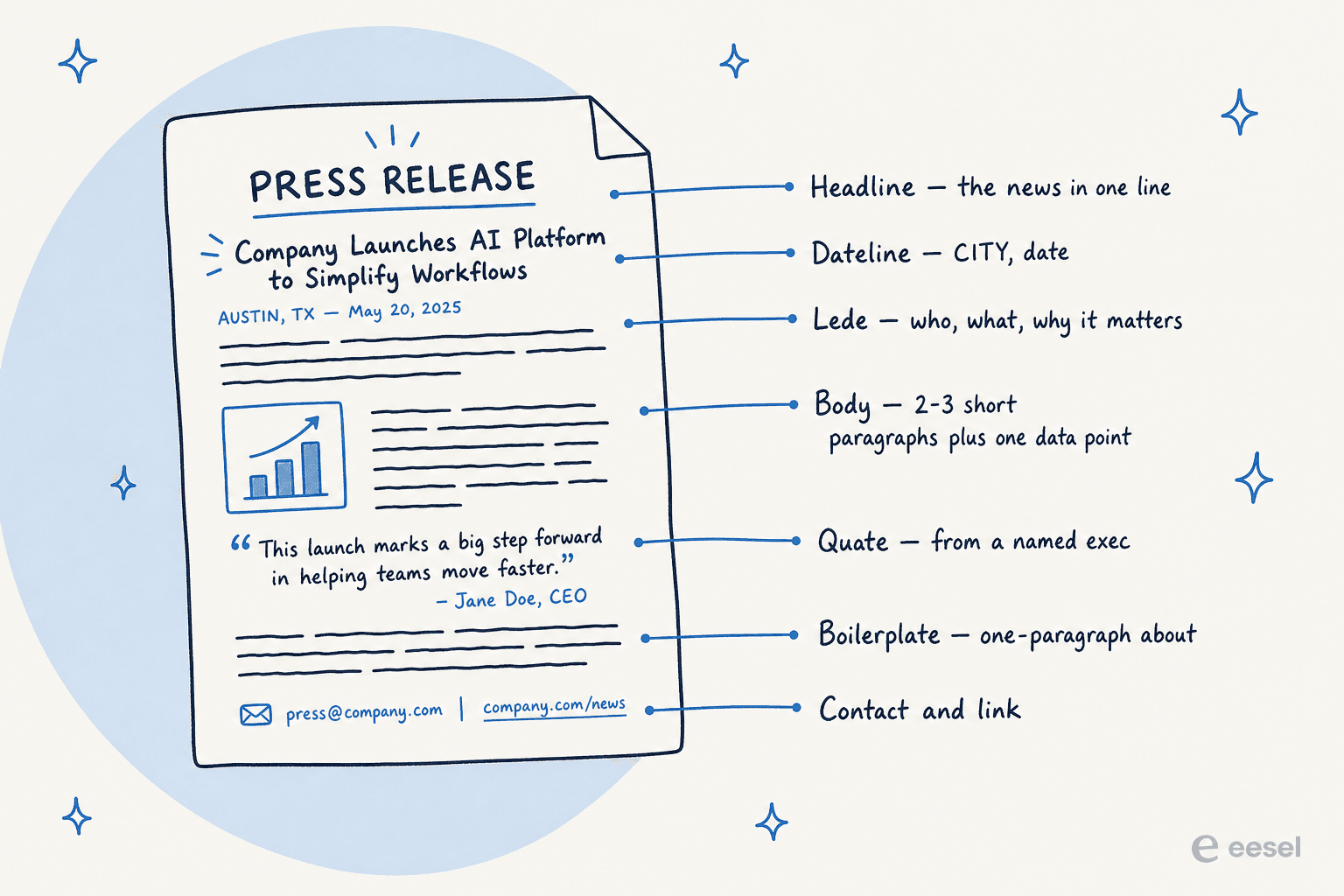
A press release is the most templated genre in all of communications. It has a fixed shape that has barely changed since the wire services standardised it: a headline that states the news, a dateline, a lede that answers who-what-why-it-matters in one sentence, a couple of body paragraphs, an executive quote, a boilerplate, and contact details. That rigidity is exactly why AI writing tools are so good at it. The structure is a solved problem, and language models are pattern machines.
So an AI press release writer is really a focused flavour of an AI content writer: you hand it a few facts, it returns a release in the right shape. Some are standalone web apps, some are features inside a broader content writer tool, and some, like eesel, are general content engines you can point at any format. The differences between them matter less than one thing they share: the quality of what comes out is set almost entirely by the quality of what you put in.
I've watched this play out across thousands of generated pieces. The teams who get usable drafts on the first try are the ones who feed the model real material. The ones who type "write a press release announcing our new feature" get back something that sounds like a press release and says nothing.
The part AI is great at, and the part it can't fake
Here's the reframe that changes how you use these tools. Most people think the hard part of a press release is the writing. It isn't. The writing is the easy part, and it's the part AI now does for free. The hard part is the journalism: having something actually new to say, knowing who'd care, and putting a real voice behind it.
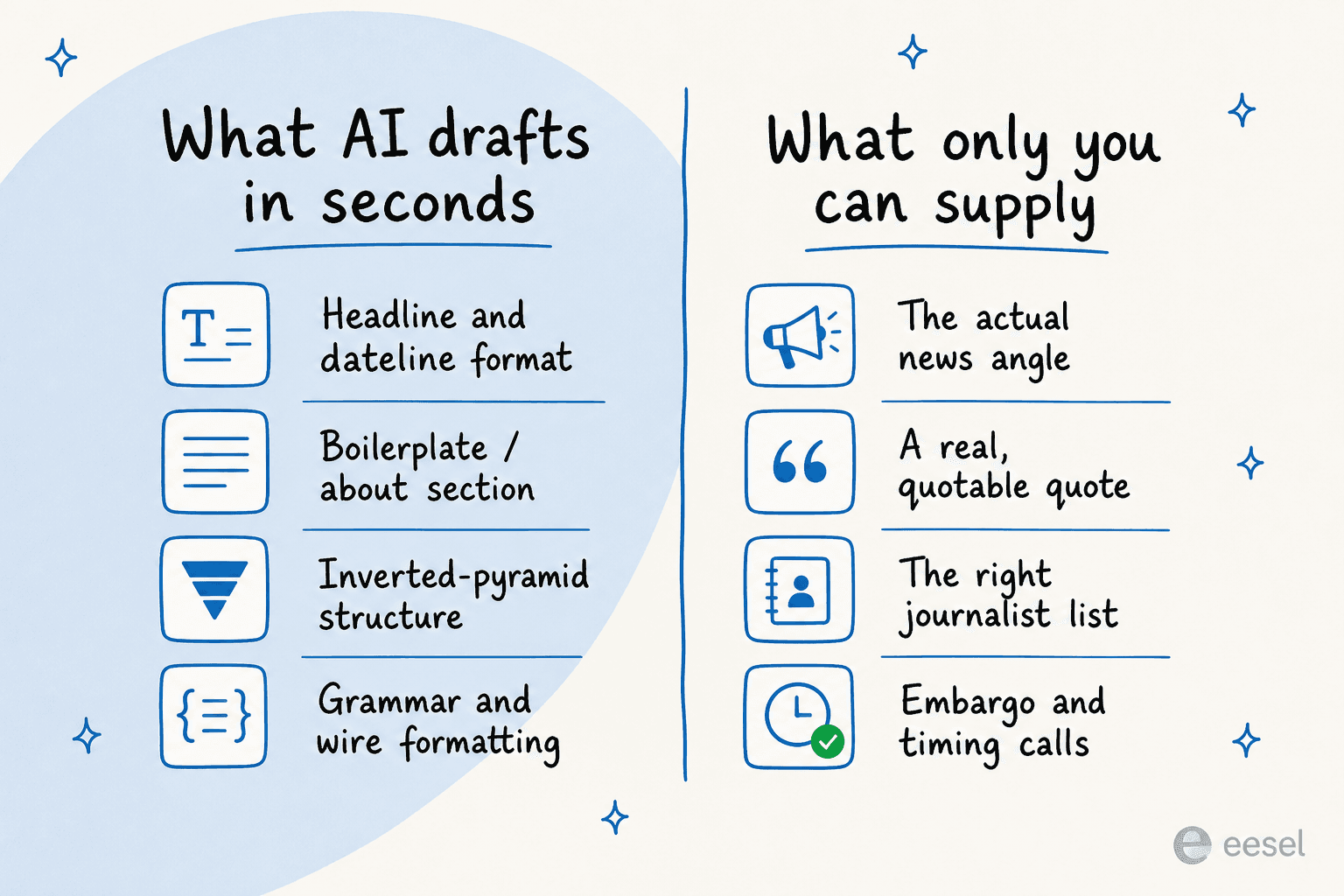
On the left of that line, AI is faster and more consistent than you are. It will never forget the dateline, never bury the lede, never let the boilerplate drift off-brand if you've trained it. On the right of the line, AI is worse than useless, because it will happily invent a confident-sounding quote and attribute it to your CEO. A fabricated quote in a press release isn't a quirky AI tell. It's the kind of thing that ends up in a correction, or worse.
This is the same lesson we learned the hard way running AI on live work: a model that sounds sure of itself is not the same as a model that's right. The fix is never to trust the parts that need a human, and to lean hard on the parts that don't. Get the angle and the quote from a person; get everything else from the machine.
The anatomy of a B2B or SaaS press release
Before you brief any tool, it helps to know the parts, because a good brief maps onto them one to one. Here's the standard shape, and what each part is actually for.
| Part | What it does | Who supplies it |
|---|---|---|
| Headline | States the news in one line, no cleverness | You set the angle, AI phrases it |
| Dateline | City and date, signals it's official | AI, every time |
| Lede | Who, what, and why it matters, in one sentence | AI drafts, you sharpen the "why" |
| Body | Two or three short paragraphs plus one real number | You supply the number, AI structures it |
| Quote | A named exec saying something a human would say | You, always |
| Boilerplate | The one-paragraph "about the company" | AI, once trained on your voice |
| Contact and CTA | Where a reporter follows up | You |
Notice the pattern. Everything in the "AI" column is structure. Everything in the "you" column is judgment or a fact only you hold. If you're announcing a funding round, a launch, or a partnership, the same split holds. For the deeper formatting craft, the rules that make content EEAT-compliant carry straight over from blog writing. So does the structure that helps a post rank in search.
How to write a press release with AI, step by step
This is the workflow I'd actually use, and it takes about 20 minutes once you have the facts.
- Write the news in one sentence first. Before you open any tool, say out loud what changed and why a stranger should care. "We raised $12M to expand our EU support team" is news. "We're excited to announce a new chapter" is not. If you can't say it plainly, no AI writer for business will rescue it.
- Gather the three things AI can't invent: one real number (the funding figure, the customer count, the percentage you moved), one real quote from a named person, and the name of the audience you're aiming at. This is the content brief, and it's 80% of the result.
- Feed it sources, not vibes. Point the tool at your existing material: your last release, your site's about page, a product doc. Grounding the draft in real text is what separates a grounded SEO content writer from a tool that free-associates. A good brief is worth more than a good prompt, which is why I brief AI carefully rather than relying on one clever instruction.
- Generate the draft and read it like a skeptic. The structure will be right. Check the facts against your brief, and check that the quote is the one your exec actually approved, not a paraphrase the model improved.
- Cut the AI tells. Strip the "in today's fast-paced landscape" openers and the rule-of-three filler. If you're seeing the same hollow phrasing across drafts, my notes on fixing repetitive AI content apply just as much here.
- Repurpose before you distribute. A single announcement is also a blog post, a changelog entry, and a LinkedIn note. Rather than write each one, repurpose the release with AI into all three formats from the one source.
A quick warning on step six: the output is only as good as where it lands. I hear from content teams whose AI drafts are perfect in the tool and then break the moment they paste into a restrictive CMS that strips the formatting. Decide where the release is going before you fall in love with the formatting.
Is your announcement even press-release-worthy?
This is the question the AI can't answer for you, and the one that decides whether the whole exercise is worth it. Not every update deserves a press release. Most don't. A press release is a promise to a journalist that there's news here, and burning that promise on a minor feature update is how you train reporters to ignore you.
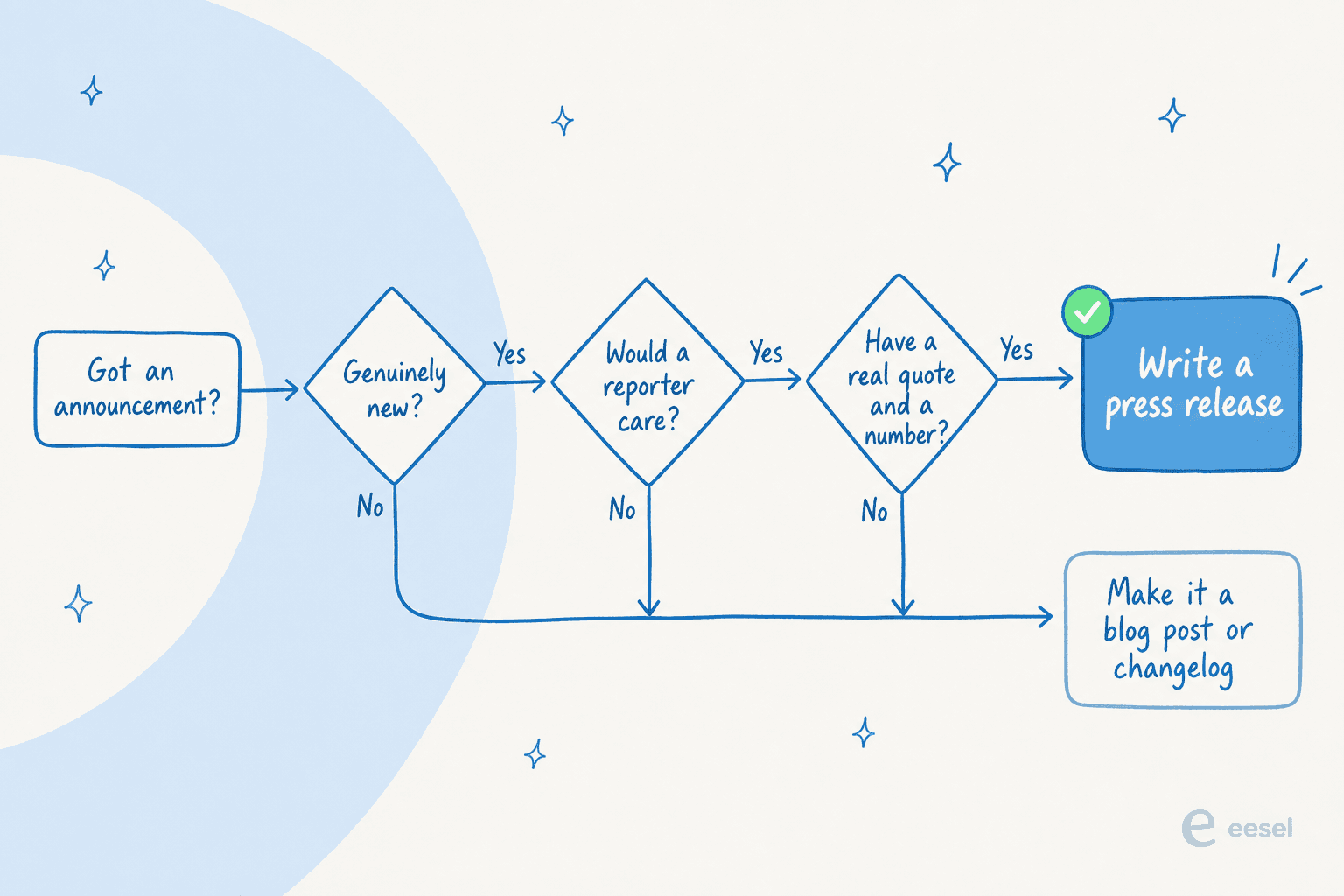
Run your announcement through three gates. Is it actually new, not just new to you? Would a reporter who doesn't already love your product care? Do you have a real quote and a real number to back it? If you clear all three, write the release. If you don't, it's a blog post or a changelog entry, not a press release, and that's not a downgrade. For a lot of B2B and SaaS teams, a well-optimised blog post does more durable work than a wire release ever will, which is the whole case for an AI blog writer for SaaS. A release gets you a day of pickup; a ranking post gets you traffic for years, and scaling that content safely is where the compounding happens.
Where AI press releases go wrong
The failure modes are predictable, which means they're avoidable. The biggest one is leaning on the AI for the parts it can't do, then publishing without checking.
Here's the difference between a line an AI produces from a thin prompt and the same line once you've grounded it:
| Generic AI draft | Grounded rewrite |
|---|---|
| "Our new feature significantly improves customer support efficiency." | "Support teams using the new auto-triage handled 41% more tickets per agent in the first month." |
| "We are thrilled to announce this exciting milestone." | "The $12M round, led by [investor], doubles our EU engineering team to 40 people." |
| "A spokesperson said the company is committed to innovation." | "'We built this because our own support queue was drowning,' said [name], CEO." |
The left column is what you get when the AI has nothing real to work with. The right column is what you get when you've done step two. Same tool, completely different output. The other recurring mistakes I see: a fabricated or "improved" quote nobody actually said, a number the model rounded or invented, and a boilerplate that drifts off-brand because the tool was never trained on the real one. The boilerplate problem is the easiest to fix, since brand voice training locks it in once and reuses it everywhere. The quote and number problems only have one fix, which is a human checking every claim before it ships, the same discipline behind any B2B content writer worth trusting.
Writing press releases with eesel
If you want one tool for the whole content side of this, that's the gap eesel fills. It's an AI teammate you point at your real sources, your site, your docs, your past posts, and it drafts in your voice instead of from a blank prompt. The same AI content writer that handles a press release will also turn it into the blog post, the changelog, and the social copy, so the one announcement does the work of five.

The concrete differentiator is the grounding: because it writes from sources you connect rather than its own memory, you spend less time fact-checking invented claims and more time on the angle and the quote, the two things that were always your job. You can start free with no credit card and run a real announcement through it before deciding, and the same engine doubles as a grounded blog writer once the release is out. Try eesel and see what it drafts from your own material.
Frequently Asked Questions
What is an AI press release writer?
An AI press release writer is a tool that drafts a press release from a short brief, handling the wire-service format (headline, dateline, lede, boilerplate, contact) so you don't start from a blank page. The good ones write from sources you point them at rather than their own memory, which is the same grounding step that separates a useful AI content writer from a generic one.
Can AI write a whole B2B or SaaS press release from scratch?
It can draft every section, but it can't decide whether your news is worth announcing or invent a real quote from your CEO. Feed it the actual news, one data point, and a real quote and it handles the boring scaffolding; you keep the angle and the final read. The same logic applies whether you're using it to write B2B blog posts or an announcement.
Is there a free AI press release writer?
Yes, plenty of tools have free tiers, though most cap length or strip out the research that makes a release credible. eesel lets you start free with no credit card, so you can run a real announcement through it before paying, and the same engine doubles as a free AI blog writer. My roundup of free AI copywriting tools covers what each free plan actually includes.
How do I stop my AI press release from sounding generic?
Generic output comes from generic input. Ground every line in a real number, a real customer, or a real quote, and train the model on how your company actually writes instead of asking for a "professional" tone. Start with brand voice training and my notes on how to stop AI content sounding generic.
How much does an AI press release writer cost?
It ranges from free tiers to per-seat subscriptions around $40 to $99 a month, plus pay-as-you-go options. eesel charges per task with no per-seat fee, so a one-off announcement costs roughly the price of a single blog draft rather than a monthly commitment. I break the models down in my guide to AI writer pricing.
Does an AI press release writer also distribute the release?
Most content tools, eesel included, draft the release but don't push it to a newswire or a journalist list, so you paste the finished copy into your distribution service or send the pitch yourself. If your announcement is really a product update, it's often better to repurpose it with AI into a blog post and changelog rather than pay for a wire.


Article by
Kurnia Kharisma Agung Samiadjie
Kurnia is a software engineer and writer at eesel AI with two years of SEO experience, writing about AI tools, helpdesk software, and customer support. He pairs a developer's understanding of how these products are built with search-driven research into what actually ranks and resonates with the people searching for them.