

Why writing a SaaS newsletter is its own problem
A SaaS newsletter isn't a blog post and it isn't a marketing blast. It's the recurring touch that keeps trial users activating, paying users discovering features they're not using, and churned users wondering if they left too early. That job is specific, and it's why a generic AI content generation tool pointed at "write me a newsletter" tends to disappoint.
The pressure isn't a shortage of ideas. It's the sheer operational load of producing across every channel at once, every week. One marketer put it well in r/DigitalMarketing:
Feels like content expectations exploded over the last 2 years. LinkedIn posts, short videos, carousels, newsletters, landing pages, email sequences, ad creatives, reporting screenshots, etc. Even small teams are expected to produce constantly now.
The newsletter is on that list, and it's recurring, which makes it relentless. A two-person SaaS marketing team can't hand-write a thoughtful issue every week on top of everything else. That's the real reason people search for an AI newsletter writer in the first place, and it's also why the wrong kind of AI makes things worse, not better.
What most AI newsletter writers get wrong
Here's the reframe that should change how you shop. Almost every "AI newsletter writer" is automating the wrong half of the work.
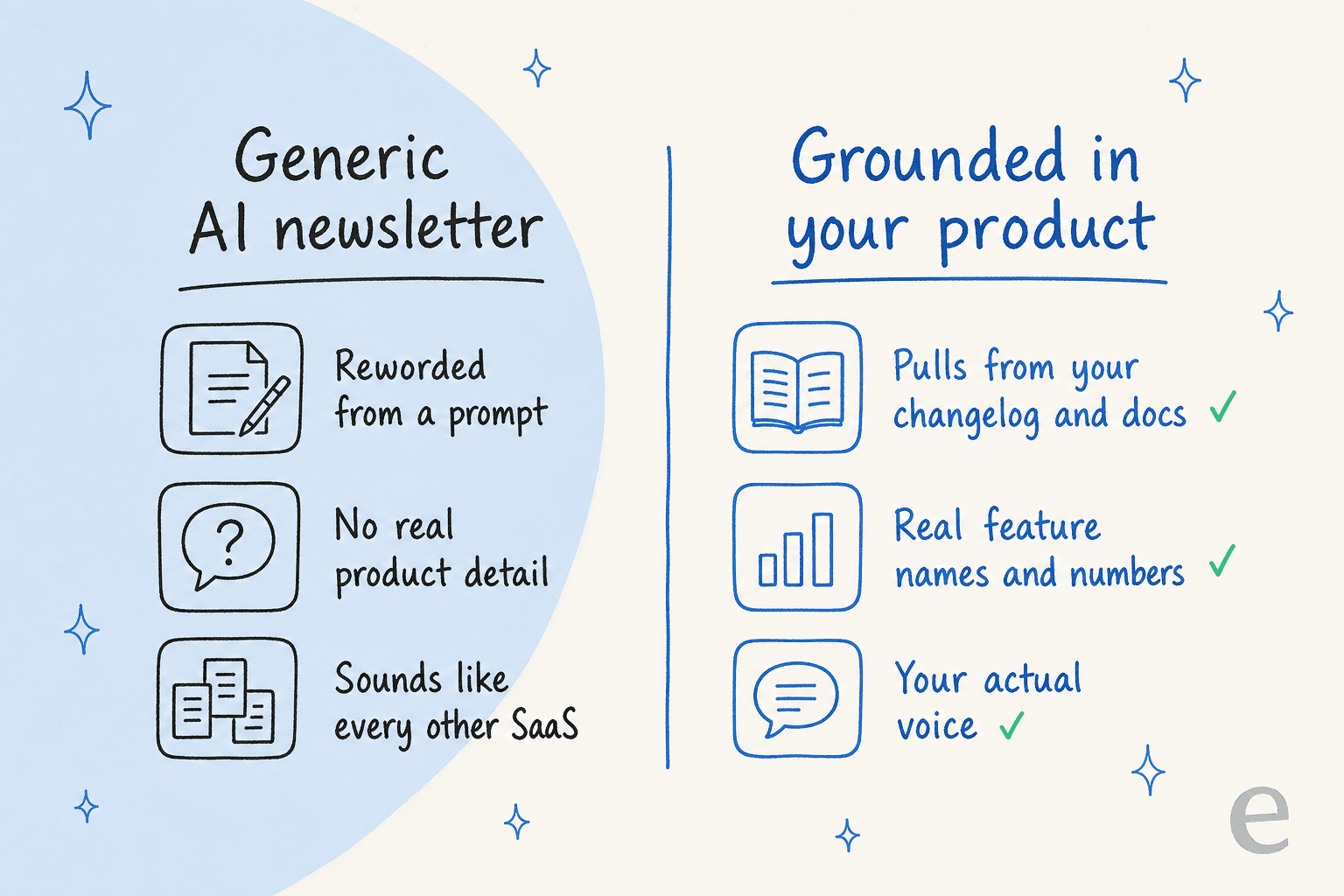
On the left is what most tools give you: you paste in a few points, the model smooths them into paragraphs, and out comes copy that reads fine and says nothing. No real feature names, no numbers, no point of view. It could be any company's newsletter. Readers, not just spam filters, can smell it. As one marketer said bluntly in r/content_marketing:
almost everyone is capable of spotting heavily-generated AI content (e.g. delve, unleash, streamline, ever-changing, you name it)... it doesn't necessarily mean a better outcome because indeed of this AI-ish feeling.
On the right is what actually works: a newsletter grounded in your product. The real skill isn't writing prose, it's pulling the right details out of your changelog, docs, and recent posts and putting them in your voice. A line like "we shipped SSO this week" is filler; "SAML SSO is live on the Growth plan, so your admins can stop sharing one login" is a newsletter someone reads. The difference is grounding, and that's the half a prompt-rewriter skips. It's the same reason a strong SEO content writer reads primary sources instead of writing from memory.
The anatomy of a SaaS newsletter worth opening
Before automating anything, it helps to know what you're actually producing. A SaaS newsletter that earns the open has a predictable shape, and each part has a natural source you can point an AI at.
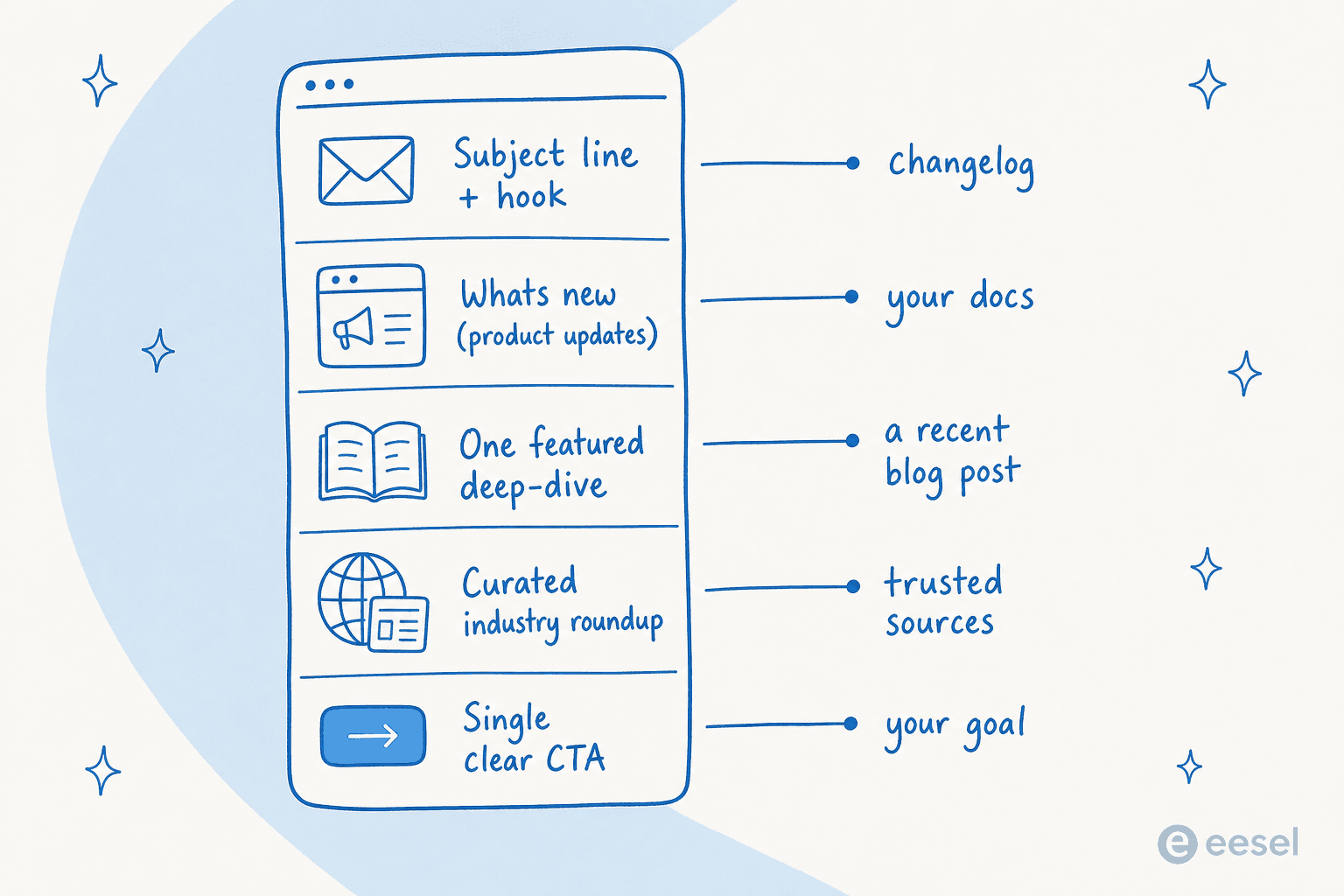
The blocks that matter most:
- A subject line and hook that names a concrete benefit, not "Our June update."
- What's new drawn straight from your changelog, written for humans rather than as a raw commit log.
- One featured deep-dive, usually a repurposed blog post or a customer story, expanded into a short narrative.
- A small curated roundup of genuinely useful links from trusted sources, so the issue isn't pure self-promotion.
- A single clear CTA, tied to one goal for that issue.
Notice how much of this is repurposing, not original writing. Your changelog already exists. Your best blog post already exists. The newsletter's job is to translate and package, which is exactly the kind of grounded, source-anchored work AI is good at when you point it at the right material. This is why I lump newsletters in with the broader content marketing tools workflow rather than treating them as a separate writing task.
How to write a SaaS newsletter with AI, step by step
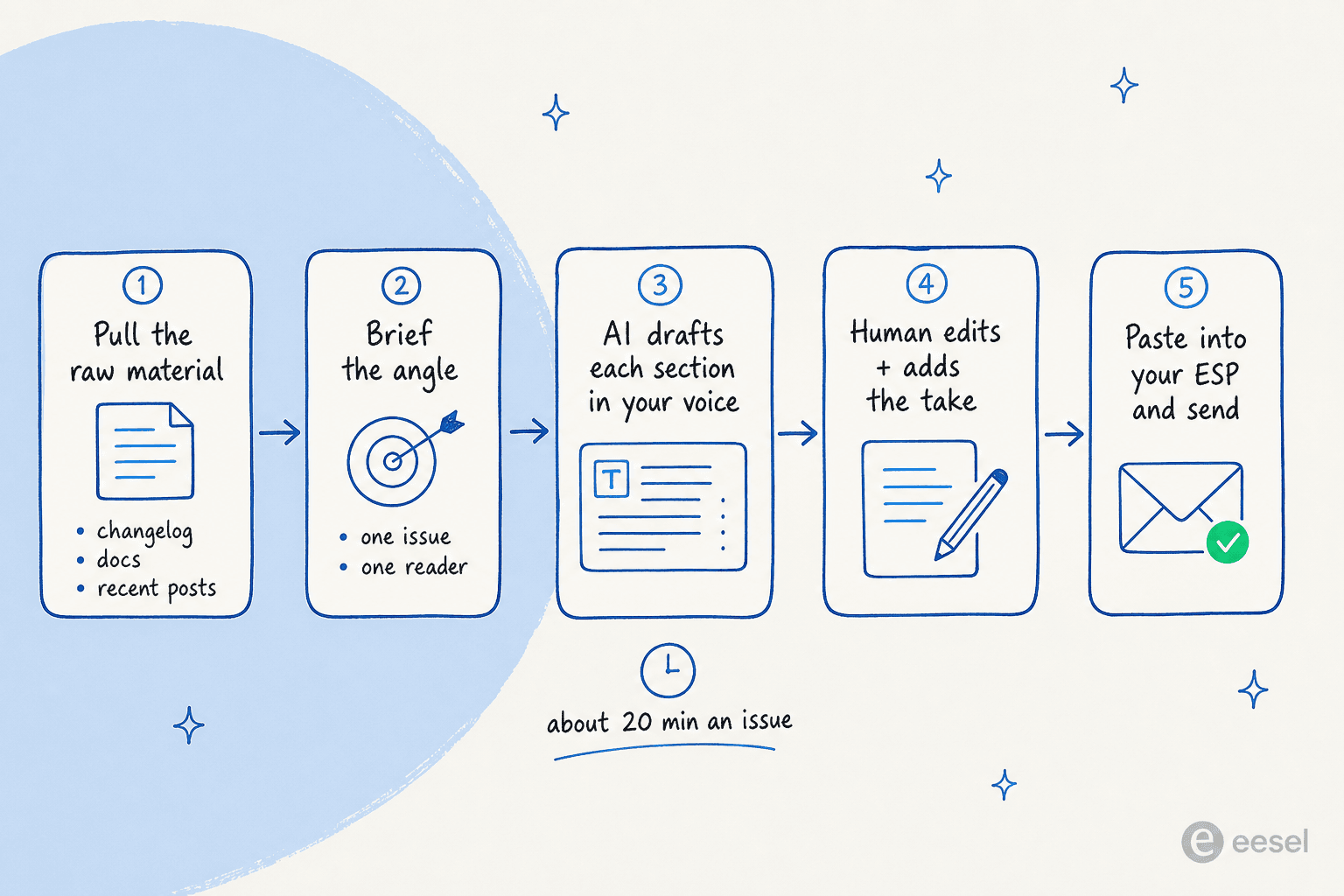
You don't need a stack of tools for this. You need one loop with five stages and the discipline to keep a human on two of them.
1. Pull the raw material first
Before you ask for a single sentence, gather the inputs: this period's changelog entries, the blog post you want to feature, any customer win worth mentioning, and two or three external links worth sharing. The model should write from these, not invent around them. A tool that can crawl your own site and knowledge base, the way a good AI content writer does, saves you from pasting it all in by hand.
2. Brief the angle for this issue
The single biggest lever on quality is the brief. One issue, one reader, one goal. Are you nudging trial users to activate, or telling power users about an advanced feature? A slug and "write a newsletter" isn't a brief. Spend ten minutes here defining the angle and the CTA and you'll cut your editing time in half. My guide to briefing AI well goes deeper, and the logic is identical to briefing any AI SaaS blog writer.
3. Let the AI draft each section in your voice
This is the stage that separates a newsletter people read from one they archive. Volume without voice is how you end up sounding like every other SaaS. The fix is a model trained on how you actually write, your existing posts and emails, not a generic tone slider. Tools with real brand voice training ingest your past content and match cadence and point of view. One content marketer described the split that works:
i spend way less time writing content now by using AI tools in my workflow... but i don't just let the AI run wild. every blog goes through a human editor to make sure the tone, quality, and "voice" are on point and aligned with the brand.
That's exactly the line I'd hold: brief at the front, voice check at the end, automate the drafting in between.
4. Edit, and add the one thing AI can't
Even a grounded draft needs a human pass, and not just for typos. The thing AI can't supply is the take, the one opinionated line that says why this update matters to you specifically. That's where a SaaS newsletter earns trust. Add it, trim anything that reads like filler, and you're done. If you want to know what you're trimming for, my notes on why AI content stalls and how AI content detectors work cover the tells readers and Google both catch.
5. Paste into your ESP and send
Here's the honest boundary. A content tool hands you a finished, formatted issue; it doesn't deliver it. You drop the copy into your email service provider, whether that's a dedicated platform from the AI email marketing world or your existing stack, set the schedule, and let it handle sends, list management, and open rates. Done right, the whole loop is roughly 20 minutes of human attention per issue, almost all of it the brief and the final read.
Does this actually scale? Yes, with the same caveat every time
I'll give real numbers, because vague "save time with AI" claims are exactly what make these posts forgettable.
eesel's content engine wasn't built for newsletters specifically, it was built for SEO and AEO blog content, but the grounding-and-voice machinery is the same, and the throughput it hits is the honest evidence for what a content pipeline can do. One eesel customer, an SEO content lead working on Webflow, runs a keyword-to-publish pipeline that ships over 360 posts a month, 12 a day, with consistent brand voice across hundreds of pieces from a small team. Another, a German eCommerce brand, generates 2,000-to-2,900-word posts, hero banner, infographics, FAQs, and internal links included, in roughly 12 to 20 minutes each. Translate that machinery to a newsletter, which is shorter and leans on content you already have, and an issue is a 20-minute job, not an afternoon.
It also pulls in people who never came for support automation at all. I hear from marketers who arrive wanting exactly one thing: "I don't need your chat and ticket services. I need help with the SEO content writing for our website." That's paraphrased from a real eesel conversation with a staffing-agency marketer, and it's a pattern, content teams and agencies using the AI SEO blog writer to produce at a clip a human team couldn't match.
But "it scales" is not "press a button and walk away," and pretending otherwise would be dishonest. Tim Soulo, Ahrefs' CMO, has a famous take worth keeping in view:
Scaling content with AI is the biggest lie in content marketing... your job isn't just to "churn out content." Your job is to make people care... CREATING MEANINGFUL CONTENT IS HARD WORK!
I don't fully agree, the 360-posts-a-month customer is my counterexample, but he's right about the failure mode. Scaling junk is the lie. Scaling researched, voiced, edited content is just an operating model, and the human still has to make people care. For a newsletter, "making people care" is that one honest take per update.
Where this breaks, and how to keep it from biting you
I'd be doing you a disservice if I only sold the upside. Three things go wrong most often.
The generic tell. If you skip the brand voice and the human edit, you get the left column of that earlier diagram, and your unsubscribe rate tells you within two issues. The fix isn't a better model, it's real grounding and a distinct voice, the same principles behind EEAT-compliant content.
Treating drafting as delivery. A content tool is not an email marketing platform. It won't manage your list, handle unsubscribes, or report open rates. Keep your ESP and use the AI for the writing, where the time actually goes. If you need help on the send side, the best AI email writers and AI email assistants are a different category worth a look.
Letting the changelog write the newsletter. Dumping raw release notes into an issue is the SaaS-specific version of generic. Your users don't care that you "refactored the settings page"; they care what they can now do. The brief stage is where you translate features into benefits, and it's the stage people skip when they're rushing.
Get those three right and an AI newsletter writer stops being a gimmick and becomes the reason you actually ship an issue every week instead of every quarter.
Try eesel for your SaaS newsletter
If you've read this far, you know my bias: an AI newsletter writer is only as good as the grounding behind it. That's the half eesel was built for.

eesel's content writer is an AI teammate that plugs into your stack, crawls your site, docs, and knowledge, and turns a brief plus your own sources into publish-ready content in your voice. For a SaaS newsletter that means it can draft the "what's new" from your changelog, expand a featured post, and match how you actually write, in about the time it takes to grab a coffee. It's free to try with no credit card, so you can run one real issue through it and see the grounding for yourself. One honest note, since we believe in those: eesel drafts the newsletter, it doesn't send it, so pair it with your email platform for delivery. If you want to compare the field first, my roundup of newsletter writing tools and the free AI newsletter writer options are a good start, then come back and run a draft.
The writing was never really the bottleneck. Writing something worth opening was. That's the part worth getting right.
Frequently Asked Questions


Article by
Kurnia Kharisma Agung Samiadjie
Kurnia is a software engineer and writer at eesel AI with two years of SEO experience, writing about AI tools, helpdesk software, and customer support. He pairs a developer's understanding of how these products are built with search-driven research into what actually ranks and resonates with the people searching for them.