A practical guide to using AI for marketing in 2026

Stevia Putri
Last edited January 12, 2026

Let's be honest, "AI" has shifted from a sci-fi buzzword to a standard part of the marketing toolkit. And if you're not using it, you're probably working harder than you need to. The real challenge is sifting through the hype to find what actually works.
That’s what this guide is for. It’s a straightforward look at how you can use AI to get more done, find smarter insights, and actually move the needle on your metrics. AI is especially powerful for scaling the tasks that eat up most of your time, like content creation and SEO. We know this firsthand because it’s how we scaled our own content strategy. Using the eesel AI blog writer, we jumped from a modest 700 daily impressions to over 750,000 in just three months. It’s all about working smarter.
What is AI for marketing?
So, what are we really talking about here? In simple terms, it's about using technologies like machine learning to understand your customers on a deeper level, automate the tedious stuff, and make decisions based on data instead of just a gut feeling.
You’re probably already bumping into two main types of AI:
- Predictive AI: This is the fortune-teller. It analyzes past data to predict what might happen next, like which customers are most likely to buy or which leads are worth chasing. It’s the engine behind smart lead scoring and demand forecasting.
- Generative AI: This is the creative partner. You give it prompts, and it generates brand-new content: blog posts, ad copy, images, you name it. It's a huge help when you're staring at a blank page.
An infographic comparing Predictive AI, which forecasts trends, and Generative AI, which creates new content, as two key types of AI for marketing.
The point isn't to make marketers obsolete. It's to give you a serious boost. By offloading the manual, repetitive work to an AI, you free up your brainpower for what people do best: big-picture strategy, creative thinking, and building genuine connections with your audience.
Core applications of AI for marketing today
Alright, let's get practical. Here are the most common ways marketers are putting AI to work right now.
Content creation and SEO
Generative AI has completely transformed the content creation process. It’s a fantastic tool for overcoming writer's block, brainstorming ideas, and producing drafts at a speed that’s simply not humanly possible.
A common challenge with AI-generated text is that it can sometimes require significant editing to align with a specific brand voice. The initial output is often text-only, meaning marketers still need to source images, find quotes, add links, and handle formatting to create a complete, engaging article.
That’s exactly the problem we built the eesel AI blog writer to fix. It doesn’t just hand you a rough draft. It delivers a complete, publish-ready, and media-rich blog post that’s actually designed to rank.
| Feature | Standard AI Writer (e.g., ChatGPT) | eesel AI blog writer |
|---|---|---|
| Output | Primarily text-based draft | Complete blog post with text and assets |
| SEO | Keyword-focused content generation | SEO-optimized structure, headings, and meta data |
| AEO | Not optimized for answer engines | Formatted for Google AI Overviews and Perplexity |
| Visual Assets | None included | Includes AI images, tables, and infographics |
| Social Proof | None included | Embeds relevant Reddit quotes & YouTube videos |
| Linking | Manual effort required for internal and external links | Adds automatic internal & external links |
Hyper-personalization and audience segmentation
You see this everywhere, from Netflix recommending your next binge-watch to Amazon's eerily accurate product suggestions. For marketers, this means we can create incredibly precise customer segments and lookalike audiences for ad campaigns. The result is higher conversion rates and a much better return on your ad spend.
Predictive analytics and data-driven insights
AI can analyze campaign data in real-time, spotting trends and patterns a human might miss. This allows you to make smart adjustments on the fly rather than waiting until the end of the month to discover a campaign wasn't working.
Here’s how that helps marketers:
- Lead Scoring: AI can evaluate a lead's behavior and demographic information to predict their likelihood of converting. This helps your sales team focus their efforts on the most promising prospects instead of chasing cold leads.
- Demand Forecasting: By analyzing market trends, seasonal shifts, and historical sales data, AI can predict future demand for your products. This is incredibly useful for managing inventory and planning your marketing calendar.
- Campaign Optimization: AI can identify which channels, ads, and messages are driving the best results and automatically reallocate your budget to maximize performance. It’s like having a data scientist constantly fine-tuning your campaigns.
An infographic highlighting three applications of AI for marketing: lead scoring, demand forecasting, and automated campaign optimization.
Top AI for marketing tools
Choosing the right AI tool depends entirely on the job you need to do. There isn't a single "best" tool, but there are excellent options for specific tasks. Here’s a rundown of some top contenders to help you build out your marketing stack.
Content generation: eesel AI blog writer
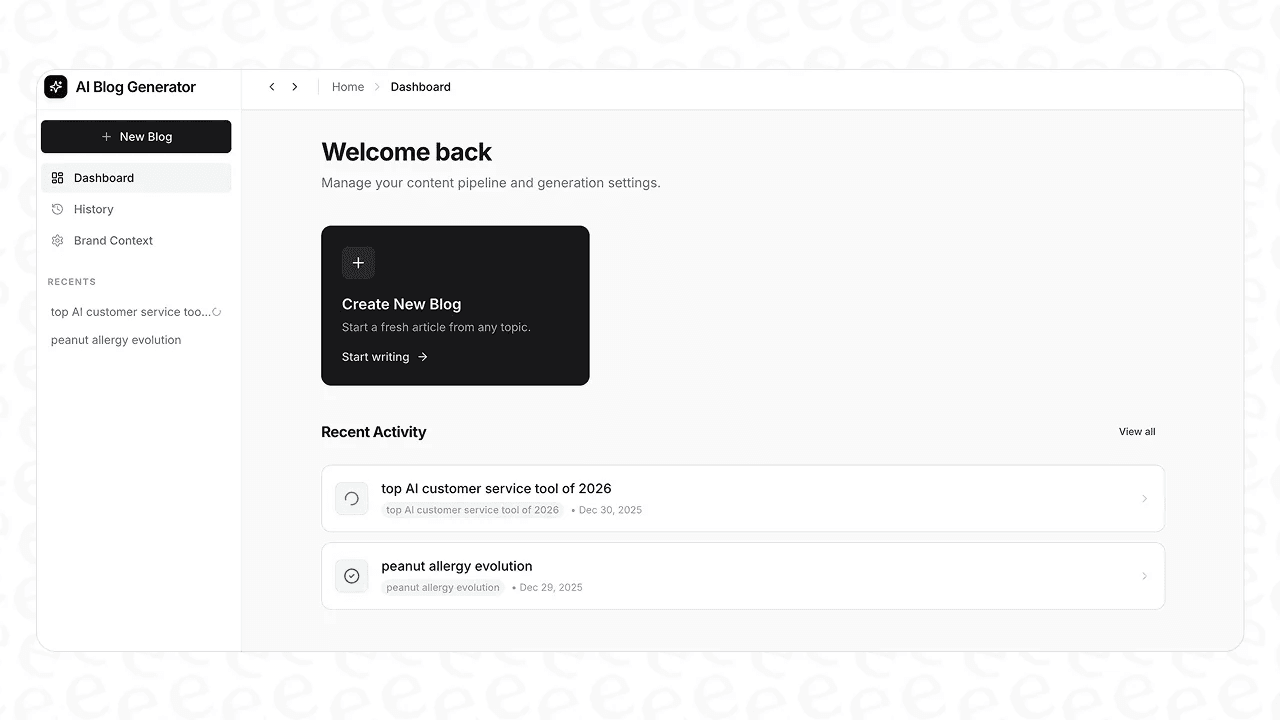
The eesel AI blog writer is designed for marketers who need to scale their content and drive organic traffic without getting lost in the weeds. Its main advantage is that it produces a complete, ready-to-publish article, not just text. It comes packed with assets like AI-generated images, relevant YouTube videos, and even real Reddit quotes for social proof. It's optimized from the start for both traditional search engines (SEO) and the new wave of AI Answer Engines (AEO).
- Best for: Marketing teams focused on winning with content marketing and driving organic growth through a high-volume, high-quality blog.
- Pricing: You can get started for $99 for 50 blog posts. The best part? It’s completely free to try, so you can see the quality for yourself.
AI copywriters: For quick drafts and brand-aligned copy
- Jasper AI: Jasper is an AI assistant for a wide range of copywriting needs. It's effective for quickly generating short-form copy like social media posts, Google ads, product descriptions, and email newsletters. Its "Brand Voice" and "Knowledge Base" features help it learn a company's style to produce on-brand copy. For long-form content, it functions as a writing assistant, generating text which can then be enhanced with visuals and formatting.
- Pricing: The Pro plan starts at $59 per seat/month with annual billing.
Content optimization: For refining existing content
- Surfer SEO: Surfer is an SEO tool that guides the writing process. It analyzes top-ranking pages for a target keyword and provides a data-backed checklist of suggestions, including keywords to include, ideal article length, and content structure. Surfer is an optimization tool, not a content generator, so it is often used alongside an AI writer. The eesel AI blog writer, for example, combines content generation with SEO optimization in a single platform.
- Pricing: The Essential plan starts at $79/month when billed annually.
I have tested most of these too, and found real differences once you get past the surface features. Based on Sprout Score comparisons, Jasper scored higher (8.2) for brand voice and long-form consistency, especially in team use. Surfer SEO scored strong (8.0) in post-publish optimization and SERP alignment, but depends heavily on pairing with another tool like Jasper. Copy.ai lagged a bit (7.4) for structured content workflows, it is fast, but less controllable. Writesonic sat in the middle (7.8), solid for ecommerce and quick drafts but needed a lot of manual editing in B2B use. If you add more tools, consider Narrato or Content at Scale; both had solid Sprout Scores for automation + SEO structure.

AI automation: For connecting your marketing stack
- Gumloop: Think of Gumloop as Zapier with an AI brain. It's a no-code platform that lets you connect your various marketing apps (CRM, social media, analytics) to build automated workflows. Its visual, drag-and-drop interface lets you create custom processes without needing to write any code.
- Best for: Automating your marketing operations. You can use it to generate social media performance reports, enrich new leads with data, or even create content briefs for your writers automatically.
- Pricing: Gumloop offers a generous free plan with 2,000 credits, and its paid "Solo" plan starts at $37/month.
How to build an effective AI for marketing strategy
Start with clear goals
Before you look at any tools, identify your biggest bottleneck. Is content production moving at a snail's pace? Are you struggling with lead quality? Is reporting a manual headache?
Frame your AI adoption around solving a specific, measurable problem. For example, instead of a vague goal like "we need AI," aim for something like: "We need to increase organic traffic by 200% in six months by publishing three high-quality blogs per week." A clear goal makes it much easier to determine if a tool like the eesel AI blog writer is the right fit, as you can directly measure its impact.
Prioritize data quality and ethical governance
An AI is only as good as the data it learns from. If your data is messy, outdated, or biased, your AI's outputs will be flawed. It’s worth taking the time to clean up your data sources before connecting them to any AI system.
It's also critical to be transparent about data privacy. Complying with regulations like GDPR is a must, but it goes beyond that. Being upfront with customers about how you use their data is essential for building and maintaining trust.
Foster collaboration between humans and AI
Let's say it again: AI is a teammate, not a replacement. The most successful marketing teams use AI to handle the repetitive, data-heavy tasks, which frees up the humans to focus on what they do best: developing creative campaigns, telling compelling stories, and building real relationships.
You cannot fully automate a blog writing and content marketing strategy. Especially Jasper and Surfer, I consider those some of the worst tools for quality content. Any time you want high quality content, you need a real person involved. If you want to create an SEO website with 100s of blog posts that's optimised for LLMs, use AI tools. But I strongly suspect an algorithm update is coming that will destroy all of these sites. It's easy to glance at content and go 'yeah that'll do' because we live in an impatient world now and want to automate things and get results quickly. But if you actually look for substance, AI cannot do it. It just mimics. Proper research will always be needed, real people writing quality will always be needed. I've never seen AI content that is as good as, or better than, paying people to do the job properly. AI is a shortcut.
Adopt an experimental mindset. Test different tools, play with various prompts, and always be looking for new ways AI can enhance your team’s capabilities.
Your next steps in AI-powered marketing
So, what's the bottom line? AI isn't a futuristic concept anymore; it's here now, and it offers a huge advantage to marketers who embrace it. It can make your team more efficient, your campaigns more personal, and your content strategy a true growth engine. The key is to be strategic: focus on your goals, choose the right tools, and remember that AI is here to augment your skills, not replace them.
For a deeper dive into the tools available, this video offers a great overview of some of the top options that can help you build out your marketing stack.
The fastest way to see what AI can do for your marketing is to tackle content production. We used the eesel AI blog writer to take our own blog from 700 to over 750,000 daily impressions in just three months. Ready to see what it can do for you?
Generate your first publish-ready blog post for free and see the difference for yourself.

Frequently Asked Questions
Share this article

Article by
Stevia Putri
Stevia Putri is a marketing generalist at eesel AI, where she helps turn powerful AI tools into stories that resonate. She’s driven by curiosity, clarity, and the human side of technology.
