What is AI engineering content? A complete guide

Kenneth Pangan

Stanley Nicholas
Last edited January 15, 2026
Expert Verified

It feels like AI engineering is everywhere these days. The field is exploding, and with it, there's a huge appetite for high-quality technical content. Companies are scrambling to create articles, guides, and tutorials that can educate potential customers, attract top talent, and establish themselves as leaders in the space.
But here’s the catch: creating expert-level AI engineering content is really, really hard. It’s a tricky balancing act. You need deep technical accuracy to earn the respect of engineers, but also enough clarity to be understood by product managers and business leaders. On top of that, it has to be practical and relevant to what people are actually building. Most teams get stuck, relying on their already-overworked subject matter experts, which creates a massive content bottleneck.
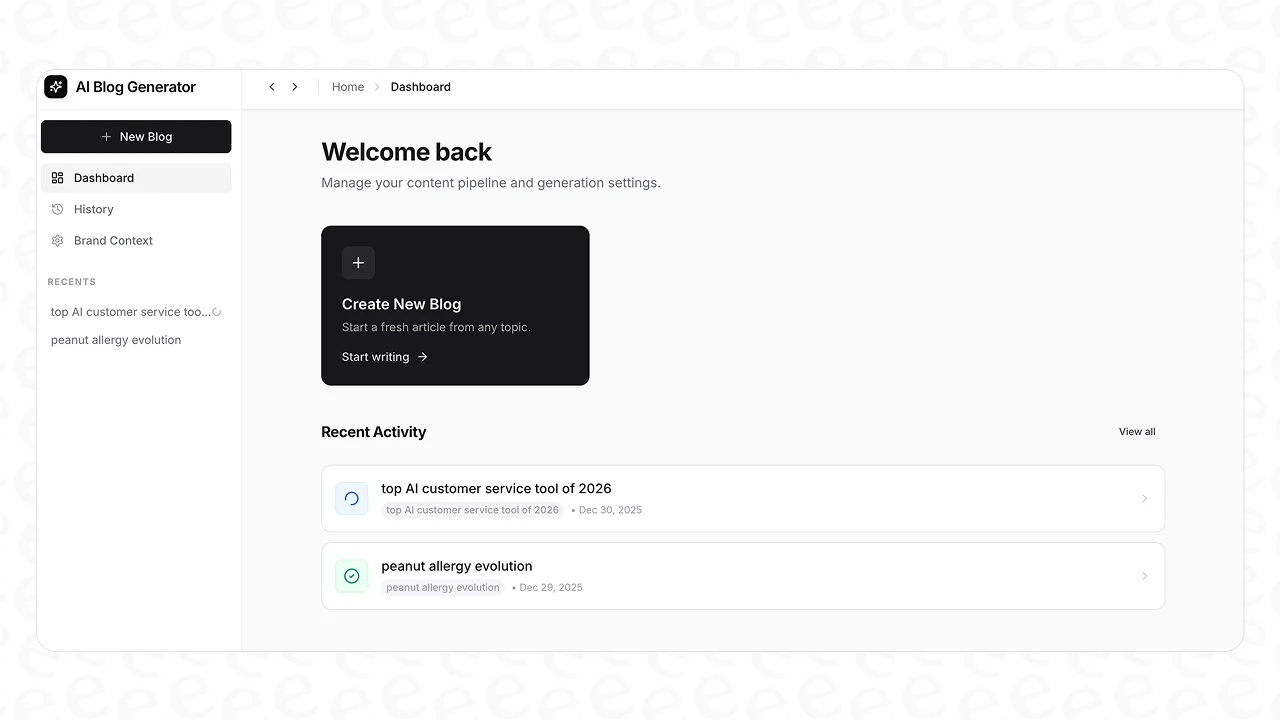
While generic AI tools can generate text, they may produce content that lacks the depth and technical nuance required by an expert audience. Specialized platforms are now being built to address this challenge. The eesel AI blog writer is designed to handle the complexities of creating expert-level articles. It’s the tool we used to take our own site’s daily impressions from a modest 700 to over 750,000 in just three months.
What exactly is AI engineering?
Before we dive into how to create great AI engineering content, it helps to be on the same page about what AI engineering actually is. It’s a newer discipline, and there’s often confusion about how it differs from traditional machine learning.
The big shift: From building models to building apps
The simplest way to think about it is that AI engineering is the discipline of building and deploying real-world AI applications. More often than not, this involves using existing foundation models (like the ones from OpenAI, Anthropic, or Google) through APIs and building useful products on top of them.
This is a big shift from traditional Machine Learning (ML) engineering, which is heavily focused on building, training, and fine-tuning models from scratch. AI expert Chip Huyen puts it perfectly: AI engineering is product-first, meaning you start with the application you want to build and work backward. ML engineering, on the other hand, is model-first. As one developer on Reddit explained it, an ML engineer builds models, while an AI engineer builds solutions using those models.
What does an AI engineer actually do?
So, what does a day in the life of an AI engineer look like? Their responsibilities are a blend of software engineering, infrastructure management, and AI model integration. Here are some of the core tasks:
- Developing and managing infrastructure: They build the pipelines and systems that allow AI models to run efficiently and at scale.
- Integrating models into applications: They’re the ones who connect an AI model to a user interface, creating APIs that make the model's capabilities accessible to the rest of the application.
- Designing agentic workflows: They build systems where AI can perform multi-step tasks, like in a RAG (Retrieval-Augmented Generation) chatbot that can pull information from a knowledge base to answer questions.
- Collaborating across teams: They work closely with data scientists, software engineers, and product managers to turn a powerful AI model into a useful and valuable product.
- Ensuring reliability and scalability: They make sure the AI systems are secure, dependable, and can handle a growing number of users without breaking a sweat.
Key components of effective AI engineering content
Now that we've defined the field, let's talk about what makes for truly great AI engineering content. To build credibility with a technical audience, your content has to deliver genuine value and go way beyond surface-level fluff.
Technical accuracy and depth
This is non-negotiable. The audience for this type of content is smart, and they can spot inaccuracies a mile away. Getting the technical details wrong is the fastest way to lose credibility. This means citing credible sources for your claims, explaining algorithms and architectures correctly, and using precise, industry-standard terminology. Your content needs to show that you know what you're talking about.
Clarity and accessibility
Here's the tricky part. While your content needs to be technically deep, it also has to be understandable. Your audience might include senior AI engineers, but it could also include junior developers, product managers trying to understand the tech, or even business leaders evaluating a new strategy.
To nail this, you need to write with clarity. Define any jargon you use, lean on analogies to explain complex ideas, and structure your content logically. Use clear headings, short paragraphs, and visuals to break up the text and make it easy to scan. The goal is to make complex topics feel accessible without dumbing them down.
Practical, real-world examples
The best technical content is actionable. It doesn't just explain a concept; it shows the reader how to apply it. This is where you can really stand out. Instead of just talking about vector databases in theory, show a code snippet of how to set one up. Instead of just mentioning RAG, create a mini-tutorial on how to build a simple RAG-powered chatbot.
Including step-by-step guides, code examples, or case studies that demonstrate how AI systems are being used in the real world makes your content infinitely more valuable. It bridges the gap between theory and practice and gives your readers something they can actually use.
Challenges in creating technical AI content
If creating great technical content were easy, everyone would be doing it. The reality is that most companies run into the same roadblocks that prevent them from producing high-quality AI engineering content consistently.
The subject matter expert bottleneck
Your best AI engineers are your most valuable resource for content, but they're also your busiest employees. They're deep in the trenches building products, debugging systems, and pushing the company forward. Asking them to set aside hours or even days to write a blog post is often unrealistic. Their time is incredibly expensive and limited, which turns them into a major bottleneck for your content pipeline.
The high cost of manual research
Even if you have a dedicated writer, the research process for a deep technical article is intense. It takes hours upon hours to comb through documentation, read whitepapers, find credible sources, and synthesize all of that information into a coherent, well-structured article. This manual effort is slow, expensive, and difficult to scale.
Limitations of generic AI for technical content
Many teams turn to AI writing tools like ChatGPT hoping for a shortcut, but they may encounter limitations, especially with technical topics. While these tools are great for brainstorming or writing simple emails, they may not produce the kind of expert-level content required for this field.
Users often report a few key drawbacks. First, they don't have built-in SEO, so the content they produce isn't optimized to rank on Google. They don't create visual assets like charts or tables, which are crucial for explaining technical concepts. They can also produce factually incorrect information, which can undermine credibility. Finally, the workflow can be inefficient, often requiring users to generate content section-by-section and perform extensive edits to create a usable format. <quote text="You need to ask chatgpt things in stages so to speak. Here’s what I usually ask it, and this works well to create unique quality content:
I am writing an article about X. Please give me a list of the entities, topics, and subtopics that I need to include in this article.
Then, once you have that list, review it. And wait as necessary. Then ask:
Use the following entities, topics, and subtopics to produce an outline for the page.
Then once you’ve reviewed and edited the outline, ask it to write the article:
Use this outline to write an article about X.
If there are any sections where it didn’t write enough, ask it to expand on that particular section. " sourceIcon="https://www.iconpacks.net/icons/2/free-reddit-logo-icon-2436-thumb.png" sourceName="Reddit" sourceLink="https://www.reddit.com/r/SEO/comments/1hwb6aw/comment/m604l1l/">
How to scale AI engineering content with the eesel AI blog writer
So, how do you overcome these challenges? This is where a specialized platform like the eesel AI blog writer comes in. It's designed to help teams produce expert-level technical content consistently and at scale, without the SME bottleneck or the limitations of generic AI.
From a single topic to a publish-ready post
The workflow is incredibly streamlined. You just provide a technical keyword or topic (like "vector databases for e-commerce") and your website's URL. The AI then gets to work, generating a complete, well-structured article with an introduction, logical headings, a conclusion, and even an FAQ section.
This isn't a rough draft that needs hours of editing. It's a publish-ready piece of content. This is the exact process we used to publish over 1,000 blog posts and grow our daily impressions to more than 750,000 in just three months.
Generate technical assets and visuals automatically
Explaining a complex process or comparing different frameworks is so much easier with a visual aid. The eesel AI blog writer understands this and automatically creates relevant assets to go along with the text. It can generate tables comparing the features of different AI models, create infographics that break down a complex workflow, or even include code snippets where appropriate. This saves your team countless hours of manual design work.
Incorporate authentic social proof
To build trust with a technical audience, you need to show that you're part of the conversation. Our blog writer has a unique feature that automatically finds and embeds real Reddit discussions and relevant YouTube video tutorials directly into the content. This adds a layer of authenticity and real-world context that generic AI content may lack. It shows your readers that you understand the community and the practical challenges they face. <quote text="Just over the weekend, I was able to generate (and tweak) 4 or so quality blog posts in an hour or two which would have amounted to ~5-10 hours of work from the contractor and myself in a normal circumstance, each. Steering the post, researching, highlighting key points, editing revisions, etc…
I did this while editing 3 or so human-made ones, which took substantially more effort to produce....it was a busy sunday, to say the least...All I did was give ChatGPT a general topic and some keywords and it was able to blast through those (sometimes abstract) concepts that I wanted to highlight; hitting all the key points (and adding ones I did not think of). 10/10 ChatGPT, 10/10." sourceIcon="https://www.iconpacks.net/icons/2/free-reddit-logo-icon-2436-thumb.png" sourceName="Reddit" sourceLink="https://www.reddit.com/r/Entrepreneur/comments/11ddwn5/weve_been_using_chatgpt_to_create_quality_blog/">
Optimize for both search and answer engines
Getting your content to rank is critical. The eesel AI blog writer optimizes every article for traditional SEO, but it also goes a step further with Answer Engine Optimization (AEO).
AEO is all about optimizing your content to be the direct answer in AI-powered search results, like Google's AI Overviews or responses from ChatGPT. This is becoming increasingly important. In fact, Gartner predicts a 25% drop in traffic from traditional search engines by 2026 because of this shift to AI-powered answers. By optimizing for AEO, you're future-proofing your content strategy.
| Workflow | Content Quality | Speed | Cost |
|---|---|---|---|
| Manual (SME-led) | High | Very Slow | High (SME time) |
| Generic AI (ChatGPT) | Low to Medium | Fast Draft | Low (but high editing & asset cost) |
| eesel AI blog writer | High | Very Fast | Low (fixed cost per article) |
For those looking to dive deeper into the field, watching a comprehensive overview can provide a solid foundation. This video offers a practical roadmap for anyone new to AI engineering, covering the essential skills and steps required to break into the industry.
This video offers a practical roadmap for anyone new to AI engineering, covering the essential skills and steps required to break into the industry.
Engineering your content for the future
AI engineering is shaping the future of technology, and creating high-quality AI engineering content is one of the most effective ways to establish your company as a thought leader and drive sustainable growth.
Traditional content creation methods can be slow and expensive, and using generic AI tools may result in content that fails to connect with a technical audience. Specialized platforms offer a new path forward, empowering your team to produce expert-level content at the speed and scale your business needs, without ever sacrificing quality or accuracy.
The best way to see the difference is to try it yourself. Generate your first technical post for free with the eesel AI blog writer and see how a single keyword can become a complete, publish-ready article in minutes.
Frequently Asked Questions

Share this post
Article by
Kenneth Pangan
Writer and marketer for over ten years, Kenneth Pangan splits his time between history, politics, and art with plenty of interruptions from his dogs demanding attention.