
AI content platforms are intended to scale your marketing, but picking the right one can be challenging. Most tools produce generic drafts that need hours of editing, and few can generate content that is ready to publish. The goal isn't just to write faster; it's to create quality, SEO-friendly content that people want to read and that search engines will rank.
Having tested dozens of these tools, this guide is meant to cut through the noise. We'll compare six of the top AI content platforms, looking at how they perform, the quality of their output, and their ease of use. This guide also covers the platform we use at eesel AI to grow our organic impressions from 700 to 750,000 per day in three months: the eesel AI blog writer.
Understanding AI content platforms
AI content platforms are more than just writers like ChatGPT. They are tools designed to help with multiple parts of the content process, from coming up with ideas to writing, optimizing, and analyzing performance. A basic AI writer takes a prompt and gives you text. An AI content platform, on the other hand, often works with your brand guidelines, does SEO research, generates images, and helps structure content for specific goals, like ranking on Google.
These platforms are made for marketing teams, SEO specialists, and businesses that need to create good content consistently and at scale. They combine different AI functions, like language models, data analysis, and image generation, into one workflow. To clarify the distinction, this visual breaks down the key differences between a simple tool and a complete platform.
How we conducted this comparison
To ensure a fair comparison, every tool on this list was tested with real marketing tasks, like generating a full blog post from a keyword. We didn't just look at feature lists; we analyzed the final output and how much work it took to get there.
Our evaluation focused on these key points:
- Quality of output: Does the content sound like a human wrote it? Is it accurate and well-researched, or does it feel like generic AI filler?
- Ease of use: Is the platform easy to figure out? Can a marketer start using it right away without a steep learning curve or needing to become a prompt engineer?
- SEO and AEO features: Does the platform help create content that’s optimized for both search engines (SEO) and AI answer engines like Google AI Overviews (AEO)?
- Completeness of the final draft: Does it give you just a block of text, or does it produce a fully structured article with headings, images, tables, and other media?
- Value for money: Does the price make sense for the quality and features you get?
A quick comparison of AI content platforms
Here’s a brief overview of the platforms we'll cover. Each one has its strengths, but they're built for different needs, from simple drafting to full-scale content production.
| Platform | Best For | Key Feature | Starting Price |
|---|---|---|---|
| eesel AI blog writer | Generating complete, publish-ready SEO blog posts | Automatically includes assets, quotes, and links | $99 for 50 blog credits |
| Jasper | Enterprise teams needing brand voice consistency | Jasper IQ and Content Pipelines for automation | $59/month (billed annually) |
| Copy.ai | Automating go-to-market (GTM) and sales workflows | AI Agents and automated Workflows | $24/month (billed annually) |
| Surfer SEO | Optimizing content for search engine ranking | Real-time Content Score for on-page SEO | $79/month (billed annually) |
| Writesonic | Tracking and improving AI search visibility (GEO) | AI Visibility Tracking across ChatGPT, Gemini, etc. | $39/month (billed annually) |
| ChatGPT | Brainstorming, summarizing, and general-purpose tasks | Flexible conversational interface | Free, with a $20/month Plus plan |
A review of six AI content platforms
Now let's get into the details of what makes each of these platforms different.
1. eesel AI blog writer
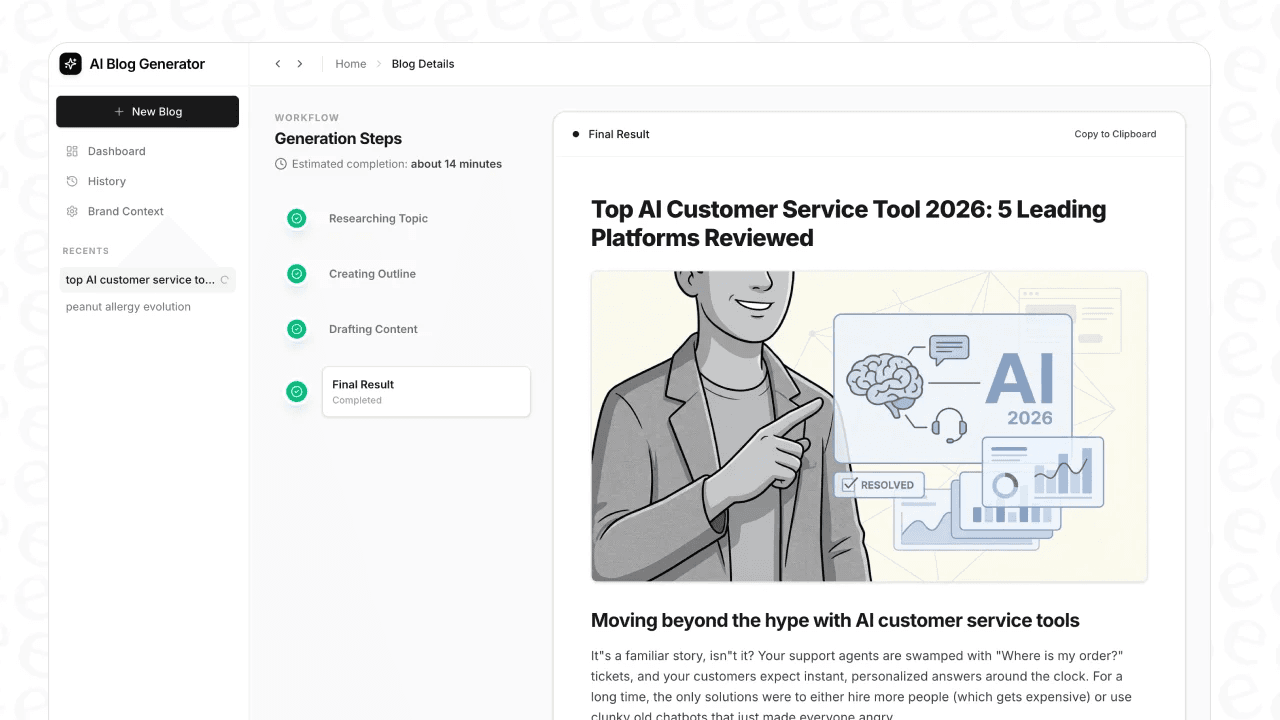
The eesel AI blog writer is designed to turn a single keyword into a complete, SEO-optimized blog post that’s ready to publish. While other tools may provide a rough first draft, eesel AI generates a fully-formed article with a structure, researched content, AI-generated images, relevant YouTube videos, and even real quotes from Reddit to add a human touch.
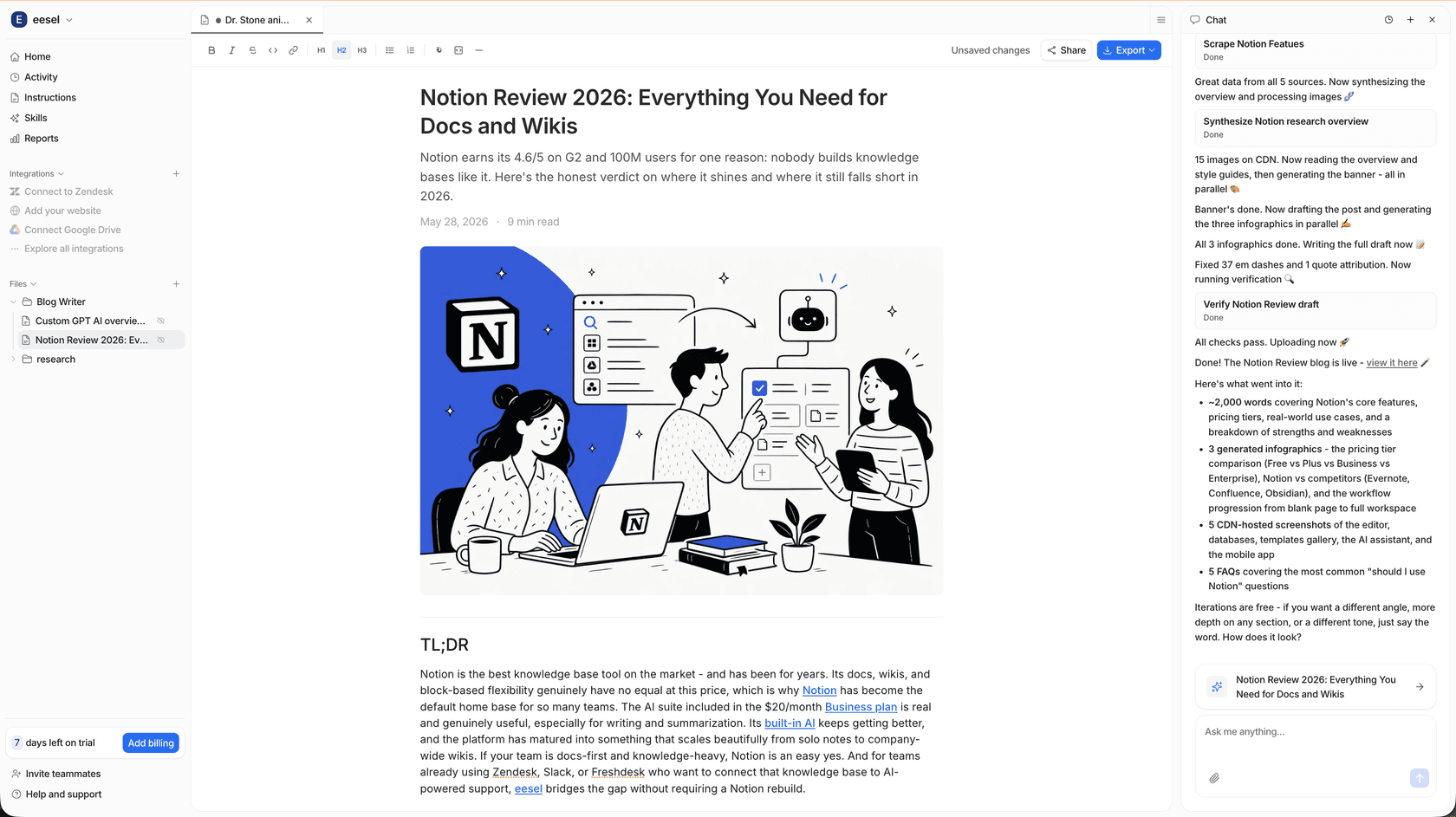
A key feature of eesel AI is its context-aware research. If you ask for a product comparison, it finds pricing and feature data. For a how-to guide, it creates step-by-step instructions. It also optimizes for AI Answer Engines (AEO), which helps your content show up in Google's AI Overviews. It focuses on blog content, so it’s not an all-in-one tool for social media or ad copy. For teams focused on growing organic traffic, that focus can be a strength. We used it to take our own blog from 700 to 750,000 daily impressions in three months.
Pricing:
- Free to try: Generate your first blog post for free to see the quality.
- Paid: $99 for 50 blog post credits.
2. Jasper
Jasper is built for marketing teams in larger companies. Its main strength is Jasper IQ, a feature that learns your brand guidelines, tone, and product info to keep all generated copy consistent. It helps automate the content process with features like Content Pipelines, which connects your strategy and creative work into a single automated system.
While Jasper is useful for maintaining a consistent brand voice and creating copy for different formats, its long-form content often benefits from a human editor to refine for search intent. It offers a set of tools like Studio for building custom AI workflows and Grid for scaling content in a spreadsheet format. It serves as a strong assistant for drafting and brainstorming, though its output may require additional steps to become a publish-ready SEO article.
Pricing:
- Pro: Starts at $59/seat/month (billed annually).
- Business: Custom pricing for enterprise features like API access and dedicated support.
3. Copy.ai
Copy.ai has shifted to become a go-to-market (GTM) AI platform for automating sales and marketing tasks. Its key feature is Workflows, which lets you automate multi-step processes like finding leads and sending personalized outreach. The platform is built around Actions and Agents that can do things like research contacts and add data.
The platform is easy to use and works well for short-form copy like ad variations or product descriptions. It also has a feature called Tables, which acts as a central data source for its AI automations. Its focus on GTM automation means it may not be the primary choice for content teams focused on creating deep, SEO-driven articles, as its long-form content can feel generic and require significant optimization.
Pricing:
- Free: Up to 2,000 words per month in Chat.
- Chat: Starts at $24/month (billed annually) for up to five seats.
- Enterprise: Custom pricing for advanced features and implementation support.
4. Surfer SEO
Surfer SEO is less of a content generator and more of a content optimization platform that uses AI to help your articles rank higher. Its main feature is the Content Editor, which analyzes the top-ranking pages for your keyword and provides a real-time SEO score as you write. It gives recommendations on word count, keyword usage, headings, and topics to include.
Surfer is a useful tool for SEO content writers as it helps remove guesswork from optimization. It works directly with Google Docs, WordPress, and even Jasper, so it fits into existing workflows. It also has tools like an AI Content Humanizer to make text sound more natural. While it can generate text, its primary function is optimization rather than creation from scratch. It tells you what to write about, but the quality of the writing still depends on you or another AI tool.
Pricing:
- Essential: Starts at $79/month (billed annually).
- Scale: Starts at $175/month (billed annually) and includes the AI Tracker feature.
5. Writesonic
Writesonic now positions itself as an AI search visibility platform, focusing on what it calls Generative Engine Optimization (GEO). Its purpose is to help your brand show up in AI search results from platforms like ChatGPT, Gemini, and Google AI Overviews. The core of the platform is its AI Visibility Tracking, which monitors your brand's performance in AI search and gives you recommendations in an Action Center.
Your competitor isn't 'optimizing for ChatGPT.' ChatGPT is just pulling from Google search results via RAG. They rank better than you in normal fucking search (probably intent not glamour). That's it. That's the whole story. There is no separate 'AI optimization.' Every snake oil salesman rebranding SEO services as 'GEO' or 'LLMO' It's the same old unglamorous story. Only the Labels have changed.. Fix your regular SEO. ChatGPT and other LLMs will follow.

Writesonic is a choice for teams that want to stay ahead of the curve on AI search. It offers a full set of SEO tools, including an AI Article Writer and a site auditor. However, since it's an all-in-one platform, some features might not be as robust as specialized tools. For example, its AI writer creates SEO-optimized text but doesn't automatically add rich media like videos or social proof.
Pricing:
- Lite: Starts at $39/month (billed annually) for SEO and content features.
- Professional: Starts at $199/month (billed annually) to access AI Search Tracking (GEO) features.
6. ChatGPT
ChatGPT is another relevant tool in this comparison. As a general AI assistant, it’s incredibly flexible. You can use it for brainstorming ideas, summarizing text, rephrasing sentences, and drafting short pieces of copy. The free version provides access to powerful models like GPT-4o, making it a useful tool for many tasks.
ChatGPT's strength is its versatility, making it a useful "second brain" for content creators. However, it is not a specialized blog writing platform. It takes significant prompt engineering and manual work to produce a well-structured, SEO-optimized article. It won't automatically add images, cite sources, or pull in real-time social proof like Reddit quotes. It’s a helpful tool in the writing process, but it won't deliver a finished, publish-ready product by itself.
Pricing:
- Free: Access to the base model (currently GPT-4o with limits).
- Plus: $20/month for priority access, higher usage limits, and access to more advanced models.
How to choose the right AI content platform
-
For drafting and ideas: If you just need help with brainstorming, getting past writer's block, or writing short copy, a general tool like ChatGPT or a copy-focused one like Copy.ai is a good choice. They’re flexible and can help with a wide range of creative tasks.
-
For brand consistency and varied formats: If you're on a larger team that needs to keep a specific brand voice across different types of content (ads, emails, social media), Jasper is a strong option because of its brand voice features and automation tools.
-
For SEO optimization: If your main goal is making sure your content ranks on Google, an optimization-first tool like Surfer SEO is a must-have. It gives you the data-driven guidance you need to compete in search.
-
For AI search visibility (GEO): If you want to track and improve your presence in AI answer engines like ChatGPT and Google AI Overviews, a specialized platform like Writesonic is built for that.
-
For publishing at scale: If your goal is to create complete, SEO-optimized, and media-rich blog posts with as little manual work as possible, a specialized platform like the eesel AI blog writer is the most direct solution. It's made for teams who want to get from keyword to published article quickly.
Choosing the right AI content platform
After reviewing these platforms, it’s clear that AI is here to augment human writers, not replace them. AI is effective at handling research, structure, and optimization, which frees up writers to focus on what they do best: adding unique insights, telling stories, and connecting with readers.
The best platform is one that fits into your workflow and helps you achieve your specific goals. For teams focused on scaling organic growth, a tool that delivers a nearly-finished product offers a significant advantage. The eesel AI blog writer was developed to handle repetitive work, allowing teams to focus on the creative aspects of content.
You can generate a complete blog post for free to evaluate its output.