Top 6 Writesonic Alternatives for 2026 (Tested & Reviewed)

Stevia Putri
Last edited January 2, 2026
AI writing tools aim to simplify content creation, promising the ability to turn a single keyword into a complete blog post. However, the output sometimes requires significant editing to align with a specific brand voice and quality standards.
Writesonic is a popular AI writing tool, but its features may not be the right fit for every user. Some users look for Writesonic alternatives due to its word-based pricing model, which varies with quality settings, while others seek different features for SEO and content workflows.
This guide provides an overview of popular alternatives to Writesonic. I have tested each tool to evaluate its performance based on key factors like content quality, SEO capabilities, workflow integration, and overall value.
What is Writesonic and why look for Writesonic alternatives?
Writesonic is an AI-powered writing platform that launched in 2021, targeting marketers and businesses that need to create content quickly. It uses advanced tech like GPT-4o to help you generate everything from blog posts to ad copy.
Its core features are the AI Article Writer and a few SEO tools. The unique thing about it is the pricing. Instead of a fixed word count, you get a "Word Balance." The number of words you can generate depends on the quality level you pick: Premium, Good, Average, or Economy. This can get tricky for teams trying to budget their content for the month.
While Writesonic is secure and compliant with standards like SOC 2, GDPR, and HIPAA, its variable word count system is one reason users explore other options. Some are looking for tools that offer a different user experience, specialized long-form content features, or capabilities designed for ranking in AI answer engines.
Our criteria for choosing the best Writesonic alternatives
To give you a fair comparison, we did more than just glance at feature lists. We got our hands dirty and evaluated each tool based on a few things that are absolutely critical for any serious content team.
-
Output Quality: Does the content sound like a human wrote it? Is it coherent and accurate, or does it feel like generic AI filler that needs a complete overhaul?
-
SEO & AEO Focus: Is the tool just churning out text, or is it actively helping you create content that will rank on Google and get cited in AI Answer Engines (that’s AEO, or Answer Engine Optimization)?
-
Workflow Integration: How easily does it fit into an actual content creation process? We’re talking about everything from research and briefing to drafting and final edits.
-
Overall Value: Does the price actually match the features you get? Is the pricing model clear, or are there hidden costs and confusing credit systems?
The best Writesonic alternatives at a glance
If you're short on time, here’s a quick rundown of our top picks and what they’re best for.
| Tool | Best For | Starting Price (Annual) | Key Differentiator |
|---|---|---|---|
| eesel AI | Scaling publish-ready blog content | $99/mo | Generates a complete blog post, not just text |
| Jasper | Marketing teams needing content variety | $59/mo per seat | AI context layer (Jasper IQ) & 50+ templates |
| Surfer SEO | Real-time, on-page SEO optimization | $79/mo | Live content score as you write |
| Frase | An all-in-one research-to-draft workflow | $38/mo | Combines SERP research with SEO + GEO optimization |
| Copy.ai | Automating go-to-market processes | $29/mo (for 5 seats) | GTM AI platform with customizable Workflows |
| Rytr | Budget-conscious creators and beginners | $9/mo | Simple interface and extreme affordability |
The 6 best Writesonic alternatives to try in 2026
Alright, let's dive into the specifics. Here’s a closer look at each alternative, including what it is, who it’s for, and where it shines (and where it falls short), based on our testing.
1. eesel AI
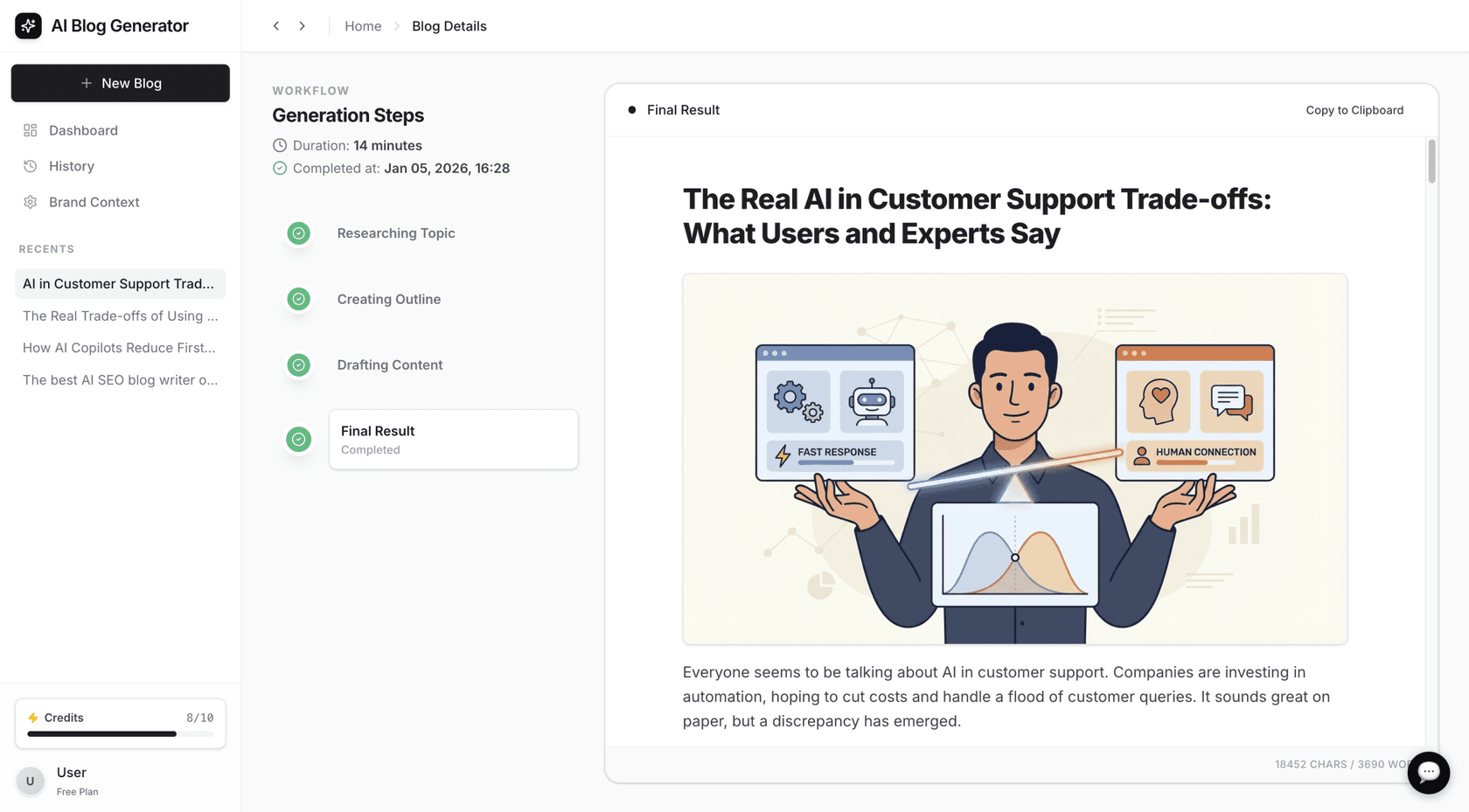
The eesel AI Blog Writer is a different kind of tool. It’s built to handle the entire blog creation process from a single keyword. This tool is designed to scale blog production. For example, it was used to publish over 1,000 optimized blogs, resulting in significant organic impression growth in a three-month period. Instead of giving you a wall of text, it delivers a fully structured, publish-ready article.
Pros: Its biggest strength is that it creates a complete package. The AI does its own research, structures the content for both SEO and Answer Engine Optimization (AEO), and automatically includes assets like AI-generated images, infographics, internal links, and even relevant quotes from Reddit to make the content feel more authentic. This can reduce the time required to move from draft to publication.
Cons: The tool is specialized for long-form blog content and may not be the ideal choice for teams requiring a wide variety of templates for short-form copy, such as social media posts or Google Ads.
Pricing: The pricing is simple and transparent. The Early Bird plan is just $99 per month for 100 blog generations. It’s also completely free to try, so you can see the quality for yourself.
Best for: Content marketers and SEO teams who need to scale up the production of high-quality, fully-optimized blog posts without juggling multiple tools.
2. Jasper
Jasper is one of the most recognizable names out there. It’s a versatile AI platform with over 50 templates for just about any kind of marketing content you can imagine, from long-form blogs to quick email subject lines. It places a big emphasis on brand consistency with its AI context layer, Jasper IQ, which learns your brand voice.
Pros: Jasper's biggest advantage is its flexibility. The Brand IQ feature is genuinely helpful for keeping your tone consistent across all your content. It also has enterprise-level security, is SOC 2 and GDPR compliant, and integrates with tools like Surfer SEO, which can make it a powerful hub for a marketing team.
Writesonic has better British English support out of the box. For you specifically, found writesonic superior for social captions and blog writing, but jasper's better for seo work and keword integration

Cons: This range of functionality is reflected in its pricing, positioning Jasper in the higher tier of the market. For highly niche or technical topics, the content generated may require fact-checking and additional depth. Also, API access is only available on their custom-priced Business Plan.
Pricing: The Pro plan starts at $59 per month per seat when you pay annually.
Best for: Established marketing teams that produce a wide variety of content and are willing to pay a premium for a feature-rich platform.
3. Surfer SEO
Surfer SEO is less of an AI writer and more of an SEO optimization platform that also has AI writing features. Its standout feature is the Content Editor, which analyzes the top-ranking pages for your target keyword and gives you a live content score as you write, telling you exactly what to do to compete.
Pros: Surfer is fantastic at giving you a clear, data-driven path for on-page optimization. The real-time feedback is very intuitive, and its integrations with Google Docs and WordPress mean your writers can optimize content right where they already work. They also have an AI Tracker add-on to see how visible your brand is in AI chats.
Cons: The platform's primary focus is on optimization rather than content generation. The AI writing features are positioned as supplementary and may be included in higher-tier plans. Full API access is also restricted to their Enterprise plan, which could be a consideration for smaller teams wanting to build custom workflows.
Pricing: The Essential plan starts at $79 per month when billed annually.
Best for: SEOs and content teams who already have a draft and want a powerful tool to ensure every piece is perfectly tuned to rank on the SERPs.
4. Frase
Frase aims to be your all-in-one solution, taking you from a keyword to a finished draft. It’s one of the few tools that’s explicitly focused on both SEO (Search Engine Optimization) and what they call GEO (Generative Engine Optimization), which is all about getting your content cited by AI platforms like ChatGPT and Perplexity.
Pros: Frase is great at automating the most tedious part of writing: research. It generates detailed content briefs by analyzing top search results. Its dual SEO and GEO scoring system gives you a unique edge in creating content that performs well in both traditional search and the new wave of AI answers.
Cons: While Frase offers a comprehensive set of features, its on-page optimization tools may not be as in-depth as those found in specialized platforms like Surfer SEO.
Pricing: The Starter plan begins at $38 per month when you pay annually.
Best for: Content creators and small businesses who want an affordable tool that combines research, briefing, and writing, with an eye toward future-proofing their content for AI search.
5. Copy.ai
Copy.ai has evolved quite a bit since it first launched. It’s grown from a simple copy generator into a full GTM (Go-to-Market) AI Platform. It’s designed to automate sales and marketing tasks using customizable, no-code "Workflows."
Pros: The workflow builder is really effective for automating repetitive jobs like finding prospects, creating outreach content, and engaging leads. The platform is also SOC 2 Type II compliant, making it a secure choice for businesses. Plus, the starting price is incredibly competitive for small teams.
Cons: Due to its focus on GTM automation, the platform may be less suitable for users whose primary need is long-form blog post creation. The focus is more on automating processes than on pure content generation.
Pricing: The Chat plan starts at just $29 per month and includes 5 seats, making it one of the most affordable options for teams.
Best for: Sales, marketing, and ops teams who want to use AI to automate their entire go-to-market engine, not just to write copy.
6. Rytr
Rytr is an AI writing assistant that hits a nice balance between being useful and being incredibly affordable. It’s a popular choice for individuals and small teams who are new to AI writing or working with a tight budget, and it specializes in short-form copy.
Pros: Rytr's main appeal is its price. It’s one of the most affordable AI writers available. For what you pay, you get decent quality content across a good range of use cases, and its browser extension is handy for writing on the fly.
Cons: Rytr does not include the advanced SEO features, research capabilities, or workflow tools found in some other platforms. The AI output may become repetitive and often requires manual editing, especially for complex subjects.
Pricing: It has a free plan that gives you up to 10,000 characters a month. Paid plans with unlimited generation run from $9 to $29 per month.
Best for: Students, bloggers, and freelancers on a strict budget who need a simple tool for basic content writing tasks.
How to choose the right Writesonic alternative for you
With so many good options, picking the right one can feel a little daunting. Here are a few practical tips to help you decide.
-
Define your main goal: Before anything else, figure out your biggest need. Are you trying to scale SEO-driven blog content? Brainstorm ad copy? Automate marketing workflows? Your primary goal will immediately help you narrow down the list.
The 'all-in-one' pitch is always tempting. Be careful though, a lot of these tools do 10 things just 'ok' instead of doing one thing really well.
-
Look beyond SEO to AEO/GEO: Ranking on Google is still important, but getting cited in AI answer engines is the next frontier. If you're thinking about future visibility, consider tools like Frase or eesel AI that are built for both.
-
Map it to your workflow: Think about how you and your team actually get work done. Do you need collaboration features? Is a Google Docs integration a must-have? A tool that doesn't fit your process will just create more friction.
-
Remember the human element: No AI tool is a magic button. The best results always come from a partnership between AI efficiency and human creativity. Make sure you budget time for a real person to edit, fact-check, add unique insights, and ensure the content truly sounds like your brand.
For a more visual comparison of these tools, the following video offers a helpful walkthrough of several top contenders, showcasing their features and interfaces in action.
Choosing the right Writesonic alternative
Selecting a Writesonic alternative involves identifying the tool that best aligns with your specific content workflow needs. Some platforms excel at generating text for various formats, while others, like the eesel AI Blog Writer, are designed to automate the entire blog post creation process. This can include research, structuring, SEO, and asset creation, turning a keyword into a structured article. The goal is to find a solution that integrates smoothly into your process and helps you achieve your content goals. Many tools, including eesel AI, offer free trials to evaluate their capabilities.
Explore more Writesonic resources: Writesonic overview, Writesonic review, Writesonic pricing, and detailed comparisons including Writesonic vs Copy.ai, Writesonic vs Rytr, Writesonic vs Surfer SEO, Writesonic vs Anyword, Writesonic vs SEO.ai, and Jasper AI vs Writesonic.

Frequently asked questions
For those just starting out, Rytr offers a generous [free plan](https://www.eesel.ai/blog/blog-writing-ai-free) that's great for short-form content. While most powerful tools require a subscription, many, like eesel AI, offer a free trial so you can test the quality before committing.
Absolutely. Tools like eesel AI are specifically designed for this. Instead of just generating text, it handles the entire workflow from research and outlining to writing a complete, publish-ready blog post with assets included. Frase is another good option that focuses on research and drafting.
It varies. Some tools, like Jasper, integrate with SEO platforms. Others, like Surfer SEO, are primarily SEO tools with AI writing features. A few, including eesel AI and Frase, are built from the ground up to optimize for both traditional search engines (SEO) and new AI answer engines (AEO/GEO), which is key for future visibility.
You might [look for an alternative](https://www.eesel.ai/blog/writesonic-ai-alternatives) if you find Writesonic's word-based pricing confusing, need more advanced SEO or workflow features, or want a tool that's more specialized for a specific type of content, like scaling long-form blog posts.
The main difference is that eesel AI is an end-to-end blog post generator, not just a text writer. It automates the entire process, from research and structuring to including AI-generated images, internal links, and even relevant quotes. This drastically reduces the manual editing and formatting time needed to get an article live.
Yes, Copy.ai has pivoted to become a Go-to-Market (GTM) AI platform. It uses customizable "Workflows" to automate tasks across sales and marketing, like lead generation and outreach, making it much more than just a content tool.
Share this article

Article by
Stevia Putri
Stevia Putri is a marketing generalist at eesel AI, where she helps turn powerful AI tools into stories that resonate. She’s driven by curiosity, clarity, and the human side of technology.
