Decagon vs Zendesk AI: Complete 2026 comparison

Kenneth Pangan
Last edited May 7, 2026
Disclosure: This article is published by eesel AI, a competitor of Decagon and Zendesk. We encourage you to read Decagon's own materials and Zendesk's own materials for their perspective.
Choosing the right AI customer service platform is a significant decision. Two names that come up frequently are Decagon and Zendesk AI. Both promise to transform how you handle customer support, but they take fundamentally different approaches.
Decagon is a standalone AI agent platform built from the ground up for autonomous customer service. Zendesk AI is an intelligence layer added to the established Zendesk help desk ecosystem. Which one fits your team depends on your existing infrastructure, technical resources, and how much automation you actually need.
Let's break down what each platform offers and how they compare.
What is Decagon AI?
Decagon is an enterprise AI platform designed specifically for customer support automation. The company was co-founded by Jesse Zhang and Ashwin Sreenivas and has raised $481M including a $250M Series D in January 2026 that valued the company at $4.5B.
Decagon's core differentiator is "Agent Operating Procedures" (AOPs). These are natural-language instructions that compile into executable workflows, allowing both technical and non-technical team members to define how AI agents handle customer interactions. The platform emphasizes full autonomy: agents reason, adapt, and take action independently across voice, chat, and email.
The customer roster includes Duolingo, Chime, Rippling, ClassPass, Figma, Dropbox, Affirm, and Oura among others. Decagon case studies report: Duolingo at 80% deflection, Chime at 70% resolution across chat and voice, and ClassPass with a 95% reduction in chat operations costs.
Decagon positions itself as the choice for companies that want AI agents handling complex workflows end-to-end, not just answering simple FAQs.
What is Zendesk AI?
Zendesk AI is the intelligence layer built on top of Zendesk's established customer service platform. If you are already using Zendesk for ticketing and messaging, the AI features integrate natively into your existing workflows.
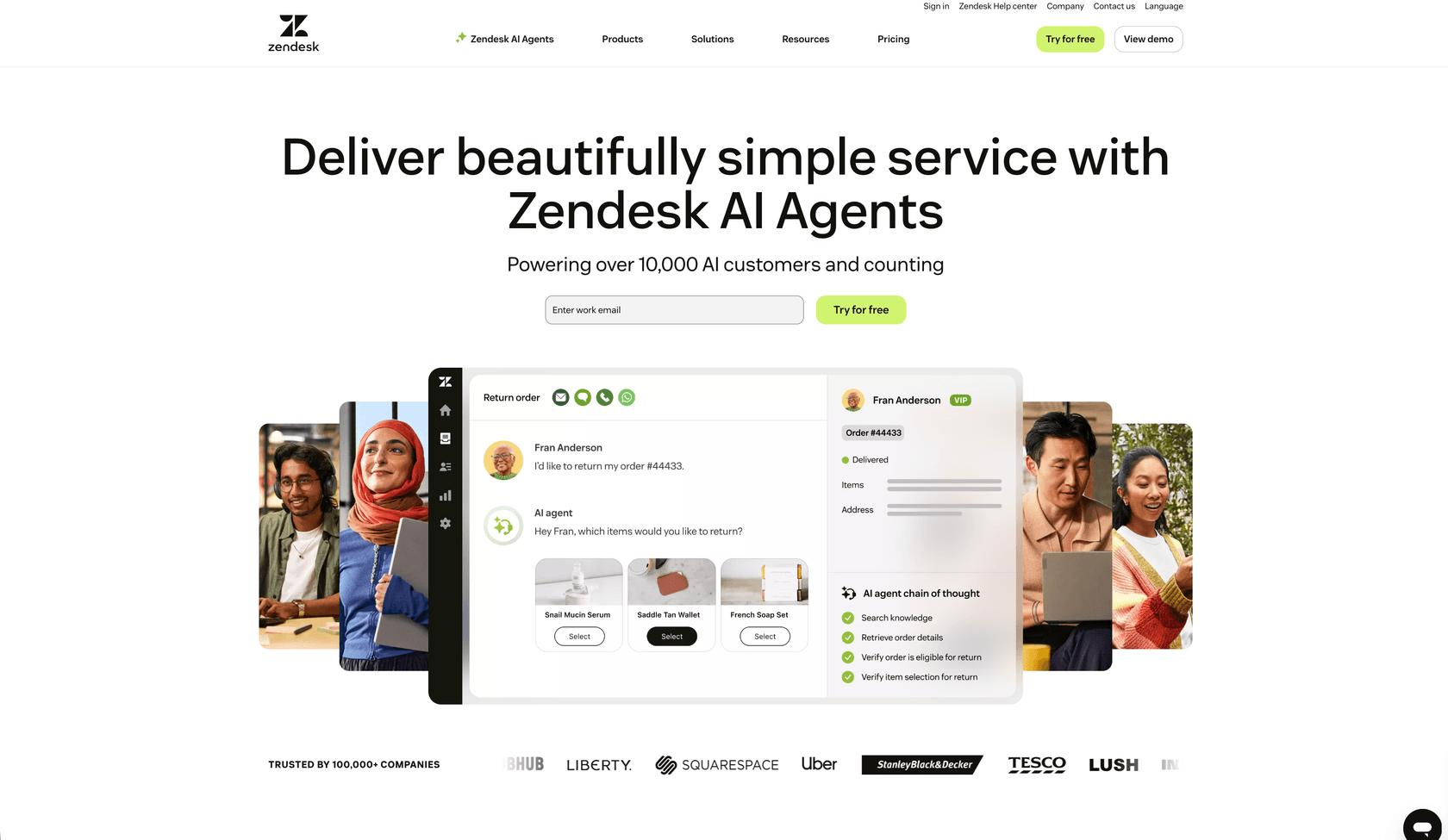
The platform focuses on three main areas: AI agents that resolve customer issues autonomously, Copilot features that assist human agents with suggested replies and next steps, and administrative tools that help optimize operations. Zendesk AI comes pre-trained across multiple industries including financial services, retail, software, and education.
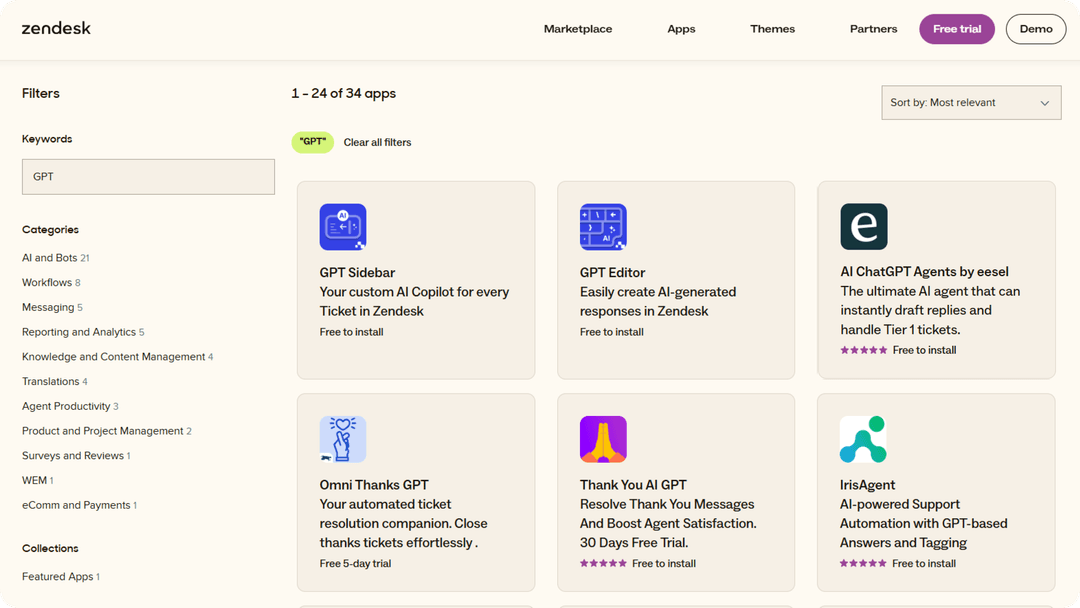
With over 100,000 companies using Zendesk, the ecosystem is mature. The Zendesk Marketplace offers 1,800+ integrations, making it straightforward to connect with tools you already use.
Customer results from the Zendesk AI agents page include: Next achieved a 66% one-touch resolution rate; UrbanStems hit 39% automated resolution and saved $100,000 in three months; Lush reports $434,000 in annual cost savings with 93% CSAT.
Zendesk AI makes the most sense for teams already invested in the Zendesk ecosystem who want to add AI capabilities without switching platforms.
Feature comparison: Decagon vs Zendesk AI
| Feature | Decagon AI | Zendesk AI |
|---|---|---|
| Core approach | Standalone AI agent platform | AI layer on existing help desk |
| AI autonomy | Full autonomous agents with backend actions | AI agents + agent assistance tools |
| Voice AI | Native, purpose-built | Available via Contact Center add-on |
| Setup complexity | Requires engineering for implementation | Self-serve with quick launch |
| Best fit | Large enterprises with engineering resources | Teams already using Zendesk |
AI capabilities
Decagon focuses on full agent autonomy. Its AI agents handle complex, multi-step workflows by connecting to your backend systems and taking real actions like processing refunds or checking order status. The AOP system lets you define these workflows in natural language, which the platform then compiles into executable, auditable logic.
Zendesk AI offers a hybrid approach. The AI agents can resolve issues autonomously, but the platform also emphasizes Copilot features that assist human agents rather than replacing them. This suits teams that want to keep humans in the loop for complex interactions. One important detail: multi-step, action-taking agents require the Advanced AI add-on, which is sold via sales with no published price. The Essential tier included in Suite plans handles knowledge-grounded responses but not backend integrations or API actions.
Voice AI
Voice is where Decagon differentiates most clearly. The platform offers native voice AI built for natural dialog, with full customization of tone, style, and speed to match your brand. Cross-channel memory means a customer can start on chat and continue on voice without repeating themselves. Decagon also launched outbound voice agents in Spring 2026 for proactive customer outreach.
Zendesk voice capabilities span multiple channels including dedicated voice AI agents that handle phone interactions end-to-end. These are available primarily as part of the Contact Center add-on at $50/agent/month. The voice features are solid but sit as an add-on rather than a core part of the platform.
Integration ecosystem
Decagon integrations include major CRMs, help desks, and knowledge bases including Salesforce, Zendesk, Confluence, and Amazon Connect, plus MCP open connectivity for custom integrations.
Zendesk's advantage is scale. With 1,800+ apps in the Marketplace and extensive API access, you can connect almost any tool. If you are already using Zendesk, the AI features plug right into your existing setup without additional configuration.
Pricing breakdown
Decagon AI pricing
No public pricing is available. The company uses a custom enterprise model, and you will need to contact their sales team for a quote.
Based on publicly available analysis, Two usage models are available:
- Pay per conversation: A fixed fee for every AI-handled interaction
- Pay per resolution: A fee only for successfully resolved issues (no charge for escalated conversations)
Both models layer on top of an estimated annual platform fee. These figures are not publicly disclosed by Decagon. Third-party analysis suggests contracts range from $95K to over $590K depending on volume, channel mix, and integration complexity.
Zendesk AI pricing
Zendesk pricing is transparent and tiered:
| Plan | Annual Price | Monthly Price | AI Features Included |
|---|---|---|---|
| Support Team | $19/agent/month | $25/agent/month | AI agents (requires Help Center add-on) |
| Suite Team | $55/agent/month | $69/agent/month | AI agents (Essential), Generative replies, Knowledge Builder |
| Suite Professional | $115/agent/month | $149/agent/month | Above + Copilot (5 uses/month), up to 5 help centers |
| Suite Enterprise | $169/agent/month | $219/agent/month | Above + up to 300 help centers |
Add-ons (per the Zendesk pricing page):
- Copilot: $50/agent/month for unlimited access
- Advanced AI agents: not publicly disclosed (contact sales)
- Quality Assurance: $35/agent/month
- Workforce Management: $25/agent/month
- Contact Center: $50/agent/month
Automated Resolutions beyond your plan's monthly allowance incur additional charges: $1.50 per resolution (committed usage purchased upfront) or $2.00 per resolution (pay-as-you-go). Each Suite tier includes 5-15 ARs per agent per month.
The predictability of per-agent pricing makes budgeting straightforward, though costs can climb with add-ons.
Real-world performance and limitations
Decagon strengths
- Proven results at scale: The case studies report concrete numbers: 80% deflection at Duolingo, 70% resolution at Chime, 95% cost reduction at ClassPass in chat operations.
- Native voice AI: Built-in voice capabilities with conversational dialog, brand customization, and Trace View for execution logging.
- Transparent agent logic: AOPs let you see and control how agents make decisions, with Agent Versioning for CI/CD-style governance.
- Enterprise security: Built for regulated industries with strict guardrails and identity verification.
Decagon limitations
- Custom pricing only: No public pricing means you cannot quickly compare costs or build a budget without a sales conversation.
- Engineering requirements: While AOPs use natural language, advanced integrations and custom workflows still need technical resources. Implementation typically takes 4-12 weeks with dedicated engineers.
- Implementation overhead: Some users report that the customer experience can feel disjointed during escalations, and performance can degrade at very high ticket volumes.
Zendesk AI strengths
- Ecosystem integration: If you already use Zendesk, AI features integrate directly with minimal disruption to existing workflows.
- Predictable pricing: Per-agent monthly fees make budgeting straightforward from the start.
- Extensive marketplace: 1,800+ integrations cover nearly any tool you are already using.
- Pre-trained models: AI works out of the box for common industries including retail, fintech, and SaaS.
Zendesk AI limitations
- Add-on complexity: Advanced AI capabilities (multi-step agents, backend actions, unlimited Copilot) require separate add-ons that can substantially increase costs. Advanced AI agents are sold via sales only with no published price.
- Essential tier ceiling: The included Essential AI agents handle knowledge-grounded FAQ responses well, but backend integrations and reasoning controls require the Advanced tier.
- Declining support quality: Multiple long-term customers on Capterra cite deterioration in Zendesk's own customer support quality over time.
Which platform should you choose?
Choose Decagon if:
- You need full AI agent autonomy with backend system actions
- Voice AI is a critical requirement
- You have engineering resources for a multi-week implementation
- You prefer usage-based pricing tied to outcomes
- You are not already committed to a specific help desk platform
Choose Zendesk AI if:
- You are already using Zendesk for ticketing
- You prefer agent assistance over full automation
- You want predictable per-agent pricing
- You need extensive third-party integrations
- You want quick deployment without engineering resources
A third option: eesel AI
There is a third option worth considering. At eesel AI, we built an AI teammate for customer support that addresses limitations of both platforms.
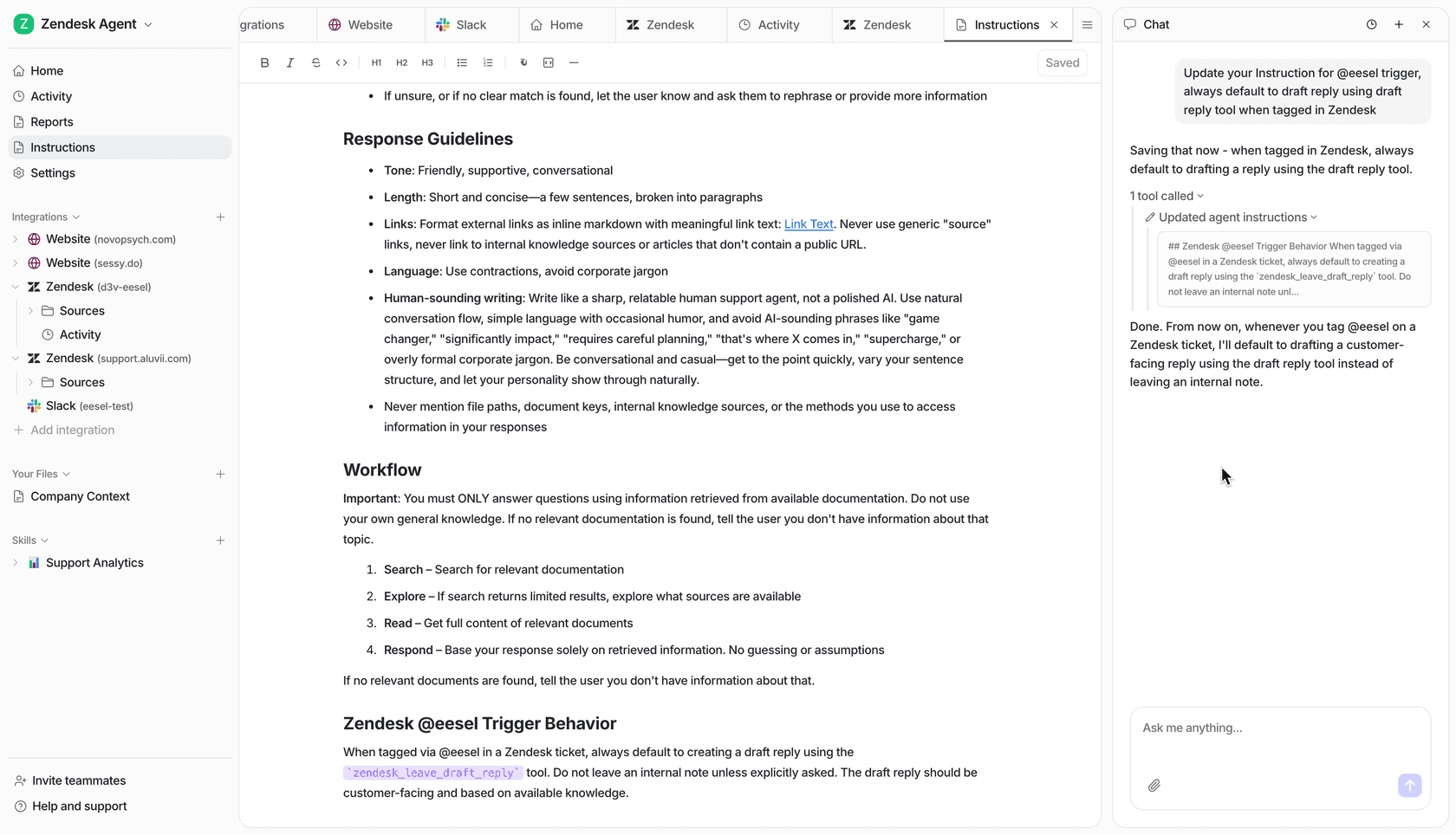
Here is how we approach the key challenges:
- Test before you launch: Run your AI agent in a sandbox using your actual past tickets before it handles any real customers. You see exactly how it performs and can refine it until you are confident.
- Simple setup: Connect to your help desk with one click. No engineering team required. We learn from your existing tickets, help center, and documents automatically.
- Multiple specialized agents: Instead of one agent trying to handle everything, you can create different AI agents for different jobs -- one for Tier 1 questions, another for internal Slack support, another for sales inquiries.
- Task-based pricing: Our task-based pricing is $0.40 per support ticket, with no monthly minimum or per-seat fees. You only pay for what gets resolved.
If you are evaluating Decagon alternatives, we would be glad to show you how eesel AI compares. You can also explore our Zendesk AI integration if you want to enhance your existing Zendesk setup.
Making the right choice for your team
The Decagon vs Zendesk AI decision comes down to your starting point and priorities.
Decagon offers the most powerful standalone AI agent platform for enterprises willing to invest in implementation. If you need sophisticated voice AI and full backend integration, and you have the technical resources to support it, Decagon delivers concrete results.
Zendesk AI is the pragmatic choice for teams already using Zendesk. The integration is seamless, pricing is predictable, and you get solid AI capabilities without overhauling your existing setup.
If you want the autonomy of Decagon with the simplicity Zendesk promises, consider a platform built specifically for teams that need to move fast without engineering bottlenecks. Our AI agent handles frontline support autonomously while keeping you in control of how and when it operates.
The best platform is the one that fits your team's capabilities, existing tools, and growth trajectory. Start with a clear assessment of what you actually need, then test before you commit.


Frequently Asked Questions
It depends on your volume and setup. Zendesk pricing starts at $55/agent/month on the Suite Team plan, making it predictable. Decagon pricing based on usage, which can be cost-effective at high volumes but requires a sales conversation to determine actual costs. Reported Decagon contracts range from $95K to over $590K annually.
Yes. Decagon integrations include major help desks including Zendesk. You can run Decagon's AI agents alongside your existing Zendesk ticketing system if you want Decagon's autonomous capabilities without switching platforms entirely.
No. Zendesk's Essential AI agents are designed for self-serve setup with no technical expertise required; basic agents can launch in minutes. The Advanced AI agents add-on, which unlocks multi-step workflows and backend integrations, requires more configuration and is sold via sales.
Decagon's native voice AI is purpose-built with conversational dialog, brand customization, and cross-channel memory. Zendesk offers voice features primarily through the Contact Center add-on at $50/agent/month. If voice is a primary requirement, Decagon has the advantage.
Decagon positions itself for enterprise customers and typically requires dedicated engineering resources for implementation. The setup complexity and custom pricing make it better suited for larger organizations. eesel AI pricing starts at $0.40 per helpdesk task with no monthly minimum, which scales better for smaller teams without large engineering capacity.
Share this article

Article by
Kenneth Pangan
Writer and marketer for over ten years, Kenneth Pangan splits his time between history, politics, and art with plenty of interruptions from his dogs demanding attention.