Zendesk for growing teams: A practical guide to scaling support in 2026

Stevia Putri
Last edited March 3, 2026
Growing a business is exciting until your support inbox becomes a black hole. What started as a manageable trickle of customer questions turns into a flood that keeps your team working late and your customers waiting. This is the exact moment when many teams start looking at help desk platforms like Zendesk.
But here's the thing: Zendesk is a powerful tool, but it's not always the right fit for every growing team. The pricing can escalate quickly, the learning curve is real, and you might find yourself paying for features you'll never use. That's why we're breaking down exactly what Zendesk offers for growing teams, what it costs, and when it makes sense (or doesn't) for your situation.
We'll also look at how we approach this differently at eesel AI. Our teammate model offers an alternative for teams that want AI-powered support without the complexity of traditional help desk configuration.
What growing teams need from a help desk platform
When your team is growing, your support needs change fast. Yesterday's spreadsheet tracking system becomes today's bottleneck. Here's what actually matters:
Scalability without chaos. You need a system that handles 10 tickets today and 1,000 tomorrow without breaking. This means automated routing, smart prioritization, and workflows that don't require a PhD to set up.
Team coordination. As you add agents, you need visibility into who's handling what, easy handoffs, and ways to collaborate without stepping on each other.
Automation that actually works. The goal isn't to replace humans. It's to handle the repetitive stuff (password resets, order status checks) so your team can focus on complex issues that need a human touch.
Integration with your existing tools. Your help desk shouldn't be an island. It needs to talk to your CRM, your e-commerce platform, and your team communication tools.
For a broader look at how different help desk solutions compare, check out our Zendesk vs Freshdesk comparison.
How Zendesk scales with your team
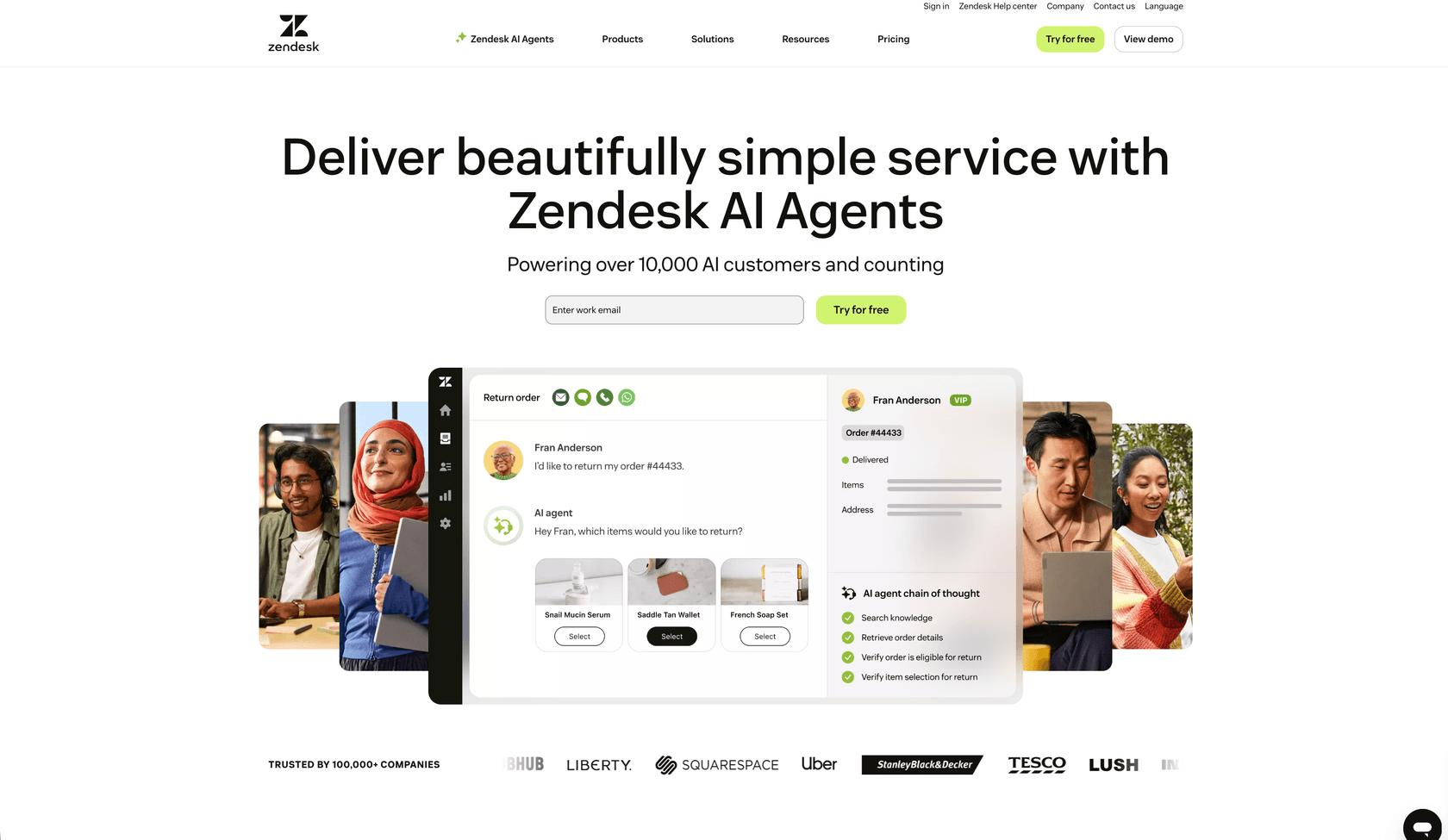
Zendesk has built its reputation on being the "complete customer service solution." With 100,000+ companies using the platform (including Uber, Slack, and Airbnb), they've clearly found product-market fit. But what does that mean for a growing team?
From startup to scale-up: Zendesk's plan progression
Zendesk structures its pricing in tiers that roughly map to company growth stages. The idea is you start small and upgrade as you need more features.
Suite Team ($55/agent/month) is the entry point for multi-channel support. You get ticketing, messaging, live chat, and basic AI agents. This is where most growing teams start. You also get a help center (knowledge base), social messaging on platforms like WhatsApp and Instagram, and phone support with call routing.
Suite Professional ($115/agent/month) adds the features that matter when you're scaling. Skills-based routing ensures tickets go to the right agent. You get up to 5 help centers, CSAT surveys, and service level agreements. This is Zendesk's most popular plan for a reason: it includes the automation and routing features that teams typically need within six months of serious growth.
Suite Enterprise ($169/agent/month) is for larger operations. You get up to 300 help centers, sandbox environments for testing changes, custom agent roles, and advanced security features like audit logs.
The jump from Team to Professional is significant ($60 per agent), but that's where the automation features live that actually help you scale.
AI and automation capabilities
Zendesk has gone all-in on AI, and the results are impressive when implemented well. Here's what's available:
AI agents can automate 80%+ of customer interactions across any channel. The Essential plan is included in all Suite tiers, while Advanced AI Agents (which handle more complex issues) require an add-on.
Copilot is Zendesk's agent assistance tool. It provides suggested replies, customer context, and can execute actions. Think of it as an AI assistant sitting next to your agents, helping them respond faster and more accurately. This is a $50/agent/month add-on.
Intelligent features include generative replies, knowledge building, generative search, and automated resolution reporting. These are designed to reduce the manual work of support.
The numbers Zendesk shares from customers are compelling. UrbanStems achieved a 39% automated resolution rate and saved $100K in just three months. Lush hit a 60% first contact resolution rate with $434K in annual savings.
For a deeper dive into Zendesk's AI capabilities specifically, see our Zendesk AI overview.
Team productivity features
Beyond AI, Zendesk offers tools for managing your team's workload:
Workforce Management (WFM) at $25/agent/month provides forecasting, scheduling, and real-time performance monitoring. Monese, a fintech company, reported 82% time savings on scheduling after implementing Zendesk WFM.
Quality Assurance (QA) at $35/agent/month automatically evaluates conversations and identifies coaching opportunities. This works across both human and AI agent interactions.
Collaboration tools include light agents (comment-only users who can view and comment on tickets), side conversations for internal discussions, and skills-based routing to get tickets to the right person.
If you're evaluating AI help desk tools more broadly, our guide to the best AI help desk tools covers the full landscape.
Zendesk pricing for growing teams
Let's talk numbers, because this is where things get interesting (and potentially expensive).
Suite plans breakdown
| Plan | Annual Price | Monthly Price | Best For |
|---|---|---|---|
| Suite Team | $55/agent/month | $69/agent/month | Small teams starting with multi-channel support |
| Suite Professional | $115/agent/month | $149/agent/month | Growing teams needing automation and SLAs |
| Suite Enterprise | $169/agent/month | $219/agent/month | Large teams requiring advanced security and customization |
Source: Zendesk Pricing
The gap between Team and Professional is significant. At 10 agents, you're looking at $600/month more for Professional. But Team lacks skills-based routing, SLAs, and CSAT surveys. Most growing teams find they need to upgrade sooner than expected.
Essential add-ons for growth
Here's where Zendesk's pricing gets complicated. Many features that growing teams need are add-ons:
| Add-on | Price | What It Does |
|---|---|---|
| Copilot | $50/agent/month | AI-powered agent assistance, intelligent triage, suggested replies |
| Advanced AI Agents | Contact sales | Handle 80%+ of complex issues autonomously |
| Workforce Management | $25/agent/month | Forecasting, scheduling, performance monitoring |
| Quality Assurance | $35/agent/month | Conversation analysis, coaching opportunities |
| Workforce Engagement Bundle | $50/agent/month | WFM + QA combined (saves $10) |
| Contact Center | $50/agent/month | GenAI voice tools, custom IVR |
| Advanced Data Privacy | $50/agent/month | Enhanced security, data residency options |
Source: Zendesk Pricing
Real cost example
Let's run the numbers for a typical growing team:
10 agents on Suite Professional with Copilot and WFM+QA:
- Base: $115 × 10 = $1,150/month
- Copilot: $50 × 10 = $500/month
- WFM+QA Bundle: $50 × 10 = $500/month
- Total: $2,150/month ($215 effective per agent)
That's $25,800 per year for a 10-person support team. And this doesn't include implementation costs, training time, or potential professional services if you need help configuring complex workflows.
When the cost doesn't make sense
Zendesk's per-agent pricing model creates some perverse incentives. Adding a part-time agent for busy periods costs the same as a full-time agent. Seasonal spikes mean paying for agents you don't need year-round.
There's also the "feature gap" problem. Many teams find they outgrow Team plan features quickly but aren't ready for the Professional price jump. You're either underpowered or overpaying.
For a different pricing approach, our pricing page explains how we structure costs based on interactions rather than seats.
Integration ecosystem for growing teams
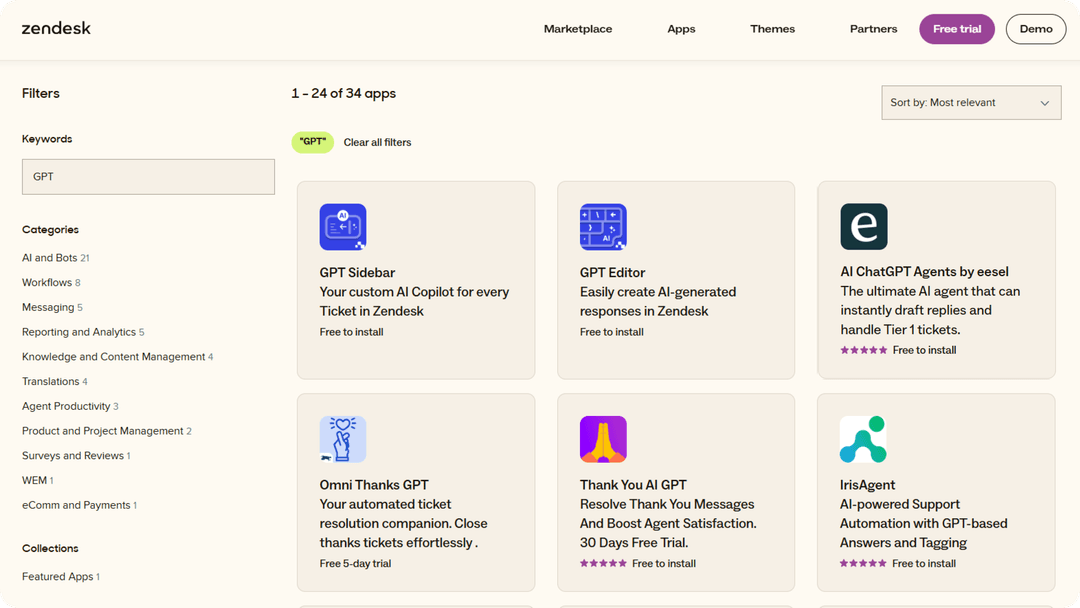
One of Zendesk's strengths is its integration ecosystem. The Zendesk Marketplace has 1,000+ pre-built integrations covering most business tools.
Collaboration tools
Slack integration lets you view, create, and take action on tickets from any Slack channel. This is particularly useful for teams that live in Slack and want support visibility without switching contexts.
Microsoft Teams integration provides similar functionality. You can view and edit tickets, get real-time notifications, and use command shortcuts directly from Teams.
CRM and business tools
Zendesk connects with major CRMs including Salesforce, HubSpot, and Pipedrive. For e-commerce, there are integrations with Shopify, WooCommerce, and Magento. These connections pull customer data into tickets so agents have context without switching apps.
The integration depth varies. Some are native Zendesk integrations, others are built by third parties. Quality and maintenance can differ significantly.
If you're specifically looking at Zendesk integrations with AI, our Zendesk AI integration page shows how we connect with the platform.
The reality of implementing Zendesk
Here's what the sales page won't tell you: Zendesk has a learning curve. It's a powerful platform, but that power comes with complexity.
Setup complexity
Getting Zendesk running isn't just about creating an account. You need to:
- Configure ticket fields, forms, and workflows
- Set up your help center structure and content
- Create automations and triggers
- Train agents on the interface
- Integrate with your other tools
For AI features to work well, you need a clean, well-organized help center. The AI learns from your content, so garbage in means garbage out. Many teams underestimate the content preparation required.
Common growing pains
Plan upgrades feel forced. You start on Team, realize you need skills-based routing, and suddenly you're paying double. The feature tiers don't always align with natural growth stages.
Add-on creep is real. You add Copilot for $50/agent. Then WFM for $25. Then QA for $35. Before you know it, your per-agent cost has doubled from the base price.
Configuration requires dedicated time. Someone on your team needs to become the Zendesk admin. For growing teams without dedicated operations staff, this is a hidden cost.
For a comprehensive look at what Zendesk offers (and where it falls short), our Zendesk ticketing system guide covers the full picture.
eesel AI: A different approach for growing teams
At eesel AI, we think about support software differently. Instead of a tool you configure, we built an AI teammate you hire and train.
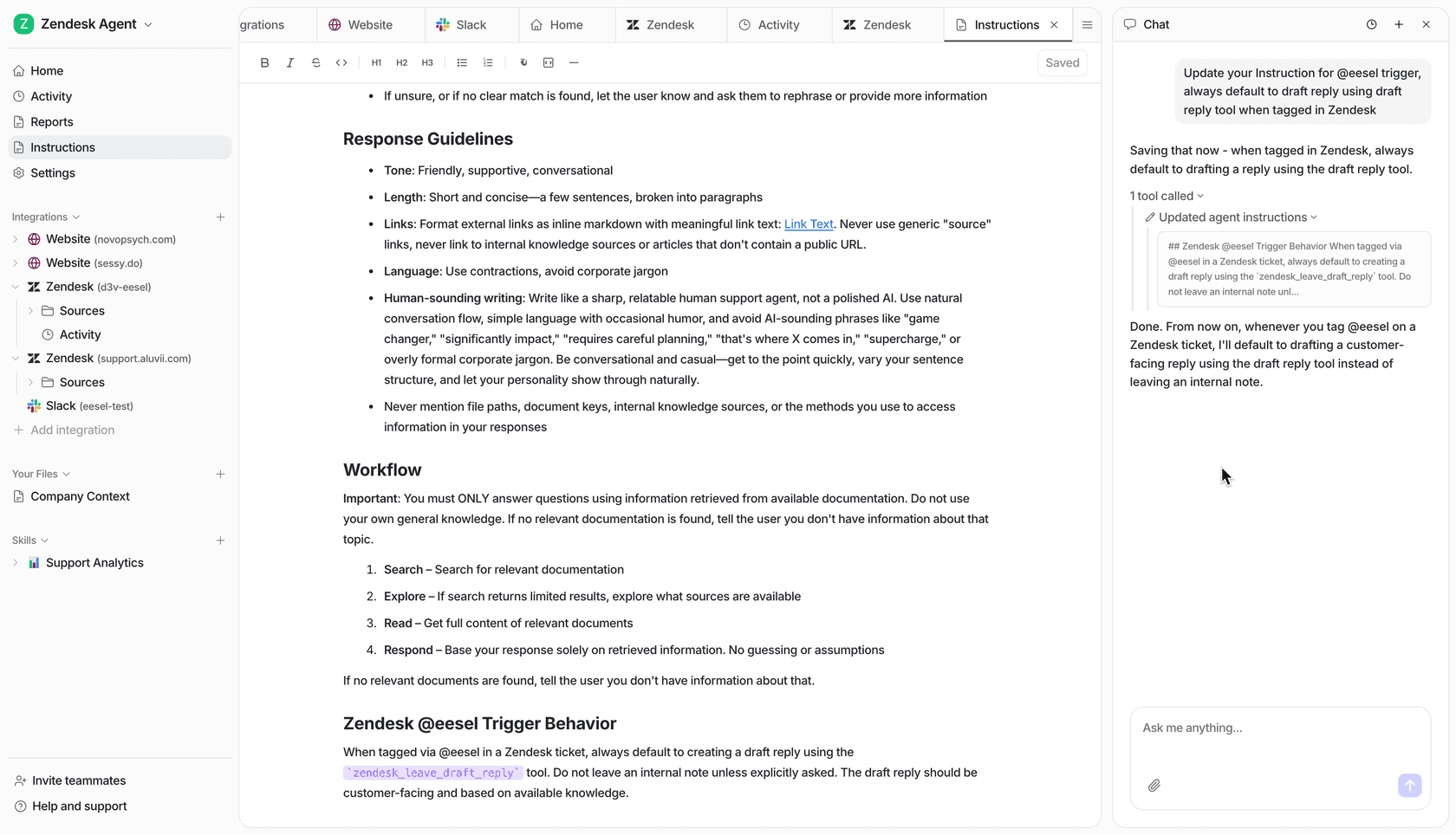
The teammate model vs. tool configuration
Traditional help desks like Zendesk require you to build workflows, set up automations, and configure routing rules. It's powerful but complex.
We take a different approach. You connect eesel to your existing tools (Zendesk, Freshdesk, Slack, your help center, past tickets), and our AI learns your business in minutes, not weeks. It reads your existing documentation, understands your tone from past conversations, and starts helping immediately.
Start with guidance, level up to autonomous
Like any new hire, eesel starts with oversight. You can have it draft replies for review before sending, limit it to specific ticket types, or set business hours when it can respond.
As eesel proves itself, you expand its scope. Teams with mature deployments achieve up to 81% autonomous resolution. The difference is you're not configuring complex workflows. You're simply giving feedback and watching eesel improve.
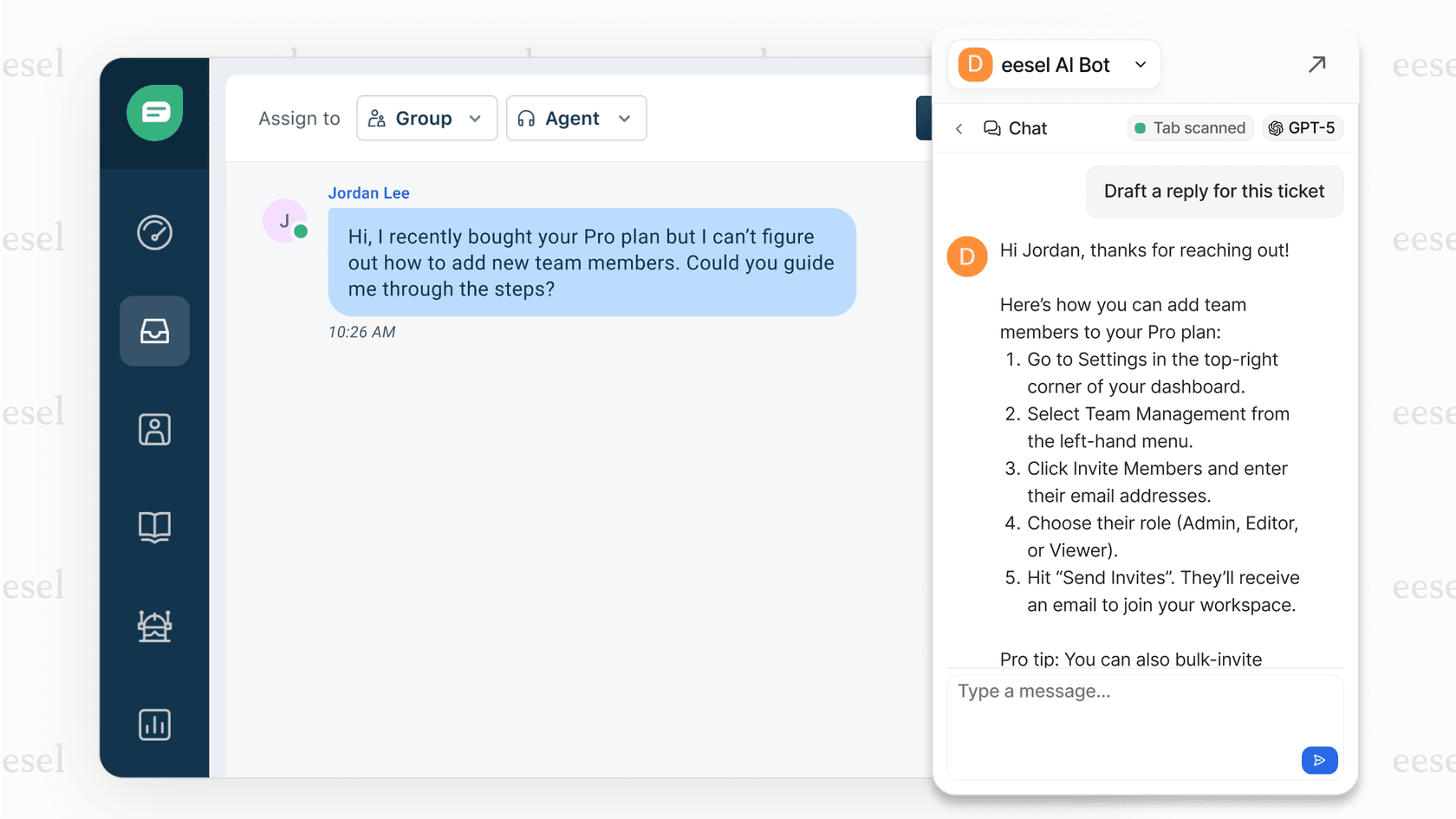
Plain-English instructions
Instead of building complex decision trees, you tell eesel what to do in plain English:
- "If the refund request is over 30 days, politely decline and offer store credit"
- "Always escalate billing disputes to a human"
- "For VIP customers, CC the account manager"
No code. No rigid configurations. Just natural language instructions that eesel follows.
Pay-per-interaction vs. per-agent pricing
Here's where the math gets interesting for growing teams. Zendesk charges per agent regardless of how busy they are. We charge per interaction.
A 10-agent team on Zendesk Professional with basic add-ons might pay $2,000+/month. With eesel AI, you pay for the AI interactions you actually use. No charges for human agents. No paying for seats during slow periods.
Our AI Agent product handles frontline support autonomously. For teams wanting AI assistance without full automation, our AI Copilot drafts replies for human review.
For a detailed comparison of how we stack up against Zendesk's AI features, see our Zendesk AI agent review.
Choosing the right approach for your growing team
So which path makes sense for you?
Zendesk is probably right if:
- You have dedicated operations staff who can manage configuration
- You need extensive customization and complex workflows
- You're already invested in the Zendesk ecosystem
- You want a single platform for all support functions
Consider eesel AI if:
- You want AI-powered support without the configuration overhead
- You prefer a teammate model where the AI learns from feedback
- Predictable costs based on usage (not headcount) matter to you
- You want to start seeing value in days, not months
The honest truth? Many growing teams outgrow basic help desks but aren't ready for Zendesk's complexity and cost. They're looking for something in between: powerful AI that works out of the box, without the enterprise overhead.
For a broader perspective on Zendesk as a platform, our Zendesk review covers the strengths and limitations in detail.
Getting started
If you're evaluating Zendesk for your growing team, start with a clear understanding of your actual needs. Don't pay for Professional features if Team will suffice, but also don't underestimate how quickly you'll need automation as you scale.
Calculate your true costs including add-ons, implementation time, and ongoing administration. The sticker price is rarely what you'll actually pay.
And if you're curious about a different approach, you can try eesel AI free or book a demo to see how the teammate model works in practice. We integrate directly with Zendesk, so you don't have to rip and replace your existing setup to get started.


Frequently Asked Questions
Share this article

Article by
Stevia Putri
Stevia Putri is a marketing generalist at eesel AI, where she helps turn powerful AI tools into stories that resonate. She’s driven by curiosity, clarity, and the human side of technology.