How to manage backorder inquiries in Zendesk: A complete guide

Stevia Putri
Last edited March 3, 2026
Nothing tests a support team's efficiency quite like a flood of backorder inquiries. When customers place orders for items that aren't immediately available, the questions start rolling in. "When will it ship?" "Can I get a refund?" "Do you have something similar in stock?"
For teams using Zendesk, managing these inquiries effectively can mean the difference between frustrated customers and loyal ones who appreciate transparent communication. This guide walks through practical strategies for handling backorder tickets, from setting up automation to creating response templates that actually help customers.
Whether you're dealing with seasonal demand spikes, supply chain delays, or simply managing pre-orders, these approaches will help your team respond faster and more consistently.
What are backorder inquiries and why do they matter?
A backorder inquiry is any customer question related to out-of-stock items they've purchased or want to purchase. These tickets typically involve:
- Requests for restock timelines and shipping estimates
- Questions about order modifications or cancellations
- Complaints about delays or lack of communication
- Requests for alternative products or substitutions
The volume of these inquiries can overwhelm support teams, especially during peak seasons or when supply chain issues hit. But here's the thing: how you handle backorder communication directly impacts customer retention. A customer who receives proactive, honest updates about their delayed order is far more likely to shop with you again than one who has to chase down information.
The challenge for support teams is that backorder questions are repetitive but emotionally charged. Customers are often disappointed or anxious about their purchases. They need accurate information delivered with empathy, and they need it quickly. Without proper systems in place, these tickets can clog your queue and burn out your agents.
Setting up custom fields for backorder tracking
Before you can automate or streamline backorder responses, you need to organize these tickets properly. Zendesk custom ticket fields let you capture specific information about each backorder situation, making it easier to route, prioritize, and report on these inquiries.
Here's a short version of what you should create:
Backorder status (dropdown field)
- Options: Pending, Restocked, Shipped, Cancelled, Refunded
- This lets you track where each backorder stands at a glance
Expected restock date (date field)
- Captures when the item should be available
- Useful for setting customer expectations and prioritizing follow-ups
Product SKU (text field)
- Identifies the specific backordered item
- Helps with reporting on which products generate the most inquiries
Order value (numeric field)
- Captures the dollar amount of the affected order
- Useful for prioritizing high-value customers
To add these fields, navigate to Admin Center > Objects and rules > Tickets > Fields in your Zendesk account. Once created, add them to your ticket forms so agents can fill them in during interactions.
The real power comes from using these fields with automation. When a ticket has the "Backorder status" field set to "Pending" and the "Expected restock date" is within 3 days, you can automatically notify the customer that their item is about to ship. This turns reactive support into proactive communication.
Creating automated responses with Zendesk triggers
Once your fields are set up, it's time to automate the repetitive parts of backorder management. Zendesk triggers are event-based actions that fire automatically when specific conditions are met. Unlike macros, which require agents to manually apply them, triggers work in the background.
Let's break down how to set up a basic backorder acknowledgment trigger:
Conditions:
- Ticket is created
- Subject or description contains "backorder," "out of stock," or "delayed"
Actions:
- Send email to customer with acknowledgment message
- Add "backorder" tag to ticket
- Set priority to "Normal" (or "High" if order value exceeds threshold)
- Assign to your fulfillment or logistics team
You can also create time-based automations for follow-ups. For example, if a backorder ticket has been in "Pending" status for 7 days with no update, automatically send a "we're still working on it" message to the customer. This prevents customers from feeling forgotten.
The "Bump Bump Solve" method works well here too. Set up an automation that sends a gentle reminder to customers who haven't responded to your backorder update after 48 hours. If they still don't respond after the second bump, the ticket can automatically close with a note that you'll reopen it if they reach out.
Backorder response templates for your team
Automation handles the initial acknowledgment, but most backorder situations need a human touch at some point. That's where macros come in. Zendesk macros are pre-written responses that agents can insert with one click, then personalize before sending.
Here are four essential templates every support team should have:
Template 1: Initial backorder acknowledgment
"Thanks for reaching out about your order #[Order Number]. I can confirm that [Product Name] is currently on backorder with an expected restock date of [Date]. We'll ship your order as soon as the item arrives. You'll receive a tracking notification via email once it ships. Is there anything else I can help you with in the meantime?"
Template 2: Restock update notification
"Good news about your order #[Order Number]. [Product Name] is back in stock and your order has been moved to our shipping queue. You should receive tracking information within 24 hours. Thank you for your patience."
Template 3: Alternative product suggestion
"I understand you're waiting for [Product Name], which is currently on backorder until [Date]. While we work on restocking, I wanted to mention [Alternative Product] which has similar features and is available to ship immediately. Would you like me to arrange an exchange, or would you prefer to wait for your original item?"
Template 4: Cancellation and refund confirmation
"I've processed the cancellation for your backordered [Product Name]. Your refund of $[Amount] will appear on your original payment method within 5-7 business days. I'm sorry this item didn't work out. If you have any questions about the refund or want help finding a similar product, just reply to this message."
The key with templates is giving agents room to personalize. Include placeholders for order numbers, product names, and dates, but encourage agents to add a sentence or two that shows they actually read the customer's message.
Integrating inventory data with Zendesk
The biggest friction point in backorder support is often the gap between your help desk and your inventory system. Agents waste time switching between Zendesk and Shopify (or whatever platform you use) to check stock status. Worse, they might give customers outdated information.
Integrating your inventory system with Zendesk solves this. Here are your main options:
- Shopify integration syncs product availability, order status, and inventory levels directly into Zendesk tickets
- WooCommerce connection pulls order and stock data for WordPress-based stores
- Custom API integration for proprietary inventory systems, webhooks can push updates to Zendesk in real time
With proper integration, when a customer emails about their backorder, the agent sees the current stock status, expected restock date, and order history right in the ticket sidebar. No tab switching, no outdated information.
You can also set up webhooks that automatically update ticket fields when inventory status changes. When a backordered product is restocked, all pending tickets for that SKU get updated and customers receive automatic notifications.
Measuring backorder support performance
You can't improve what you don't measure. For backorder management, track these metrics:
| Metric | Why it matters | How to track it |
|---|---|---|
| Backorder ticket volume | Shows demand patterns and problem products | Tag all backorder tickets and run reports |
| Average resolution time | Measures efficiency of your process | Zendesk's native resolution time metric |
| CSAT for backorder tickets | Gauges customer satisfaction with delays | Filter CSAT by backorder tag |
| Cancellation rate after support | Indicates if your communication is working | Track cancellations within 48 hours of ticket closure |
Use Zendesk Explore to build dashboards showing these metrics over time. Look for patterns: are certain products generating more backorder inquiries? Are customers who receive proactive updates less likely to cancel?
This data helps you make business decisions beyond just support. If one product constantly goes on backorder and generates support tickets, maybe it's time to adjust your inventory strategy or find alternative suppliers.
How eesel AI automates backorder responses
Rule-based triggers and macros help, but they have limits. They can't understand context, interpret vague customer messages, or adjust tone based on the situation. That's where AI comes in.
We built eesel AI to handle exactly these kinds of repetitive but nuanced support scenarios. Instead of rigid trigger rules, eesel learns from your past backorder responses and inventory data to understand what customers are asking and respond appropriately.
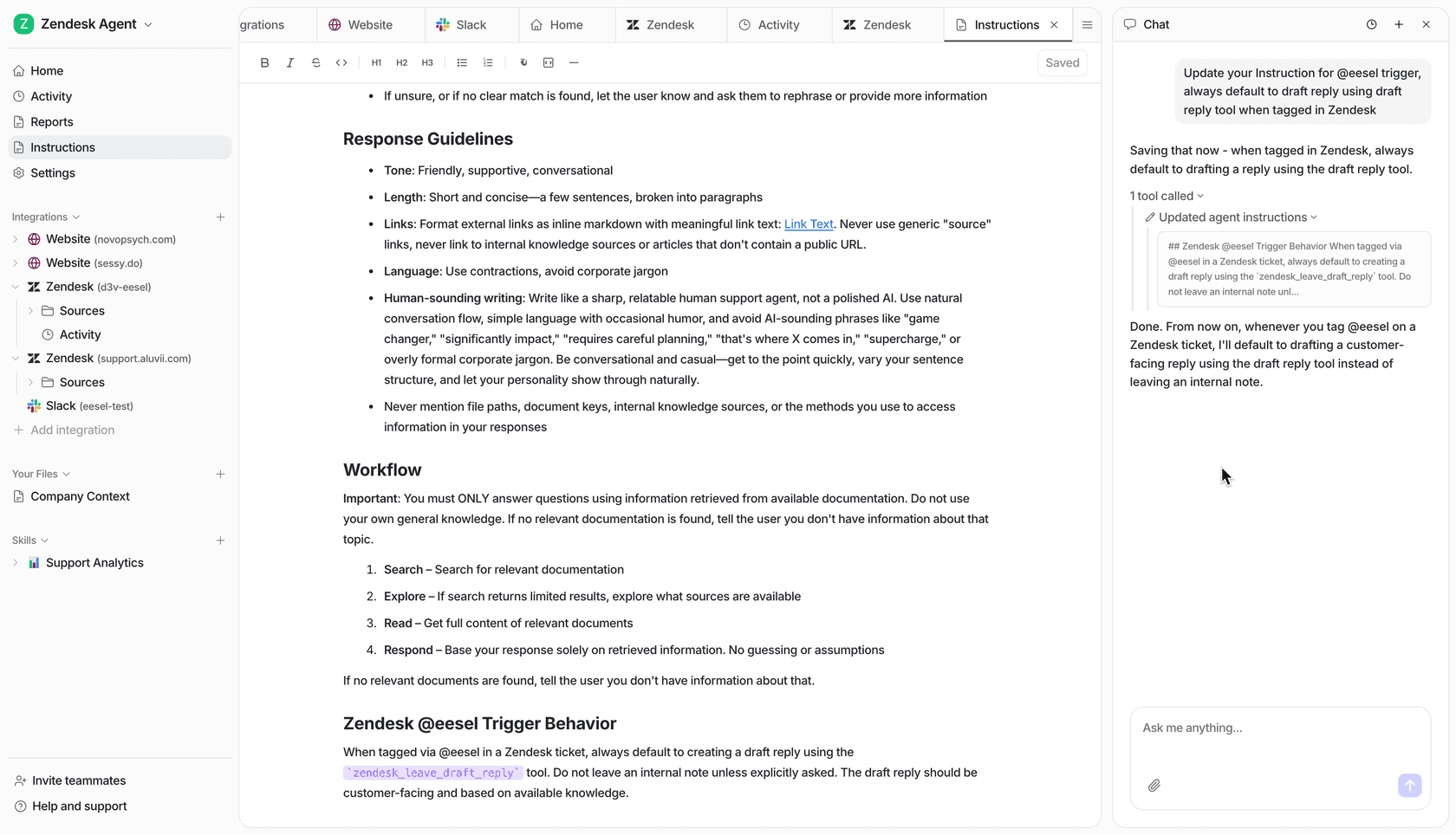
Here's how it works for backorder management:
- Connect eesel to Zendesk the integration takes minutes, not weeks
- Train on historical tickets eesel reads your past backorder responses to learn your tone, policies, and common scenarios
- Connect your inventory system Shopify, WooCommerce, or custom platforms via API
- Configure escalation rules in plain English, tell eesel when to involve a human ("Always escalate orders over $500" or "If the customer mentions legal action, escalate immediately")
Once set up, eesel can handle the routine backorder questions that eat up your team's time. "When will my order ship?" "Is this item in stock?" "Can I cancel my backorder?" These get instant, accurate responses pulled from your inventory data and help center.
The results speak for themselves. Teams using eesel for backorder and general support automation typically see up to 81% autonomous resolution for routine inquiries. That means your human agents can focus on the complex cases that actually need their expertise.
eesel AI integrates with Zendesk alongside your existing triggers and macros. You don't have to rebuild your workflow, just enhance it.
Best practices for backorder communication
Regardless of what tools you use, these principles will improve your backorder support:
-
Be proactive Don't wait for customers to ask. Send updates when status changes, even if the news is "no news yet."
-
Set realistic timelines Under-promise and over-deliver. If you think it'll be 2 weeks, tell them 3. When it arrives early, you look good.
-
Offer alternatives Sometimes customers just want a solution, not a specific product. Have suggestions ready.
-
Provide self-service options An order status portal reduces "where is my order" tickets significantly.
-
Follow up consistently Even if there's no update, check in. Silence feels like being ignored.
-
Document everything Keep records of what you promised. If an agent told a customer "next week," that needs to be in the ticket notes.
Managing Zendesk backorders with the right mix of automation and human touch
Backorder management doesn't have to be a support nightmare. With the right combination of custom fields, triggers, templates, and AI, you can turn a source of customer frustration into an opportunity to build trust.
The key is starting with organization (custom fields), adding automation for the repetitive stuff (triggers and macros), and then layering in AI for the nuanced conversations that don't fit rigid rules.
If your team is drowning in backorder tickets and you're looking for a way to automate without losing the human touch, try eesel AI. We integrate directly with Zendesk and can start learning from your existing responses in minutes, not weeks.
Bottom line? Your customers understand that sometimes items go out of stock. What they won't tolerate is being left in the dark. Give them clear, honest communication and you'll turn backorder situations into loyalty-building moments.


Frequently Asked Questions
Share this article

Article by
Stevia Putri
Stevia Putri is a marketing generalist at eesel AI, where she helps turn powerful AI tools into stories that resonate. She’s driven by curiosity, clarity, and the human side of technology.