Wordtune vs Semrush: Which AI writing assistant is right for you?

Kenneth Pangan

Katelin Teen
Last edited January 19, 2026
Expert Verified

Picking the right AI writing tool can feel a bit like you’re stuck between two very different, very specific choices. You've got tools built for creative flair, some for academic writing, and others that are all about data-driven SEO. It’s easy to get lost when all you really want is something to help you write better and maybe get a few more people to read your work.
On one side, you have Wordtune, an AI assistant focused on helping you refine and rephrase your writing. It’s like having a clever editor on your shoulder, suggesting different ways to make your sentences clearer and more impactful. On the other side is Semrush, a marketing giant with content tools engineered to help you climb the search engine rankings.
So, which one do you go for? Do you need a tool to perfect your writing style or one to boost your performance on Google? The answer really boils down to what you’re trying to achieve.

Alternatively, some tools aim to combine both writing assistance and SEO. For example, the eesel AI blog writer is designed to generate a complete, SEO-ready article from a single keyword, addressing both writing quality and search visibility.
What is Wordtune?
Wordtune is an AI-powered writing assistant and paraphrasing tool that’s all about helping you say what you mean, just better. Think of it less as a content creator and more as a writing partner. Its main job is to take text you've already written and offer different ways to phrase it, helping you find the perfect tone and clarity for your audience.
It’s built to be intuitive, almost like you’re brainstorming with a friend who has a way with words. Here’s a quick look at what it does:
- Rewrite: This is Wordtune's core feature. Highlight any sentence, and it will give you multiple rephrasing suggestions. It's great for those moments when you know what you want to say, but the words aren't quite right.
- Tone Adjustment: Need to go from a casual blog post to a formal report? Wordtune can change the tone of your text with a click, making it sound more professional or conversational.
- Shorten & Expand: If you're trying to hit a word count or just need to be more concise, the "Shorten" feature is a huge help. On the flip side, the "Expand" feature can help you add more detail to a point.
- Summarizer: This is super handy for research. You can feed it articles, PDFs, or even YouTube videos, and it will give you a quick summary of the main points.
- Spices: This is Wordtune’s feature for getting past writer’s block. It can continue your text, add a counterargument, or even drop in a statistical or historical fact to spice up your writing.
What are Semrush's content tools?
Semrush is a whole different animal. It's an all-in-one digital marketing platform used by over a third of Fortune 500 companies. While it covers everything from PPC to social media, we'll focus on its two main content tools: the SEO Writing Assistant (SWA) and the broader Content Toolkit.
Unlike Wordtune, which is about the art of writing, Semrush is all about the science of ranking on search engines. Its main goal is to help you create content that is optimized to perform well. It does this by analyzing competitor data and SERPs, then providing actionable advice to improve your work.
Here are the key features that shape its content creation process:
- Real-time SEO Recommendations: As you write in the SWA, it scores your text based on your target keywords. It gives you specific, live suggestions to improve SEO, readability, and tone of voice.
- Originality Checker: A built-in plagiarism checker ensures that your text is unique, which is a big deal for SEO.
- Topic Finder & SEO Brief Generator: Before you even start writing, these tools help you find content ideas based on what people are searching for. The brief generator then creates a detailed outline with target keywords and other SEO guidelines based on top-ranking pages.
- AI Article Generator: Semrush can now generate a full draft based on the brief you create, making sure the content is aligned with SEO best practices from the start.
Feature comparison: Wordtune vs Semrush
Now that we have a general idea of what each tool does, let's compare them side-by-side in a few key areas. The table below and the following infographic break down the key differences.
Core writing capabilities
Wordtune is the clear winner here. Its strength lies in improving your writing at the sentence and paragraph level. The AI is great at offering creative alternatives that genuinely improve the flow and impact of your text. It's a tool for writers who have the ideas but want to polish the delivery.
Semrush, on the other hand, is more prescriptive. The "Rephraser" in its SEO Writing Assistant is focused on hitting SEO targets. It might suggest simplifying a sentence to improve your readability score or tweaking it to include a keyword. It’s less about creative expression and more about checking SEO boxes.
SEO and content strategy
This one is pretty straightforward. Wordtune has no native SEO features. It’s purely a writing enhancement tool. It won't help you with keyword research or strategic planning. You use it after you’ve already decided what to write about.
Semrush is the complete opposite. SEO and content strategy are its bread and butter. The Content Toolkit is built for the planning phase, with a Topic Finder for ideas and an SEO Brief Generator to structure your content based on what’s already ranking on Google. The SWA then helps you stick to that strategy as you write.
Workflow and integrations
Wordtune is all about being simple. It has a clean editor and handy browser extensions that work across platforms like Google Docs and Gmail. The workflow is easy to pick up, so anyone can start using it right away.
Semrush is a feature within a much larger platform. While it offers add-ons for Google Docs, WordPress, and MS Word, the overall system can be a lot for someone who just needs a bit of writing help. It’s a powerful suite, but it has a steeper learning curve.
Full content generation
Wordtune’s "Spices" feature can "continue writing" from your last sentence, which is great for breaking through a mental block. However, it's not designed to generate a full, long-form article from scratch.
Semrush has a dedicated AI Article Generator in its Content Toolkit. This tool can create entire drafts based on your SEO brief, ensuring the output is structured for search performance from the beginning.
| Feature | Wordtune | Semrush (Content Tools) |
|---|---|---|
| Primary Goal | Improve writing clarity, style, and tone | Optimize content to rank in search engines |
| Core Function | Stylistic rewriting and rephrasing | Data-driven SEO recommendations |
| SEO Tools | None | Comprehensive (Topic Finder, SWA, Briefs) |
| Content Generation | Can expand on ideas ("Spices") | Full drafts from AI Article Generator |
| Ideal User | Writers, students, professionals polishing text | SEO specialists, content marketers, agencies |
| User Interface | Simple editor and browser extensions | Part of a complex, data-heavy marketing platform |
| Pricing Model | Affordable, with a free plan for limited use | Premium subscription for toolkits or full platform |
Pricing comparison
The pricing for these two tools reflects their very different purposes. Wordtune is priced as a focused utility, while Semrush is an investment in a full business platform.
Wordtune pricing
Wordtune is designed to be accessible for individuals.
- Basic Plan: Free. This gives you 10 rewrites per day, which is fine for casual use or just trying it out.
- Premium Plans: The Unlimited plan starts at $6.99 per month (billed annually). This unlocks unlimited use of all its features, making it an affordable tool for students and writers who need consistent help.
Semrush pricing
Semrush's writing tools are part of its larger subscription models, which are aimed at businesses and marketing pros.
- Content Toolkit: You can get this as a standalone plan for $60 per month. This gives you access to the AI Article Generator, Topic Finder, and SEO Brief Generator.
- SEO Writing Assistant (SWA): This is included in the main Semrush platform subscriptions. To give you an idea, the Pro+ plan starts at $248.17 per month when billed annually.
The takeaway is pretty clear: Semrush is a serious business investment. It’s priced for teams focused on driving organic traffic, not for an individual looking to clean up their emails.
Who should use Wordtune vs Semrush?
So, after all that, who should use which tool? Let’s break it down.
When to choose Wordtune
Ideal for: Students, academics, non-native English speakers, and professional writers. Basically, anyone who wants to polish their drafts and experiment with phrasing. If the final quality of your writing is what matters most, Wordtune is a great partner.
Limitations: It’s a tool for after you've written a draft, not before. It won't help you decide what to write about, which keywords to target, or how to structure your post to rank on Google. You bring the ideas; it helps you refine them.
When to choose Semrush
Ideal for: SEO-focused content teams, digital marketing agencies, and any business that relies on organic search for growth. It’s for users who need a data-driven workflow to create content that performs well in search results.
Limitations: It's overkill (and way too expensive) for individual writers or anyone not focused on SEO. Its data-first approach can sometimes feel like it's stifling creativity by prioritizing keywords over flow.
An alternative for end-to-end content creation: eesel AI blog writer
For users looking for a single tool that handles the entire workflow, from keyword to a publish-ready blog post, other options are available. The eesel AI blog writer is designed to generate complete articles that are both well-written and optimized for search engines.
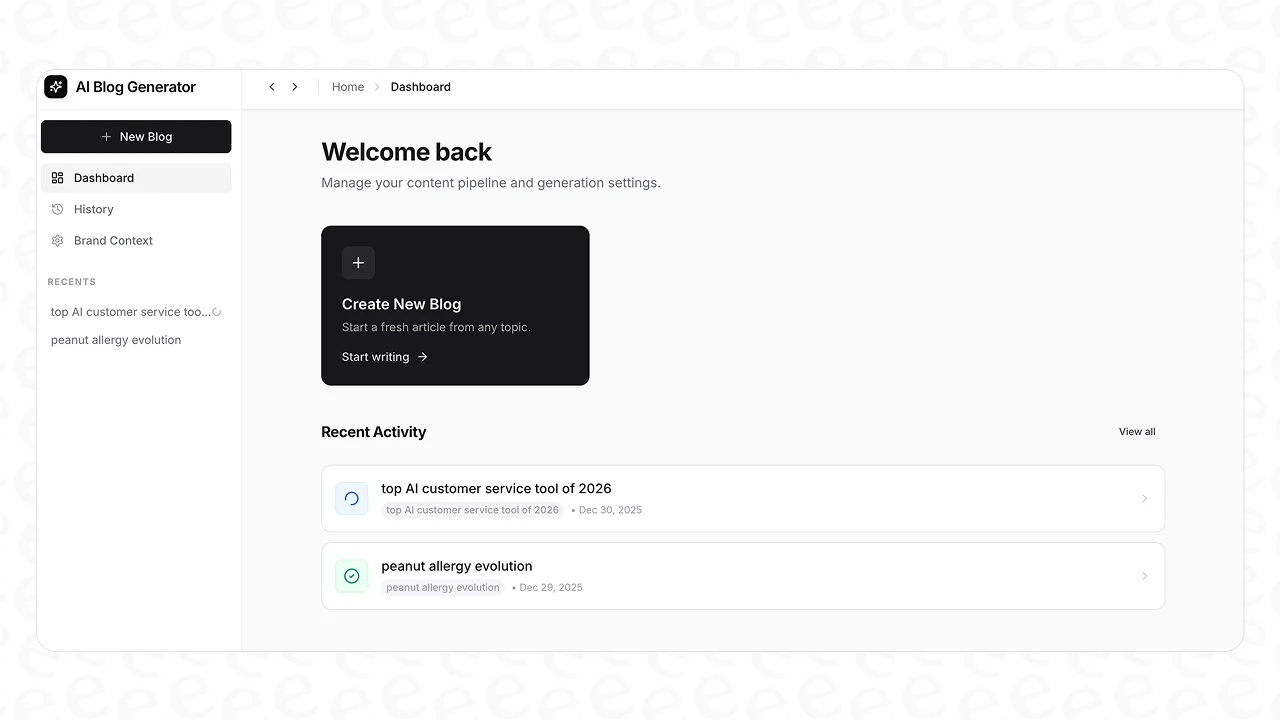
Instead of just refining sentences or checking SEO boxes, it generates a complete content package. Here's what makes it different:
- It generates more than just text: You don't just get a wall of words. The eesel AI blog writer produces a fully structured article with AI-generated images, infographics, and data tables to break up the text.
- It integrates social and video proof: To build trust, it automatically embeds relevant Reddit quotes and YouTube videos into the post. This adds real-world Experience and makes your content more engaging.
- It combines SEO and AEO: The content isn't just optimized for traditional search engines. It's also structured for AI Answer Engines like Google AI Overviews and Perplexity, getting your content ready for the future of search.
- As an example of its application, this tool was used to grow the eesel AI blog from 700 to 750,000 daily impressions in three months by publishing over 1,000 optimized posts.
It is free to try, allowing you to generate a full blog post to evaluate its quality.
For more context on the wide range of AI tools available for content and marketing, the video below offers a broad overview of the current landscape.
This video discusses various AI tools for content creation, providing context for the Wordtune vs Semrush comparison.
Wordtune vs Semrush: Which is right for you?
At the end of the day, Wordtune and Semrush are both great tools, but they solve different problems for different people.
Choose Wordtune if your main goal is to refine your words, perfect your style, and make every sentence as clear as possible. It’s a writer’s tool, plain and simple.
Choose Semrush if you’re building a content strategy where every article is a calculated move to capture search traffic. It’s a marketer’s tool, designed for performance.
For those who need a solution that combines high-quality content generation and SEO performance without using multiple tools, an alternative like the eesel AI blog writer may be a good fit. It is designed to handle the entire process, allowing users to focus on publishing.
You can generate a complete blog post for free to see how it works.
Frequently Asked Questions

Share this post
Article by
Kenneth Pangan
Writer and marketer for over ten years, Kenneth Pangan splits his time between history, politics, and art with plenty of interruptions from his dogs demanding attention.