What is an on-page SEO score and why does it matter?

Katelin Teen
Katelin Teen
Last edited February 1, 2026
Ever hit "publish" on a blog post and then just wait? You've done the keyword research, written the content, and found a decent image. But is it actually optimized to show up in search results? That little seed of doubt can be a real pain.
This is where the on-page SEO score comes into play. Think of it as a report card for your webpage, giving you a quick look at its health and how ready it is to rank.
What is an on-page SEO score?
An on-page SEO score is a single number that SEO audit tools use to show how well a webpage is following search engine best practices. For instance, Semrush's Site Audit tool provides a "Site Health" score that serves as a great benchmark for your overall on-page optimization.
Semrush's On Page SEO Checker provides optimization ideas for improving webpage rankings. While Semrush is not 100% accurate, it is widely considered a valuable guide for SEO strategies.

Here's a key thing to remember: this score is a diagnostic tool, not a direct ranking factor that Google uses. Nailing a 100/100 score won't magically send you to the top of the search results. However, a high score is a very strong signal that you're doing the right things: the kind of things that Google and other search engines tend to reward.
Most tools use a 0-100 scale, which you can generally interpret like this:
- 90–100 (Good): Your page is looking solid.
- 50–89 (Needs Improvement): There are a few issues holding you back that are worth investigating.
- 0–49 (Poor): Your page has some significant problems that are likely hurting its chances to rank.
Getting into that green "Good" zone is the best way to ensure technical glitches aren't undermining your content.
How tools calculate the on-page SEO score
There's no single, universal formula for this. Every tool has its own proprietary method. But the general approach is pretty consistent: they start you with a perfect score (like 100) and then deduct points for every issue they find.
Components of the score calculation
This penalty-based system is easy to understand. The more serious the problem, the more points you lose. Most tools, Semrush included, sort these issues into three categories.
-
Errors: These are the major red flags that can seriously harm your search engine performance and create a poor user experience. Examples include broken internal links leading to 404 pages, duplicate content appearing on multiple pages, or pointing to the wrong pages in your sitemap.xml file.
-
Warnings: These are less severe but still important. They won't sink your site overnight, but they are holding your page back from its full potential. This could be things like images missing descriptive alt text, using temporary (302) redirects instead of permanent (301) ones, or having title tags that are too long (over 60 characters) or too short.
-
Notices: These are the minor issues. Think of them as suggestions for extra polish. They don't have a big effect on your score, but they're still good practices to adopt.
An infographic explaining what is on-page SEO score, showing how errors, warnings, and notices deduct points from a starting score of 100.
Here’s a simple table to illustrate how it works:
| Starting Score | Issue Found | Severity | Penalty | New Score |
|---|---|---|---|---|
| 100 | Duplicate content | Error | -8 | 92 |
| 92 | Image missing alt text | Warning | -3 | 89 |
| 89 | Title tag too long | Warning | -3 | 86 |
Key factors that influence the on-page SEO score
A good on-page SEO audit checks dozens of signals. To keep it simple, we can group them into three main areas: technical, content, and user experience.
Technical factors
This covers all the behind-the-scenes work that helps search engines discover, crawl, and make sense of your page.
- Core Web Vitals: These are specific metrics Google uses to measure a page's user experience. To get a passing grade, you need to hit the "good" threshold for all three. According to Google, those thresholds are:
- Largest Contentful Paint (LCP): How fast does the main content appear? Aim for 2.5 seconds or less.
- Cumulative Layout Shift (CLS): Does the page layout shift around as it loads? This score should be 0.1 or less.
- Interaction to Next Paint (INP): How quickly does the page react when a user clicks something? This should be 200 milliseconds or less.
A visual guide explaining the Core Web Vitals (LCP, CLS, INP) and their target metrics, which helps answer what is on-page SEO score.
- Mobile-Friendliness: Your site has to look good and function smoothly on a smartphone. Google uses the mobile version of your site for indexing, so this is non-negotiable.
- Security & Indexability: This involves having HTTPS for security, using clean URLs, and correctly setting up your "robots.txt" and "canonical" tags so search engine crawlers know what to do.
Content factors
This is all about the words, images, and overall structure of your page.
- Content Quality: Your content must be original, genuinely helpful, and provide a real answer to the user's search query. Having duplicate content is a major error that will pull your score down.
- Keyword Optimization: Are you using your target keyword in the right spots? It should show up naturally in your URL, title tag, meta description, and your main H1 heading. The goal is to make it sound human, not robotic.
- Meta Content: Your title tag and meta description act as an ad for your page in the search results. A compelling one encourages clicks. Duplicate titles and descriptions on different pages are a common warning.
- Content Structure: A logical heading structure (one H1, then H2s and H3s) makes your content easier for both people and search engines to digest.
User experience (UX) factors
This is all about making your page easy and pleasant for a person to navigate.
- Internal Linking: Linking to other relevant pages on your website helps users discover more information and helps search engines understand the relationships between your content. Broken internal links are a significant error.
- Image Optimization: Every image needs descriptive alt text. This assists visually impaired users and gives search engines context. Also, compress your images so they don't slow your page down.
- Readability: Is your content easy to follow? Some tools even score this. Using simple language, short sentences, and concise paragraphs helps keep readers engaged, which is a positive signal for Google.
Here’s a quick summary of where to focus your efforts:
| Factor | Impact on Score | What to Do |
|---|---|---|
| Core Web Vitals | High | Ensure LCP is <2.5s, CLS is <0.1, and INP is <200ms. |
| Duplicate Content | High | Use canonical tags or 301 redirects to consolidate pages. |
| Title Tag Optimization | High | Include target keyword and keep it under 60 characters. |
| Internal Links | Medium | Add contextual links to other relevant pages and fix broken ones. |
| Image Alt Text | Low | Add descriptive text to all important images for context. |
How to improve your on-page SEO score
Alright, you get the factors. So what's next? Here’s a straightforward process to start improving your score.
Start with a comprehensive audit
You can't fix a problem you don't know you have. Use a tool like Semrush's Site Audit or Google's PageSpeed Insights to get a baseline score and a list of action items.
The trick is to prioritize. Always tackle the critical Errors first. Fixing those will give you the most significant improvement. Once they're handled, you can move on to the Warnings and then the Notices.
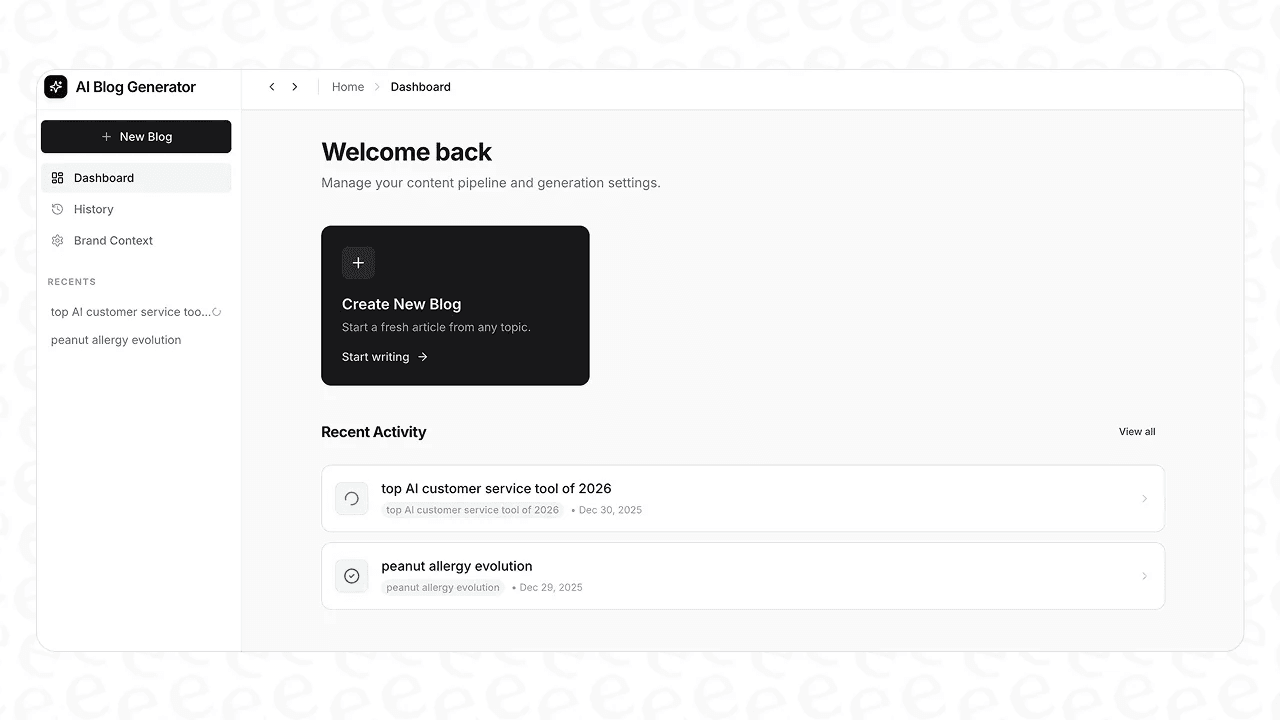
Generate optimized content from the start
For example, at eesel, this platform was used to grow daily search impressions from 700 to 750,000 in just three months by publishing over 1,000 optimized articles. You can generate your first blog post for free to see how it works.
Beyond the score: Focusing on what truly matters
It’s easy to get fixated on hitting that 100/100, but don't forget it's not the end goal. You can have a technically perfect page that still flops because the content is dull, unhelpful, or doesn't align with what the user was actually looking for.
Calling this tool an SEO audit tool is dangerous. It gives some information, but is no replacement for tools such as Screaming Frog or DeepCrawl.
The on-page SEO score is a guide. It's a great tool for finding and fixing the technical hurdles that keep your great content from being seen.
Your main focus should always be the person reading your page. The score just helps you make sure their experience is as seamless as possible.
For a more visual guide on how to put these principles into practice, this step-by-step video walks through the key elements of on-page SEO.
So, what is an on-page SEO score? It’s a handy diagnostic metric that shows you how well your page is set up for search engines. It's calculated based on a wide array of technical, content, and user experience factors, and you can improve it by running an audit and methodically fixing the issues it uncovers.
But at the end of the day, the score is just a means to an end. The real objective is to create a fantastic user experience that search engines will naturally want to reward with higher rankings.
Instead of only fixing scores after content is live, you can focus on publishing content that’s built to rank from day one. Try the eesel AI blog writer for free and see how this approach works.

Frequently Asked Questions
Share this article

Article by
Katelin Teen
Katelin is an operations specialist at eesel where she uses her psychology training and education experience to optimize B2B SaaS processes. Outside of work, she unwinds with story-driven games, writing, and keeping up with latest tech innovations.