What is AI copywriting? A practical guide for content teams

Kenneth Pangan
Written by

Kenneth Pangan

Reviewed by

Stanley Nicholas

Last edited January 12, 2026

Expert Verified

Image alt text

AI copywriting has gone from a niche idea to a standard tool in many marketing and content workflows. The main draw is obvious: it can write content much faster and on a larger scale than ever before. With a few clicks, you can get drafts for blog posts, social media updates, and ad campaigns.

But speed brings its own problems. Many teams worry about quality, originality, and the risk of factual errors. How do you create more content without sounding like a robot? And how do you make sure what the AI writes is actually correct?

This guide will give you a balanced and practical look at what AI copywriting is, how it works, and how to use it as a powerful tool, not just a replacement for human strategy. Modern tools are now solving these issues by moving beyond simple text to produce complete, publish-ready articles. It’s an approach that helped our team at eesel AI grow from 700 to 750,000 daily impressions in just three months by creating high-quality content that people find genuinely helpful.

What is AI copywriting?

AI copywriting is simply using artificial intelligence tools, mainly large language models (LLMs), to generate written content for marketing. This can be anything from short social media posts and ad copy to detailed product descriptions and long-form blog articles.

It’s important to know that AI doesn't "write" with original thoughts. It's more like a very sophisticated autocomplete. These models are trained on huge amounts of text from the internet, and they work by predicting the next word in a sentence based on the patterns they’ve learned. As researchers at MIT have pointed out, the AI’s logic is based on statistics, not on understanding the meaning behind the words.

Reddit
These AI aren't truth-detectors, they are predictors of likely certain words in certain structures are to be used, regardless of whether those words are true or even actually make sense semantically.

The goal is to produce text that sounds human in response to a prompt. When it works well, the result can be hard to tell apart from something a person wrote. The trick is guiding it to produce content that is not only coherent but also accurate, original, and on-brand.

How does AI copywriting work?

If you dig a bit deeper, most AI copywriting tools are built on Large Language Models (LLMs). You’ve probably heard of the big ones, like the GPT models from OpenAI.

Here’s a simple breakdown of how it works:

  • Training Data: These models learn grammar, style, facts, and even biases by analyzing billions of text examples from the internet, like books, articles, and websites. This massive dataset helps them recognize patterns and write like a human.
  • The Process: For you, the user, it’s pretty simple. You give it a request, and the AI generates a response.

Here’s what that looks like in practice:

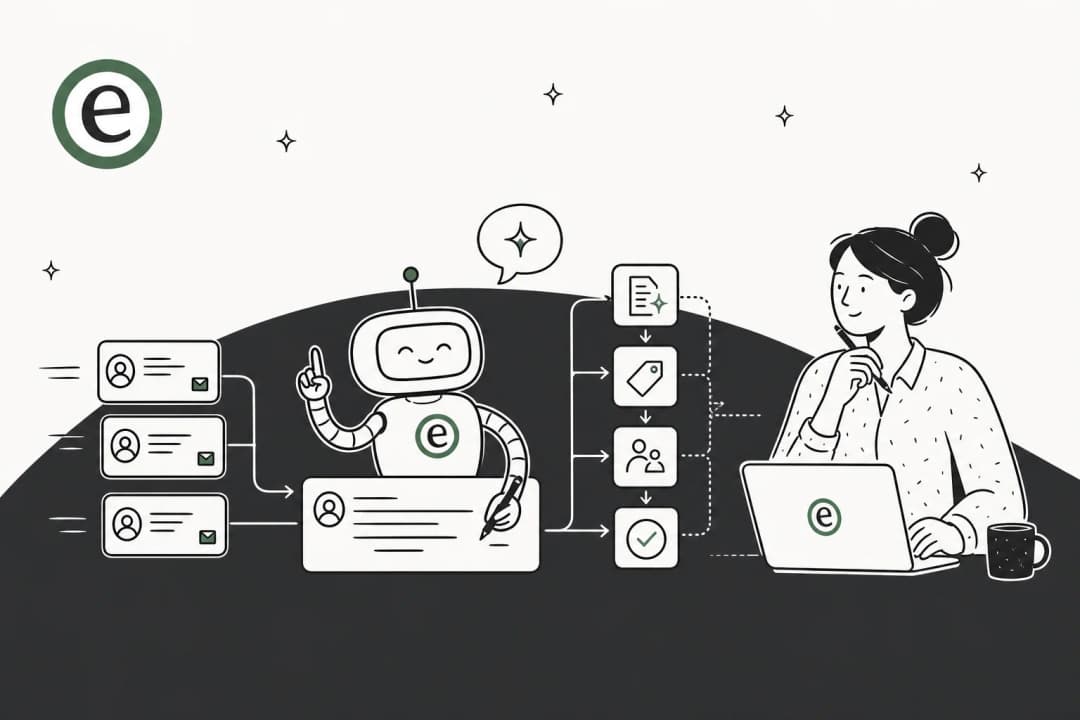
An infographic flowchart explaining the AI copywriting process, from user prompt to generated text.

The most important part of this whole process is your prompt. The quality of what you get out is directly tied to the quality of what you put in. You’ve likely heard the phrase "garbage in, garbage out." A vague prompt like "write a blog post about marketing" will get you a generic, useless result.

Reddit
Seriously most ppl think AI is a magic box that makes perfect shit but if you don’t know how to correctly prompt and use the AI your shit will be mediocre at best

A good prompt, however, gives clear context. It should specify the tone of voice (e.g., professional, witty), the target audience (e.g., small business owners), and the structure of the content you need. The more detail you give, the better the AI can understand what you want and generate something relevant.

Common uses for AI copywriting

AI copywriting tools are most valuable when you use them for the right tasks. They’re great for structured, repetitive, or high-volume content, while strategic and creative work still needs a human in charge.

Think of it on a spectrum. On one end are tasks perfect for automation. On the other is work that really needs a human touch. Here are some of the most common ways people use AI copywriting today:

Use CaseDescriptionWhere it Shines
Brainstorming & IdeationGenerating dozens of blog titles, ad headlines, or campaign angles from a single topic.Quickly getting past writer's block and exploring creative ideas you might not have thought of.
First DraftsCreating a rough version of a blog post or article based on an outline.Getting words on the page quickly, giving a human writer a solid base to refine and fact-check.
Product DescriptionsGenerating unique descriptions for hundreds or thousands of e-commerce products.Scaling repetitive work while keeping a consistent tone and including key features.
Ad Copy VariationsCreating multiple versions of headlines and body text for A/B testing on platforms like Google or Facebook.Producing the high volume of content needed for performance testing without doing it all by hand.
Repurposing ContentTurning a long blog post into a series of social media updates, an email newsletter, or a video script.Getting more value out of existing content by efficiently adapting it for different channels.

For brainstorming, an AI can be a great creative partner. Instead of staring at a blank page, you can get 20 different headlines in 10 seconds and pick the one that works. For first drafts, the goal isn't a perfect article, but a structured starting point that saves hours of writing time.

Similarly, for ad copy, the value is in volume. An AI can generate 50 headline variations for A/B testing way faster than a person can, letting you test more ideas and find what works. And for repurposing, AI makes it easy to take a 2,000-word article and pull out key points for a Twitter thread or LinkedIn post.

Reddit
I also ask it to write me an outline or description. I often don't follow the outline but it provides good points to cover sometimes.

The pros and cons of AI copywriting

Like any tool, AI copywriting has its strengths and weaknesses. Knowing them helps you use the technology well and avoid common issues.

The pros: What AI does well

  • Speed and scale: This is the biggest one. AI tools can generate text in seconds, letting teams produce content at a volume that’s impossible for human writers alone. This is huge for tasks like creating thousands of unique product descriptions or filling a new website with content.
  • Overcoming writer's block: AI can be a great brainstorming partner. When you're stuck, you can use it to generate outlines or headlines to get things moving. It gives you a starting point to build on with your own expertise.
  • Cost efficiency: For basic, high-volume writing that doesn't need deep expertise, an AI tool can be cheaper than hiring more writers. It helps smaller teams do more with less and compete on content volume.

The cons: Common limitations of AI copywriting

While the benefits are clear, the limitations are what separate mediocre AI content from high-quality work that gets results. Most standard AI writers have the same problems.

  • It lacks originality and sounds generic: Because AI models are trained on existing internet content, they often just rehash common phrases and ideas. The result is often bland, forgettable content, sometimes called "AI slop", that doesn't stand out or offer anything new.
  • It struggles with human emotion and brand voice: AI can't fake genuine emotion, humor, or irony. These are the things that connect with readers and make copy persuasive. It also has a hard time capturing a unique brand voice without a lot of manual prompting for every piece of content, which kind of defeats the purpose of using it for speed.
  • It's prone to inaccuracies and "hallucinations": This is one of the biggest risks. AI models can confidently state wrong information or even make up sources and stats. This is known as "hallucination," and it means every fact from an AI has to be carefully checked by a human.
    Reddit
    You're grossly overestimating AIs ability to recall facts. You should never use ai for factual information, only abstract bigger picture things. It will fail you when asked for specifics.
  • It produces text, not a complete article: Most AI copywriters just give you a wall of text. You're still responsible for everything else that makes a great blog post: finding images, designing infographics, building data tables, and sourcing social proof like real user quotes. That’s a lot of work that a simple text generator doesn't solve.

Overcoming the limitations of AI copywriting

The limitations of most AI tools are why many content teams get frustrated. They promise speed but often create more editing work, leaving you with generic text that still needs a ton of effort to become a finished piece.

But the next generation of AI platforms is designed to solve these exact problems. They offer a better workflow by focusing on producing complete, high-quality content, not just text.

From text generation to complete articles with eesel AI

The eesel AI blog writer was built to tackle the common problems of AI content generation. It goes beyond simple text drafts to create a complete, SEO-optimized, and human-sounding blog post from a single keyword.

A screenshot of the eesel AI blog writer dashboard, a tool that helps users understand what AI copywriting can produce.

Here’s how it directly addresses the common challenges:

  • Context-aware research: Instead of just rewriting what's already out there, eesel AI does context-aware research. For a comparison post, it pulls pricing and feature data. For a product review, it finds technical specs. This makes the content valuable, specific, and unique.
  • Genuinely human tone: The output has been refined over a year to have a genuinely human tone. It avoids the generic phrasing and robotic sentences that make "AI slop" so easy to spot.
  • Complete assets: The platform automatically generates complete assets to go with the text, including AI-generated images, data tables, and infographics. It also integrates real Reddit quotes and YouTube videos to add authenticity and social proof.
  • Answer Engine Optimization (AEO): Beyond standard SEO, it optimizes content for AEO. This prepares your content to be cited as a source by platforms like Google’s AI Overviews, making sure it stays visible as search changes.

AI as a partner, not a replacement

AI copywriting is a powerful technology that’s here to stay. It offers huge advantages in speed and scale, but it’s not a magic button for creating great content. The best approach is a partnership between a smart human and a capable AI. The human brings the strategy, expertise, and final polish, while the AI handles the heavy lifting of research, drafting, and asset creation.

Reddit
Smart human + AI > smart human

But the quality of your AI partner matters a lot. While basic generators give you rough drafts that need heavy editing, advanced platforms are designed to deliver nearly publishable content that solves the most common AI problems from the start. By handling research, tone, and asset creation, these tools free you up to focus on strategy and growth, not just editing.

To understand this better, it helps to see how experts are framing the conversation. The following video explains why the combination of a skilled copywriter and a powerful AI tool is the perfect combination for success.

A video explaining what AI copywriting is and how it can be used as a tool to enhance, not replace, human writers.

The best way to see the difference is to try it yourself.

Ready to see what high-quality AI copywriting looks like? Generate your first complete blog post for free with the eesel AI blog writer.

Frequently Asked Questions

AI copywriting is the use of AI tools to generate written content like blog posts, ads, or product descriptions. For a small business, it's a [practical way to produce more content](https://digitalmarketinginstitute.com/blog/using-ai-tools-for-copywriting) faster and at a lower cost than hiring a large team, helping you improve your online presence and SEO without a huge budget.
Yes, generally. Tools like ChatGPT are based on large language models (LLMs), which are the core technology behind most AI copywriting platforms. However, specialized tools like the eesel AI blog writer are built specifically for [content creation](https://www.eesel.ai/blog/ai-tools-for-content-marketing) and include features like SEO optimization, research, and asset generation that general-purpose chatbots don't.
The biggest weakness is its tendency to produce generic, unoriginal content that just rehashes information already on the internet. This ["AI slop"](https://www.reddit.com/r/Blogging/comments/1cj0fmc/dont_use_ai_to_copy_paste_mindlessly_use_it_as_a/) often lacks unique insights and can struggle to rank well because it doesn't provide new value to the reader. It also risks factual inaccuracies that can harm your site's credibility.
The easiest way to start is with a user-friendly tool. Begin with simple, structured tasks like generating headlines or product descriptions to get a feel for how it works. Focus on writing clear, detailed prompts-the more context you provide about your audience, tone, and goal, the better your results will be.
Not for high-quality, strategic content. AI is best seen as a partner or a tool that assists human writers. It can handle the heavy lifting of drafting and research, but it still requires [human oversight for fact-checking](https://www.chillistore.com/blog/5-cautions-on-the-limitations-of-using-ai-copywriting-tools/), strategic direction, capturing a unique brand voice, and adding genuine creativity.
Without careful guidance, AI can dilute your brand voice and produce unoriginal content. Because it learns from a vast dataset of existing text, its default output is often [average and generic](https://www.reddit.com/r/copywriting/comments/1k9tkoi/someone_finally_said_the_real_truth_about/). Maintaining a unique voice requires providing very specific instructions in your prompts or using advanced platforms that can learn and adapt to your brand style.

Share this post

Kenneth undefined

Article by

Kenneth Pangan

Writer and marketer for over ten years, Kenneth Pangan splits his time between history, politics, and art with plenty of interruptions from his dogs demanding attention.