
If you’ve ever stared at a surprisingly high Amazon Redshift bill and wondered where it all went wrong, I feel your pain. Many teams jump on Redshift because it’s powerful, but soon find themselves wrestling with costs that creep up, performance that slows down, and a whole lot of complexity. It can feel like you need a dedicated crew just to keep the thing running.
That feeling sent me looking for a better way. I wanted to find the best Redshift alternatives, but I wasn't just looking for a carbon copy. My goal was to find the right tool for the job. Sometimes that means a more modern data warehouse. And sometimes, as I found out, the best alternative isn't a data warehouse at all.
Here’s a breakdown of what I found, with a straightforward look at their good sides, their bad sides, how much they cost, and who they’re really for.
What is Amazon Redshift?
First, let's make sure we're on the same page. Amazon Redshift is AWS's cloud data warehouse service. It’s built to handle absolutely massive, petabyte-scale data storage and analytics, which is why it’s so popular with large companies.
Under the hood, Redshift is based on PostgreSQL, so it feels familiar to a lot of developers and data analysts. It uses a clever trick called columnar storage, which makes queries on huge datasets really fast because it only has to read the specific columns you ask for.
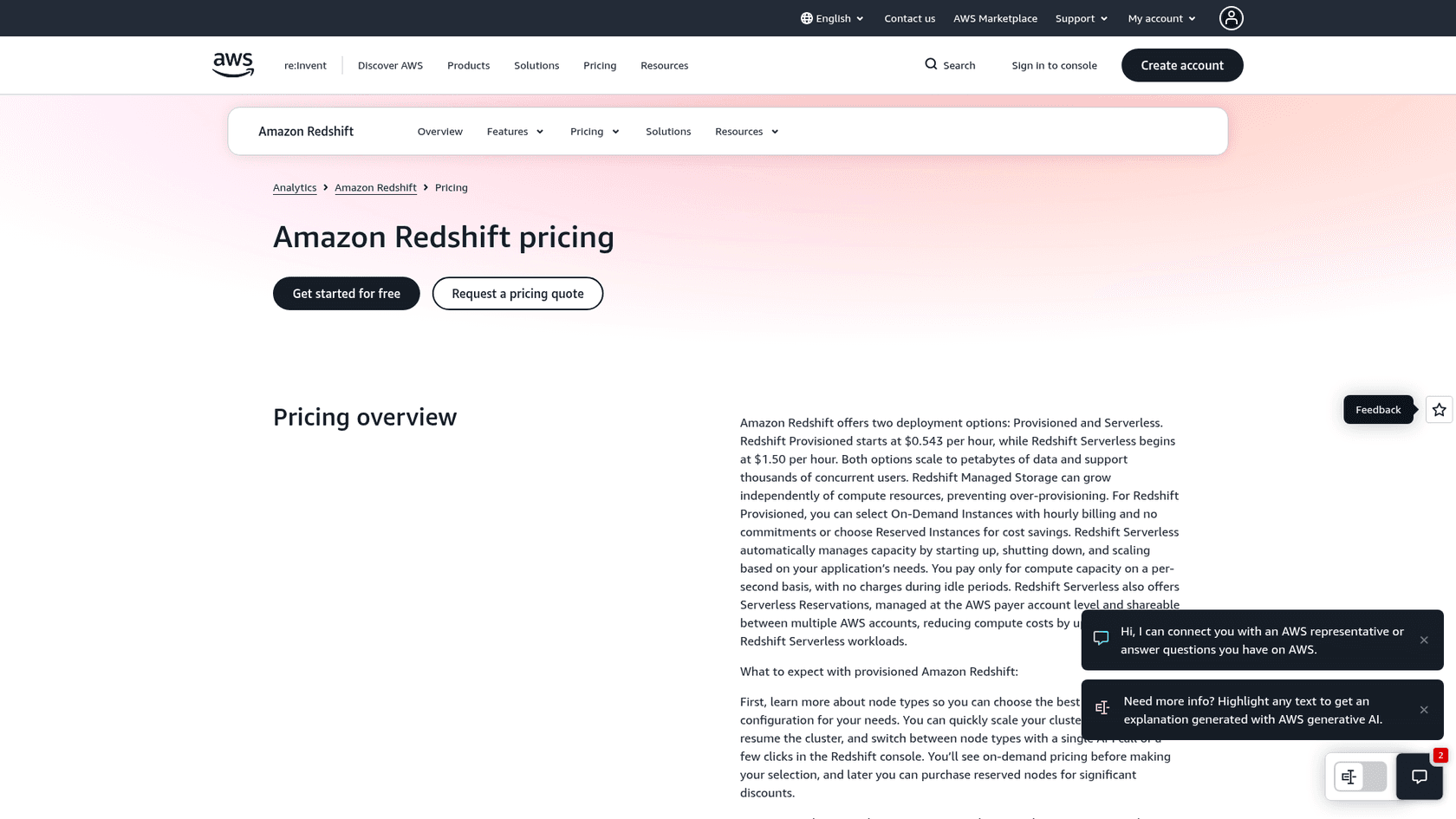
Its classic setup is “provisioned,” meaning you choose and set up clusters of servers (called nodes), which gives you a ton of control but also a ton of responsibility. AWS now also offers Redshift Serverless, billed per second with no charge while idle. Most people use it for things like feeding business intelligence (BI) dashboards, running complex analytics reports, and digging through mountains of log data to find patterns.
Why even look for Redshift alternatives?
Look, Redshift is a beast, and for some companies, it’s the right call, especially if they’re already all-in on AWS. It handles enormous datasets and tough queries without breaking a sweat. But let’s be real about the headaches that have people searching for Redshift alternatives.
-
The Cost is Confusing: This is the big one.
The pricing model isn’t simple. On Provisioned clusters you pay per hour (from $0.543) plus separate fees for managed storage, while Serverless starts at $1.50 per hour. It’s way too easy to get a nasty surprise at the end of the month if you aren't watching your usage like a hawk.As one user on Reddit put it, the price for a large project can be "insane."
-
Constant Babysitting: Redshift is not a "set it and forget it" kind of tool. You need some real data engineering skills to configure, manage, and tune it. Teams have to constantly run maintenance tasks like "VACUUM" and "ANALYZE" to keep it from slowing down, which is just more work on your plate.
-
Inflexible Setup: While newer versions have gotten better, Redshift has a history of tying compute power and storage together. This means you often have to overpay for one just to get more of the other. Competitors like Snowflake were built from the start to keep these separate.
-
Getting Data In is a Chore: Just loading your data into Redshift can be a huge project. It usually means building and maintaining complex ETL (Extract, Transform, Load) pipelines. This is a massive bottleneck if you need to use your data quickly, like turning recent customer support chats into automated answers.

Our criteria for picking the best Redshift alternatives
To keep this from becoming a random list, I judged these Redshift alternatives based on a few things that directly address the problems I just mentioned:
-
Performance & Scalability: How well does it handle big queries? Can it grow with our data without collapsing or forcing us to redesign everything?
-
Cost-Effectiveness: Is the pricing easy to understand? Or is it another black box that’s going to give me a minor panic attack when the bill comes?
-
Ease of Use & Management: How much of a data expert do I need to be to run this? Can I get my hands dirty myself, or do I have to sit through a dozen sales calls just to see how it works?
-
Flexibility & Integration: Does it play nice with the other tools we use? Does it lock us into one cloud provider? And more importantly, can it do more than just sit on data for reports, can it actually help us use that data day-to-day?
A quick comparison of the top Redshift alternatives for 2025
Before we get into the nitty-gritty, here's a quick cheat sheet comparing the options.
| Feature | eesel AI | Snowflake | Google BigQuery | Azure Synapse | Amazon Athena |
|---|---|---|---|---|---|
| Primary Use Case | Real-time AI Support Automation | Multi-Cloud Data Warehousing | Serverless Data Analytics | Unified Analytics (MSFT eco) | Ad-hoc Query on Data Lakes |
| Setup Time | Minutes | Hours to Days | Hours | Hours to Days | Minutes |
| Pricing Model | Fixed monthly credit plans | Consumption-based (per second) | Consumption-based (per TB) | Consumption-based (per hour) | Per query (per TB scanned) |
| Best For | Support & IT teams needing fast ROI | Enterprises needing flexibility | Teams in the Google ecosystem | Enterprises invested in Azure | Quick analysis of S3 data |
| Self-Serve? | Yes, radically | Yes (free signup) | Yes | Yes | Yes |
The 5 best Redshift alternatives for data analytics in 2025
Okay, let's dive in. The first option here is a little different, it makes you question if you even need a data warehouse for certain problems. The others are more traditional replacements, but each has its own unique flavor.
1. eesel AI
Sometimes the smartest move is to sidestep the problem completely. Instead of going through the hassle of warehousing all your support data just to analyze it later, eesel AI suggests a different path: use that data right where it is to automate your support. It gets right to the core job, making support faster and better, without the huge cost and headache of a data warehouse project.
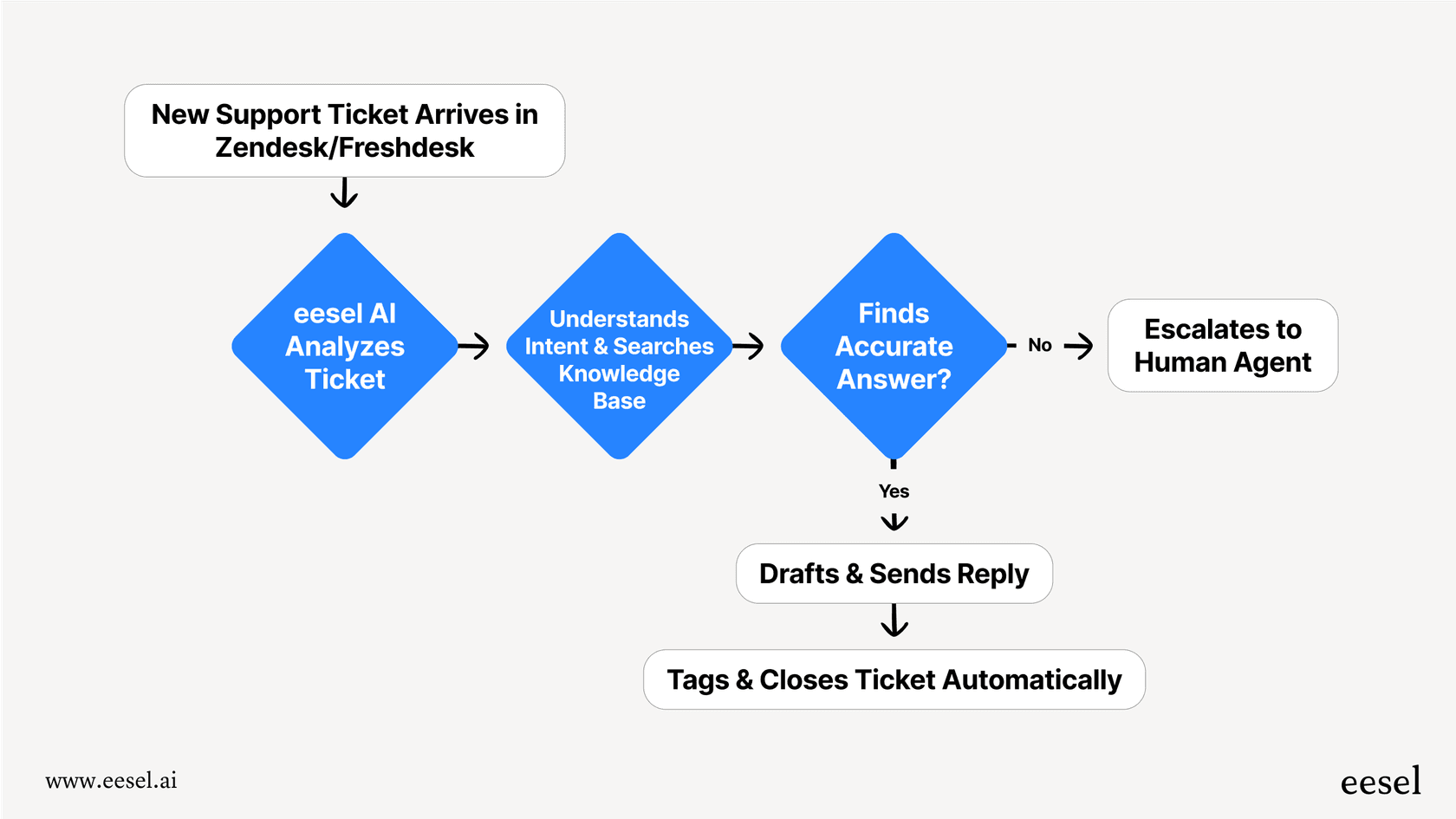
eesel AI is an AI platform that connects directly to your help desk (like Zendesk or Intercom) and all your other knowledge sources like Confluence, Google Docs, and even your team's past tickets. It uses this information to handle frontline support questions, draft replies for your agents, and sort incoming tickets automatically.
Pros:
-
Live in minutes: This is its superpower. You can sign up, connect your help desk with a click, and have a test AI agent running without ever talking to a salesperson. It completely skips the months-long projects that data warehouses demand.
-
No ETL needed: It connects directly to where your knowledge already lives, so there are no pipelines to build or babysit. It can even learn from messy, unstructured data like your team's past conversations.
-
Predictable Pricing: eesel AI uses fixed monthly credit plans (one credit per ticket or chat), with any overage capped at a limit you set. You know exactly what you’re paying, which is a breath of fresh air after dealing with the unpredictable usage-based models of data warehouses.
Cons:
-
It’s not a general-purpose data warehouse. It’s built specifically for customer service, ITSM, and internal support.
-
It won't replace your BI tools if you need to do deep, historical business analysis across the whole company.
Pricing:
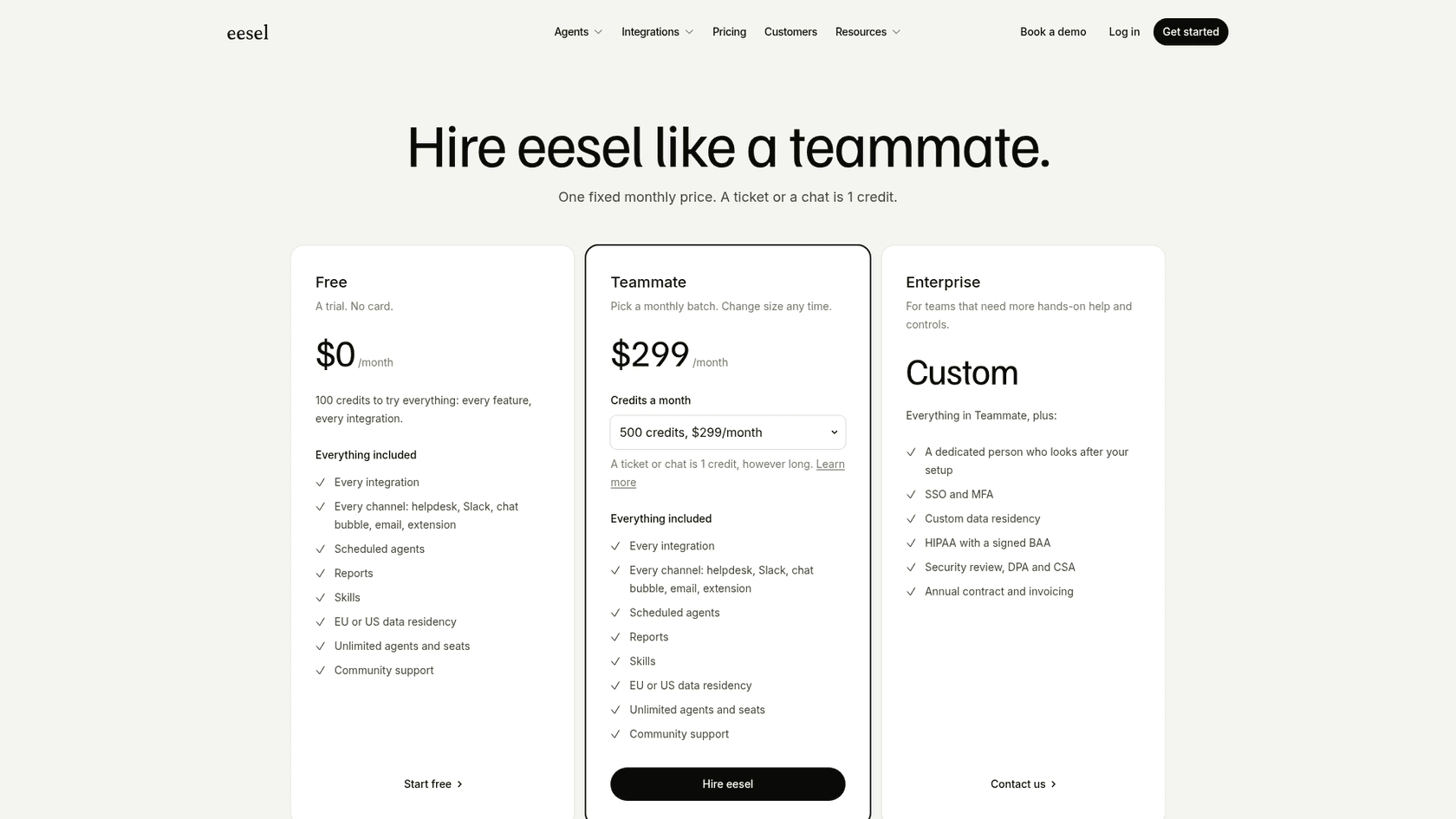
eesel AI's pricing is refreshingly simple. Plans are fixed monthly credit batches, with a free plan to start and no surprise fees.
-
Free Plan: $0 with 100 credits to try everything, no card needed.
-
Teammate plans: fixed monthly credit batches from $299 for 500 credits up to $1,899 for 5,000, with every integration, unlimited agents and seats.
2. Snowflake
Snowflake is probably the name you hear most often when talking about Redshift alternatives. It's a true giant in the data world, known for its smart architecture and ability to run on different clouds.
Snowflake's big idea was the complete separation of storage and compute. This means you can ramp up your processing power for a heavy-duty job and then dial it back down to save cash, all without messing with your stored data. It runs on AWS, Google Cloud, and Azure, so you aren't stuck with one cloud provider.
Pros:
-
The separation of compute and storage is top-notch and can save you a lot of money if you manage it well.
-
Multi-cloud support gives you freedom and prevents vendor lock-in.
-
It has very mature data sharing and security features, which big companies love.
Cons:
-
The usage-based pricing, while flexible, can be a nightmare to predict. Costs can climb quickly if queries aren't well-optimized.
-
It still needs a lot of data engineering work and separate ETL tools to get data loaded in.
-
It still has a sales-led side: Snowflake offers a free signup to start, but larger plans and commitments go through its sales team.
Pricing:
Snowflake’s pricing is all based on what you use. You pay for storage and compute (which they call "virtual warehouses") separately.
-
Storage: Billed monthly, starting around $23 per TB (after their compression).
-
Compute: Billed by the second, based on "credits." A credit costs around $2-$3 depending on your cloud, region, and plan. For example, an Enterprise plan credit on AWS US East is $3.
3. Google BigQuery
Google BigQuery is Google’s answer to Redshift, and its main draw is that it’s completely managed and "serverless." This makes it a great choice for teams who want to stop managing infrastructure and start analyzing data.
With BigQuery, there are no clusters to set up or nodes to configure. You just load your data and start asking questions. Google handles all the heavy lifting behind the scenes. It's also tightly integrated with the rest of the Google Cloud Platform and has some cool, built-in machine learning features.
Pros:
-
The serverless setup means zero infrastructure to manage. It’s about as "hands-off" as a data warehouse can get.
-
It is incredibly fast for huge queries.
-
The pay-per-query model can be very cheap for teams that don't run queries constantly.
Cons:
-
That pay-per-query model can bite you. One bad query that scans terabytes of data by mistake can result in a shocking bill.
-
It really shines when you’re already using other Google Cloud tools.
Pricing:
BigQuery pricing comes in two main flavors:
-
On-Demand Pricing: You pay for the amount of data your queries scan. The first 1 TB each month is free, then it's $6.25 per TB.
-
Capacity Pricing (Editions): You pay a flat rate for dedicated processing power, which gives you more predictable costs for heavy use. The Standard edition starts at $0.04 per slot-hour.
-
Storage: Active storage costs about $0.02 per GB per month.
4. Azure Synapse Analytics
If your company lives and breathes Microsoft, then Azure Synapse Analytics is the obvious Redshift alternative. It’s more than just a data warehouse; it’s an all-in-one analytics platform that tries to bundle data integration, warehousing, and big data processing into a single spot.
It’s meant to be the central hub for all things data within the Azure world, with tight links to services like Azure Data Lake and, most importantly, Power BI for dashboards.
Pros:
-
Flawless integration with other Azure services and Microsoft tools like Power BI.
-
It gives data engineers, data scientists, and analysts a single place to work.
Cons:
-
The interface can feel a bit bloated, since it's trying to be a jack-of-all-trades.
-
It's not very intuitive if you're not already steeped in the Azure way of doing things.
Pricing:
Like the others, Azure Synapse uses a pay-as-you-go model with a few different parts:
-
Serverless SQL Pool: Similar to Athena, you pay for data processed, at about $5 per TB.
-
Dedicated SQL Pool: You pay for a set amount of power, measured in Data Warehouse Units (DWUs). A small instance costs around $1.20/hour.
-
Data Storage: About $23 per TB per month.
5. Amazon Athena
Last but not least, we have Amazon Athena. This one is interesting because it’s not really a data warehouse. It's a query service that lets you analyze data that's sitting directly in Amazon S3 using standard SQL.
Athena is serverless, so there's no infrastructure to manage whatsoever. You can just point it at a file in your S3 data lake and start running queries right away. This makes it perfect for quick, one-off analyses without the whole song and dance of setting up an ETL pipeline to load data into a warehouse.
Pros:
-
No ETL required. You query your data right where it lives.
-
The pricing is dead simple: you just pay for the data you scan.
-
It's perfect for quickly exploring raw data without any setup.
Cons:
-
It’s not built for the kind of complex, high-speed, repetitive queries that a proper data warehouse is designed for.
-
Performance really depends on how your data is formatted and organized in S3 (hint: use Parquet, not CSV).
Pricing:
Athena's pricing model is wonderfully straightforward:
-
Pay per query: It's $5.00 for every terabyte of data your query scans.
-
You don't get charged for failed queries, and you can save a lot of money by compressing your data and organizing it properly.
When considering Redshift alternatives, is a data warehouse always the right answer?
After digging into all these tools, one thing became really clear: you have to match the tool to the problem. If your goal is to build massive, company-wide BI dashboards for looking at historical trends, then yeah, a data warehouse like Snowflake or BigQuery is probably what you need.
But what if your problem is more immediate and operational? What if you just need to cut down on customer support response times or automatically answer common questions?
Building an ETL pipeline, managing a data warehouse, and then building an app on top of it just to automate support is a long, expensive, and complicated road. For a problem like that, it's total overkill.
A tool like eesel AI gives you a much more direct route to getting value from your data. By plugging straight into your help desk and knowledge sources, it skips the entire data warehousing step. It focuses on the actual outcome, delivering a return on your investment in days or weeks, not quarters or years.
Find the Redshift alternatives that solve your real problem
Choosing a Redshift alternative isn't about picking the newest, fanciest data warehouse. It's about figuring out your actual business problem and finding the straightest line to a solution.
Snowflake gives you incredible flexibility, BigQuery offers serverless simplicity, Azure Synapse is the champion of the Microsoft world, and Athena is the king of quick S3 queries. They are all fantastic at what they do.
But don't get stuck thinking every data problem requires a data warehouse. If your "big data" problem is actually a "slow customer support" problem, then the best Redshift alternative might not be a database at all. It might be an AI automation platform that can use the knowledge you already have, right now.
eesel AI connects to the tools you already use, learns from your past work, and starts solving real problems in minutes. If that sounds like a better approach, you can give it a try for free and see how quickly you can get your support on autopilot.
Frequently asked questions
What are the primary reasons companies start searching for Redshift alternatives?
Companies often seek Redshift alternatives due to escalating costs, complex management requirements, inflexible compute/storage coupling, and the challenges of building ETL pipelines. Many find Redshift requires significant data engineering effort and can lead to unpredictable monthly bills.
How do the pricing models of different Redshift alternatives compare?
Pricing for Redshift alternatives varies, often falling into consumption-based models (paying for data scanned or compute used) or flat monthly fees. Snowflake and BigQuery use consumption, while eesel AI offers fixed monthly credit plans, directly addressing Redshift's often confusing cost structure.
Are there any serverless Redshift alternatives that simplify infrastructure management?
Yes, several Redshift alternatives offer serverless capabilities, significantly reducing infrastructure management overhead. Google BigQuery and Amazon Athena are prime examples, allowing users to query data without provisioning or maintaining servers.
Can Redshift alternatives be used for more than just traditional business intelligence and reporting?
Absolutely, some Redshift alternatives go beyond traditional BI. For instance, eesel AI focuses on activating support data directly for AI automation, offering a direct path to improve operational efficiency without a full data warehousing project.
When might a non-data warehouse solution be a better choice among Redshift alternatives?
A non-data warehouse solution, like eesel AI, might be a better choice among Redshift alternatives when your primary goal is immediate operational value, such as automating customer support. These tools often connect directly to existing data sources, bypassing the need for complex ETL and warehousing.
What considerations should guide my choice of Redshift alternatives?
When evaluating Redshift alternatives, consider performance and scalability, cost-effectiveness (predictable vs. consumption), ease of use and management, and flexibility. Also, think about whether a traditional data warehouse truly addresses your core business problem, or if a more specialized solution is better.


Article by
Kurnia Kharisma
Kurnia is a software engineer and writer at eesel AI with two years of SEO experience, writing about AI tools, helpdesk software, and customer support. He pairs a developer's understanding of how these products are built with search-driven research into what actually ranks and resonates with the people searching for them.