

Trying to decide between Koala AI vs ChatGPT? This guide breaks down their main strengths, from Koala's focus on SEO to ChatGPT's all-around usefulness, and introduces another option you might not have considered.
From general assistants to specialized tools
If you've been on the internet in the past couple of years, you've probably heard of Large Language Models (LLMs). These are the AI systems trained on huge datasets that let them generate text that sounds surprisingly human. The first big wave of these tools, led by ChatGPT, felt like a peek into the future: a general helper that could answer questions, write emails, and even code.
But as the tech has grown up, things have started to change. The market is shifting from these jack-of-all-trades AIs to specific platforms built for specific jobs. Instead of a general assistant, you now have AI tools designed from the ground up to create SEO-friendly content, design marketing materials, or analyze data.
Here, we'll compare two popular tools on that spectrum: Koala AI, which is all about SEO content, and ChatGPT, the flexible powerhouse. We'll get into what each one does best to help you pick the right tool for your work. We’ll also look at the next step in this evolution: platforms like the eesel AI blog writer that handle the entire content creation process, from a single keyword to a finished post with all the assets included.
Understanding Koala AI
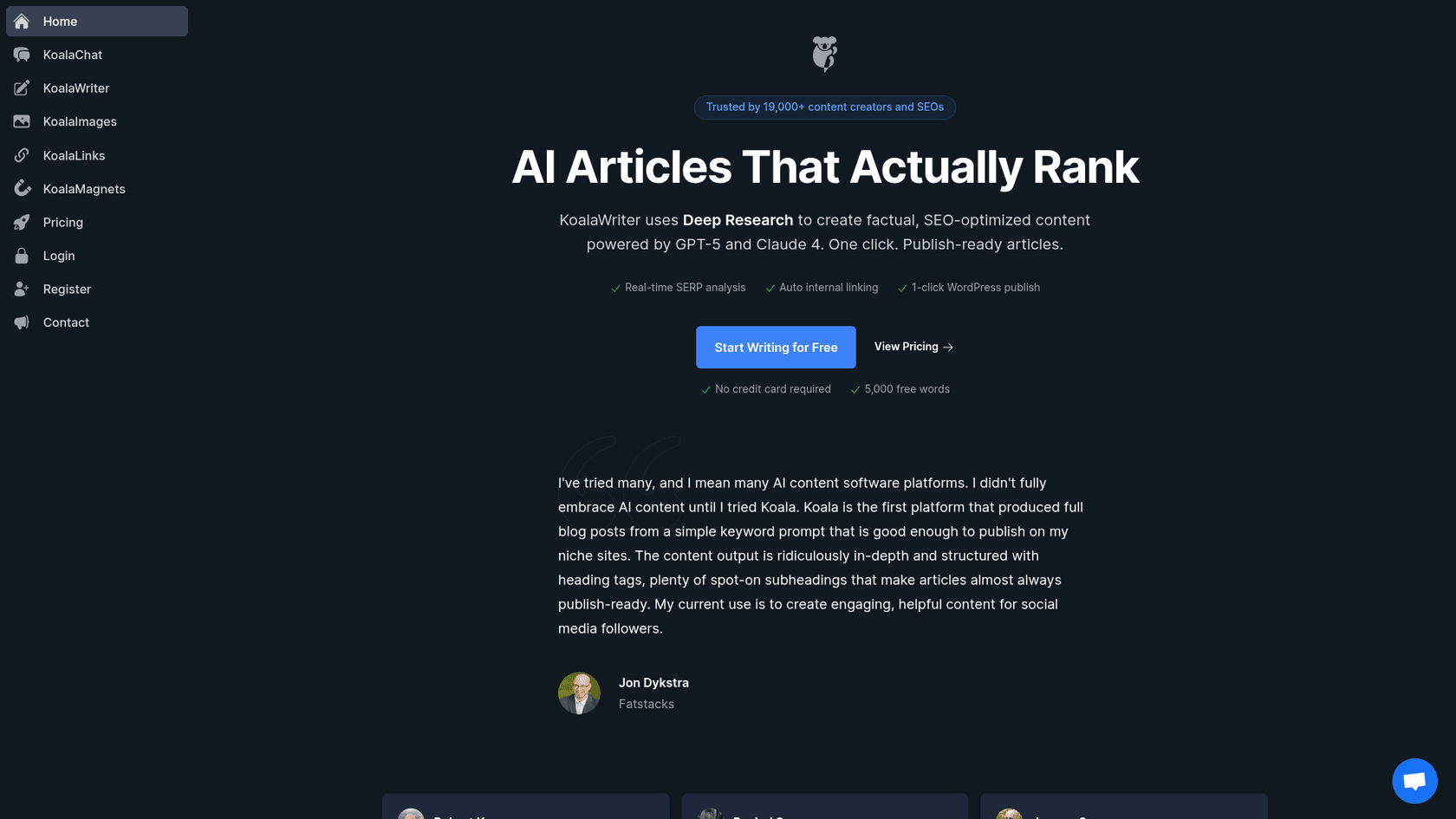
Koala AI is an all-in-one platform made for SEO pros, affiliate marketers, and content publishers. Used by over 19,000 creators, it offers a set of tools (KoalaWriter, KoalaChat, etc.) with one main goal: to generate structured, long-form articles that are "almost always publish-ready."
Its main purpose is to simplify the creation of SEO content. Instead of facing a blank page with a complicated prompt, you give it a keyword, and it handles much of the initial work.
Here are some of its key features:
- AI-Powered SEO: KoalaWriter uses real-time SERP analysis to check the top-ranking pages for your keyword. It then figures out important terms to include in your article, helping you create content that matches what's already doing well in search results.
- Real-Time Data: One of the big problems with early AI models was their knowledge cutoff date. Koala AI works around this by accessing the web to pull up-to-date information, which is great for topics that need current data.
- Specialized Content Types: It has built-in modes for different kinds of articles, especially for Amazon affiliate articles. This mode can grab live product info, prices, and real customer reviews from Amazon, which saves a ton of time for affiliate marketers.
- Workflow Automation: The platform has features to help you publish faster, like automatic internal linking and one-click publishing to WordPress and Shopify.
- Customization and Control: Koala AI gives you an outline editor to structure your article before you generate it, plus options to control the tone and point of view.
Pricing
Koala AI has a free trial with 5,000 words so you can see what it can do. After that, paid plans start with the Essentials plan at $9/month for 15,000 words. It's good to know that using more advanced models will use up your word credits faster than the standard ones.
Understanding ChatGPT
ChatGPT, from OpenAI, is the tool that made conversational AI a household name. It’s a powerful and flexible model designed to be a jack-of-all-trades. Its biggest strength is its versatility, not that it's built for one specific job.
For content creators, ChatGPT is useful for several tasks that help the writing process, rather than handling the entire process. Here are some common ways people use it:
- Brainstorming article topics and creating outlines.
- Summarizing long documents or complicated research.
- Writing and fixing snippets of code.
- Drafting short copy for emails, social media posts, or ads.
- Answering complex questions and explaining things simply.
The main drawback for bloggers and content marketers is that it just produces plain text. A ChatGPT response as a starting point, not a final product. Turning its raw text into a complete blog post takes a lot of manual work. You still have to do all the formatting, fact-checking, SEO work, and find your own images, videos, and other media.
Pricing
ChatGPT uses a freemium model. The free version gives you access to a solid model, but it can be slower and doesn't have the newest features. The ChatGPT Plus plan is $20/month and gives you priority access to the best model, faster speeds, and cool features like DALL-E image generation, data analysis, and web browsing.
An alternative: The eesel AI blog writer
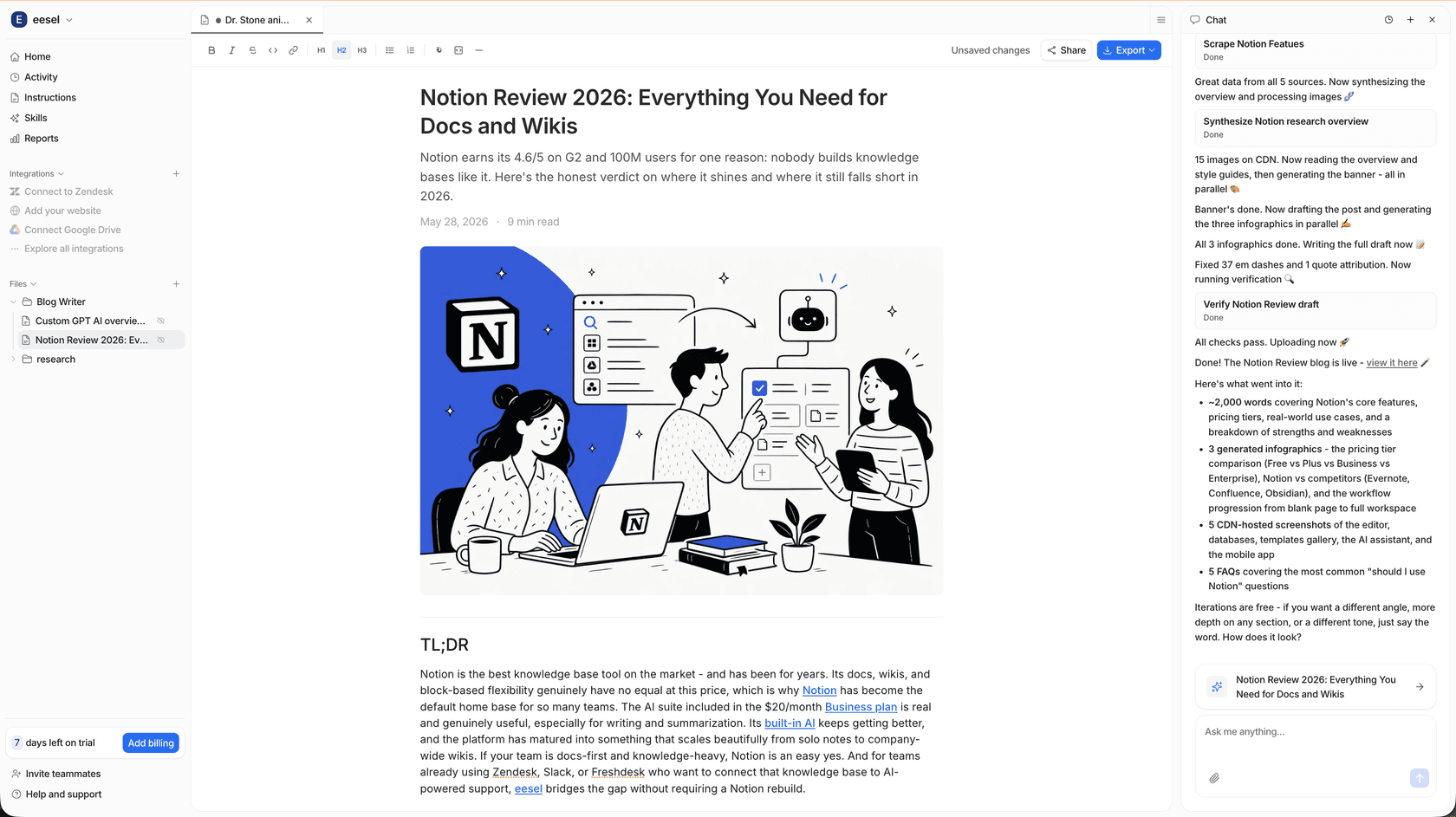
The process is straightforward. You give it a keyword, and eesel AI generates a full article with everything you need: headings, AI-generated images, data tables, relevant YouTube video embeds, and even real Reddit quotes to add some real-world perspective.
Here are a few things that differentiate it from other AI writing tools:
- Context-Aware Research: The platform automatically finds relevant information based on the kind of blog post you're making. If you're writing a comparison, it gathers pricing data. For a product review, it looks for technical specs. This is more than just a simple web search; it delivers structured, useful information.
- Automatic Asset Generation: Instead of just writing text, it creates and inserts AI images, infographics, and tables right into the post. This removes the step of using separate tools for visuals and then adding them to your article by hand.
- AEO (Answer Engine Optimization): The content is structured not just for old-school SEO but also for AI-powered search results like Google's AI Overviews. This helps make sure your content is ready for how people will find information in the future.
We used this exact tool at eesel AI to grow our own organic traffic from 700 to 750,000 daily impressions by publishing over 1,000 optimized blogs.
It is also free to try. You can generate your first publish-ready blog post and see the difference for yourself.
Koala AI vs ChatGPT: A detailed comparison
So, how do these two tools really compare? This isn't about which AI is "better" in general, but which one is the right tool for the job you need to do. One is like a specialized factory for first drafts; the other is a flexible assistant for creative tasks.
This table breaks down the key differences from a content creator's point of view.
| Feature | Koala AI | ChatGPT |
|---|---|---|
| Primary Use Case | SEO-driven, long-form content generation (blogs, affiliate articles). | General-purpose AI assistant (Q&A, brainstorming, coding, short drafts). |
| SEO Features | Built-in (real-time SERP analysis, keyword extraction, internal linking). | Manual (requires user to provide keywords and carefully structure prompts). |
| Data Freshness | Natively accesses real-time web data for up-to-date content. | Limited to training data, unless using web search features in paid plans. |
| Output Format | Structured, formatted articles with headings. Can embed AI images and videos. | Plain text output that requires manual formatting, fact-checking, and media sourcing. |
| Specialized Workflows | Built-in modes for Amazon product roundups with live data. | No specialized content modes; relies entirely on user prompts for structure. |
| Ease of Use | High. Designed for one-click article generation with minimal prompting. | Moderate. Output quality depends heavily on the user's prompt engineering skills. |
| Pricing Model | Tiered monthly subscription based on word count (starts at $9/month). | Freemium model with a flat $20/month fee for the Plus version. |
As you can see, the main difference is their approach. Koala AI’s built-in SERP analysis and real-time data are key features for efficiently creating competitive, long-form content. It’s designed to be a "content factory" that produces solid first drafts that you can then polish and publish.
ChatGPT, on the other hand, is a versatile "writing assistant." Its flexibility makes it a better creative partner for brainstorming ideas, summarizing research, or writing short copy where you want more direct control. Its usefulness, however, is directly tied to how well you can write a detailed prompt.
How to choose the right tool
To make it even simpler, here are a few clear scenarios to help you decide which tool, or combination of tools, is the best fit for you.
When to use ChatGPT
Best for: Ideation, research, and short-form copy.
Choose ChatGPT when you need a creative partner to begin the creative process. It’s the right tool for:
- Brainstorming a list of blog post topics or generating potential outlines.
- Summarizing a dense research paper or transcribing audio into text.
- Quickly drafting an email, a social media update, or a product description.
- Getting past writer's block by asking it to rephrase a sentence or paragraph.
When to use Koala AI
Best for: Scaling up the production of SEO-focused first drafts.
Choose Koala AI when your main goal is to generate long-form content. It’s the ideal choice if you:
- Need to quickly generate drafts of blog posts or affiliate product reviews that are already optimized for a keyword.
- Have a workflow where your team takes a solid first draft and then handles the final editing, formatting, and media.
- Are creating content on topics that need up-to-the-minute information, thanks to its real-time data access.
When to use a tool like the eesel AI blog writer
Best for: Producing complete, publish-ready blog posts with minimal manual work.
Choose a tool like the eesel AI blog writer when your goal is to scale your content workflow, not just the writing. It’s the best fit when you:
- Want a complete asset—a fully formatted post with AI images, infographics, tables, and video embeds—not just a text draft.
- Want to spend less time on editing and formatting so you can publish content faster.
- See Answer Engine Optimization (AEO) and including real social proof like Reddit quotes as a key part of your strategy.
For a more detailed video breakdown of how these tools compare for business use cases, the following review offers a practical perspective.
Picking the right tool for the job
The whole Koala AI vs ChatGPT debate doesn't really have a single winner. It's about understanding that different tasks need different tools. ChatGPT is a flexible assistant perfect for brainstorming and short-form writing. Koala AI is a specialized draft writer designed to produce SEO-focused text efficiently. And a tool like the eesel AI blog writer is a complete content generation platform that automates the whole process from keyword to a fully published post.
The best approach often involves using a mix of these tools. You might use ChatGPT for ideas, a specialized writer for drafts, and an end-to-end generator to scale your publishing.
Take a look at your current workflow. If you're spending too much time formatting plain text drafts, hunting for relevant images, and manually optimizing every post for SEO, it might be time to try a more complete solution.
Ready to turn a single keyword into a complete, SEO-optimized blog post in minutes? Try the eesel AI blog writer for free and see the difference.