How to write longer blogs without sacrificing quality

Stevia Putri
Last edited January 20, 2026
Ever find yourself staring at that blinking cursor, trying to stretch a simple idea into a whole paragraph? You're not the only one. The pressure to create long-form content is intense, but it often leads to what you see people complaining about on Reddit: articles stuffed with fluff that just buries the answer.
everyone says 'long form content ranks better' so i've been forcing myself to write 2000+ word blog posts. problem is half of it is just filler to hit the word count. i could say the same thing in 800 words but then it 'won't rank.' feels like i'm optimizing for robots instead of readers. does anyone actually read 2000 word blog posts or do they just skim and leave?

It feels like a no-win situation. You need to write in-depth content to rank on Google, but you also don't want to waste your reader's time.
The good news is, you don't have to pick one over the other. There's a repeatable way to create substantial, high-quality blog posts that people actually want to read and that search engines will love. It all comes down to building a solid foundation and focusing on value, not just word count. And thankfully, modern tools can do a lot of the grunt work, letting you focus on creating content that really stands out.
The truth about long-form content and SEO
Let's get one thing straight: "long-form content" isn't just about writing a ton of words. It's about creating a complete resource that fully answers a reader's question. The goal is to be the last click: the one-stop shop for whatever they were looking for.
Sure, there's a link between word count and rankings. The average Google first-page result is about 1,447 words. But correlation isn't the same as causation. As Google's own Search Advocate John Mueller has said, "Word count is not a ranking factor." You don't get extra points just for hitting a certain number.
So, why does comprehensive content usually do so much better? A few things are at play:
- Topical Authority: Longer articles give you the space to cover a topic from all sides, which shows Google you know what you're talking about. It's no wonder that websites with active blogs have, on average, 434% more indexed pages, building a huge library of expertise over time.
- Satisfying Search Intent: When you answer a user's question thoroughly (and the follow-up questions they didn't even think to ask), they don't need to go back to the search results. That's a massive signal to Google that your page is a good result.
- Increased Engagement: People will stick around for content that's actually valuable. A long-running study by Orbit Media has consistently found a strong connection between longer content (over 2,000 words) and bloggers reporting "strong results."
The main takeaway here is that length should be a byproduct of value. Or, as Google's Danny Sullivan put it, "Write as long or short as needed for people who read your content." Don't aim for a word count; aim to be the best answer out there.
Foundational steps for writing longer blogs
Great long-form content doesn't just appear out of thin air. It's built on a solid base of planning and research. If you just dive into writing, you'll probably run out of ideas pretty quickly. Here’s how to set yourself up for success before you even start typing.
Start with a detailed outline
The secret to writing a lot isn't about typing faster; it's about planning better. An outline is your roadmap. It breaks a huge topic into smaller, manageable pieces and makes sure you cover everything without going off on a tangent. Think of it like building a puzzle; you lay out all the pieces first to see how they connect.
Your outline doesn't have to be super complex. A simple structure can work wonders:
- Introduction: Grab the reader's attention and explain what the article is about.
- 4-6 Sub-topics: Each one should be a major H2 heading that answers a specific question related to your main topic.
- Conclusion: Sum up the key points and give a clear call to action.
Conduct deep research
Once you have your outline, it's time to gather the raw materials. This isn't just about skimming a few competitor blogs. It's about becoming a temporary expert on your topic.
Your research should be split into two main parts:
- Audience Research: You need to understand what your reader is thinking. What are they really trying to find out? Tools like Google's "People Also Ask" section are fantastic for this. Also, spend some time on forums like Reddit or Quora. Search for your keyword and see what conversations come up. The way people talk and the problems they describe are pure content gold.
Research fast: grab 'People Also Ask' questions on Google, scan top 3 results, Reddit/Quora threads, then explain in your own words.
Focus on value, not filler
This is the most important rule of all. As you write, keep asking yourself: "Does this sentence actually help the reader?" If the answer is no, get rid of it.
We've all landed on those recipe sites where you have to scroll through a 1,000-word story about someone's grandma just to find the ingredients. That's fluff, and it's the enemy of good long-form content. It's written to hit a word count, not to help the user.
Every section, paragraph, and sentence should have a clear purpose. If you've planned and researched well, you'll have more than enough valuable information to share without needing to resort to filler.
How to maximize readability in long-form content
A 3,000-word article can look pretty intimidating. If a reader clicks your post and is met with a giant wall of text, they're probably going to hit the "back" button immediately. Your job is to make your content look as inviting and easy to read as possible, no matter how long it is.
Break up text with clear headings
Think of your headings and subheadings (H2s and H3s) as signposts that guide the reader. They make the content scannable, letting someone quickly find the section that's most relevant to them. The Nielsen Norman Group has been talking about the importance of scannable content for years because it’s how people actually read online.
Whitespace is just as important. Keep your paragraphs short, maybe two to three sentences at most. This is a simple trick that makes a huge difference, especially for people reading on their phones. It gives their eyes a break and makes the content feel less dense.
Use visuals to tell a better story
Visuals do more than just make your article look nice. They break up long blocks of text, explain complex ideas quickly, and keep readers engaged.
The data supports this. Articles with images get 94% more views on average. And that Orbit Media study found that bloggers who use seven or more images per post are 2.3x more likely to report strong results.
Don't just toss in random stock photos. Use visuals that add real value:
- Infographics: Great for summarizing a process or highlighting key stats.
- Screenshots: A must-have for how-to guides that walk through software.
- Tables: A clean way to compare features, prices, or data.
Inject your unique perspective
In a world full of AI-generated content, your unique voice is your greatest asset. A human tone is what separates content that connects from content that just fills a page.
Don't be afraid to add your own perspective. Share a personal story related to the topic. Offer an opinion that might be a little different from everyone else's. As writer Dan Koe says, the real value in long-form content lies in perspective: explaining an idea in a way no one else has. This is how you build a real audience, not just chase website traffic.
Leveraging AI to write longer blogs without burnout
Okay, let's be real. Even with a perfect plan, writing thousands of words is a lot of work. It takes time and can lead to serious burnout, especially if you're trying to scale up your content production.
This is where AI can really make a difference. Think of it as a powerful assistant that can handle 80% of the manual work, freeing you up to focus on the strategic 20%: the planning, the unique insights, and the final polish.
Write longer blogs efficiently with eesel AI
The eesel AI blog writer is designed to take a single keyword and generate a complete, publish-ready blog post. This approach aims to create content that is already structured for readability and optimized for SEO, reducing the time needed for editing, research, and formatting.
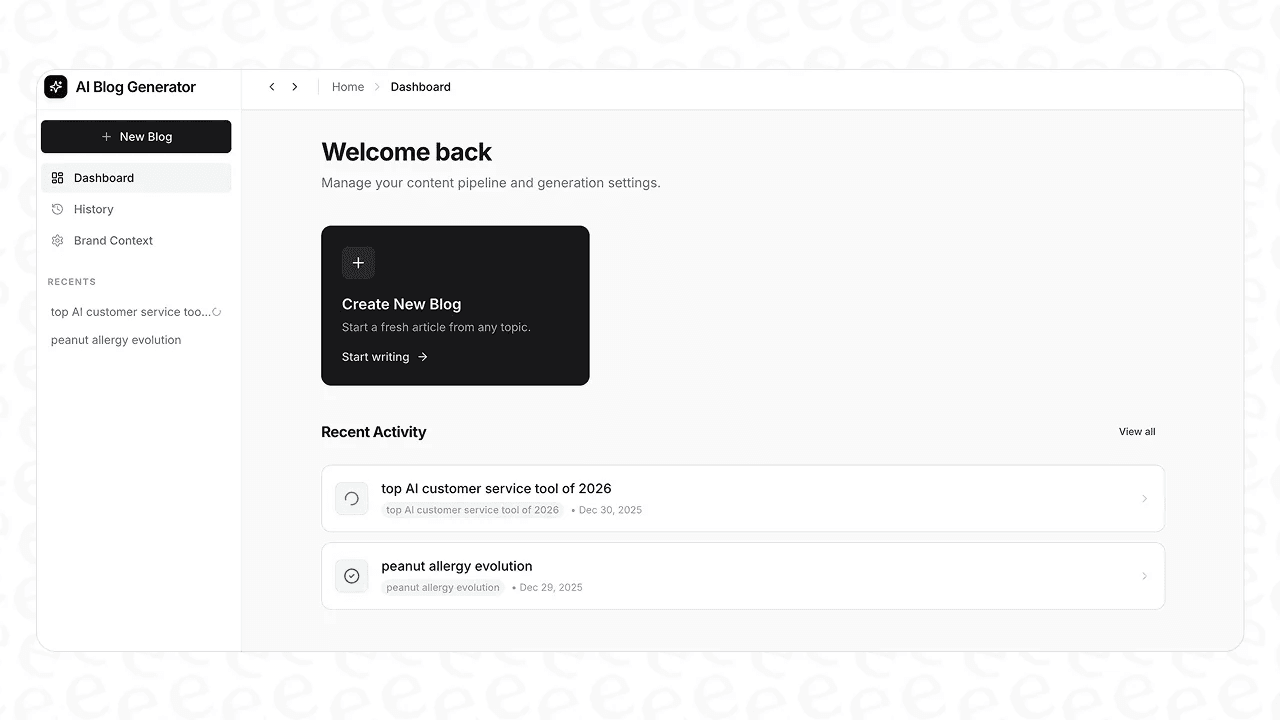
It's the exact tool we used to scale our own blog, growing from 700 to over 750,000 daily impressions in just three months. It automates the most time-consuming parts of creating long-form content, so you can produce more without letting quality slide.
Here’s how it handles the biggest challenges of long-form content:
- Context-Aware Research: Instead of just generating generic text, the AI automatically finds specific data relevant to your topic. Writing a comparison post? It will pull in pricing and feature data. A product review? It will find the technical specs. This makes sure your content is packed with substance right from the start.
- Automatic Asset Generation: Remember how important visuals are? The eesel AI blog writer creates custom AI images, infographics, and data tables for your post automatically. No more searching for stock photos or messing with design tools.
- Authentic Social Proof: To add that vital human element, the AI can pull in relevant Reddit quotes and embed YouTube videos directly into the article. This adds credibility and brings different voices into your content.
Common pitfalls to avoid
Even with a great tool like eesel AI, your strategy is what really counts. A powerful tool won't save a bad strategy. Here are a few common mistakes to watch out for:
- Forcing a topic: Not every keyword needs a 2,000-word article. A simple "what is" question might be best answered in 500 words. Let the search intent and the topic's complexity decide the length, not the other way around.
Yeah! I feel this so hard. I was doing the same thing and my bounce rate was like 75% cause nobody wants to read that much text. Switched to writing however long the topic actually needs... My posts are now like 1200 words average instead of 2000 but engagement went up cause people actually finish reading them. google doesn't seem to care about word count as much as people think.
If you're a visual learner, watching a step-by-step guide can make these concepts click. Here’s a helpful video that breaks down how to structure and write long-form content efficiently.
Putting it all together
Writing great long-form content isn't about some secret SEO trick. It really comes down to a simple, three-part strategy: plan your work, focus on value and readability, and use smart tools to do it efficiently.
When you stop chasing an arbitrary word count and start focusing on creating the most helpful resource on a topic, you'll find that the length takes care of itself. Always remember that length should be a result of depth, never the goal itself.
Ready to turn your next keyword into a complete, high-quality article? Try the eesel AI blog writer for free and generate publish-ready content in minutes.

Frequently Asked Questions
Share this article

Article by
Stevia Putri
Stevia Putri is a marketing generalist at eesel AI, where she helps turn powerful AI tools into stories that resonate. She’s driven by curiosity, clarity, and the human side of technology.