How to write blog introductions with AI

Stevia Putri
Last edited February 1, 2026
You have about eight seconds. That's the average time you get to hook someone who lands on your blog. Some research suggests people form a first impression of your entire website in 0.05 seconds. If your intro doesn't pull them in right away, they are likely to click the back button. A weak start can lead to a bounced visitor.
The core components of a hook-worthy introduction
The hook: Your first and most important impression
The hook is just your first sentence or two. Its only job is to make someone stop scrolling. It should be sharp, interesting, and relevant. NPR points out a few classic journalistic hooks that work well:
- Anecdotal lead: A quick, relatable story.
- Zinger lead: A surprising or bold statement that makes you think.
- Observational lead: A comment on a trend or something everyone's experiencing.
You could also use a shocking statistic, challenge a common belief, or ask a question that hits on your reader's biggest pain point.
The transition: Connecting the hook to your content
After you've got their attention, you have to connect the hook to the topic of your blog post. The transition is the bridge that gets you there.
It adds context, acknowledges the reader's problem, and keeps the momentum going. It tells the reader you understand their struggle and you're about to offer a solution.
The promise: Setting clear expectations for the reader
The promise is the final piece. It's a straightforward statement about what the reader will get from your article. It’s like a contract: you're telling them exactly what they'll learn, so they know their time won't be wasted.
A good promise might be something like, "In this guide, you'll learn three practical steps to..." or "By the end of this post, you'll have a framework for..." This cuts out the guesswork and gives them a solid reason to stick around.
Three approaches to writing blog introductions with AI
Let's get practical. You have a few different types of AI tools for writing intros, and they all have their benefits and drawbacks.
Using general AI chatbots like ChatGPT and Claude
It’s a good way to brainstorm. You can get a handful of different angles in a few seconds, which is helpful when you're stuck.
However, there are limitations to consider. First, these models are "consensus engines," not researchers. They predict the next word based on a huge dataset, which means they can produce content that is inaccurate or outdated. Remember, ChatGPT 3.5's knowledge stops in September 2021.
Second, the writing is usually generic. It may not have a unique voice and often needs a lot of editing to sound human.
My perspective (bit experience) is about value for readers or E-E-A-T for Google. Well of course you can relatively fast create article with chatgpt by one prompt but be realistic. Google don't penalize ai content but how many users stay to finish read fluf article from ai first draft.

Lastly, these tools generally lack specific context about your brand, products, or SEO strategy. The intros can feel disconnected as a result. Your results are only as good as your prompt.
| Prompt Type | Example | Typical Output Quality |
|---|---|---|
| Basic Prompt | "Write a blog intro about the benefits of remote work." | Generic, lacks a strong hook, and uses clichés. Requires heavy editing. |
| Detailed Prompt | "Write a blog intro targeting HR managers. Start with a surprising statistic about employee retention in remote-first companies. Hook the reader, introduce the topic, promise value, and use a professional but approachable tone." (Inspired by r/ChatGPTPromptGenius) | More specific, includes a clear hook, and better aligns with the target audience's interests. Still requires brand voice editing. |
Using AI writing assistants like Jasper or Grammarly

The main advantage is convenience. They can check your grammar, tone, and style as you write. Some, like Jasper's Brand IQ, even let you create a knowledge base to keep the content aligned with your brand voice.
I write blog content regularly and use a few tools to make things easier and faster. I use ChatGPT to plan and write drafts. It helps a lot with speed and structure. Grammarly is great for checking grammar and improving the tone of my writing. For keyword research, I use LowFruits. It is very useful if you want your content to do well in search engines. I use Canva to make visuals for social media posts. Sometimes I also use QuillBot when I need to rewrite or reword something quickly.
However, many are based on templates. For example, Grammarly's tool will ask for a topic, audience, and tone to make a draft, but it's not conducting independent research.
You are still the one driving the process, providing the main ideas and putting all the pieces together. With platforms like Jasper, you have to build and manage your own "Content Pipelines" to make it all work. They're often focused on refining text or writing small bits of content, not creating a full, researched article from just a keyword.
Using a dedicated AI blog writer for a complete workflow
This leads to a third option: a dedicated AI blog writer. This kind of tool doesn't just write an intro; it generates a complete, publish-ready blog post where the introduction is contextually aligned with the rest of the content.
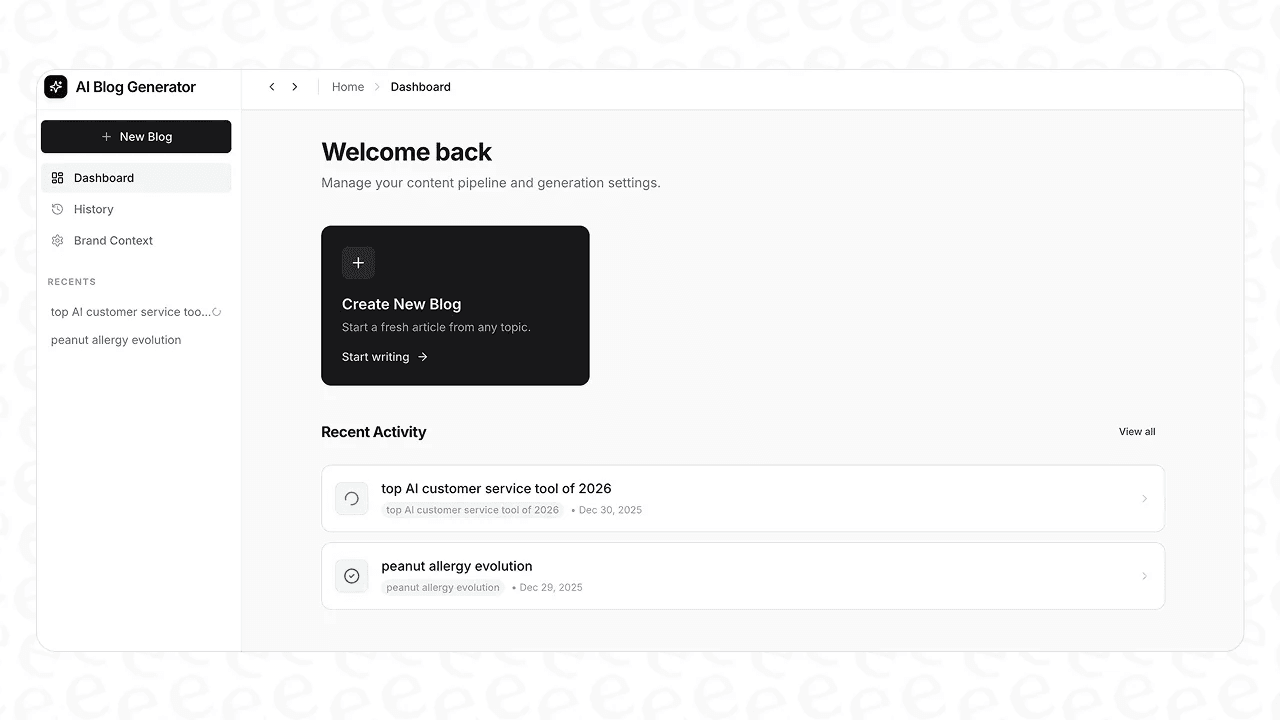
The eesel AI blog writer is an example of this approach. You provide it a keyword and your website URL, and it analyzes your site to learn your brand, products, and voice automatically.
This approach addresses some of the challenges found with other AI tools:
- Context-Aware Research: The intro is created from an understanding of the topic and how it connects to your business.
- Automatic Asset Integration: It's not just about words. It can find and embed relevant YouTube videos or pull real quotes from Reddit to create hooks that resonate with people.
- AEO and SEO optimized: The intro and the whole article are written for both humans and AI answer engines like Google AI Overviews and Perplexity. This is important for search visibility today.
At eesel AI, we used this tool to grow our blog from 700 to 750,000 daily impressions in 3 months. The best part is that it's completely free to try, so you can judge the quality for yourself.
Advanced strategies for writing blog introductions with AI
Whichever tool you end up using, a few strategies can help you get better results. These tips will help you steer the AI toward intros that are more interesting, on-brand, and effective.
Crafting detailed prompts with clear instructions
The golden rule of AI is simple: the quality of the input affects the quality of the output. A vague prompt will get you a vague intro every time.
To get better results, you have to be specific. One solid template, inspired by copywriting frameworks and prompt engineering guides, is the Problem-Agitation-Solution (PAS) model.
- The Problem-Agitation-Solution (PAS) Template: "Draft a 150-word blog introduction for an article about [Topic]. Start by identifying the primary problem: [Describe reader's pain point]. Agitate the problem by explaining the negative consequences: [Describe the 'so what?']. Finally, promise a clear solution by telling the reader they will learn [List 2-3 key takeaways]."
Pro tip
Always tell the AI who you're writing for, what tone you want, and a rough word count. The more details you give it, the better the output will be.
The crucial role of context and brand voice
An intro can be technically perfect and still feel wrong if it doesn't sound like you. This is why context and brand voice are so important.
You need to give the AI some background on your topic, your audience, and your specific angle. For some tools like Jasper, this means you have to manually build a style guide and define your brand voice by feeding it examples and rules.
That can work, but it requires setup and ongoing updates. This is where an automated tool can make a difference. The eesel AI blog writer handles this automatically. By looking at your website, it learns your voice and product positioning, which saves time and helps ensure consistency from the start.
The final step: Human editing and refinement
AI is a great co-writer, but it's not a replacement for a human. As one Reddit user on r/SEO points out, LLMs are "not strong enough to independently create content" because they are consensus engines, not research tools. They don't understand things; they just predict what word comes next.
Well, it’s bitter but true, if you want real traffic, avoid using AI tools. I’ve tested this on my personal platform. AI-generated content sometimes ranks, but its effectiveness gradually slows down. Human-written content, on the other hand, ranks with stability in the long term.
You should always review AI-generated intros. Check for accuracy, clarity, and make sure it matches your brand. That final human touch is what makes content great. You can add a personal story, a unique thought, or just tweak a sentence to make it yours.
The best tools understand this and mix AI generation with human editing. The eesel AI blog writer, for instance, has AI editing features built in. You can highlight any part of the text and tell the AI how to revise it, giving you a balance of speed and control.
The importance of a well-crafted introduction
A great blog intro is your best shot at getting someone to read your content. If you nail it, you've got an engaged reader. If you don't, you've got another bounced visitor.
AI can be a huge help here. You can use general chatbots for brainstorming, writing assistants to clean up your writing, or a dedicated platform to handle the whole process. As we've covered, if you want integrated and context-aware results, a tool that understands your brand's context can be very effective.
The point isn't just to write intros faster. It's to consistently create high-quality articles that grab readers from the first line, keep their promises, and show up in search results.
Seeing these techniques in action can make a big difference. For a practical demonstration, the video below walks through how to use an AI tool specifically for crafting compelling blog intros, offering tips you can apply right away.
Tired of staring at a blinking cursor? You can try eesel AI blog writer and get your first complete, SEO-optimized article done in minutes.

Frequently Asked Questions
Share this article

Article by
Stevia Putri
Stevia Putri is a marketing generalist at eesel AI, where she helps turn powerful AI tools into stories that resonate. She’s driven by curiosity, clarity, and the human side of technology.