

What is Grammarly?
What is Quillbot?
A feature-by-feature comparison of Grammarly vs Quillbot
To see the practical differences between Grammarly and Quillbot, it helps to compare their main functions directly. The next sections give an objective look at their features, performance, and pricing.
| Feature | Grammarly | Quillbot | Winner |
|---|---|---|---|
| Primary Function | All-in-one writing assistant | Paraphrasing and writing tool suite | Tie (Depends on need) |
| Grammar Checking | Comprehensive and detailed | Functional for basic errors | Grammarly |
| Paraphrasing | Basic sentence rewriting for clarity | Advanced tool with multiple modes | Quillbot |
| Plagiarism Detection | Unlimited checks, lower accuracy | Limited checks, higher accuracy | Quillbot (for accuracy) |
| Additional Tools | Tone detector, generative AI | Summarizer, translator, citation generator | Quillbot |
| Integrations | Browser, desktop, and mobile apps | Browser extensions and Word add-in | Grammarly |
| Pricing (Annual) | $12/month | $8.33/month | Quillbot |
Grammar and spell checking for Grammarly vs Quillbot
Grammarly's main strength is its grammar checker. It does more than just fix basic spelling and punctuation; it provides suggestions on style, tone, and clarity by pointing out things like wordy sentences or passive voice. This makes it a comprehensive proofreading tool. Non-native English speakers often find its advice on comma rules and verb tenses helpful.
Quillbot's grammar checker is effective for catching standard errors in spelling, punctuation, and grammar. It flags common mistakes and helps clean up a document. However, it is not as detailed as Grammarly and doesn't provide the same level of stylistic feedback or tone analysis. It works for a basic review, but if you need detailed feedback on the finer points of your writing, Grammarly offers more in-depth feedback.Fellow non-English here and I use Grammarly. It helps with the comma rules and keeping me going in the same grammatical tense.

Paraphrasing and rewriting: A key difference in Grammarly vs Quillbot
Paraphrasing is Quillbot's core feature and its primary strength. It offers several modes (Standard, Fluency, Formal, Creative, Academic) that let you adjust the rewritten text for different needs. This is useful for adapting content for various audiences. You can also use a synonym slider to control how much of the original vocabulary is changed, giving you precise control over the result. This makes it a great tool for students, researchers, and writers who want to rephrase content for originality or clarity without losing the original meaning.
Grammarly has a rewriting function, but it serves a different purpose. It's mainly for improving clarity by rephrasing individual sentences that are unclear, too long, or grammatically awkward. It focuses on polishing existing text rather than being a dedicated tool for paraphrasing entire passages. A review from Demand Sage notes that Quillbot is more specialized if your main goal is to rephrase or repurpose text, as its features are built for that specific job.
Plagiarism detection performance in Grammarly vs Quillbot
Both tools include a plagiarism checker, but their performance and limits are quite different, creating a clear trade-off.
Grammarly's Pro plan comes with unlimited plagiarism checks against a large database of academic papers and websites. This is helpful if you need to check many documents often. However, its effectiveness has been debated. A study by AcademicHelp found that in their test, Grammarly's checker only detected 3% of plagiarism from an internet sample, which suggests it might miss some types of copied content.
On the other hand, Quillbot's plagiarism checker was much more effective in the same test, detecting 99.7% of the plagiarized text. This points to a higher level of accuracy. A limitation is its usage is restricted; the Premium plan only lets you scan up to 20 pages per month (a page is about 250 words). This makes Quillbot more accurate for occasional, important checks, but the low monthly limit is a significant restriction for anyone with high-volume needs.
AI features and content generation: A Grammarly vs Quillbot analysis
Grammarly and Quillbot have both added generative AI to help with writing, but neither is built for creating complete, long-form articles from a single prompt. Their AI functions are there to support the editing process, not to replace content creation.
GrammarlyGO offers help with brainstorming, outlining, and writing short texts like emails or paragraphs. It works as a co-writing assistant. However, its use is capped by a number of prompts. Free users get 100 prompts per month, while Pro users get 2,000, which is a lot more but still a fixed amount.
Quillbot offers AI Chat for similar brainstorming and drafting. It also has an AI Detector, though some reviews note it can be inaccurate, sometimes flagging human-written text as AI-generated.
I'm using both quillbot and grammarly. I write everything on my own first and later paraphrase in quillbot to make it strong in english. But I noticed that what I have written first, grammarly doesn't show AI plagiarism in that, but with the quillbot paragraph showing AI detected plagiarism in grammarly.
User experience and integrations for Grammarly vs Quillbot
Grammarly provides a more integrated user experience across different platforms. It's available as a browser extension for Chrome and Edge, a desktop app for Windows and Mac, and a mobile keyboard for iOS and Android. This wide availability means you can get its suggestions in emails, social media posts, and apps like Google Docs and Slack. The consistency across devices makes it a convenient tool that's always working in the background.
Quillbot's integrations are more limited, mainly offering a browser extension for Chrome and an add-in for Microsoft Word. While this covers common writing environments, it doesn't have dedicated desktop or mobile apps. This makes it less accessible if you write on different devices or outside of a web browser or Word. The user experience is simple on its supported platforms, but it doesn't have the same reach as Grammarly.
An alternative for end-to-end content generation: eesel AI blog writer
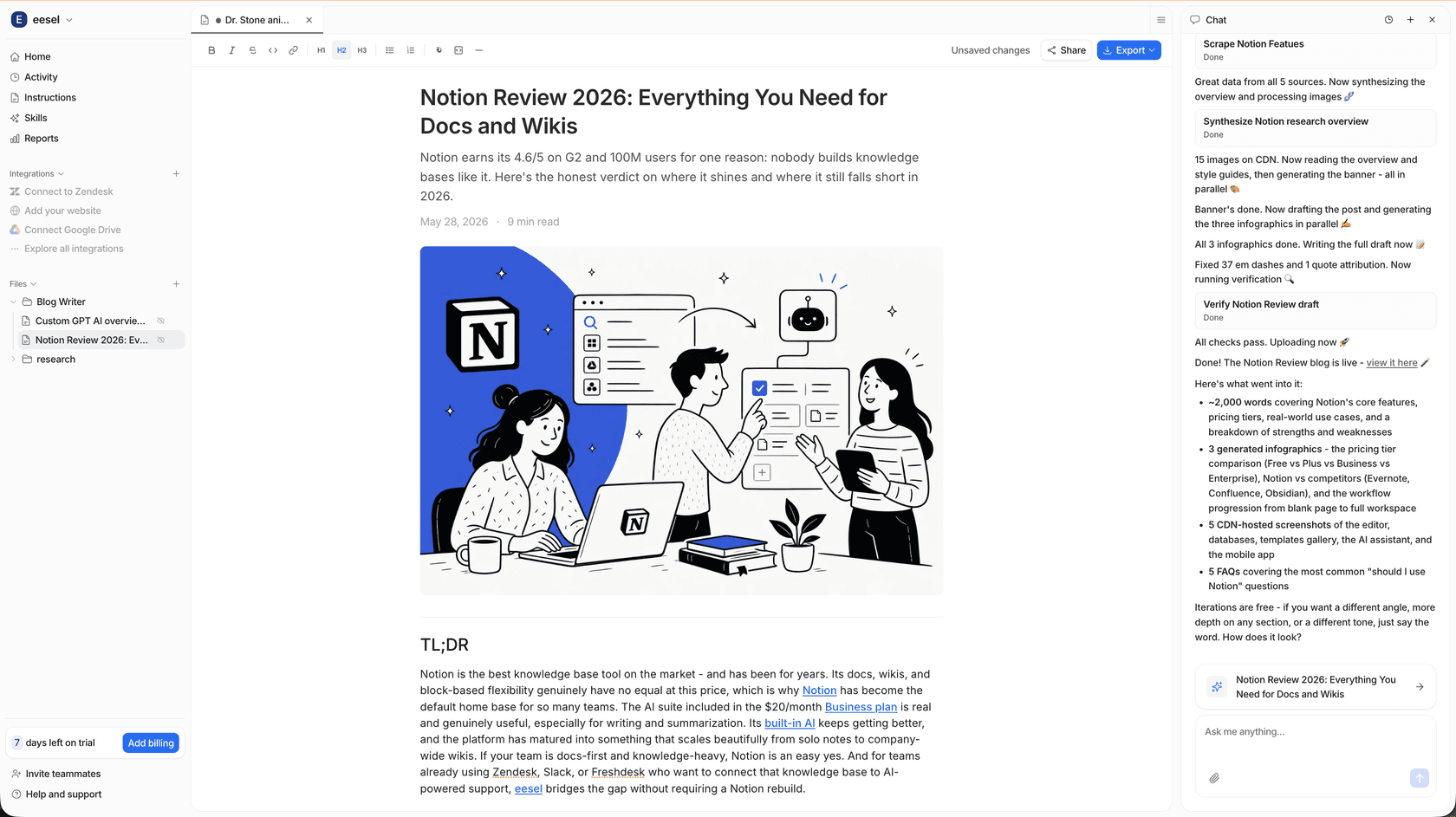
- Automatic assets: The AI generates and adds relevant images, infographics, and tables directly into the article.
- Authentic social proof: It finds and includes real quotes and discussions from platforms like Reddit to add credibility.
- Deep research with citations: The AI conducts research and automatically adds external links to sources, improving the content's authority.
This approach helped eesel AI's own blog grow from 700 to over 750,000 daily impressions in a few months. It is an alternative for teams focused on scaling content creation for organic growth.
Pricing breakdown for Grammarly vs Quillbot
- Free: This plan covers basic grammar, spelling, and punctuation checks. It also includes tone detection and 100 generative AI prompts per month.
- Pro: Starts at $12/month when billed annually. This plan unlocks all features, including full-sentence rewrites, advanced tone adjustments, unlimited plagiarism detection, and 2,000 generative AI prompts per month.
- Enterprise: This tier is for larger organizations and offers custom pricing, enhanced security, a style guide, and dedicated support.
Quillbot Pricing:
- Free: The free version limits the paraphrasing tool to 125 words at a time and provides access to only two paraphrasing modes (Standard and Fluency).
- Premium: Starts at $8.33/month (billed annually). This plan gives you unlimited words for the paraphraser, access to all writing modes, and the plagiarism checker (still limited to 20 pages per month).
For a more visual breakdown of how these tools perform in real-time, the video below offers a detailed walkthrough. It compares the key features, user interfaces, and overall usability of both Grammarly and Quillbot, providing practical insights to help you see them in action.
Choosing between Grammarly and Quillbot: Which tool is right for you?
Choosing between Grammarly and Quillbot comes down to your main writing tasks. Neither one is universally "best"; the right choice is the one that fits your workflow.
- Use Grammarly if: Your primary goal is to proofread and polish your writing. Its detailed grammar, style, and tone suggestions make it a comprehensive assistant for professionals, marketers, and anyone who needs their final text to be error-free.
- Use Quillbot if: Your work involves paraphrasing, summarizing, or academic writing. Its advanced paraphrasing modes and tools like the Summarizer and Citation Generator are well-suited for students and content creators who repurpose or condense information.
- Use both together for: A comprehensive workflow. Many people use Quillbot first to paraphrase a draft for clarity and originality, then run it through Grammarly for a final, deep check on grammar, style, and tone.
- Consider an alternative like eesel AI if: Your goal is to generate complete, SEO-optimized blog posts at scale, not just edit existing text. The eesel AI blog writer is built for content creation from a single keyword, making it a suitable option for marketing teams focused on driving organic traffic.