What is copywriting? A complete guide for modern marketers

Katelin Teen
Last edited February 1, 2026
Ever opened an email with a subject line so good you just had to click? Or scrolled past a social media ad that made you stop and look? That’s copywriting at work.
Simply put, it's the art and science of writing words that convince people to do something. It’s the silent force behind almost all marketing, sales, and brand messaging. A fantastic product can easily flop with bad copy, while a decent one can sell out with the right words. It's that important.
What is copywriting?
Copywriting is the process of writing promotional stuff to get people to take a specific action. That action could be buying something, clicking a link, signing up for a newsletter, or just thinking differently about a brand.
It gets confused with a couple of other terms, so let's sort that out:
- Copywriting vs. copyright: This one's easy. Copyright is a legal thing that gives a creator exclusive rights to their work. Copywriting is a marketing skill. One is about legal protection, the other is about persuasion.
- Copywriting vs. content writing: This one's a bit fuzzy, and honestly, the lines are blurring. Some say content writing (like blogs or articles) is to inform or entertain, while copywriting is to sell. But here's the thing: all good business writing should be persuasive. A blog post isn't just there to share facts; it's there to build trust and guide the reader toward being a customer. It's probably better to think of content writing as a form of copywriting.
An infographic comparing the key differences between copywriting, content writing, and copyright, explaining their distinct goals and applications.
At the end of the day, copywriting is about connecting with people and getting real, measurable results. It’s not about flowery language; it’s about understanding psychology and using words to hit a business goal.
The different types of copywriting
Direct response copywriting
This is the kind of writing that asks for an immediate reaction. It's all about getting the reader to do something right now. Think "Buy Now," "Sign Up Today," or "Download Your Free Guide." It’s punchy, direct, and doesn't leave any room for confusion.
You see it all over the place: sales pages for online courses, email campaigns with limited-time offers, and social media ads that take you straight to a product page. This style is heavily data-driven. Writers are obsessed with conversion rates, click-through rates, and A/B testing headlines to see what pulls the best numbers.
Brand copywriting
If direct response is a sprint, brand copywriting is more of a marathon. The goal here isn't an instant sale but to build a long-term relationship and a solid brand identity. It’s about shaping how people feel about a company.
Think of slogans like Nike's "Just Do It." That phrase isn't telling you to buy shoes this second, but it perfectly sums up the brand's vibe of motivation and empowerment. You'll also see it in "About Us" pages that tell a good story, brand videos, and even clever billboard ads. It's less about the hard sell and more about creating a personality that sticks with people.
SEO copywriting
This is where writing for humans and writing for search engines shake hands. SEO (Search Engine Optimization) copywriting is all about creating content that ranks high on Google but is still genuinely useful and interesting for the reader.
The work involves a lot of keyword research to figure out what people are searching for, then weaving those keywords into headings, subheadings, and the main text. It also means structuring the content so it's easy for both people and search engine bots to digest. Blog posts, website service pages, and product descriptions are all classic examples of SEO copywriting.
B2B vs. B2C copywriting
Your writing style changes completely depending on who you're talking to. The copy for a business executive is going to be very different from the copy for someone shopping for new sneakers.
Here’s a quick comparison:
| Aspect | B2B (Business-to-Business) | B2C (Business-to-Customer) |
|---|---|---|
| Audience | Industry experts, decision-makers | General consumers |
| Tone | Professional, informative, logical | Relatable, emotional, direct |
| Goal | Generate leads, build long-term relationships | Drive immediate sales, build brand loyalty |
| Content | White papers, case studies, long-form guides | Social media posts, short emails, product pages |
What does a professional copywriter do?
It’s easy to think a copywriter just writes all day, but that’s just a fraction of the job. The final piece of writing is like the tip of an iceberg; most of the heavy lifting happens before a single word is typed.
Copywriters are people who write advertising or marketing material for others who have something to sell. This can include everything from social media posts to emails to websites to big-budget multimedia campaigns... They also are able to write stuff that moves the needle. e.g sells shit. Often, they consistently write emails that have a high open rate, ads that have a high click rate, and most importantly, a high conversion rate.

Here's a peek at what the role really involves:
- Deep research: This is the bedrock of any good copy. A copywriter has to become a mini-expert on whatever they're writing about. That means understanding the product inside and out, studying the market, sizing up the competition, and, most importantly, getting into the mind of the target audience. What are their biggest pain points? Their hopes and dreams? What kind of language do they use? Without this groundwork, the copy is guaranteed to fall flat.
- Strategic thinking: After the research, the copywriter has to come up with a game plan. What’s the main message we need to get across? What's the best angle to take? How do we structure the information to lead the reader on a logical and emotional journey? This is the part where they map out the whole story.
- Writing and storytelling: Now it's time to actually write. This means using persuasive language, setting a clear and consistent tone of voice, and often using storytelling to forge an emotional connection. Good copy doesn't just inform; it captivates. It makes the reader feel something.
- Editing and polishing: Nobody nails it on the first draft. A huge chunk of a copywriter's time is spent ruthlessly editing their own work. They chop out extra words, fix confusing sentences, check for typos, and keep refining the copy until it’s as sharp and effective as possible.
A workflow diagram outlining the four key stages of the professional copywriting process, from research to final editing.
A good copywriter also has to be a chameleon. One day they might be writing with the voice of a quirky startup, and the next they could be drafting a formal white paper for a bank. Juggling different brand voices, formats, and industries is all part of the fun.
How AI is changing the copywriting landscape
Generative AI tools are everywhere, and they've definitely made a splash in the copywriting world. They can be great for brainstorming, kicking writer's block to the curb, or getting a rough draft down.
However, relying solely on generic AI for your copy can present some challenges.
Here are a few common considerations:
- The output can sometimes sound generic or use repetitive phrases.
- The content may be superficial, summarizing existing information without providing deep or original insights, which can impact search engine rankings.
- There is a risk of generating factual inaccuracies, which requires careful fact-checking to maintain brand credibility.
- The output is typically text-only, lacking the images, charts, or social proof that enhance readability and build trust.
The real trick isn't just making words appear on a screen; it's creating complete, well-researched, SEO-friendly articles that people actually want to read.
From AI drafts to publish-ready copy with the eesel AI blog writer
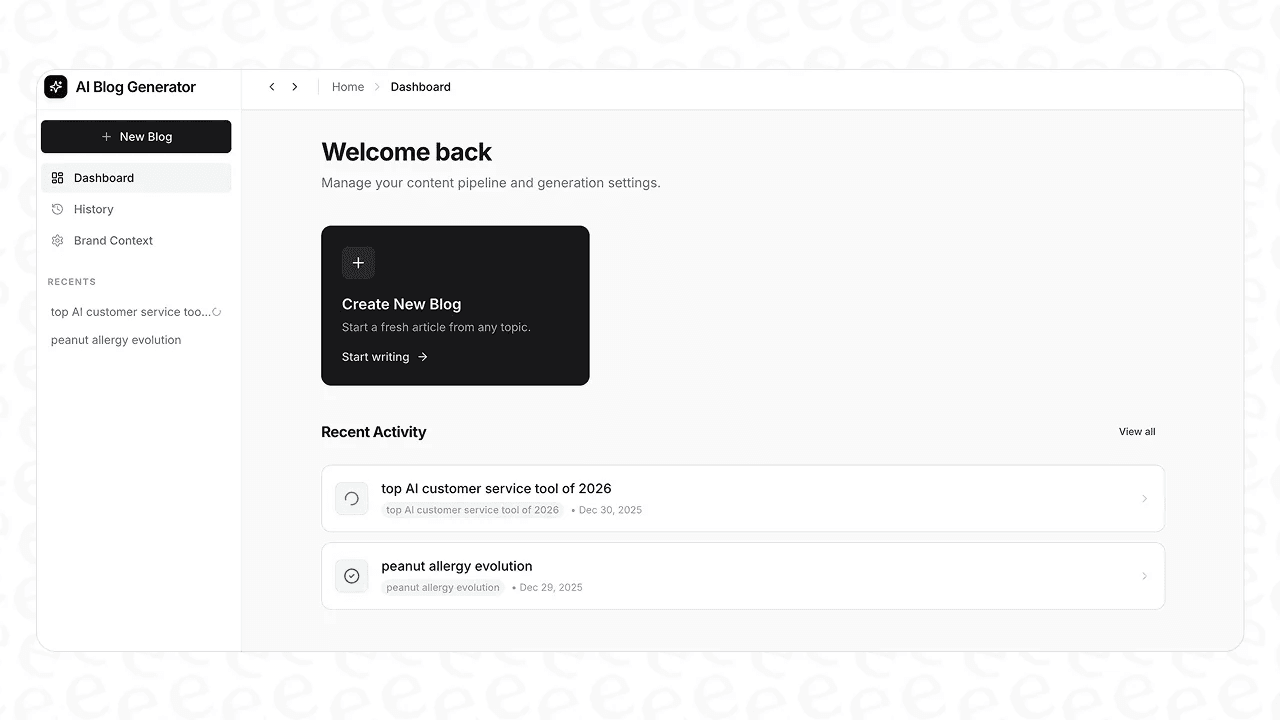
This is where advanced AI tools are making a difference. The eesel AI blog writer, for example, is designed to address these challenges. It aims to produce a complete, publish-ready blog post from a single keyword, moving beyond a simple text draft.
It addresses common AI limitations through several key features:
- Deep research with citations: It actively researches the topic, pulling in relevant info and including links to external sources and your own content. This builds trust with both your readers and search engines.
- Automatic asset generation: A blog post needs more than just words. The eesel AI blog writer automatically creates a full article with AI-generated images, infographics, and data tables to make the content easier to scan and more engaging.
- Authentic social proof: For a real human element, it finds and embeds relevant YouTube videos and actual quotes from Reddit forums. This brings in different voices and adds a layer of credibility that generic AI just can't match.
- AEO (Answer Engine Optimization): It structures content to show up not just in traditional search results, but also in Google's AI Overviews and other answer engines. This is a big deal for staying visible in 2026.
An infographic detailing the features of the eesel AI blog writer for advanced copywriting, including research, asset generation, social proof, and AEO.
We know it works because we use it ourselves. Here at eesel AI, this very tool took our blog from 700 to 750,000 daily impressions in only three months after we published over 1,000 fully optimized posts. This approach makes it a comprehensive content generation platform.
To see these principles in action, check out this comprehensive guide that breaks down the fundamentals of effective copywriting with practical examples.
The evolving state of copywriting
So, what is copywriting? It's a vital skill that mixes the art of persuasion with the science of human psychology to help businesses grow. The core principles of knowing your audience and crafting a message that resonates will always be essential.
But the tools we use are changing fast. Modern copywriters shouldn't see AI as a threat; they should see it as a powerful assistant. The key is to leverage AI as a powerful partner that handles the time-consuming tasks of research, asset creation, and optimization. This frees up humans to do what they do best: focus on strategy and creativity. The future of copywriting is a team-up between human insight and smart, context-aware AI that produces high-quality content that's ready to publish.
Scale your copywriting with smarter AI
If you're looking for an alternative to generic AI drafts that take hours to fix, it might be time to try something new. The eesel AI blog writer can turn a single keyword into a complete, SEO-optimized, and media-rich article that's good to go.
Generate your first blog post for free and see the difference for yourself.

Frequently Asked Questions
Share this article

Article by
Katelin Teen
Katelin is an operations specialist at eesel where she uses her psychology training and education experience to optimize B2B SaaS processes. Outside of work, she unwinds with story-driven games, writing, and keeping up with latest tech innovations.